“Offshore wind, I have decided to put the project on pause” with Trump’s return, Total Chief Executive Officer Patrick Pouyanne said at an energy industry conference in London on Tuesday.
“I said to my team, the project in New York, we’ll see that in four years,”he said. “But the advantage is it’s only for four years.”
Perhaps Mr. Pouyanne thinks Total owns those 84,332 acres in the Atlantic or that they have the right to hold the leased area indefinitely. They do not. The OCS Lands Act calls for diligent development of leases and BOEM has promulgated implementing regulations.
The Total (Attentive Energy) lease was issued on 5/1/2022. Per 30 CFR § 585.235(a)(1), the company must submit a Construction and Operations Plant (COP) no later than 5/1/2027, more than 20 months before the end of the Trump administration. BOEM will have ample time to act on the plan prior to the next administration.
BOEM could also call for progress updates and an earlier COP submittal if there is evidence that the lessee is not moving forward with development plans (as would already seem to be the case given Mr. Pouyanne’s public statements in London).
In the absence of progress in developing the lease, BOEM could seek cancellation (§ 556.1102) for failure to comply with the diligence mandate in OCSLA (556.1102 (a)). Cancellation could also be pursued based on misrepresentations in acquiring the lease (556.1102 (c)) or the threat of unacceptable harm to the environment or national security (556.1102 (d)).
Rather than making rash comments at a public forum in London, perhaps Mr. Pouyanne would have been wise to first meet with energy officials of the new administration early next year. At a minimum, the CEO’s comments will help justify any attempts to cancel the Total (Attentive Energy) lease on diligence grounds.
The table below illustrates the dramatic decline in bidding for Atlantic wind leases over the past 2 years. (The California sale is also included in the table.)
offshore area
sale date
leases sold
acres leased
bonus bids ($ millions)
$/acre
NY/NJ
2/2022
6
488,000
4,370
8955
California
12/2022
5
373,268
757.1
2028
Central Atl.
8/2024
2
277,948
92.65
333
Gulf of Maine
10/2024
4
439,096
21.9
50
Accepting that bidding at the 2/2022 sale, which averaged nearly $9000/acre, was irrationally exuberant, bidding at this week’s sale was still incredibly weak. Even the bids at the Central Atlantic sale, just 2 months ago, averaged $333/acre, 6.7 times higher than the Gulf of Maine bids.
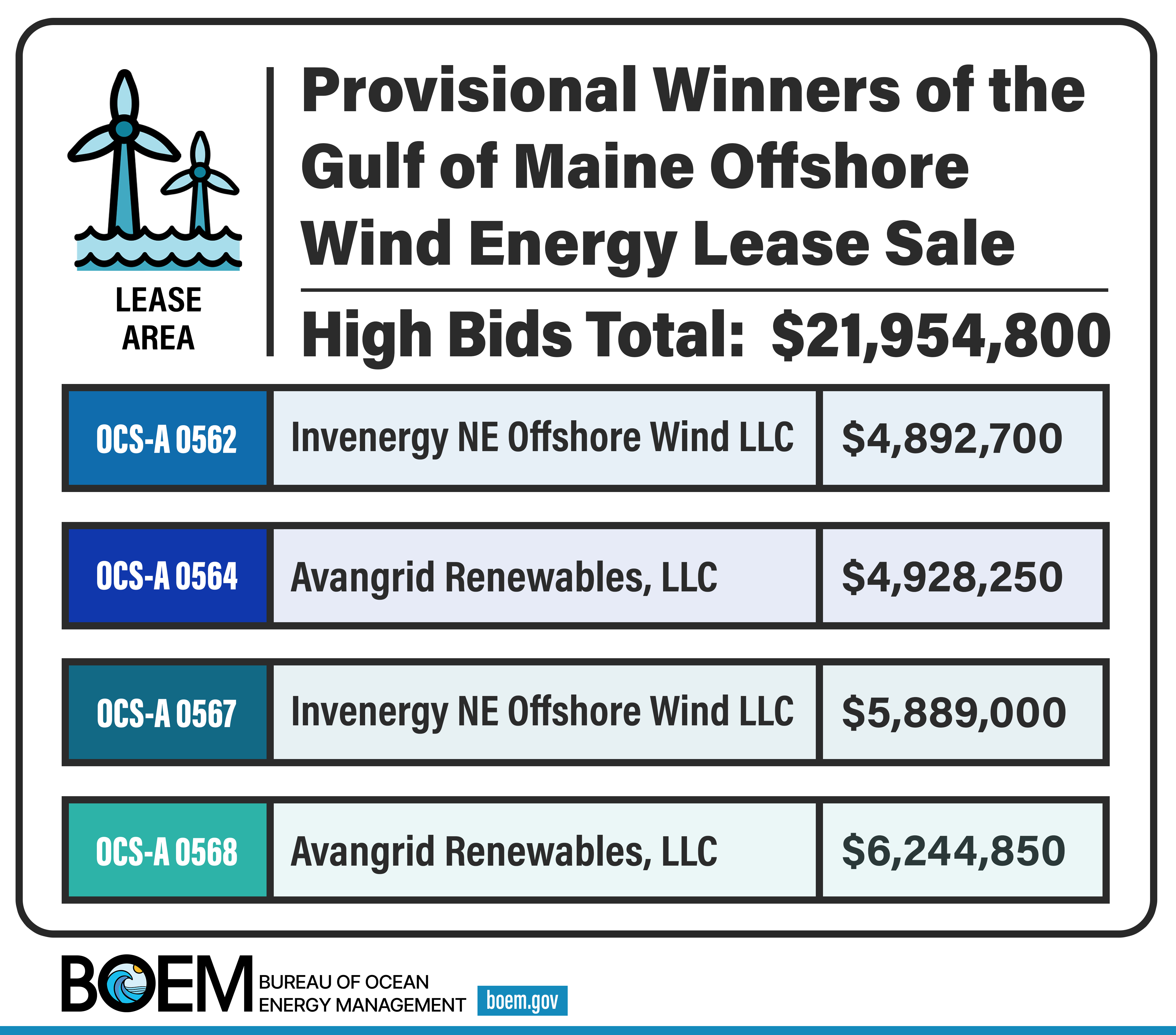
Do the Gulf of Maine bids pass BOEM’s fair market value tests? Apparently so; the sale notice established $50/acre as the minimum bid, and that is where the bidding started and ended. Invenergy and Avangrid had no competition and presumably got the tracts they wanted at the lowest possible price. We’ll see how this works out for the companies and power consumers.
As promised, Ocean City, Maryland, neighboring towns, counties, fishing groups, the Save Right Whales Coalition, and a long list of commercial entities have sued BOEM for approving the Construction and Operations Plan (COP) for the Maryland Offshore Wind project. The complete filing is attached.
The plaintiffs’ discussion of BOEM’s failure to consider true alternatives (begins on p. 43) is particularly interesting. They contend that “BOEM rejected out-of-hand all true alternatives, and selected alternatives with only minor differences in number of turbines and the route for the power cables from the proposed action.“
The plaintiffs also assert (p. 44) that “BOEM flatly rejected the option of not authorizing the Maryland Offshore Wind Project—as though approval were foreordained, with only the details to be determined.“
The plaintiffs’ argue further (p. 46) that BOEM failed to analyze the 3 phases of the project, particularly the third phase which is open-ended at this time.
Blade failure concerns are discussed beginning on p. 49. Excerpt:
“Missing from BOEM’s Final EIS is any discussion or analysis of the environmental impacts in the event of blade and turbine failure and the degradation of Project components, which are known and foreseeable possibilities that should have been reviewed and analyzed by BOEM. Risks of blade and turbine failure and component degradation are not hypothetical. Rather, they pose real dangers to the water quality of the ocean, fish and essential fish habitats, marine mammals, benthic resources, and recreational and commercial boaters.”
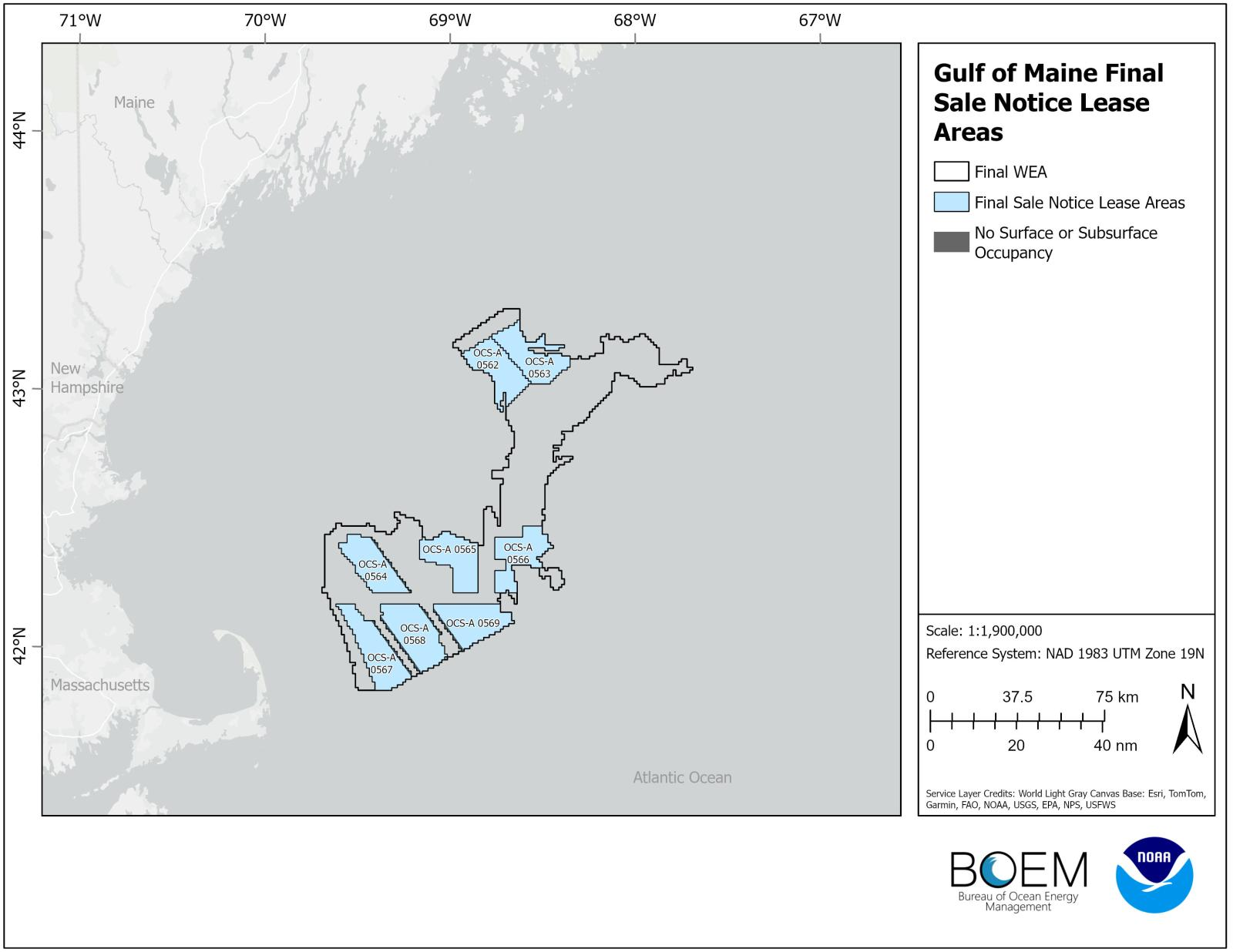
Gulf of Maine Final Lease Areas, Acres, and Assigned Region
Lease Area ID
Total Acres
Developable Acres
OCS-A 0562
97,854
97,854
OCS-A 0563
105,682
105,682
OCS-A 0564
98,565
93,756
OCS-A 0565
103,191
103,191
OCS-A 0566
96,075
96,075
OCS-A 0567
117,780
113,208
OCS-A 0568
124,897
116,363
OCS-A 0569
106,038
101,757
Total
850,082
827,886
Average
106,260
103,486
Note that the ave. lease size is 18.4 times larger than a typical Gulf of Mexico oil and gas lease
Today’s Gulf of Maine sale will likely be the last wind lease sale for at least a year.
Per a provision in the “Inflation Reduction Act,” no offshore wind leases may be issued after 12/20/2024, the one year anniversary of the last oil and gas lease sale (no. 261).
The date of the next oil and gas lease sale is anyone’s guess. Next week’s elections are, of course, the elephant in the room. However, there is also an enormous ruling by a Federal judge in Maryland that would halt the issuance of Gulf of Mexico oil and gas leases and the approval of operating plans effective Dec. 20, 2024. Ironically (or perhaps not?), this is the same date after which no wind leases may be issued absent an oil and gas lease sale.
Chevron and industry trade associations have appealed Judge Boardman’s ruling. (Given the enormous implications of that ruling on current and future Gulf of Mexico production, I’m curious as to why Chevron is the only major producer that is a party in this appeal. Chevron was also the only producer that was a party in the litigation overturning the restrictive Sale 261 lease sale provisions. I’m assuming there is some legal or tactical reason for the absence of participation by Shell, bp, and Oxy?)
Finally, given the legislation linking future wind sales with oil and gas sales, are the Sierra Club et al, the plaintiffs in this case, comfortable with Judge Boardman’s decision? Perhaps they are okay with the judge’s ruling given the absence of any planned Atlantic wind leasing until 2026?
“Defendant Bureau of Ocean Energy Management (“BOEM”), acting as lead federal agency, violated federal law when it approved an industrial-scale energy project known as Revolution Wind. BOEM approved this project without considering its adverse effects on National Historic Landmarks (NHLs) and other historic properties within one of the most historically and culturally significant communities in the country. BOEM also failed to take a “hard look” at Revolution Wind’s impacts on the environment, leaving unanswered questions even though the law required BOEM to inform the public about the project’s environmental benefits and costs.“
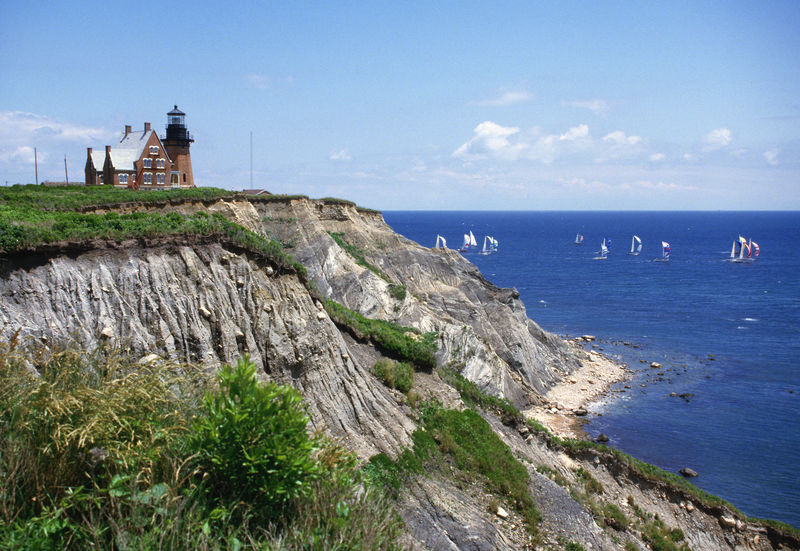
Those who have visited the Newport Cliff Walk and historic “cottages” are likely to appreciate the concerns of the Preservation Society. Their court filing is attached.
The New England Fishermen’s Stewardship Association (NEFSA) is sending the attached letter to Maine Gov. Janet Mills along with a petition with over 2,500 signatures urging her to halt the development of offshore wind farms in the Gulf of Maine.
A Gulf of Maine wind lease sale is scheduled for Oct. 29.
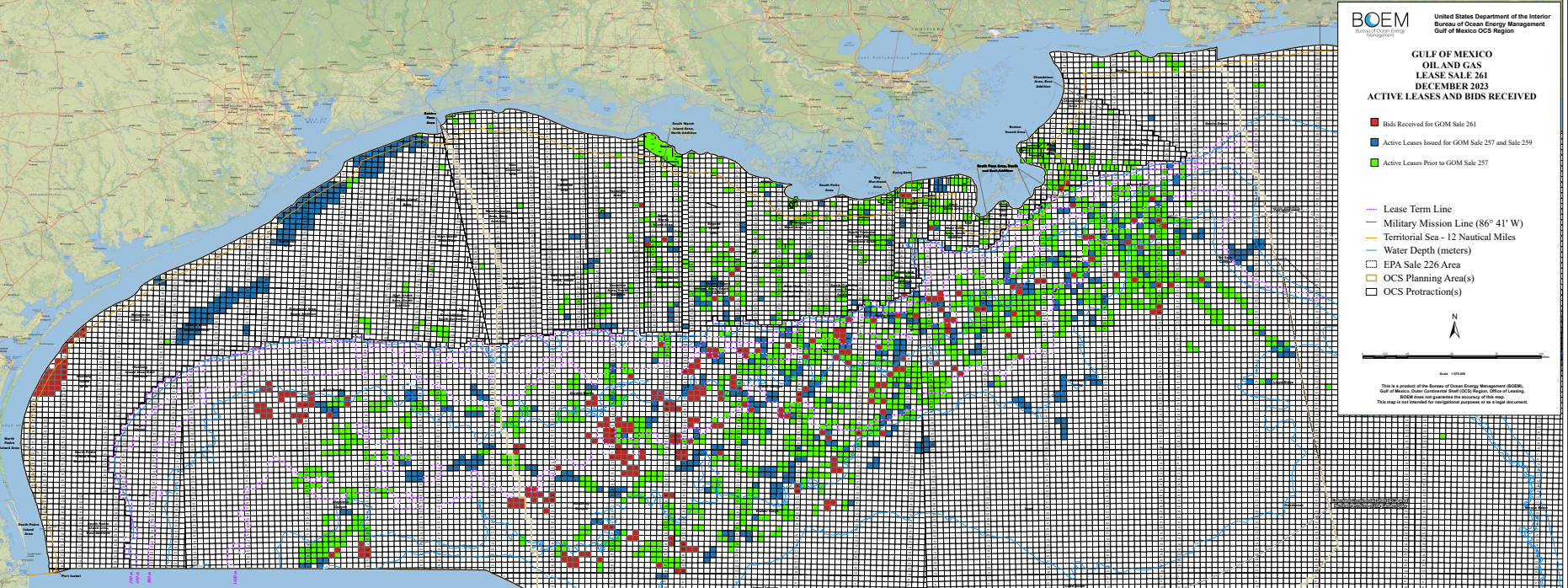
199 oil and gas leases were wrongfully acquired at Sales 257, 259, and 261 with the intent of developing these leases for carbon disposal purposes. Repsol was the sole bidder at Sale 261 for 36 nearshore Texas tracts in the Mustang Island and Matagorda Island areas (red blocks at the western end of the map above). Exxon acquired 163 nearshore Texas tracts (blue in map above) at Sales 257 (94) and 259 (69).
Despite false starts by Exxon and Repsol (see above summary), no carbon sequestration (disposal) leases may be issued or developed until implementing regulations have been promulgated. In that regard, no news is good news for those who are less than enamored with CO2 disposal in the Gulf of Mexico.
The implementing regulations will be controversial. Most operating companies prioritize GoM production over GoM disposal. Most environmental organizations are strongly opposed to CO2 disposal schemes that sustain fossil fuel production and benefit fossil fuel producers. Taxpayers are leery of subsidizing these projects and absorbing increased costs for energy and consumer goods.
The Administration is, of course, well aware of this opposition and will not be publishing implementing regulations prior to the election. The next Administration, regardless of the election outcome, will no doubt take a hard look at these issues before proposing regulations.
The few oil and gas producers that are rather cynically hoping to cash in on CO2 disposal in the GoM will therefore have to wait, perhaps for a long time.
“The Tribe has consistently urged that BOEM delay moving forward with wind energy development until a better understanding is made of the impacts to fish, wildlife, the marine environment, and cultural resources important to the Tribe,” said Tribal Council Chair Brad Kneaper. “No one, including BOEM has an understanding on how wind development will impact the fragile marine environment. BOEM developed an environmental assessment document that narrowly focused on the impacts of the lease sale and completely turned a blind eye to the inevitable impacts that construction and operation of these private energy facilities will have on Coastal resources, the Tribe, and other residents.”
“The timeframe for wind development appears to be driven by politics, rather than what is best for Coastal residents and the environmental,” said Chair Kneaper.
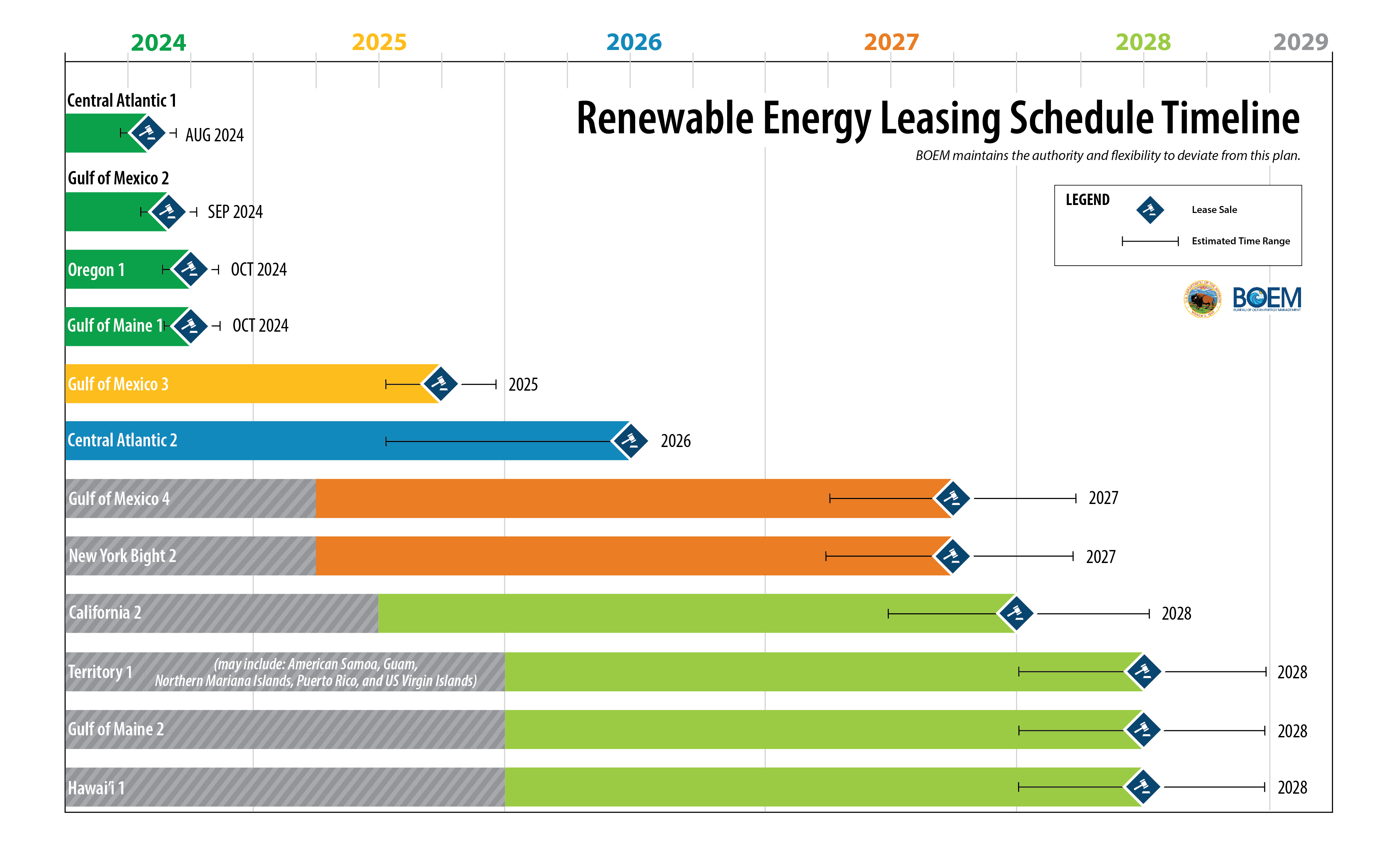
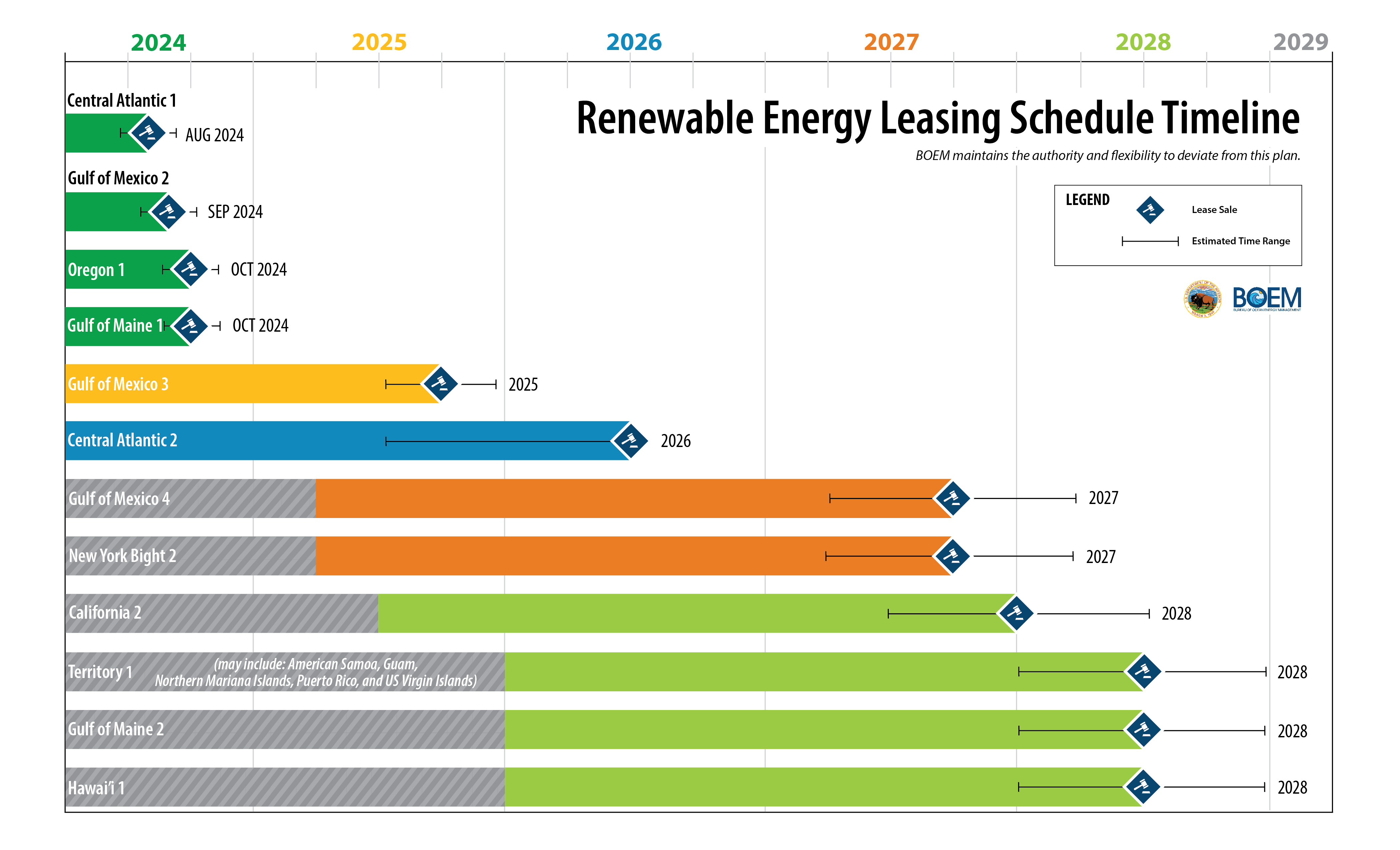
BOEM’s front-loaded 5 year wind leasing plan (graphic below) may have been influenced by (1) the possibility that the upcoming elections could affect offshore wind policy, and (2) the legislative prohibition on issuing wind leases after 12/20/2024 unless an oil and gas lease sale is held prior to that date.
Given that the next oil and gas lease sale will be in 2025 or later, BOEM was perhaps motivated to hold wind sales prior to the 12/20/2024 deadline (with a bit of a buffer to issue the lease documents). Indeed, the wind leasing plan proposed 4 sales between August and October of 2024 and only a single 2025 sale. That 2025 wind sale is in the Gulf of Mexico, where industry interest in wind leases is, at best, tepid.
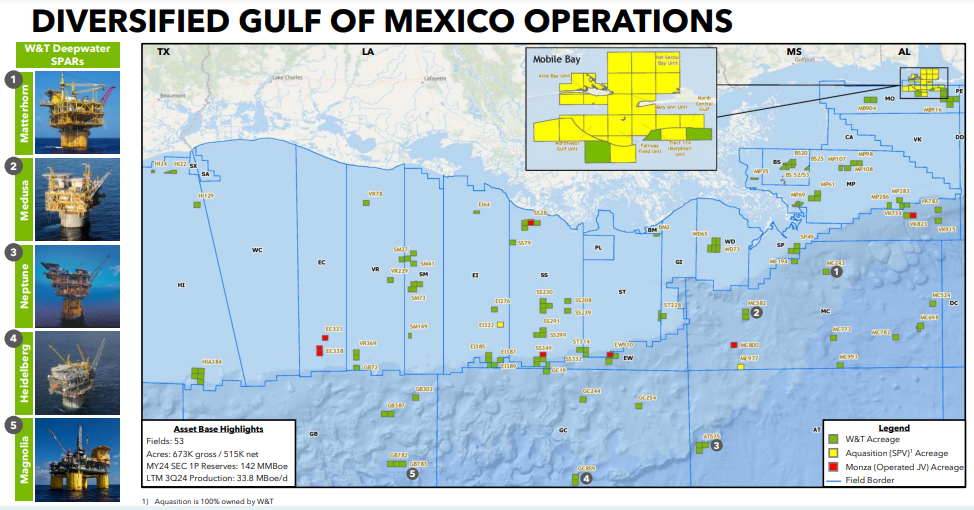
The previously discussed sale of Cox assets in 6 GoM fields to W&T was completed in January for $72 million, $16.5 million less than the proposed price. W&T, an established GoM operator, believes they can increase the pre-bankruptcy production (8300 boepd) through workovers, recompletions, and facility repairs.
The extent to which W&T is assuming decommissioning liability for the Cox assets is unclear to this observer. Decommissioning information from W&T’s SEC filing is pasted at the end of this post.
In February, Cox won court approval to sell “about a dozen oil fields to Natural Resources Worldwide LLC for about $20 million following a bankruptcy court auction.” This sale is more concerning given that the purchaser has no operating history in the GoM, and scant information about the company can be found online. Perhaps they are affiliated with Natural Resources Partners L.P., an energy investment firm which “owns mineral interests and other rights that are leased to companies engaged in the extraction of minerals,” but “does not mine, drill, or produce minerals, has no operations, and conducts business solely in an office environment.”
Per BOEM data, Cox filed requests to assign a number of leases to Natural Resources Worldwide (NRW) in May, but those requests have yet to be approved. Hopefully, BOEM is taking a hard look at these requests and their obligations following the court auction. Decommissioning liabilities should be their number one concern. (Note: NRW was just listed as the operator of the former Cox platform at EI 361, so presumably at least some of those assignments have now been approved.)
According to BOEM’s platform data base, Cox and affiliates Energy XXI and EPL still operate 243 platforms, down from 435 in June 2023. Also per the data base, the Cox companies have not removed any platforms during 2023 or 2024 YTD, so the reduction in platforms is presumably the result of the W&T transaction. Most of the remaining Cox platforms are old – 16 of their 77 major platforms were installed in the 1950s!
Meanwhile, Cox and affiliates continue to be the GoM violations leader by far with 549 incidents of non-compliance (INCs) in 2024 YTD, 45% of the GoM total for all operators. No other company has more than 100 INCs (although Whitney Oil and Gas has a disappointing 93 INCs, including 33 facility shut-ins on only 65 inspections!)
operator
platforms/ major platforms
warning INCs
component shut-in INCs
facility shut-in INCs
Cox
209/69
407
44
4
Energy XXI
19/7
73
1
2
EPL
5/1
16
1
1
Total Cox
233/77
496
46
7
Total GoM
1519/736
831
317
68
INCs are for 2024 as of 9/17/2024. A major platform has at least 6 well completions or more than 2 pieces of production equipment.
The Company may be subject to retained liabilities with respect to certain divested property interests by operation of law. Certain counterparties in past divestiture transactions or third parties in existing leases that have filed for bankruptcy protection or undergone associated reorganizations may not be able to perform required abandonment obligations. Due to operation of law, the Company may be required to assume decommissioning obligations for those interests. The Company may be held jointly and severally liable for the decommissioning of various facilities and related wells. The Company no longer owns these assets, nor are they related to current operations.
During the three months ended March 31, 2024, the Company incurred $2.6 million in costs related to these decommissioning obligations and reassessed the existing decommissioning obligations, recording an additional $5.3 million. As of March 31, 2024, the remaining loss contingency recorded related to the anticipated decommissioning obligations was $20.8 million.
Although it is reasonably possible that the Company could receive state or federal decommissioning orders in the future or be notified of defaulting third parties in existing leases, the Company cannot predict with certainty, if, how or when such orders or notices will be resolved or estimate a possible loss or range of loss that may result from such orders. However, the Company could incur judgments, enter into settlements or revise the Company’s opinion regarding the outcome of certain notices or matters, and such developments could have a material adverse effect on the Company’s results of operations in the period in which the amounts are accrued and the Company’s cash flows in the period in which the amounts are paid. To the extent that the Company does incur costs associated with these properties in future periods, the Company intends to seek contribution from other parties that owned an interest in the facilities.
Total wants to sit on their wind lease until the next administration (2029). Can they do that?
Posted in energy policy, Offshore Wind, tagged Attentive Energy, BOEM, CEO comments, COP deadline, diligent development, lease cancellation, OCSLA, Total, wind lease on December 3, 2024| Leave a Comment »
Impressive arrogance from the CEO of a foreign company that paid $795 million for a lease (OCS-A 0538) that was worth pennies on the dollar even before the Presidential election:
“Offshore wind, I have decided to put the project on pause” with Trump’s return, Total Chief Executive Officer Patrick Pouyanne said at an energy industry conference in London on Tuesday.
“I said to my team, the project in New York, we’ll see that in four years,” he said. “But the advantage is it’s only for four years.”
Perhaps Mr. Pouyanne thinks Total owns those 84,332 acres in the Atlantic or that they have the right to hold the leased area indefinitely. They do not. The OCS Lands Act calls for diligent development of leases and BOEM has promulgated implementing regulations.
The Total (Attentive Energy) lease was issued on 5/1/2022. Per 30 CFR § 585.235(a)(1), the company must submit a Construction and Operations Plant (COP) no later than 5/1/2027, more than 20 months before the end of the Trump administration. BOEM will have ample time to act on the plan prior to the next administration.
BOEM could also call for progress updates and an earlier COP submittal if there is evidence that the lessee is not moving forward with development plans (as would already seem to be the case given Mr. Pouyanne’s public statements in London).
In the absence of progress in developing the lease, BOEM could seek cancellation (§ 556.1102) for failure to comply with the diligence mandate in OCSLA (556.1102 (a)). Cancellation could also be pursued based on misrepresentations in acquiring the lease (556.1102 (c)) or the threat of unacceptable harm to the environment or national security (556.1102 (d)).
Rather than making rash comments at a public forum in London, perhaps Mr. Pouyanne would have been wise to first meet with energy officials of the new administration early next year. At a minimum, the CEO’s comments will help justify any attempts to cancel the Total (Attentive Energy) lease on diligence grounds.
Read Full Post »