“The 19th century is known as the “century of coal,” but, as the technology scholar Vaclav Smil has noted, not until the beginning of the 20th century did coal actually overtake wood as the world’s No. 1 energy source. Moreover, past energy transitions have also been “energy additions”—one source atop another. Oil, discovered in 1859, did not surpass coal as the world’s primary energy source until the 1960s, yet today the world uses almost three times as much coal as it did in the ’60s.“
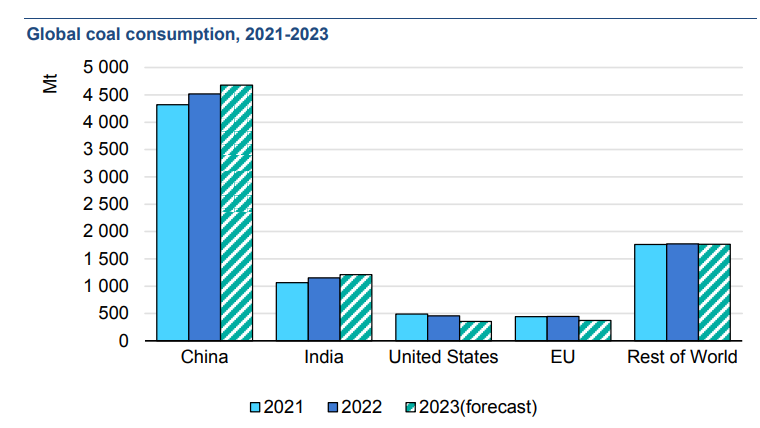
Coal is not going away. Per IEA, coal consumption in 2022 set a new record (8.3 billion tonnes) and will stay at or near that level in 2023 and 2024. See the chart below for 2021, 2022, and 2023 (est.) consumption in million tonnes. India and China are joined by the “Rest of the World” (outside the US and EU) in the billion tonne club.
Message: Coal is cost effective and reliable, and will continue to be a major source of energy.
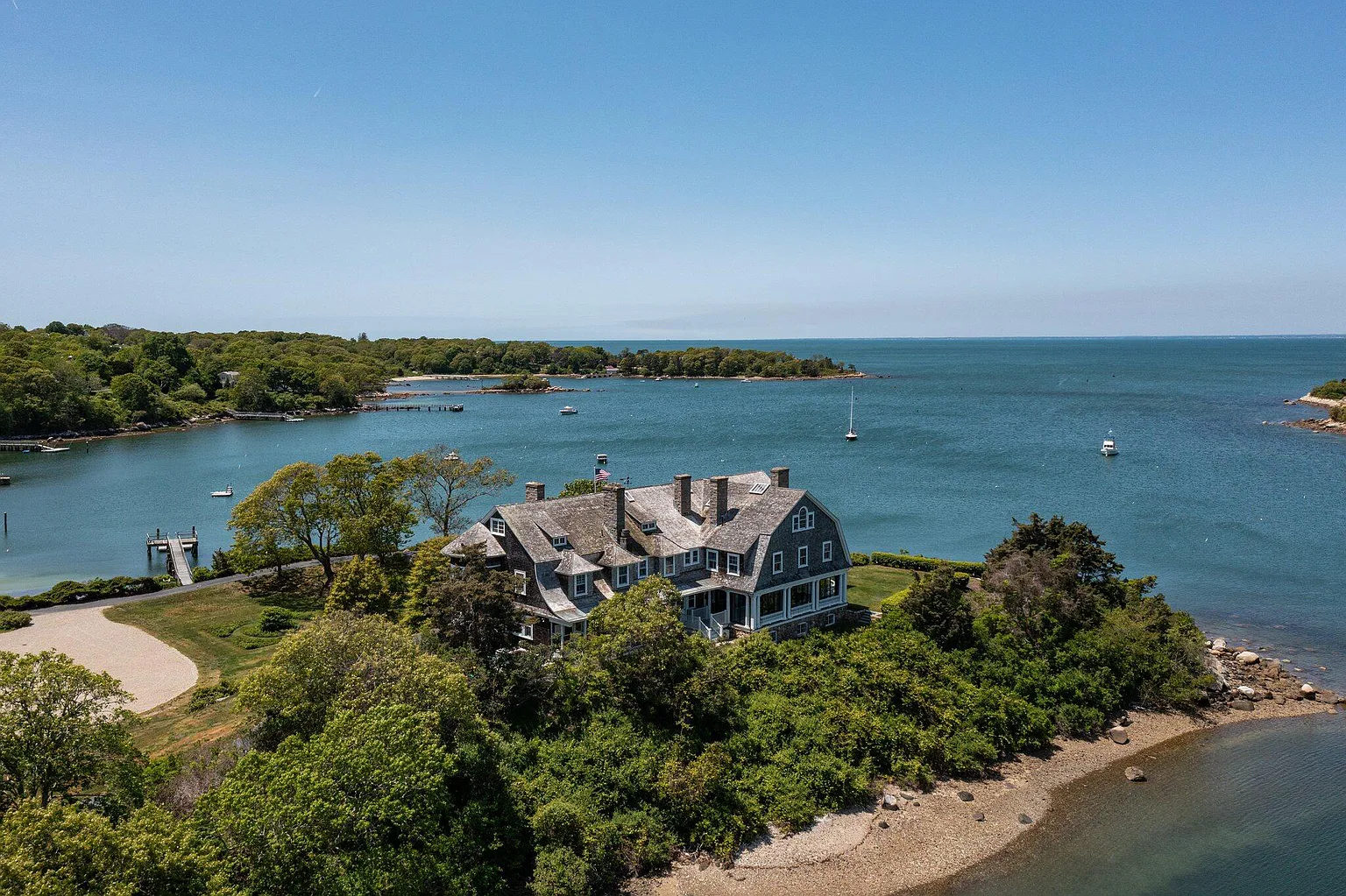
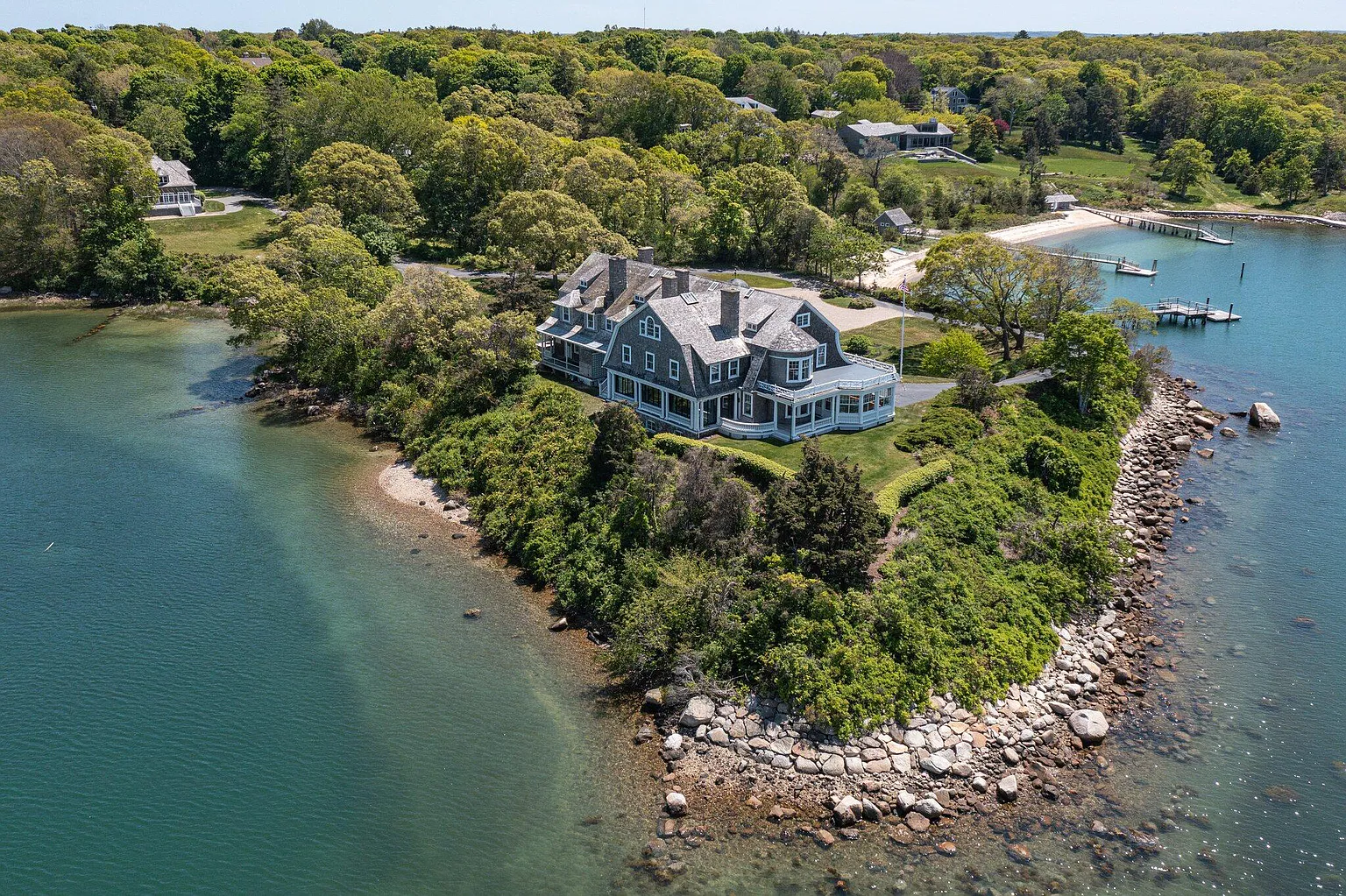
According to Zillow, the National Academies beloved Jonsson Center in Woods Hole was sold on Friday (8/4) for $13.5 million, less than half the original asking price. I have no idea who bought it and how it will be used. The Jonsson Center was an amazing venue for meetings and conferences. The beautiful estate served the marine science and policy communities well for decades.
WASHINGTON, Aug 1 (Reuters) – The Biden administration has pulled an offer to buy 6 million barrels of oil for the Strategic Petroleum Reserve, an Energy Department spokesperson said on Tuesday, as oil prices are expected to keep rising after a output cut from Saudi Arabia.
So much for adding a few drops to the SPR bucket. When your reserve is down 380 million barrels in a seller’s market, you don’t have a lot of purchasing leverage. Don’t expect much of an SPR refill anytime soon. It’s easy to deplete strategic assets; much more difficult to replace them.
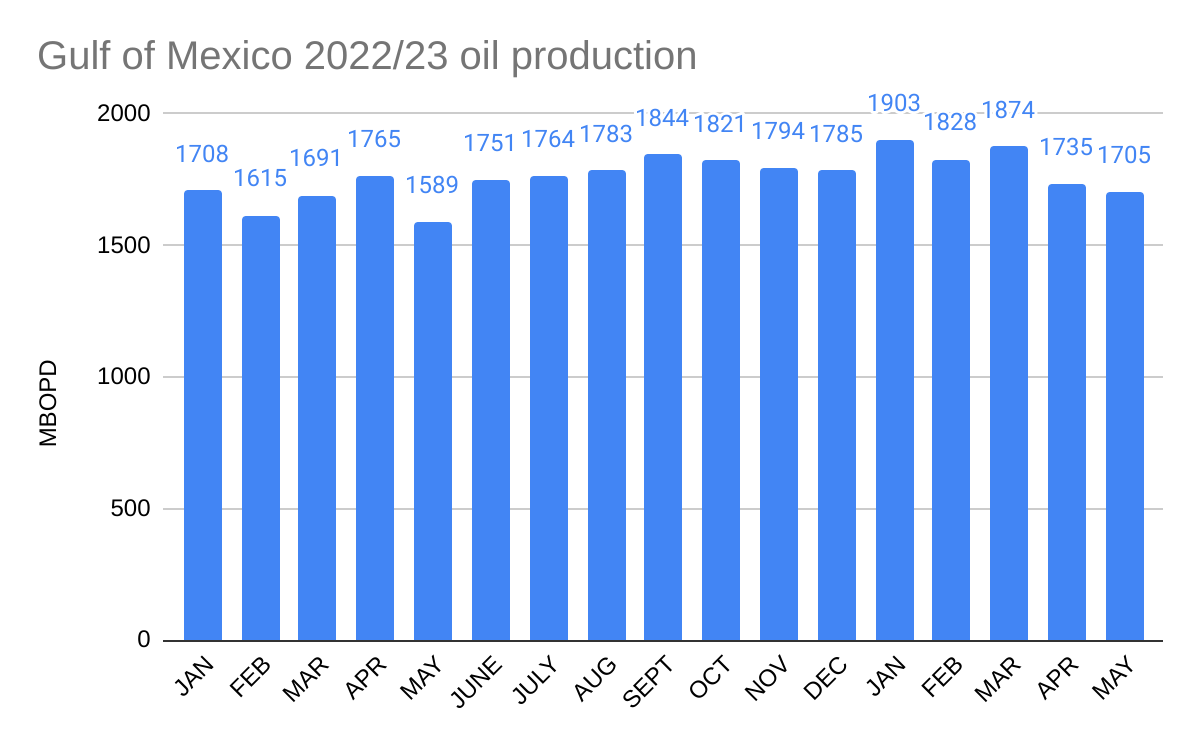
Gulf of Mexico 2023 oil production has dipped over the past 2 months, and is down 10% since January.
2023 production is reasonably well aligned with the EIA forecast which shows new production being offset by declines in existing fields.
Last year, BOEM forecast that production would average 2.0 million bopd in 2023. That forecast was justification for curtailing BOEM’s Proposed 5 Year Leasing Program. For the first time in the history of the OCS program, the primary concern of the program managers was that production might be too high for too long! This stunning quote from the 5 year leasing plan explains why so few lease sales were proposed:
“BOEM’s short-term (20-year) production forecast for existing leases shows steady growth from 2022 through 2024 and declining thereafter (see Section 5.2.1). The long-term nature of OCS oil and gas development, such that production on a lease can continue for decades makes consideration of future climate pathways relevant to the Secretary’s determinations with respect to how the OCS leasing program best meets the Nation’s energy needs.“
Per the DOI regulatory agenda published on 7/27/2023 (excerpt below), the final BSEE well control rule was published in June. Of course, that did not happen, but the update tells us that the final rule should be published soon. The delay is probably in the internal review process which moves at the pace of continental drift 😉.
BOE comments on the proposed rule are attached here.
12. Oil and Gas and Sulfur Operations in the Outer Continental Shelf-Blowout Preventer Systems and Well Control Revisions [1014–AA52]
Legal Authority: Not Yet Determined [BOE note: This is rather comical since the OCSLA authority was specified in the preamble to the proposed rule and you would never publicly imply that you didn’t know the authority for a final rule. 😉]
Abstract: This rulemaking revises the Bureau of Safety and Environmental Enforcement (BSEE) regulations published in the 2019 final rule entitled “Oil and Gas and Sulfur Operations in the Outer Continental Shelf-Blowout Preventer Systems and Well Control Revisions,” 84 FR 21908 (May 15, 2019), for drilling, workover, completion and decommissioning operations. In accordance with Executive Order (E.O.) 13990 (Protecting Public Health and the Environment and Restoring Science to Tackle the Climate Crisis) and the E.O.’s accompanying “President’s Fact Sheet: List of Agency Actions for Review,” BSEE reviewed the 2019 final rule and is updating to subpart G of 30 CFR part 250 to ensure operations are conducted safely and in an environmentally responsible manner.
In the Gulf of Mexico, deepwater leases produce large volumes of oil and gas from only a few surface facilities that are relatively distant from shore.
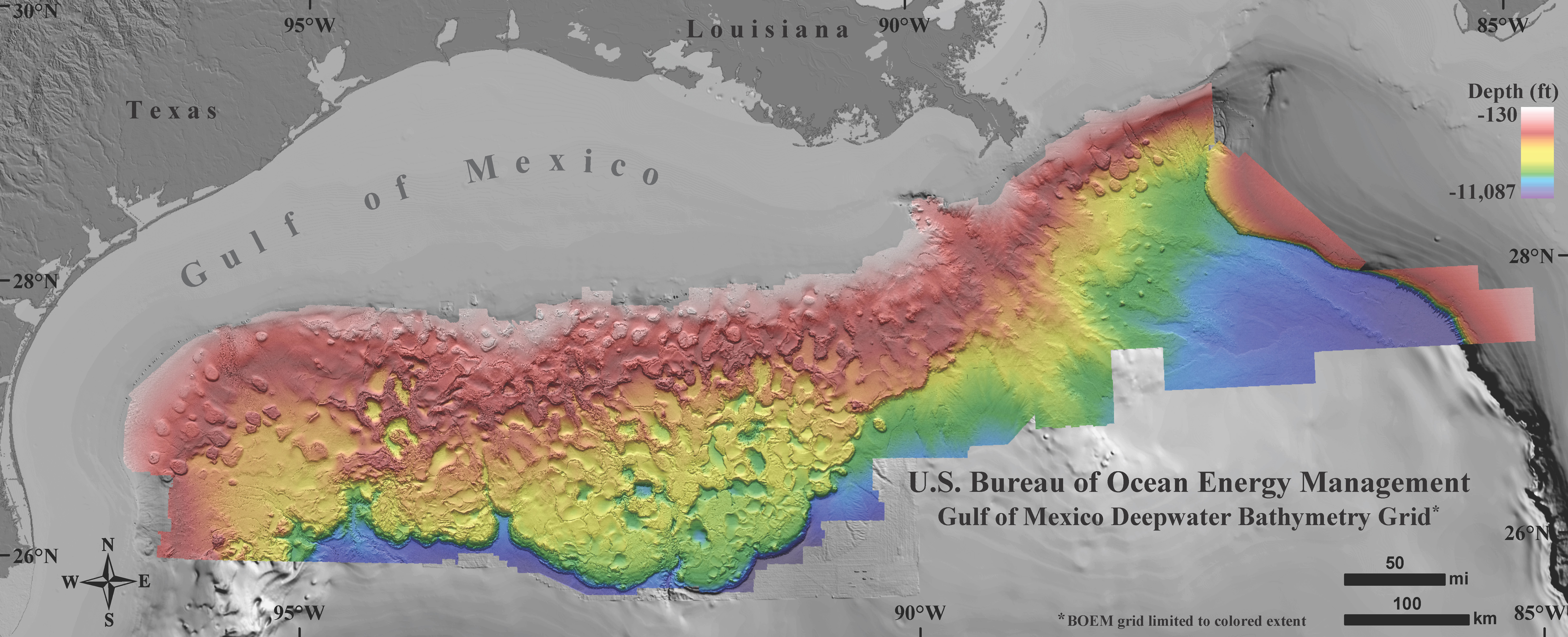
The Gulf of Mexico encompasses approximately 617,800 square miles and stretches 932 miles across from east to west. BOEM’s deepwater bathymetry grid of the northern Gulf of Mexico, created using 3D seismic data, covers more than 90,000 square miles (colored area in figure below). In this vast area, only 59 surface facilities produce ~1.7 million bopd and 2.2 bcfd.
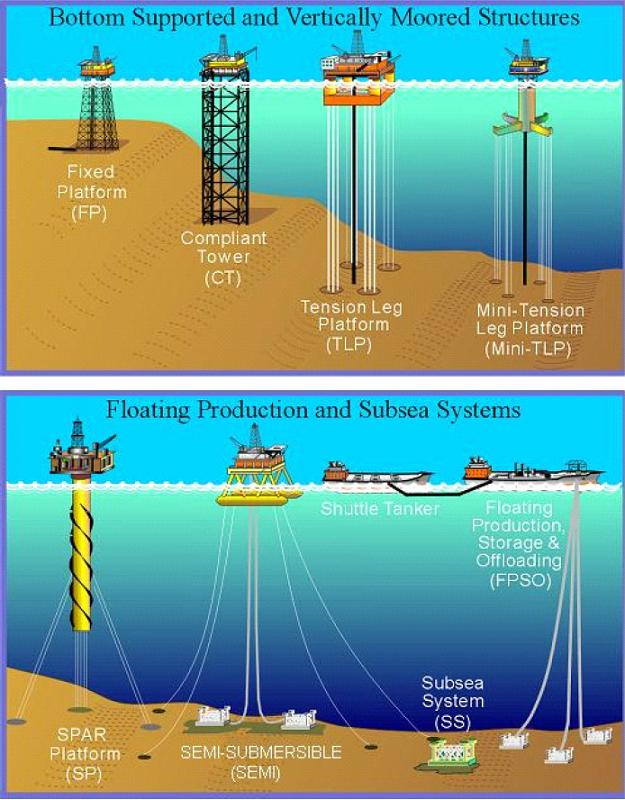
The 59 deepwater facilities are comprised of:
6 fixed platforms in water depths from 1023 to 1353′
2 compliant towers (1648 and 1754′)
17 tension leg platforms and mini-TLPs (1500-5185′)
18 spars (1930-7835′).
13 production semisubmersibles (aka floating production units; 3280-7400′)
2 fpso’s (8300 and 9560′) and a mobile production unit (2200′)
Attached is a settlement agreement between NOAA and 4 NGOs that could have major implications for deepwater oil and gas operations in the Gulf of Mexico.
As background, the Rice’s Whale (formerly Bryde’s whale) area has been expanded (see map above) such that it fences off deepwater leases by creating a barrier to vessel transportation. The expansion is based on a single study that concluded that Rice’s whales were “the most plausible explanation” for moan calls observed in the northwest GOM shelf break area. No Brice’s whales were sighted in the expanded area during this study. The authors do point to a 2017 sighting offshore Corpus Christi, which is apparently the only actual sighting of a Brice’s whale along the NW GoM shelf break.
The settlement agreement commits BOEM, presumably with their concurrence, to exclude the expanded area from future leasing, to issue a Notice to Lessees and Operators (exhibit 1 below) and to attach stipulations to new leases (exhibit 2). Because BOEM’s authority to impose major new requirements without proposing a regulation for public review and comment is questionable, the Notice (NTL) describes the restrictions as “recommended measures.” However, the liability risks associated with the failure to comply with this “guidance” would be unacceptable to most companies. Adding to the muddle, the language in the lease stipulation differs by making it perfectly clear that compliance is required.
The most troubling restriction from an operational standpoint:
“To the maximum extent practicable, lessees and operators should avoid transit through the Expanded Rice’s Whale Area after dusk and before dawn, and during other times of low visibility to further reduce the risk of vessel strike of Rice’s whales.“
Comments:
Deepwater facilities are typically far from shore, and a requirement to transit only between dusk and dawn, particularly in the winter, is unrealistic and onerous. This is further complicated by the speed limit provision.
Those who have worked offshore know that periods of low visibility are unpredictable and can extend for days. The low visibility transit restriction is thus highly punitive and increases operational risks on the vessels and at the facilities they serve.
The vague “to the maximum extent practicable” caveat provides little comfort for planners, managers, and crews, and is a de facto acknowledgement that the requirement is unreasonable.
These restrictions, coupled with the required Automatic Identification System data, open the door to endless challenges, especially given the keen interest of the litigious organizations that are parties in the settlement agreement.
Deepwater GoM operations are few in number and highly dispersed, which is a more important mitigating factor than those included in the agreement. More on this tomorrow.
In addition to the deepwater operations that will be much more difficult to supply, there are currently 81 production platforms within the expanded Rice’s whale area (100 to 400 m water depth).These include important facilities like Amberjack, Cognac, Cerveza, and Lobster. What are the implications for these platforms? Will they be required to have full-time whale observers? Can they only be supplied during daylight hours with good visibility? Why not consider using these platforms as bases for more definitive studies?
Further to the previous point, there are 103 existing leases in the 100-400 m depth zone that is now excluded from leasing? 90 of these leases are still in their primary term, and 21 were issued in the past 2 years. How will the contractual rights of these leaseholders be protected? (In fact, the value of all 1550 active leases in >100 m water depth is affected by this agreement.)
Have BSEE and Coast Guard been consulted on the practicality and safety implications of these requirements?
Deepwater operations have been ongoing in the GoM for 50 years, and there is no apparent evidence of impacts to this species. Why can’t the consultation process and any necessary followup studies be completed before decisions are made regarding operating restrictions?
Finally, BOEM’s third footnote in the NTL (pasted below), doesn’t demonstrate great confidence in the need for the onerous requirements that are being imposed.
“This is not meant to be construed as a blanket determination as to whether BOEM, at present, has determined that there is a “reason to believe” that incidental take may occur, within the meaning of the ESA, the consultation regulations, or BOEM’s regulations. Those decisions will be made on a case-by-case basis in accordance with BOEM regulations referenced below.” Comment: Huh??? How are these blanket restrictions case-by-case, and how are they being imposed without public review?
Jean-Louis Daeschler, a pioneering offshore engineer, has shared this very interesting story about his interaction with George HW Bush (pictured):
One day I was driving in Kennebunkport and told my wife that I met the man who lived in that house on the coastal road – the President George HW Bush!
Early in my career, a new drillship was being built in Port Arthur TX for Zapata Offshore. One morning, the entrance to the shipyard was closed off. A peaceful group of picketers told us we could not enter. Many of us had left work clothes, file drawings, and even passports and money at our camp in the yard. This was before mobile phones and the internet! So we went back home to wait for guidance. 2-3 days later we had to attend a meeting in Houston (a 2 hr drive) at the Pennzoil Tower, and we met Mr Bush. He was very cool and calmed us down. He advised us not to cross the picket line or get into an argument with the workers. He had already made arrangements to use 4-5 rooms at a Holiday Inn near Beaumont. They removed the hotel furniture and provided desks, pencils, and phones. Our personal effects had been collected from the yard and delivered to the our temporary workplace at the Holiday Inn.
My colleagues and I had a great chat with Mr. Bush. In particular he asked me questions about the D-Day invasion at Normandy. However, although I was born there, it was at the end of the war in 1945, so I did not personally experience the invasion. We left the meeting relaxed and with directives on what not to do. He kindly gave me one of his gold Cross pens, before we shook hands and departed.
Years later at a dinner in Aberdeen with Total Fina Elf, I gave that pen to the wife of the Project Manager (without the story). So there we go; a pen from Houston goes to Paris via Aberdeen in 17 years! Sometimes you smile in the oil patch!
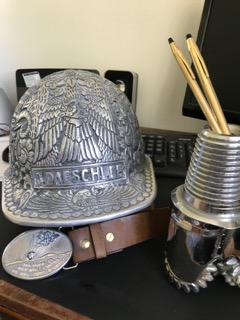
JL Daeschler photo: Red Adair belt with a diamond drill bit from the Beaufort sea, a hardhat from Indonesia, and 2 new Cross pens! Life is good 😀


 Bud's Offshore Energy (BOE)