Feeds:
Posts
Comments

Good report; worth reading.  Some of the positive points are unlikely to get much attention, so we’ll mention them here:

  1. The National Incident Management System/Incident Command System worked as intended
  2. Personnel provided by the Responsible Party (RP) and Coast Guard personnel worked effectively together, and there was “unity of effort” throughout the response organization.
  3. The team found no evidence of collusion between the Coast Guard and RP.
  4. The response generally benefited from the ability of the Government and the private sector to rapidly assess and adapt to new or unusual contingencies and develop innovative solutions for problems not previously experienced.
  5. The knowledge acquired and capabilities learned from this experience are unprecedented, and should become a basis for significant improvements in planning, preparedness, and response for industry, Government, and the response community.

The “Political Demands” section beginning on page 75 includes relatively candid observations on the challenges associated with the management of such a high profile response.

Growing demand for new offshore oil rigs, partly driven by the Gulf of Mexico spill last year, has led to a spurt of building in shipyards and raised tough questions about what to do with the old rigs. Reuters

What? Have they not looked at the Rigs-to-Reefs+++ page™ (a BOE exclusive)?

“At a certain point it just doesn’t make any sense to upgrade them or put another 5-10 million bucks into them,” said John Tasdemir, an analyst at Canaccord Genuity. “Better just to scrap them and either start over, or just do something else.”

“Do something else” is correct and there are many options!

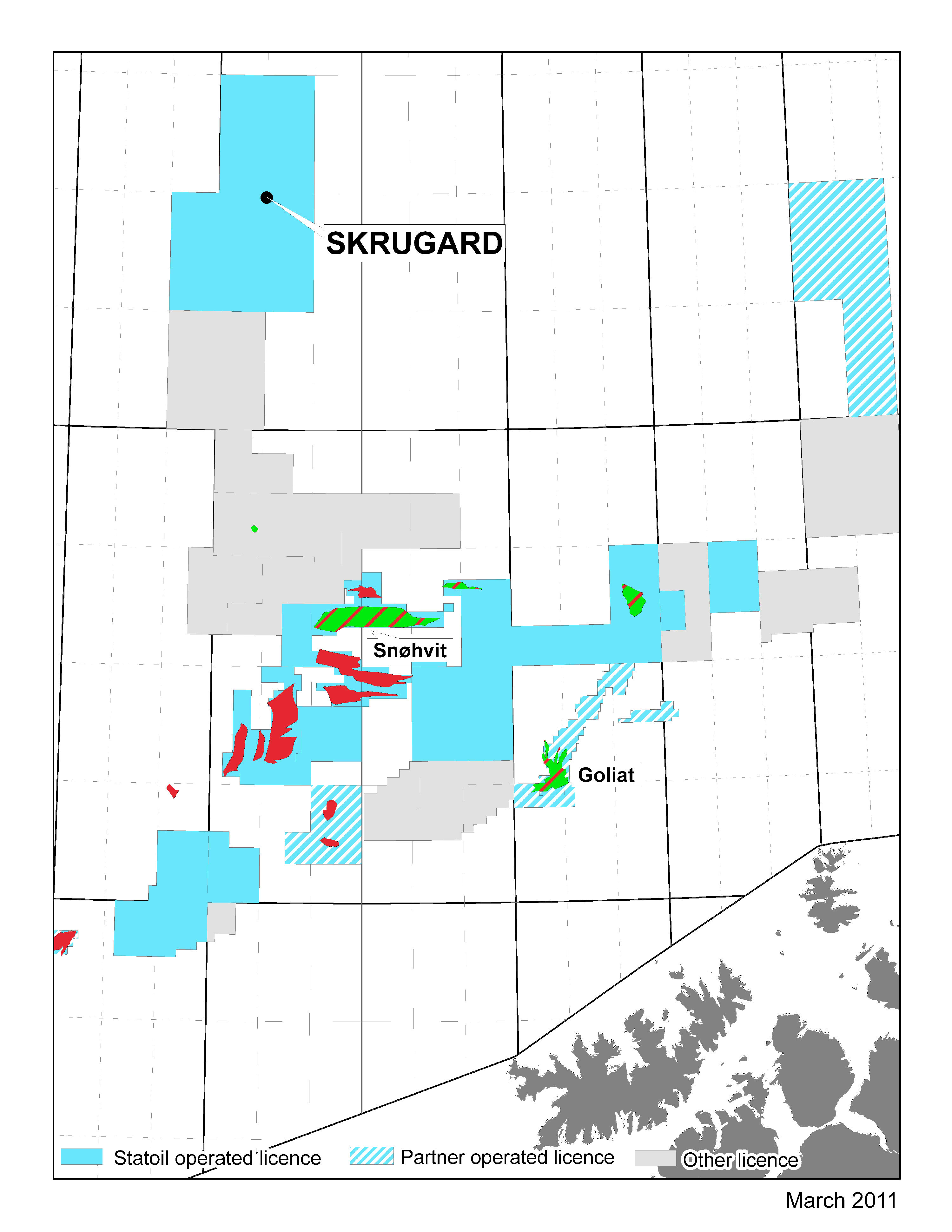
Statoil, along with partners Eni Norway and Petoro, has made a significant oil discovery on the Skrugard prospect in the Barents Sea. The breakthrough discovery is one of the most important finds on the Norwegian continental shelf in the last decade. Statoil announcement

A recent Colin Leach comment (below) merits a separate post.  Keep in mind that formation gas is highly soluble in oil-based fluids. Under bottomhole temperature/pressure conditions, the gas may be completely dissolved in the drilling fluid, complicating kick detection.

Problem: A small amount of gas is in the riser above the BOP.  This gas has been recognized, the BOP has been shut, and the well below the BOP has been killed and circulated.

What to do next? There may be 2000 bbl of mud in the riser.  Overboard?  In any case if this is done, it may get quite exciting when the (small) gas pocket reaches surface.  Do we always send this mud overboard?  Whenever there is a doubt?

The alternative of circulating through a “riser gas handler” (if the rig is equipped with one) is quite safe as long as some back-pressure  (perhaps 200 psi as a minimum) is held on a choke in order to prevent what was termed “explosive unloading” from happening.  Without this back-pressure, the events that follow are disastrous.

Follow-up: It is time to take a step back and re-look at this whole situation.  To do so does require the realistic modeling software….OLGA, Drillbench etc.. Simple gas calculations (P1V1=P2V2…..or even allowing for Z) don’t include the dynamic effects that you will see and simply must not be used.  The gas rates that come from these simple calculations are misleadingly low.

Certainly this is an area where the industry needs some focused effort.


Shale gas is important to the economic future of states like Pennsylvania. However, there are legitimate public concerns about environmental issues including the potential for contaminating freshwater supplies. Significant impacts are preventable with prudent operating practices and effective regulatory programs. So what directive does the responsible State agency issue to its inspectors?

Field inspectors and regional directors for the state Department of Environmental Protection have been told they must obtain approval from DEP Secretary Michael Krancer before issuing permits or enforcing regulations pertaining to Marcellus Shale drilling.. PostGazette.com

How would you like to be an inspector for an organization like that?

Unless this decision is promptly reversed, expect the following:

  1. The public will assume that politicians are micromanaging critical field inspection programs, and confidence in the regulatory program will be eroded.
  2. Inspectors will be unable to respond quickly when violations are observed. Morale will suffer. Skilled personnel will leave or lose motivation.
  3. Regulatory efficiency will decrease while costs increase.
  4. The operating companies will deal directly with the Secretary’s office, leaving field personnel out of the loop.
  5. The industry’s image will suffer. Effective regulation identifies those who are willing to cut corners and protects the leading companies.

Former DEP Secretary John Hangar commented on the State decision on his blog.

Cheryl Anderson submitted a report on a synthetic mud spill from the Henry Goodrich which is operating offshore Newfoundland.

An estimated 26,400 litres (approximately 166 bbl) synthetic based mud spill occurred Monday east of St. John’s from Suncor Energy Henry Goodrich rig while drilling an exploration well on Monday but not reported until today – a three day delay.  Preliminary reports indicate the cause may have been a valve left open on the mud pit. vocm.com


John Milne Book Launch

John C Milne

“Dubs” is a term used in Aberdeen and northeast Scotland to describe all varieties of mud. That is the first thing I learned in reading John Milne’s excellent book “DUBS, How the Oil Came North.”  John’s first job in the offshore industry was with a drilling mud supplier back in 1969 when he was still a college student.  John presents a series of amusing and informative anecdotes about hie work experiences between 1969 and 1973 during the early years of North Sea offshore exploration. The book is available through the publisher, PlashMill Press. Good read!

I also recommend Bjørn Vidar Lerøen’s excellent book “Drops of Black Gold,” which

Drops of Black Gold - Statoil

chronicles the history of Statoil and Norwegian offshore oil and gas development. The book includes a now famous 1962 letter from Phillips Petroleum to the Norwegian government. In the letter, Phillips seeks exclusive rights to the entire Norwegian continental shelf in return for conducting a seismic survey program. Hey, nothing wrong with asking! 🙂

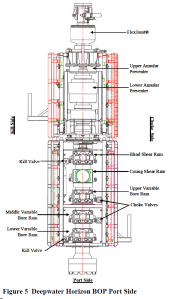
In a previous post, we discussed JL Daeschler’s comments suggesting that the emergency disconnect sequence (EDS) may have actuated the shear ram, but that the sequence aborted when the ram did not close fully. Another knowledgeable commenter, while requesting not to be named, noted that:

Whether the EDS-functions terminated before the sequence was completed is clearly a relevant question.

I agree and believe this possibility may have been dismissed without being fully considered. The DNV report claims that the EDS sequence never actually initiated, probably because of a loss of communication with the stack after the initial explosion.  As evidence, the report offers the following:

There is an account of lights flashing, indicating that the EDS function had initiated. There are no accounts of any specific lights going steady, which would have indicated a function had been completed and confirmed by the subsea control pods.

Comment: Perhaps no light stopped flashing because the first step in the sequence, BSR actuation, was not concluded (i.e. the BSR never fully closed).

Reviewed ROV video indicated no evidence that the sequence had initiated; the LMRP remained latched to the BOP, the Blue and Yellow Control Pod stingers were not retracted.

Comment: This only tells us that the sequence terminated prior to unlatching he LMRP and retracting the pod stingers.  It says nothing about the timing of the BSR closure.

Note that pages 166-167 of the DNV report indicate that the EDS was manually functioned (at the test facility) via surface control and that it functioned as intended.

The report also confirms that the accumulators were functional:

HP Shear Close, EDS, AMF/Deadman and Autoshear have a common reliance on the accumulator bottles (8 x 80 gallon) located on the BOP. Testing of these accumulators determined that they functioned as intended in the as-received condition.

The report goes on to say:

This is further indication the BSR’s were activated either by the Authoshear or possibly the AMF/Deadman functions. No further failure cause analysis was performed.

Comment: So why was the EDS ruled out as the trigger for the BSR activation? Also, if the shear ram was activated by the AMF, why did that sequence terminate after the ram closed (partly)?

Comment on the riser disconnect: While closure of the BSR is a critical first step in the EDS or AMF sequence, riser disconnect, which has received very little attention, is equally important. To prevent flow, you want the well sealed before you disconnect the riser and the column of drilling fluid contained within. However when an EDS is activated, there is a good chance that the well may already have started to flow. Under those circumstances, you need to quickly disconnect the riser so the workers can be removed from the threat. In the case of the Deepwater Horizon, the failure of the riser to disconnect is as significant as the  failure of the BSR to seal the well. Although the EDS may have been activated too late to save the workers who lost their lives, they would likely have been safe if the rig had been disconnected from the well prior to the initial surge.

Previewing his speech at a New York City fundraiser last night, Obama said he wants to break “the pattern of being shocked at high prices and then, as prices go down, being lulled into a trance.”

“Let’s actually have a plan,” he said. “Let’s, yes, increase domestic oil production, but let’s also invest in solar and wind and geothermal and bio-fuels and let’s make our buildings more efficient and our cars more efficient.” USA Today

Encouraging.

This is a very nice human interest story, but is a message in a bottle a violation of the London Convention?

Nearly a quarter-century after a German boy tossed a message in a bottle off a ship in the Baltic Sea, he’s received an answer.

A 13-year-old Russian, Daniil Korotkikh, was walking with his parents on a beach when he saw something glittering lying in the sand.

“I saw that bottle and it looked interesting,” Korotkikh told The Associated Press on Tuesday. “It looked like a German beer bottle with a ceramic plug, and there was a message inside.” NPR