Feeds:
Posts
Comments

Posts Tagged ‘synthetic mud’

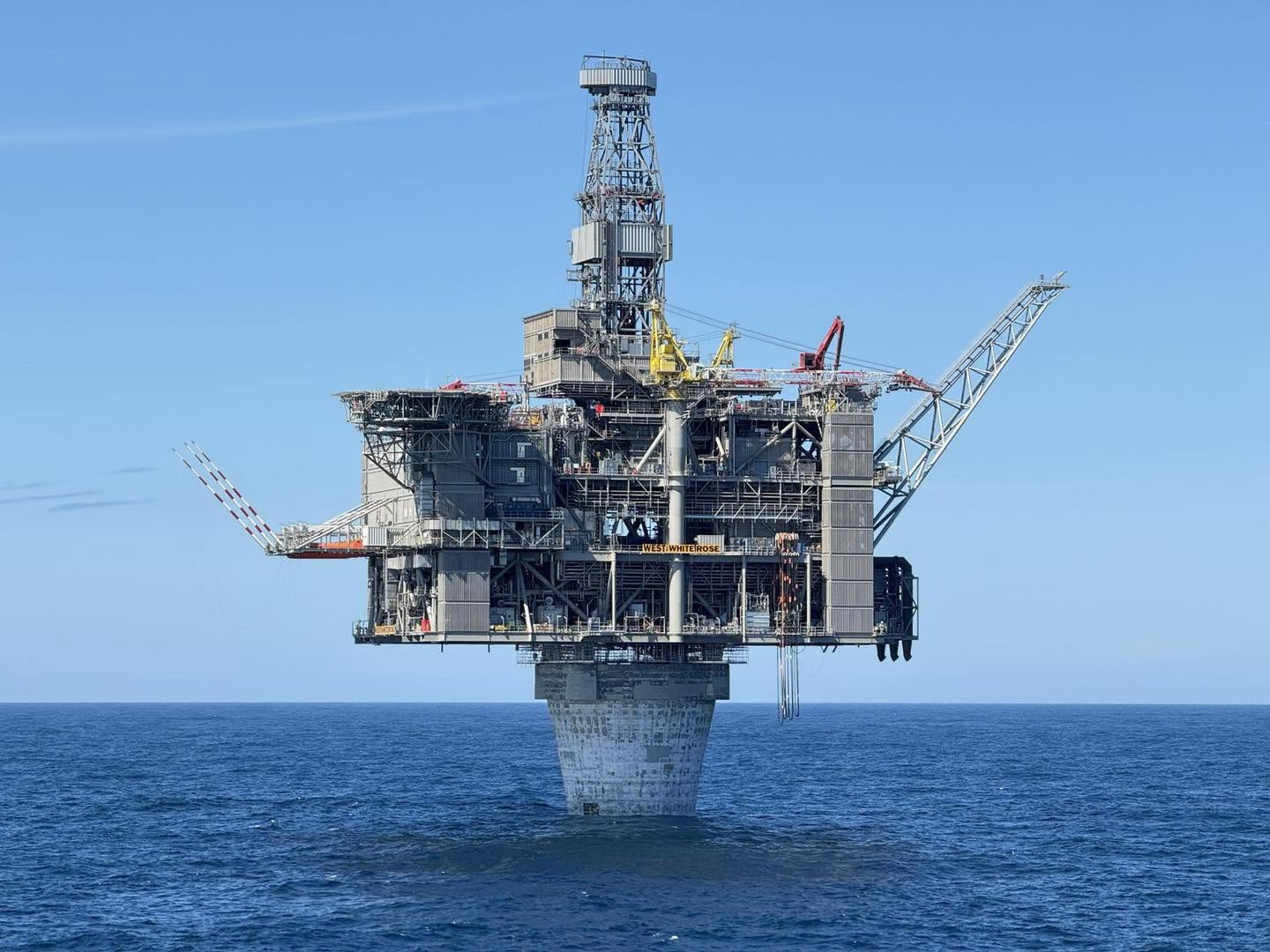
West White Rose platform, a concrete tower 350 km offshore Newfoundland in 120 m of water. Production, expected to begin late this year, will be transported to the Sea Rose FPSO.

The C-NLOER does a very good job of informing the public about offshore incidents, even those that are relatively minor, in a timely manner. The information below is excerpted from their report.

On October 29, 2026 Cenovus reported a spill of approximately 1,400 litres (370 gallons, 8.8 barrels) of synthetic-based mud (SBM) from the West White Rose Platform.

The release occurred during completions operations through the cuttings discharge chute, approximately 63 metres below sea level. No indication of the release was observed at the sea surface from the platform or the standby vessel, which conducted a sweep of the area.

As a precaution, operations were suspended on the West White Rose on October 29 while Cenovus investigated the circumstances surrounding the release. Operations resumed the next day with measures in place to prevent recurrence. C-NLOER Environmental Protection and Well Operations staff were engaged by Cenovus prior to the resumption of operations and are continuing to monitor Cenovus’s investigation and response.

SBM is a dense fluid used during drilling and well operations. It is a mixture of synthetic base fluid, a food-grade oil, and various weighting agents and additives. The synthetic base fluid has very low toxicity in marine environments, with the potential to biodegrade when sufficient oxygen is present. Because of its density, SBM generally sinks and settles, with effects due to the seabed coverage near the release, limited to within tens of metres of the discharge location.

Read Full Post »

A recent Colin Leach comment (below) merits a separate post.  Keep in mind that formation gas is highly soluble in oil-based fluids. Under bottomhole temperature/pressure conditions, the gas may be completely dissolved in the drilling fluid, complicating kick detection.

Problem: A small amount of gas is in the riser above the BOP.  This gas has been recognized, the BOP has been shut, and the well below the BOP has been killed and circulated.

What to do next? There may be 2000 bbl of mud in the riser.  Overboard?  In any case if this is done, it may get quite exciting when the (small) gas pocket reaches surface.  Do we always send this mud overboard?  Whenever there is a doubt?

The alternative of circulating through a “riser gas handler” (if the rig is equipped with one) is quite safe as long as some back-pressure  (perhaps 200 psi as a minimum) is held on a choke in order to prevent what was termed “explosive unloading” from happening.  Without this back-pressure, the events that follow are disastrous.

Follow-up: It is time to take a step back and re-look at this whole situation.  To do so does require the realistic modeling software….OLGA, Drillbench etc.. Simple gas calculations (P1V1=P2V2…..or even allowing for Z) don’t include the dynamic effects that you will see and simply must not be used.  The gas rates that come from these simple calculations are misleadingly low.

Certainly this is an area where the industry needs some focused effort.


Read Full Post »

Cheryl Anderson submitted a report on a synthetic mud spill from the Henry Goodrich which is operating offshore Newfoundland.

An estimated 26,400 litres (approximately 166 bbl) synthetic based mud spill occurred Monday east of St. John’s from Suncor Energy Henry Goodrich rig while drilling an exploration well on Monday but not reported until today – a three day delay.  Preliminary reports indicate the cause may have been a valve left open on the mud pit. vocm.com


Read Full Post »