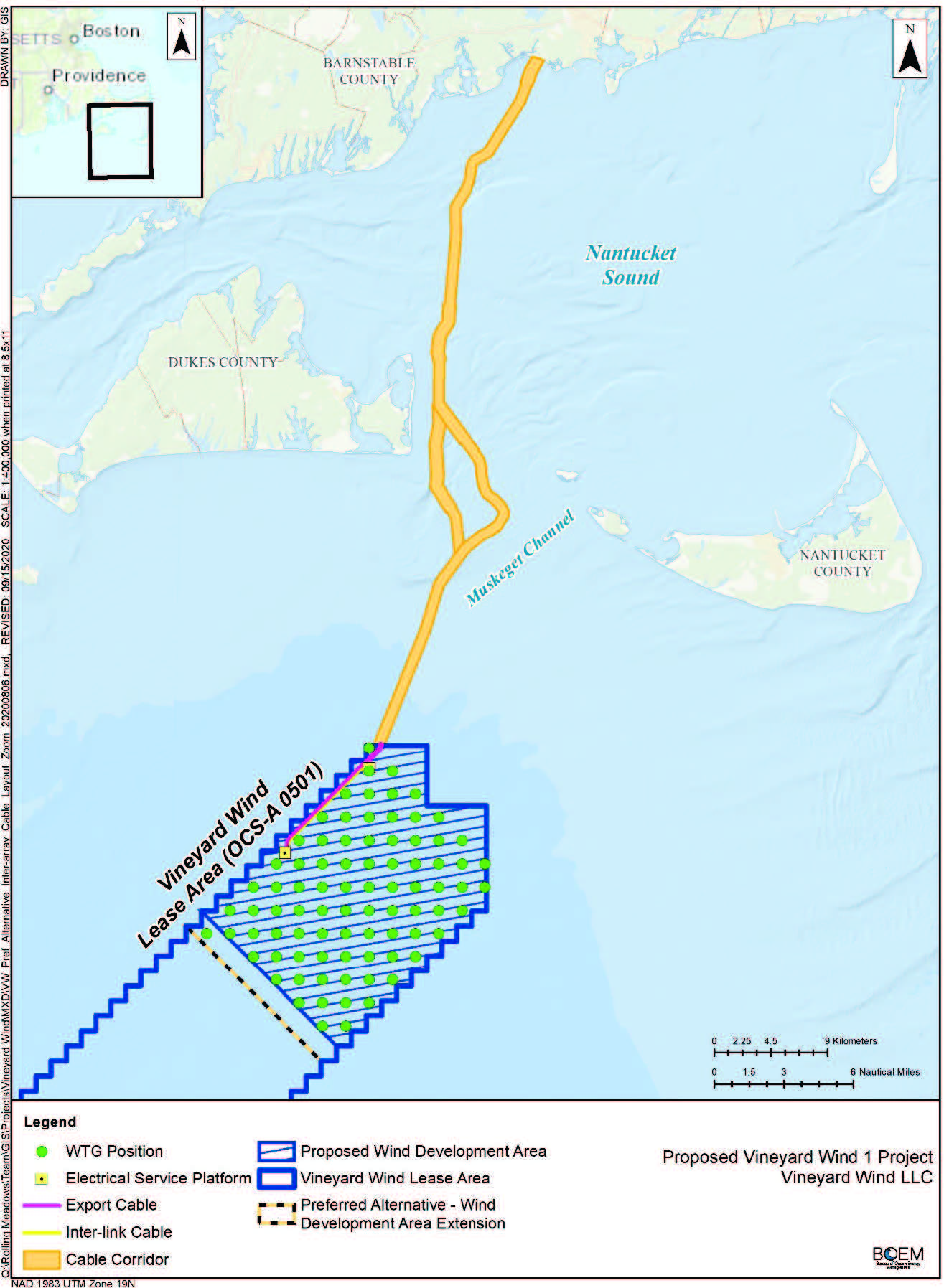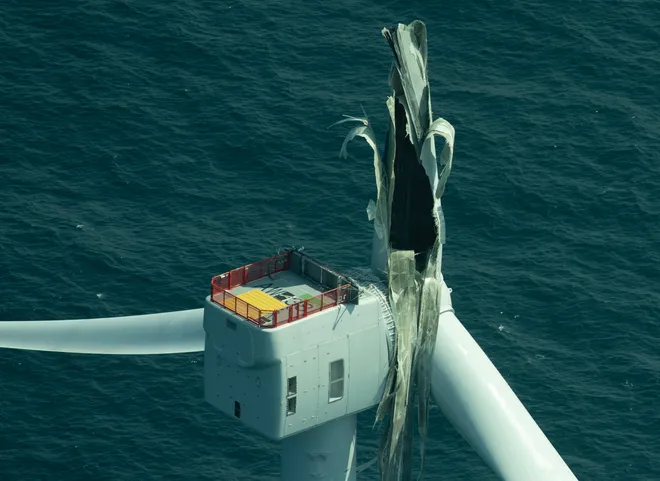
The attached Memorandum of Understanding between Vineyard Wind (VW) and the Town of Nantucket is long on bureaucratic procedures and short on risk mitigation and penalties.
The agreement details requirements for monthly reports, liaisons, written correspondence, plan reviews, and participation on incident management teams, but excludes any monetary penalties for past or future incidents. (With regard to penalties, should BSEE have assessed civil penalties for the 2024 turbine incident in accordance with 30 CFR ยง 285.400 (f)? This was a major pollution event.)
This MOU provision gives the impression that the Town is subordinate to VW:
“The Town will provide Vineyard Wind 1 up to 4 business days, if required, to identify and correct errors in the Townโs intended public communications about the Project.”
The responsible party should not be exercising oversight over the communications of an affected local government. Can you imagine Santa Barbara County reaching such an agreement with Sable Offshore?
Finally, the MOU further establishes the Town as a de facto partner in the project. VW, not the Town, is the responsible party and must be held fully accountable for project performance.
Judge Patti Saris vacated part 2 of Trump’s 1/20/2025 “Wind Memo.”Part 1, which withdrew all OCS lands from wind leasing, was not in dispute. Part 2 suspended issuing wind energy permits and other authorizations.
The judge ruled (full order attached) that the suspension of wind permitting violates Administrative Procedures Act provisions requiring agencies “to proceed within a reasonable time and to set and complete proceedings expeditiously.”
She concluded further that “the moratorium halts all wind energy authorizations indefinitely, pending a comprehensive assessment with no timeline, which is inconsistent with statutory deadlines and general commands for prompt processing in laws like OCSLA, the Clean Water Act, and others governing wind projects.”
Although the judge’s assessment of the permitting moratorium seems sound, the merits of offshore wind as a primary energy source remain very much in doubt.
The Town of Nantucketโs attorney, Greg Werkheiser of Cultural Heritage Partners, told The Light last month that โitโs taken far too longโ to get a final report on the blade failure.ย
Member companies, which include major players such as รrsted, Equinor, Vattenfall, RWE, and CIP, report quarterly data on accidents, near-misses, hazardous observations, and equipment damage. As is the case with most industry reporting schemes, anonymity is prioritized over transparency.
Sรธrensen asserts that the G+ wind industry data are incomplete: โIt shows that what is reported under the guidelines has gone down, and also that there is a cut off on what is being reported that does not include the full value chain on the industry.โ He notes that a contractor to Northland Power from Canada, a member of G+, was involved in a 2024 workplace accident in Taiwan that resulted in three fatalities. (It’s also noteworthy that Equinor’s 2024 Empire Wind fatality was not included.)
Sรธrensen: โThere have been no significant improvements in the last 10 years. Safety in offshore wind is neither getting worse nor better. There are no signs of that.โ
โIโm speaking up because we owe people the truth. If weโre not honest about the actual safety conditions in offshore wind, we canโt change them. Misinformation about workplace safety creates a dangerous illusion that everything is โunder controlโ, while too many people are getting hurt. But when we dare to speak about reality as it is, we create the foundation for a safer, faster, and truly sustainable energy transition,โ Sรธrensen says.
โAnd then it becomes difficult to learn if you have to wait for something to go through 57 gates and down past legal,โ he says. (Sound familiar?)
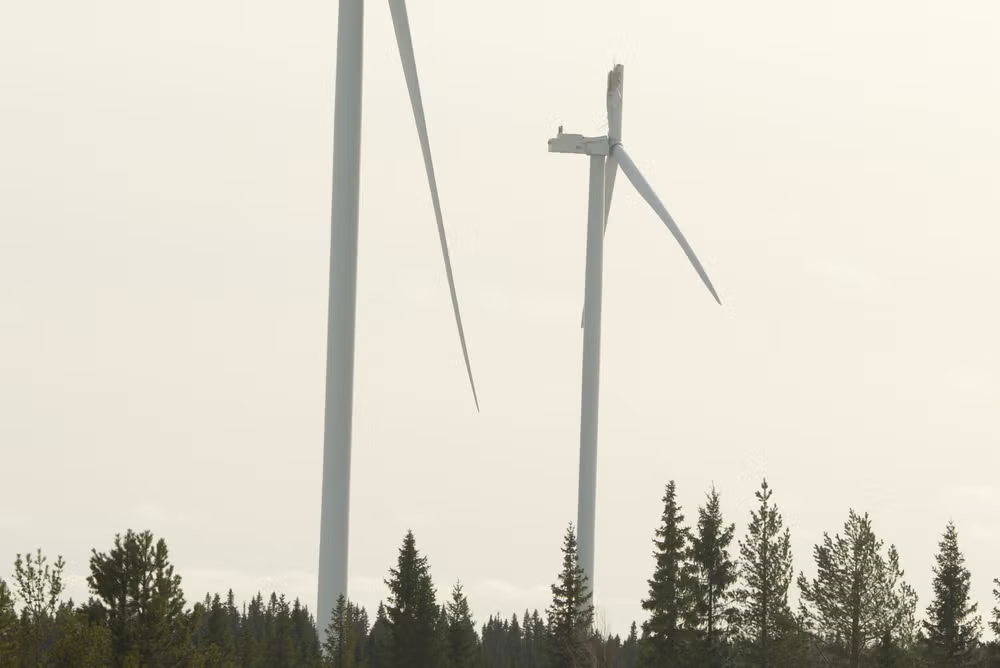
Plymouth MA wind turbine that lost a blade. (Stuart Cahill/Boston Herald)
Friday’s turbine blade failure in Plymouth MA is perhaps getting added attention given its proximity to the 7/13/2024 Vineyard Wind blade failure offshore Nantucket. The Plymouth blade landed in a nearby cranberry bog (video and picture below).
Per the MV Times, the turbines for the Plymouth project were manufactured by Gamesa, which is now part of Siemens Gamesa. Both the South Fork Wind and Revolution Wind projects off the coast of the Martha’s Vineyard are being developed by รrsted using turbines from Siemens Gamesa. Coastal Virginia Offshore Wind, the largest offshore wind project in the United States, is also being developed with Siemens Gamesa turbines. This is not to imply a higher degree of risk for those turbines. Vineyard Wind, where the only US offshore failure has occurred to date, is using GE Vernova turbines.
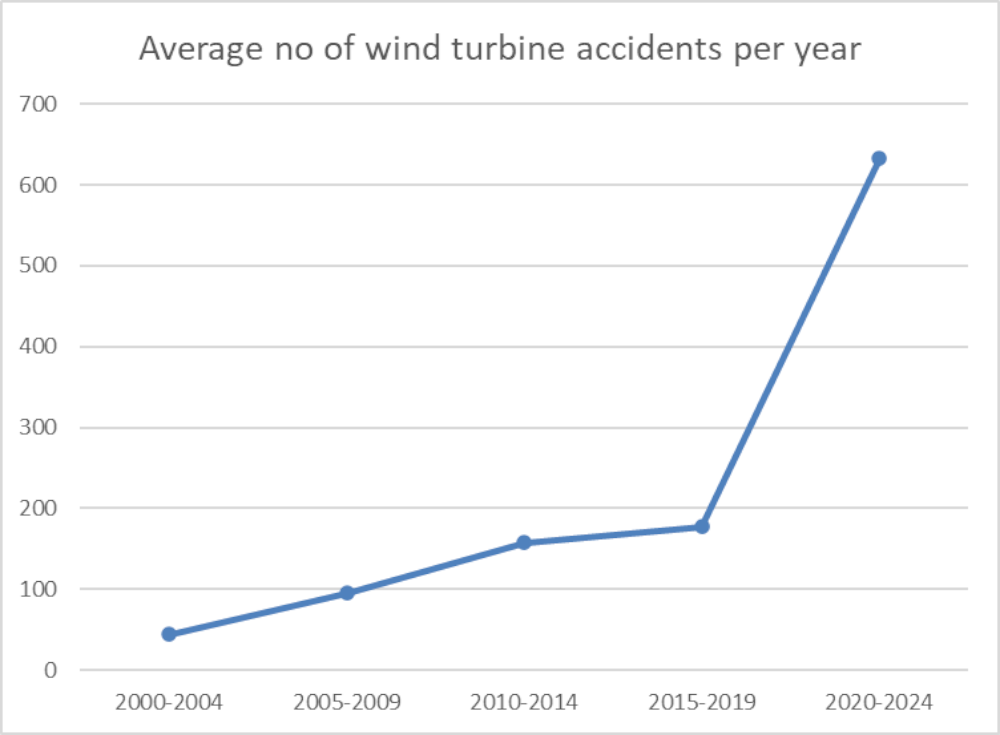
Unfortunately, turbine blade failures are much too common. Last October, Lars Herbst reported, based on a Wind Power article, that โwith an estimated 700,000 blades in operation globally, there are, on average, 3,800incidents of blade failure each year.โ Lars noted that the annual blade failure rate of about 0.5% translates to 1.5% of all operating wind turbines experiencing a blade failure every year, a remarkably high failure frequency.
Scotland Against Spin data indicate that blade failure is the second most common accident type in the wind industry, and the most common cause of accidents at operational wind turbine sites. SAS reports further that pieces of blade are documented as travelling up to one mile, and have gone through the roofs and walls of nearby buildings.
Lastly, we are still awaiting BSEE’s report on the Vineyard Wind failures so we can better understand what happened and why.
The Construction and Operations Plan (COP) for the SouthCoast Wind project was approved during the last week of the Biden Administration. That approval has been challenged by the Town and County of Nantucket. Ocean Wind, a joint venture of EDP Renewables (Portugal) and ENGIE (France), is the leaseholder.
It is ORDERED that the case be REMANDED to BOEM for reconsideration of its decision and that proceedings in this court are STAYED until further order of the court. It is further ORDERED that, on or before January 3, 2026, and every 60 days thereafter, the parties shall file a joint status report indicating the status of BOEMโs remand proceedings. It is further ORDERED that on or before 30 days following the issuance of a decision by BOEM, the parties shall file a joint status report informing the court if further proceedings are necessary and, if so, providing a proposed schedule for those proceedings.
The UK Met Office told Recharge that the historic trend of wind speeds in Britain was downwards. โThe UK annual mean wind speed from 1969 to 2024 shows a downward trend, consistent with that observed globally. There have been fewer occurrences of maximum gust speeds exceeding 40/50/60 knots in the last two decades compared to the 1980s and 1990s.โ
Citigroup informs that load factors for both onshore and offshore wind are falling behind capacity growth in Britainโs turbine fleet.
Per the Citigroup analysts, the increasing focus on wind wakes in UK waters has led to a ballooning number of disputes between developers.
In addition to wake losses, local turbulence in the wake regions creates significant unsteady fatigue loads on the downstream turbines, whichย shorten their working life.
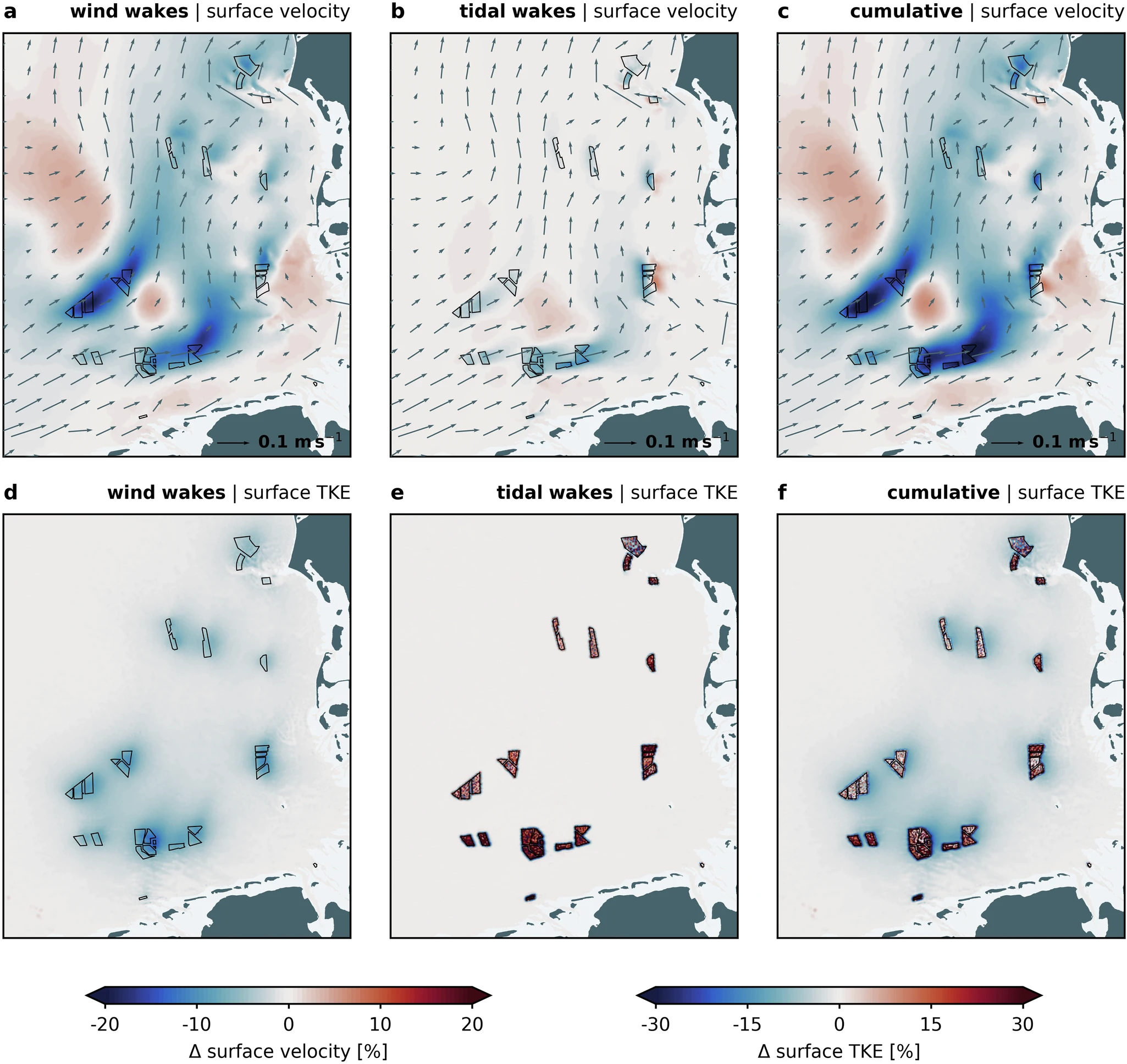
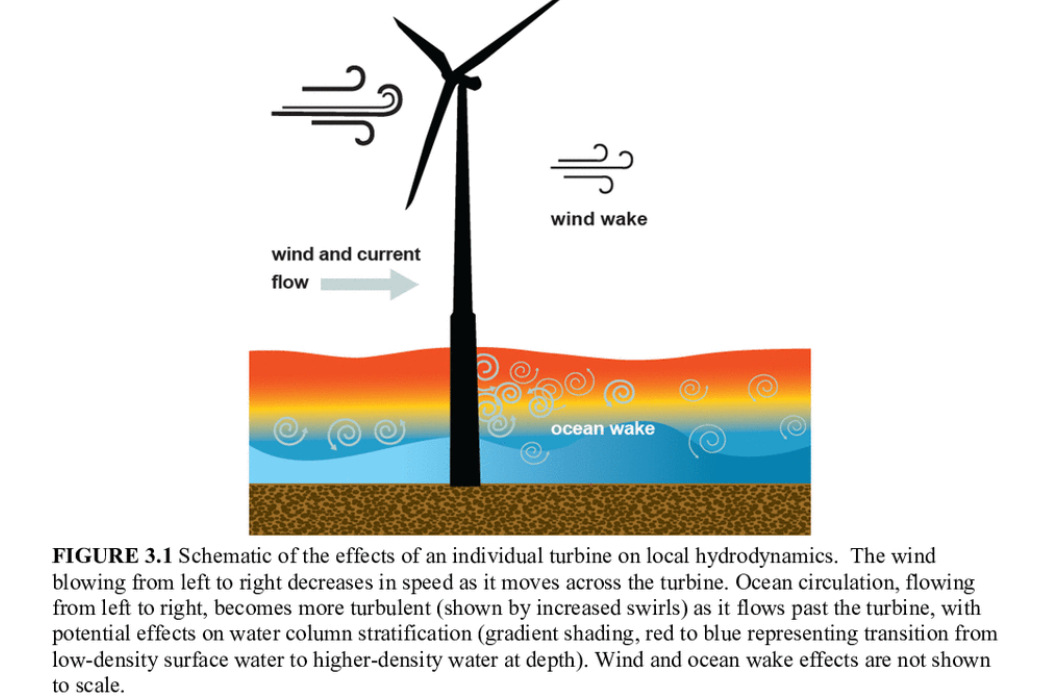
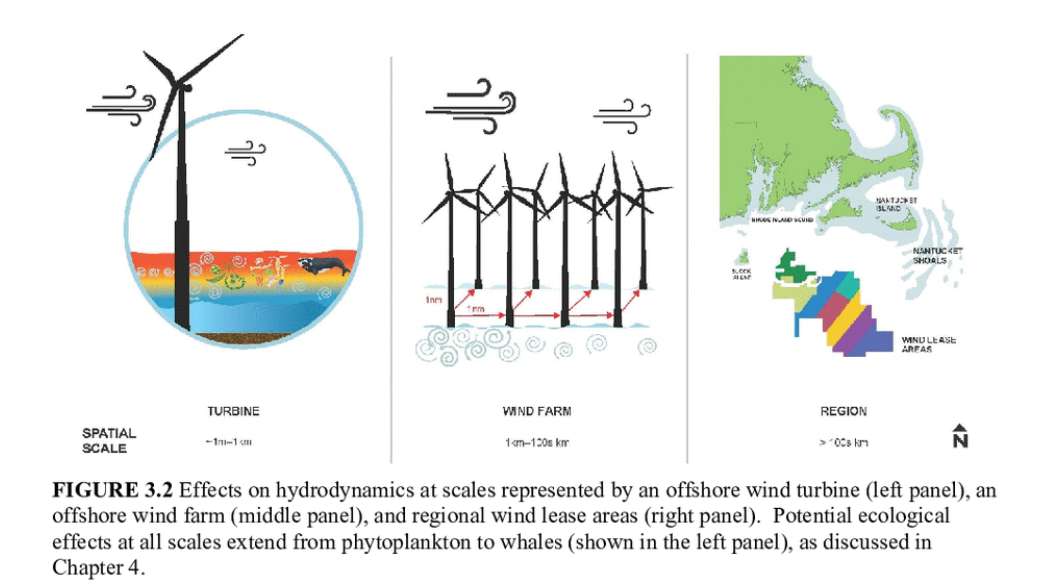
Aย recent studyย shows that hydrodynamic conditions in the ocean altered by wind wakes can strongly influence marine primary production (phytoplankton).
The US National Academy of Sciences advised BOEM about the hydrodynamic effects of wind turbines and the potential implications for the endangered North Atlantic right whale (see figure below).
The attached legal petition from Save LBI and Green Oceans, asserts that BOEM improperly amended OCS wind leases at the end of the previous Administration.
The amended language makes it more difficult to cancel leases by stipulating that an OCS wind lease must be suspended for 5 years before it can be cancelled, and that in the event of cancellation, the lessees must be compensated.
The sentence of concern:
Any cancellations are subject to the limitations and protections contained in subsections 5(a)(2)(B) and (C) of the Act (43 U.S.C. ยง 1334 (a)(2)(B) and (C)). (Those subsections are pasted at the end of this post in their entirety.)
Compensation could be very costly to the Federal govt (taxpayer) given the wild (irrational?) bidding for some leases and subsequent planning and development costs.
See Section 8 of this lease for an example of the amended language. Note that the lease changes are not highlighted or otherwise identified; nor was there any public notice of this change.
The petitioners are requesting that the new lease language be rescinded and that cancellation language in the lease be aligned with the regulations.
(B) that such cancellation shall not occur unless and until operations under such lease or permit shall have been under suspension, or temporary prohibition, by the Secretary, with due extension of any lease or permit term continuously for a period of five years, or for a lesser period upon request of the lessee;
(C)that such cancellation shall entitle the lessee to receive such compensation as he shows to the Secretary as being equal to the lesser of (i) the fair value of the canceled rights as of the date of cancellation, taking account of both anticipated revenues from the lease and anticipated costs, including costs of compliance with all applicable regulations and operating orders, liability for cleanup costs or damages, or both, in the case of an oilspill, and all other costs reasonably anticipated on the lease, or (ii) the excess, if any, over the lesseeโs revenues, from the lease (plus interest thereon from the date of receipt to date of reimbursement) of all consideration paid for the lease and all direct expenditures made by the lessee after the date of issuance ofsuch lease and in connection with exploration or development, or both, pursuant to the lease (plus interest on such consideration and such expenditures from date of payment to date of reimbursement), except that (I) with respect to leases issued before September 18, 1978, such compensation shall be equal to the amount specified in clause (i) of this subparagraph; and (II) in the case of joint leases which are canceled due to the failure of one or more partners to exercise due diligence, the innocent parties shall have the right to seek damages for such loss from the responsible party or parties and the right to acquire the interests of the negligent party or parties and be issued the lease in question;
Attached is a court filing challenging Delaware’s approval of the Coastal Construction Plan for that project. Some interesting points from the filing:
Maryland local governments declined to allow the transmission lines from the Maryland Offshore Wind Project to come ashore in their jurisdictions.
The Governor of Delaware agreed to allow the transmission lines to make landfall at the Delaware Seashore State Park.
The transmission pipelines would then traverse the adjacent Delaware Bays, to an inland substation, from which the power would be sent to Maryland.
US Wind applied for a number of permits from the Delaware Department of Natural Resources (DNREC) specific to horizontal directional drilling, laying cable pipelines, and other coastal construction activity.
The approval process, including provisions for public input, was not consistent with State regulations.
The Secretaryโs decision to issue the beach construction permit is supported virtually exclusively by documents which were submitted by US Wind after the close of public comment.
Decommissioning and financial assurance information, a favorite BOE topic for both wind and oil/gas, was submitted after the close of the public record.
Interesting case: Delaware litigation on approval of the Coastal Construction Permit for the Maryland Offshore Wind Project
Posted in decommissioning, energy policy, Offshore Wind, Regulation, tagged Coastal Construction Plan, court filing, decommissioning, Delaware litigation, Maryland Offshore Wind, public comment, US Wind on October 29, 2025| Leave a Comment »
The Dept. of the Interior is currently reconsidering approval of the Construction and Operations Plan for the Maryland Offshore Wind Project (US Wind).
Attached is a court filing challenging Delaware’s approval of the Coastal Construction Plan for that project. Some interesting points from the filing:
Read Full Post »