
“Knowledge not shared is knowledge wasted.”
Posted in Uncategorized on January 1, 2024| Leave a Comment »
Posted in California, Offshore Energy - General, rigs-to-reefs, Uncategorized, tagged big swell, California, platform Esther, rigs-to-rides, surf on December 31, 2023| Leave a Comment »
Posted in climate, energy policy, Uncategorized, Wind Energy, tagged COP 28, Denmark, fossil fuel, Jens Christiansen, renewable energy on December 4, 2023| Leave a Comment »
The quote and graphic are from Jens Christiansen, a Danish physicist and nuclear power advocate.
Energy reality on display (vs. COP theater):

Posted in Offshore Energy - General, Uncategorized, tagged court order, deep sea mining, Georges Bank, Greenpeace, TMC, Zapata Saratoga on December 1, 2023| Leave a Comment »
TMC
- The District Court of Amsterdam has ordered Greenpeace International to immediately disembark from the research vessel commissioned by TMC subsidiary Nauru Ocean Resources Inc (NORI) to conduct legally-mandated environmental impact assessments requested by the Legal and Technical Commission of the International Seabed Authority (ISA)
- Since November 23rd, Greenpeace’s unsafe and unlawful activities have hindered independent scientists in conducting environmental and scientific studies to assess ecosystem function and recovery one year on from NORI’s pilot nodule collection system test
A bit of history: We experienced Greenpeace protesters on Georges Bank way back in 1981. They were dispatched from the Rainbow Warrior which visited the Zapata Saratoga, 155 miles SE of Nantucket. Given the remote location, the protest was unexpected. However, the drilling operation was not disrupted and no action was taken against Greenpeace. Four years later, the Rainbow Warrior was bombed by French commandos while in port in Auckland, NZ prior to planned protests against French nuclear testing in the South Pacific. Sadly, one crew member was killed during this incident.

Posted in Offshore Energy - General, rigs-to-reefs, Uncategorized, tagged Little Mermaid, reef effect, Thanksgiving, Under the Sea on November 23, 2023| Leave a Comment »

“Under the sea, under the sea, darling it’s better down where it’s wetter, take it from me”


Posted in Australia, Gulf of Mexico, Offshore Energy - General, Uncategorized, tagged Gulf of Mexico, Karoon Energy, LLOG, Who dat on November 21, 2023| Leave a Comment »

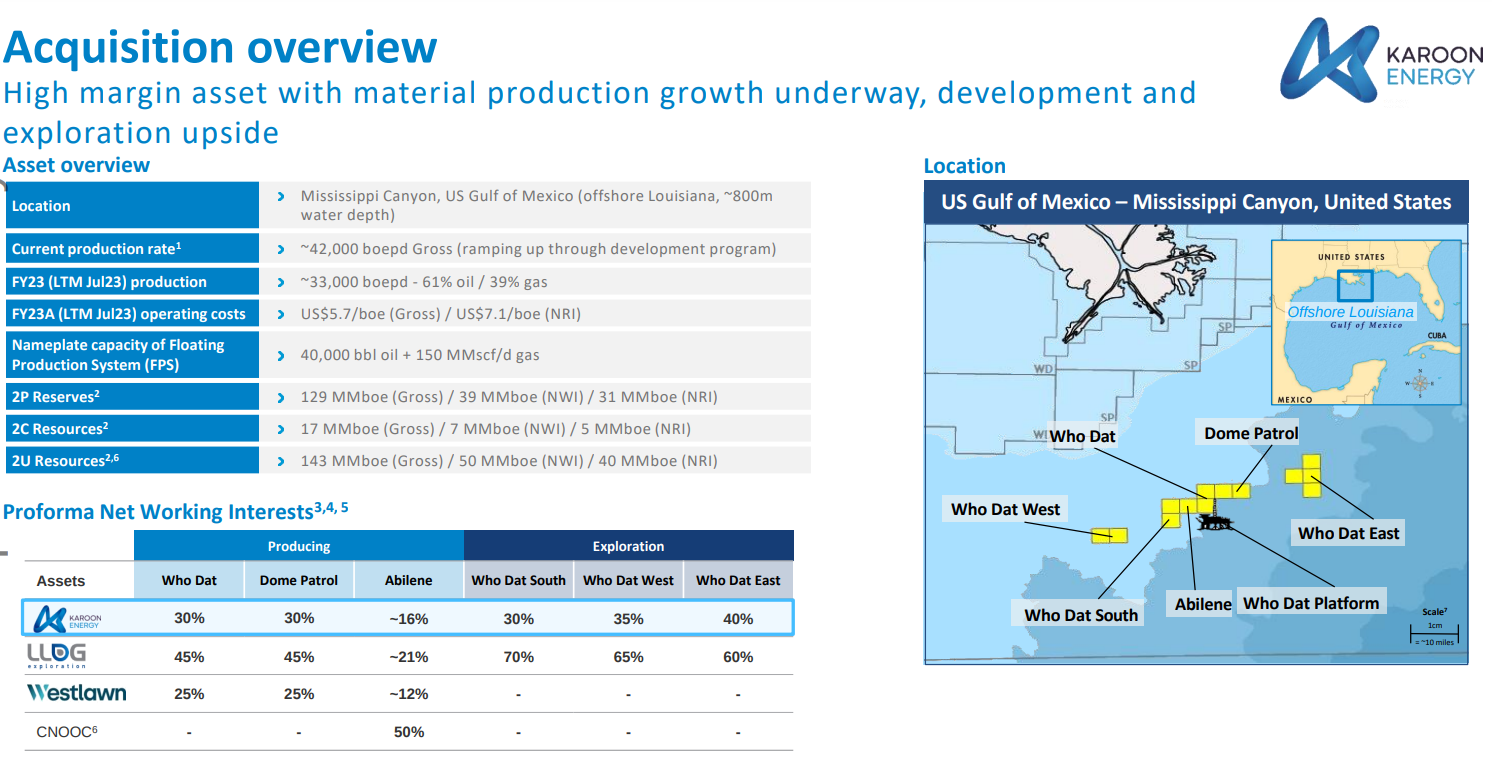
Karoon Energy, an Australian company, has entered the Gulf of Mexico in a big way by acquiring an interest in the Who Dat field (winner of BOE’s best field name award!) from LLOG. For more information on the acquisition, see Karoon’s slide at the end of this post. The full presentation is here.
To learn more about the cultural importance of ‘Who Dat,’ see the youtube clip below, or read this article. For more in-depth ‘Who dat’ history, this wiki page is quite good.

Posted in Offshore Energy - General, Uncategorized, tagged 57 years, DOI, Gig Kocher, retirement, Texas A&M, USAF, Yankees on November 3, 2023| Leave a Comment »

Gig Kocher recently retired from BSEE after an amazing 57 years of Federal service. Nine of those years were served in the US Air Force, and the remaining 48 were at the US Dept. of the Interior, mostly in the offshore oil and gas program.


Gig is a native New Yorker and a huge Yankees fan (tough year in that regard). However, it’s only fitting that a guy named Gig would eventually become a Texas A&M Aggie (“Gig ’em!”), where he earned a master’s degree in computer science back in the mainframe and punch card era.

Gig was a strategic planning wiz who excelled at concisely outlining the steps and tactics needed to achieve desired objectives. He managed major updates to the documents and information technology systems critical to the success of our offshore energy programs.
Gig will be greatly missed by the troops at BSEE. His retirement event went something like this: 😉
Posted in climate, energy policy, Uncategorized, tagged climate ultras, Department of the Interior, resignation, Tommy Beaudreau on November 2, 2023| Leave a Comment »
Deputy Secretary of the Interior Tommy Beaudreau was “disrupted” (perhaps a euphemism for the thuggish behavior demonstrated in the video clip below) by climate ultras in New York on Sept. 21. On Oct. 4, Mr. Beaudreau announced that he would be leaving the Dept. of the Interior.
The official announcement provides no reasons for his departure. By all accounts, Beaudreau was highly regarded by career employees in the Department. Was he troubled by his experience in NYC and the absence of a response from DOI? Was it difficult being a lone advocate for a more balanced energy policy?
Posted in energy policy, Jamaica, Offshore Energy - General, Regulation, Uncategorized, tagged CIA, Clarion-Clipperton Zone, deep sea mining, Glomar Explorer, Hidden Gem, ISA, Manzanillo, Naura, The Metals Company, UNCLOS on October 26, 2023| Leave a Comment »

Andrew Konczvald’s reports from Manzanillo, Mexico about the presence of the Hidden Gem (pictured above), a converted deepwater drillship, have renewed BOE interest in deep sea mining, a topic that is full of political, environmental, legal, and operational intrigue:


Posted in energy policy, Offshore Energy - General, Uncategorized, tagged Chevron, Hess, IEA, merger, OPEC, S&P Global on October 25, 2023| Leave a Comment »

Washington Post article (mainly commentary) on the Hess acquisition. Excerpts:
WP: “Chevron is acquiring oil driller Hess in a $53 billion all-stock deal announced Monday, bringing the energy giant deeper into the fossil fuel business at a time when policymakers are pressing for a broader transition to renewables.”
Comment: Many who live and work outside of the Post’s policy bubble differ on the urgency and practicality of the transition. Their primary concerns are reliable, secure, and affordable energy. Many elected representatives agree, which is why there is little national support for legislation restricting fossil fuels and imposing rigid transition timelines. Administrative actions, like the 5 year leasing plan, that handicap US offshore production are also being questioned.
And what are we transitioning to? Wind and solar are intermittent energy sources that can complement fossil fuel power generation, but not replace it. Nuclear energy has strong proponents, but faces stiff opposition, much of which is from the same groups that oppose fossil fuels. Other energy alternatives like ultradeep geothermal are very promising but are still years away.
WP: “The investments run counter to U.S. and global climate policies, which aim to rapidly phase out the internal combustion engine and shift power grids to zero emissions energy. The International Energy Agency reported last month that demand for oil, gas and coal will peak by 2030 before going into a steady decline, leading its executive director, Fatih Birol, to warn oil company executives that decisions to double down on fossil fuel infrastructure could prove misguided.“
Comment: Fortunately, IEA does not dictate corporate investment decisions. Perhaps IEA should look more closely at their own forecasts which show essentially no decline in oil or gas demand through 2050. Their assertion that demand for all fossil fuels will peak by 2030 is based on their speculative forecast calling for a sharp decline in coal demand, even though coal consumption is currently at record levels. IEA’s forecasts are also dependent on questionable assumptions such as this: “50% of new US car registrations will be electric in 2030.”
S&P Global sees oil demand rising by about 7 million b/d to 109.3 million b/d in 2030, before a gentle decline in the latter half of the 2030s, with oil falling to 100.8 million b/d in 2050. OPEC expects global oil demand to rise to 110 million barrels per day (bpd) and overall energy demand to rise 23% by 2045.
WP: “Still, the massive acquisitions from both Chevron and Exxon indicate their executives believe fossil fuels will continue to drive their business well into the future. Emphasizing affordability, company executives have said they see oil and gas alongside renewables.”
Comment: Spot-on. The WP could have shortened their commentary to these 2 sentences.
WP: Alex Witt, senior adviser for oil and gas at the advocacy group Climate Power, said the Hess acquisition shows the company’s true priorities. “Today’s news proves what we already knew — Chevron executives only care about the short-term, putting potential profits over the lives of families and the future of our planet,” Witt said in a statement Monday.
Comment: Or perhaps both Chevron and the lives of families will benefit, as they have in the past.