This rather arrogant and condescending policy makes neither good business sense nor good social sense (unless you support energy poverty), but I’m sure the executive team is proud. That said, they do seem to have left themselves with a fair amount of wiggle room.
In line with the policy, we will no longer provide new lending or capital markets finance for the specific purpose of projects pertaining to new oil and gas fields and related infrastructure when the primary use is in conjunction with new fields.
We will continue to provide finance or advisory services to energy sector clients at the corporate level, where clients’ transition plans are consistent with our 2030 portfolio-level targets and net zero by 2050 commitment.
Using satellite data, SpaceKnow detected 2 “dark ships” near the pipelines prior to the explosions. The ships were operating with their automatic identification system (AIS) transponders turned off or malfunctioning. While this is cause for suspicion, no data were provided on the frequency of such issues in the Baltic. Also, what were the specific routes and timelines for these vessels? Absent this information. the “dark ship” reports aren’t terribly meaningful.
Although the assumption that the explosions occurred outside the pipeline seems most likely, some observers have suggested that the explosions were internal. It’s unknown whether the investigators have ruled out this possibility.
Meanwhile, the folks in Germany and elsewhere in Europe are understandably impatient. They want answers from their governments!
Two supporters of Just Stop Oil have thrown soup over Vincent Van Gogh’s Sunflowers, as actions in the capital roll into the 14th day. They are demanding that the UK government halts all new oil and gas projects.
It’s disappointing that this statement was even necessary. Under the circumstances, the need for new UK offshore licenses would seem to be obvious and undeniable.
“The European energy sector right now is cracking at the seams. Without the contribution of UK oil and gas resources, that crack would be a gaping hole.”
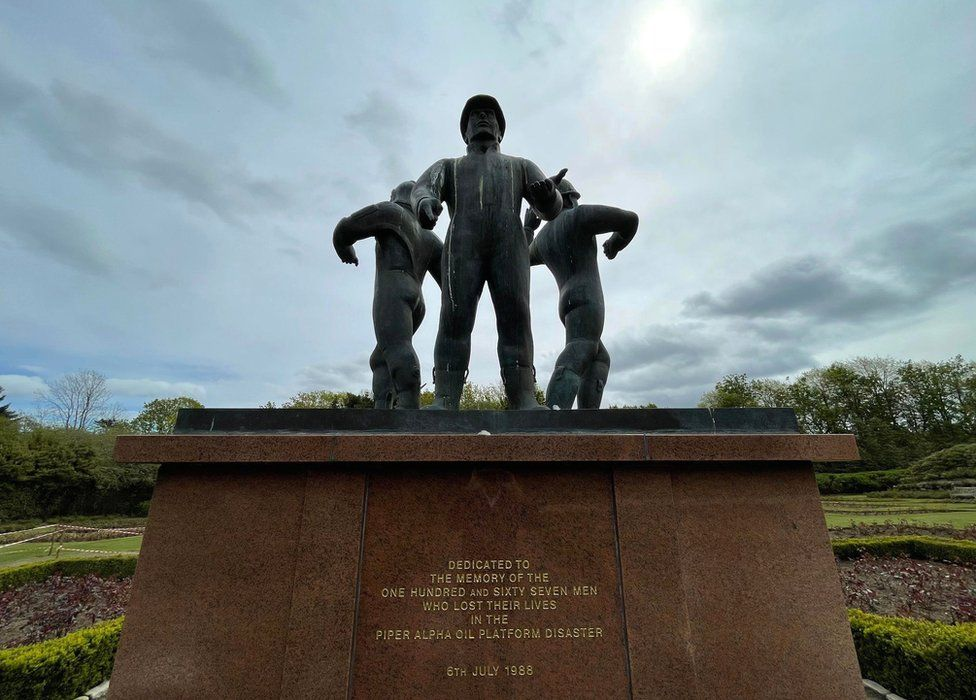
In terms of the total number of fatalities, the Piper Alpha fire was the worst disaster in the history of offshore oil and gas operations and sent shock waves around the world. Eight months later another interactive pipeline-platform fire killed 7 workers at the South Pass 60 “B” facility in the Gulf of Mexico. A US Minerals Management Service task group reviewed the investigation reports for both fires and recommended regulatory changes with regard to:
the identification and notification procedures for out-of-service safety devices and systems,
location and protection of pipeline risers,
diesel and helicopter fuel storage areas and tanks,
Lord Cullen’s comprehensive inquiry into the Piper Alpha tragedy challenged traditional thinking about regulation and how safety objectives could best be achieved, and was perhaps the most important report in the history of offshore oil and gas operations. Per Cullen:
“Many current safety regulations are unduly restrictive because they impose solutions rather than objectives. They also are out of date in relation to technological advances. Guidance notes lend themselves to interpretations that discourage alternatives.There is a danger that compliance takes precedence over wider safety considerations and that sound innovations are discouraged.“
Cullen advocated management systems that describe the safety objectives, the system by which those objectives were to be achieved, the performance standards to be met, and the means by which adherence to those standards was to be monitored. He called for safety cases that describe major hazards on an installation and provide appropriate safety measures. Per Cullen, each operator should be required in the safety case to demonstrate that the safety management systems of the company and the installation are adequate to assure that design and operation of the platform and its equipment are safe.
The International Regulators’ Forum (IRF) does a good job of compiling safety performance data for offshore oil and gas operations in member countries. Because these data are collected by the respective regulators and compiled in accordance with established guidelines, we consider the IRF compilations to be the most credible international incident summary data for the offshore industry.
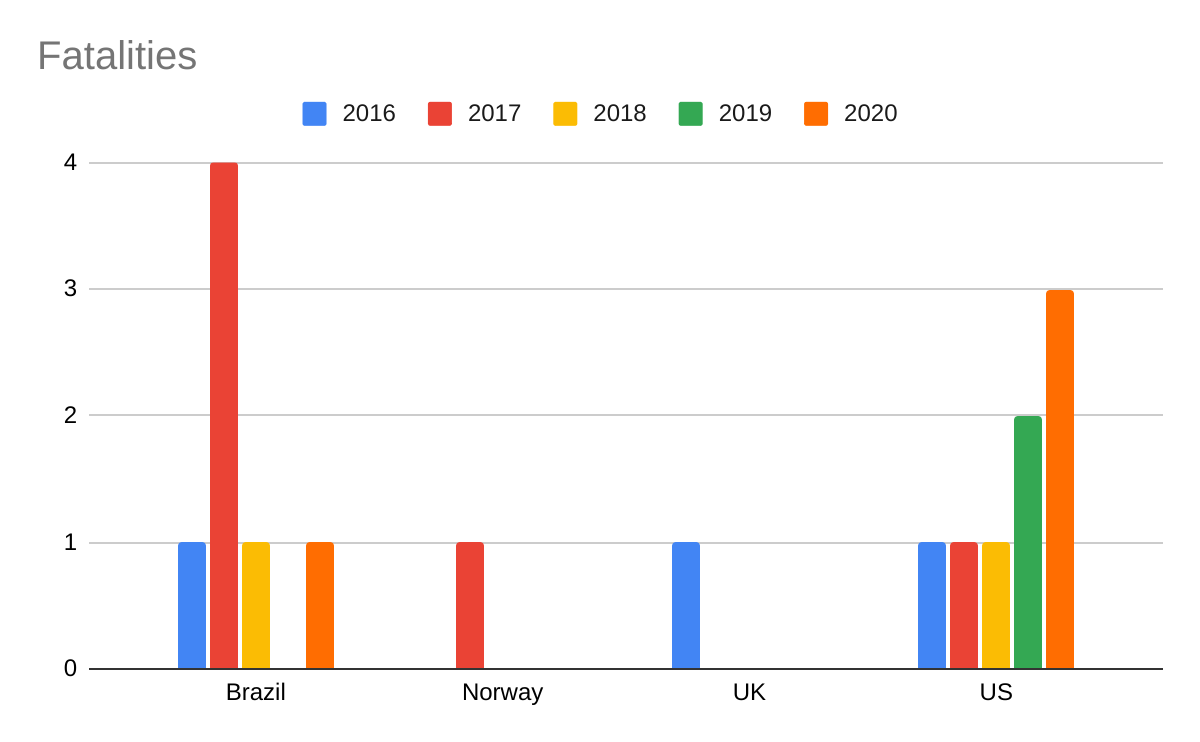
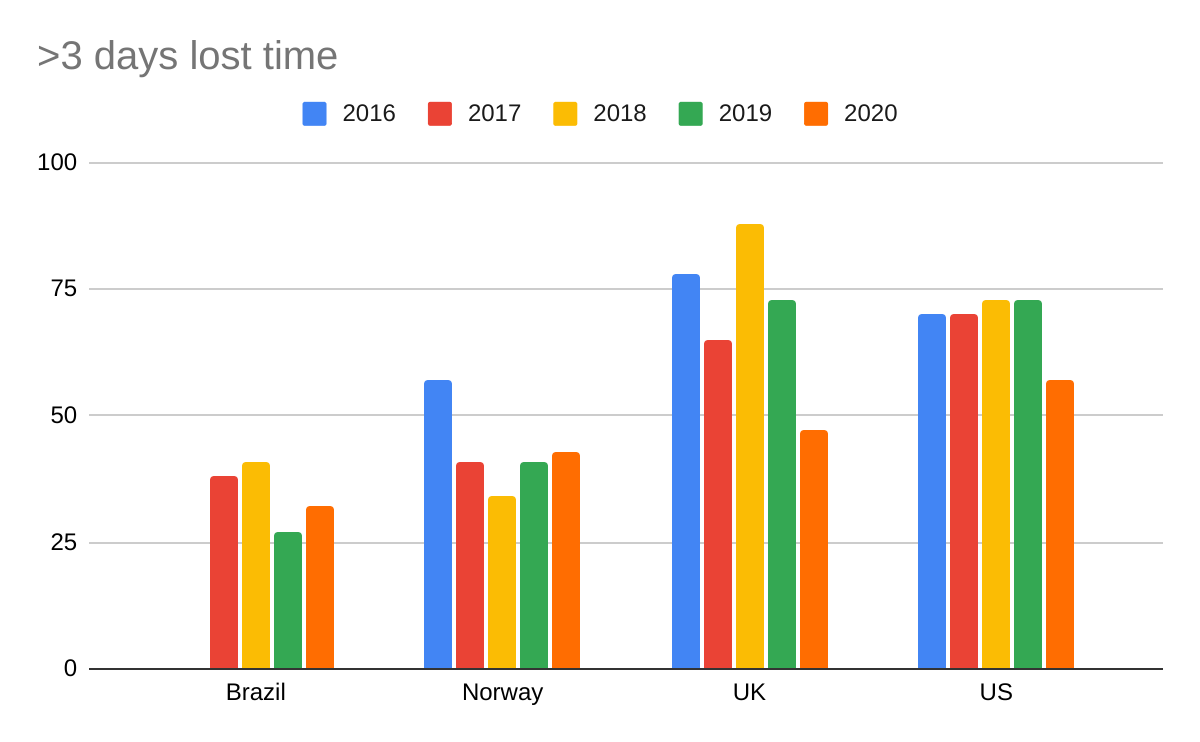
BOE looked at the numbers for the IRF countries with the highest level of activity in terms of hours worked – Brazil, Norway, UK, and US. These countries accounted for 90% of the total hours worked in 2020, the last year for which data are available. The 2020 hours worked (millions) were also relatively similar for the 4 countries: Norway – 41.2, UK – 42.4, US – 50.4, Brazil – 50.7. The differences in hours worked were somewhat greater in the prior years, but not dramatically so.
We charted the fatality and lost-time (>3 days) data (below). Our intent at this point is to draw attention to the IRF data sets, not to assess and compare performance. We do think the overall safety performance in these and other IRF countries, while far from perfect, is quite good given the hundreds of millions of hours worked, complexity of operations, logistical challenges, and difficult operating environments. We recommend that the IRF prioritize the timely posting of these data, and begin providing causation information so that companies and other interested parties can better identify performance issues and safety trends.
While the text of the announcement implies otherwise, the new name prioritizes the “transition” over concerns about energy supply, security, and reliability. In that regard, the timing seems questionable.
Why not the North Sea Energy Authority (NSEA) or UK Offshore Energy Authority (UKOEA)?
Will OPEC+ be impressed? Perhaps China will add a few coal-fired power plants in honor of the name change.
The term energy transition somehow sounds like it is a well-lubricated slide from one reality to another. In fact, it will be far more complex: Throughout history, energy transitions have been difficult, and this one is even more challenging than any previous shift.
The 19th century is known as the “century of coal,” but, as the technology scholar Vaclav Smil has noted, not until the beginning of the 20th century did coal actually overtake wood as the world’s No. 1 energy source. Moreover, past energy transitions have also been “energy additions”—one source atop another. Oil, discovered in 1859, did not surpass coal as the world’s primary energy source until the 1960s, yet today the world uses almost three times as much coal as it did in the ’60s.
On Sunday, the Norwegian government announced that its sovereign wealth fund, the world’s largest, wwould divest its Russian assets, worth around 25 billion Norwegian crowns ($2.80 billion).
Reuters
“In the current situation, we regard our position as untenable,” Equinor Chief Executive Anders Opedal said in a statement. “We will now stop new investments into our Russian business, and we will start the process of exiting our joint ventures in a manner that is consistent with our values.”
Reuters
British oil giant BP said Sunday that it is “exiting” its $14 billion stake in Russian oil giant Rosneft over Moscow’s invasion of Ukraine in one of the biggest signs yet that the Western business world is cutting ties over the Kremlin’s invasion of Ukraine.
Britain sees a “good, solid” future for the North Sea’s oil and gas industry and will issue new licences to expand output in the future, Energy Minister Greg Hands said on Tuesday.
“We need continued investment into the North Sea,” Hands told the International Energy Week online conference.
Meanwhile, the US government seems intent on supporting legal and administrative actions that stymie offshore exploration and development. The US is sanctioning its own offshore industry during an international crisis centered around energy.
2021 was the first year in the history of the US offshore program dating back to the passage of the OCS Lands Act in 1953 without a single oil and gas sale, and there is no lease sale on the horizon.Most years have had multiple sales, regardless of the party in power. The only attempted 2021 sale (no. 257) was required by a Federal Court decision in Louisiana. That sale was annulled by a questionable DC court decision that the Federal government chose not to appeal.