“Today’s announcement delivers on Harbour’s long-standing ambition to establish a presence in the deepwater Gulf of America. With LLOG, we found the right combination of high-quality assets and a talented team, providing a strong strategic and cultural fit with our company. The transaction positions us as a leading player in a region with well-established infrastructure, a supportive fiscal and regulatory environment and opportunities for additional growth.”
LLOG was the 6th largest Gulf of America producer of both oil and gas in 2024 with production of 27 million bbls of oil and 34 BCF of gas. LLOG was the high bidder on 11 tracts in the recent BBG1 sale.
Harbour is not currently a Gulf of America leaseholder.
Reuters had reported that Shell was in advanced talks to acquire LLOG. Apparently, either Shell lost interest or Harbour made a more attractive offer.
JL Daeschler, other North Sea veterans, and those of us who once admired the UK offshore program, lament the sad plight of their oil and gas industry and the destruction of the economy in northeast Scotland.
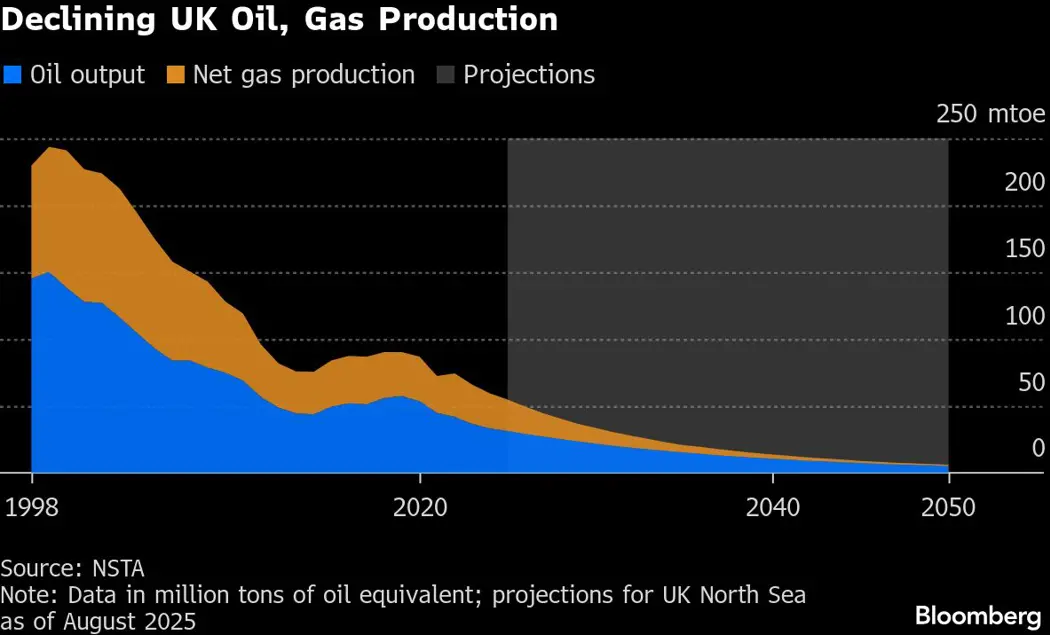
Incomprehensibly, the UK has retained the Energy Profits Levy, which requires North Sea operators to hand over 78% of their diminished profits to the Treasury. Most have regrettably chosen to do business elsewhere. Investment in the UK North Sea is at a record low and a study from Robert Gordon University says jobs are being “quietly” lost at a rate of 1,000 a month.
The UK government is grudgingly allowing some tieback production to existing facilities, but this will do little to stem the industry’s decline. JL notes that this limited infield development is not the type of new field investment needed to grow production and sustain the service industry (rigs, boats, helicopters, equipment, etc.).
“The term energy transition somehow sounds like it is a well-lubricated slide from one reality to another. In fact, it will be far more complex: Throughout history, energy transitions have been difficult, and this one is even more challenging than any previous shift.”
Related article in the WSJ: “Europe’s Green Energy Rush Slashed Emissions—and Crippled the Economy”
“European politicians pitched the continent’s green transition to voters as a win-win: Citizens would benefit from green jobs and cheap, abundant solar and wind energy alongside a sharp reduction in carbon emissions. Nearly two decades on, the promise has largely proved costly for consumers and damaging for the economy.”
“Europe largely took an “or” strategy: It raced to replace fossil fuels with solar, wind and biomass by taxing carbon heavily, subsidizing renewables and closing scores of fossil-fuel power plants. Britain, which pioneered the use of coal for energy, last year became the first large industrialized country to shut all of its coal-fired power plants. It has also banned new offshore oil-and-gas drilling. Denmark plans to eliminate gas for home heating by 2035. Around one-fifth of Germany’s municipal utilities plan to shut down their gas networks in coming years, according to an October survey by the utilities’ trade association.”
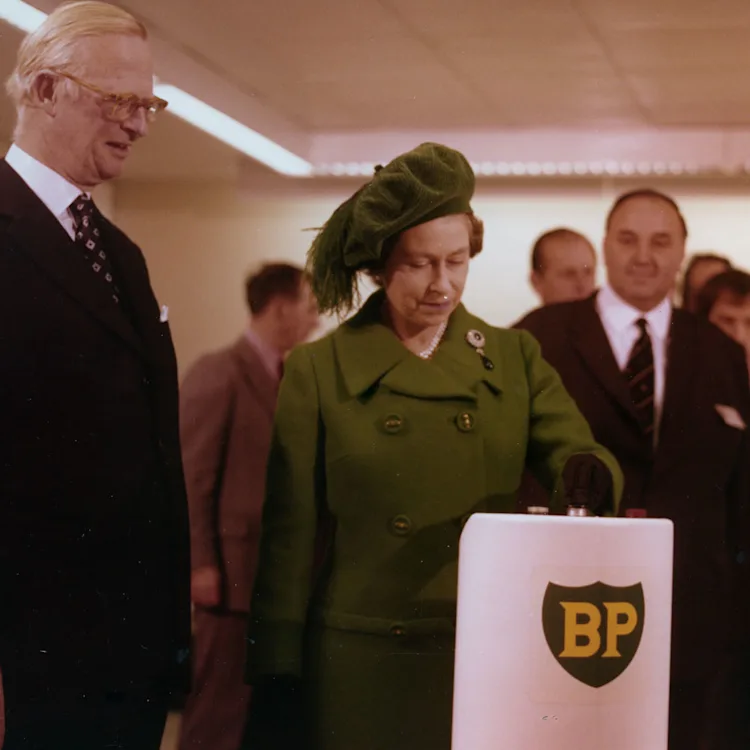
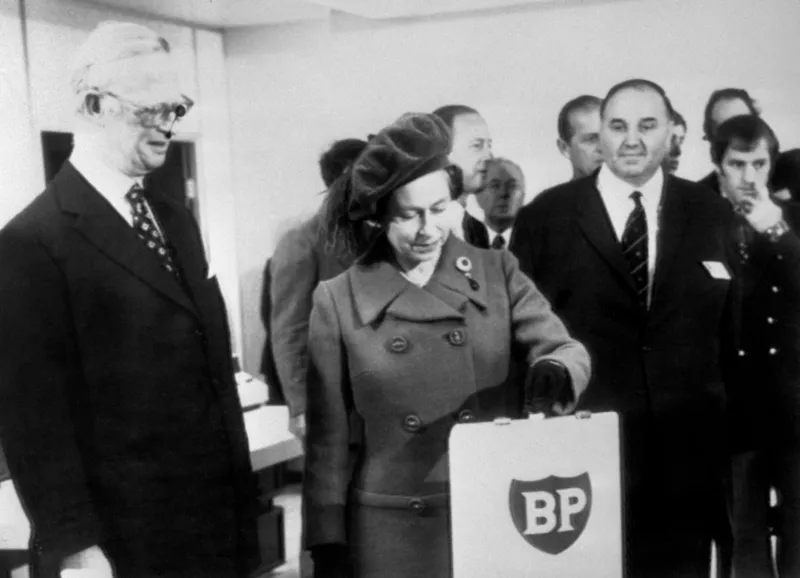
Queen Elizabeth inaugurated Forties field production.
Marking the Forties field’s half-century, the current operator Apache said it stood as a testament to Scottish grit, industrial excellence, and enduring human spirit.
In November 2024 Apache said it had suspended new drilling and would end all its operations in the North Sea by 2029. ☹
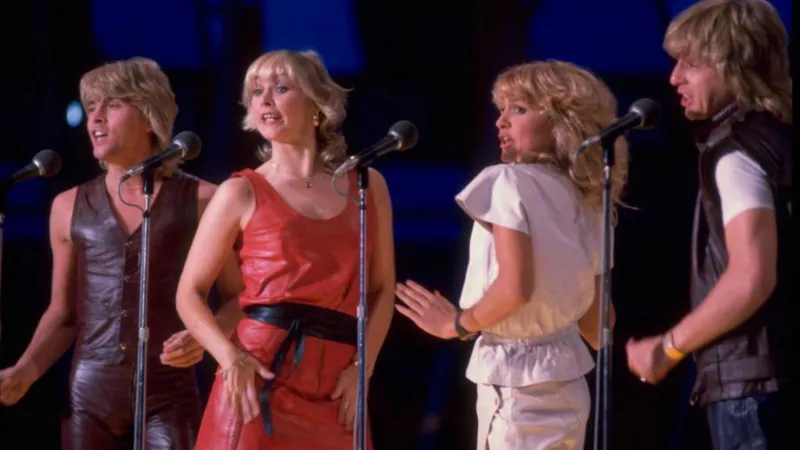
Bucks Fizz performed on a Forties field platform in the 1980s
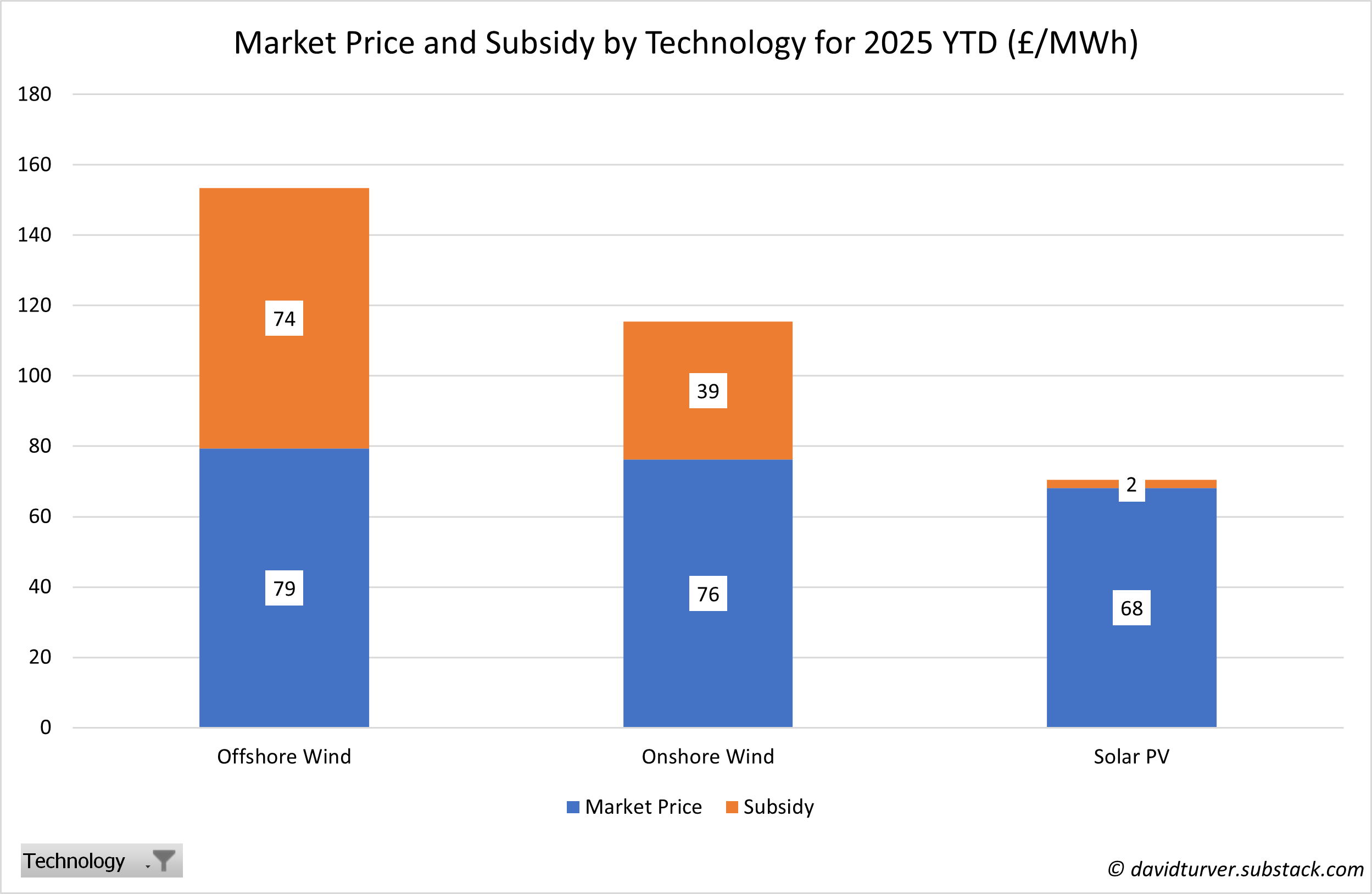
JL Daeschler informs that UK offshore wind energy is 82% foreign-owned. Foreign companies are thus the primary beneficiaries of the UK’s generous renewable energy subsidies (chart below).
“We have been warning for some time that it is crazy for a developed economy to try and run its electricity generation system using technologies that are dependent on the weather. Even though there has been only a relatively modest decline in wind output this year, the operators and owners of wind farms are learning the hard way that it is very difficult to run a business that is at the mercy of the vagaries of the weather. Many of these companies are up to their eyeballs in debt. They better hope the wind blows hard this Autumn and Winter so they can collect higher subsidies, or they will be in real trouble.“
We have consistently raised concerns about decommissioning financial assurance for offshore wind facilities. Turner echoes those concerns noting that the wind industry’s “perilous finances are an even bigger reason to insist that proper funds are set aside to fund decommissioning or the long-suffering taxpayer will be on the hook for another hidden cost of renewables.“
To the planners behind the scenes in Glasgow, Edinburgh, and London who draw borders with maps but never set foot on the land they destroy.
To the investors who calculate profit and pretend it’s about the planet.
And it’s addressed to all who love Scotland, to those who still believe that the Highlands are sacred ground, that wilderness is not a void, but the pulse of something ancient and irreplaceable.
To those who once walked through moorland and silence and felt that rare sense of belonging to something pure.
And to those who now see it slipping away, amidst noise, steel, and greed.
Let’s stand together for what we love! Before it’s too late!
Beyond the Kyle of Sutherland the heart of the Highlands is being remade not by nature, but by contracts, cables, cranes, and lots and lots of money!
For example: In Invershin and Golspie they plan to house 400 workers, 150 here, 250 there, for five years of construction, working around the clock. (As in numerous other places in Scotland)
Diesel trucks will thunder down our single-track roads,shaking cottages and scaring sheep.
Quiet valleys will become supply corridors.
The night will be lit by headlights and engines.
And when they’re finished, silence will not return, because the monster turbines will remain, and with them, endless power lines will be built in the name of the price of progress.
They will stand like giant steel soldiers, an eternal monument to power and greed in the middle of our once pristine nature!
From Spittal to Beauly, a high-voltage line will soon run through the heart and soul of the North, right through forests, moors, and nesting grounds.
They call it a necessary connection. But why?
Because they produce more than they can transport! Because their greed is limitless!
To make a profit, to export, to a faraway market.
This isn’t about clean energy for Scotland.
It’s about feeding the industrial grid, at the expense of our ecosystems, our wildlife, our peace.
The osprey, the golden eagle, the bats that hunt over rivers, all will suffer from what you call development in the name of progress.
Migratory birds will collide with turbines taller than our churches.
Red deer will lose their habitat.
The once living soil will be buried under concrete.
What they will take from us
They will drain the peat bogs our greatest natural carbon stores, and turn them from the lungs of the Highlands into scars.
They will clear forests for turbine foundations and access roads.
Thousands of trees will fall in the name of green energy!
They will carve paths through river valleys where salmon once leaped and otters played.
They will pour thousands of tons of concrete into living soil.
And if you call it green energy I ask:
How green is a forest without trees?
How clean is a wind that smells of diesel?
The Death of the Dark Night
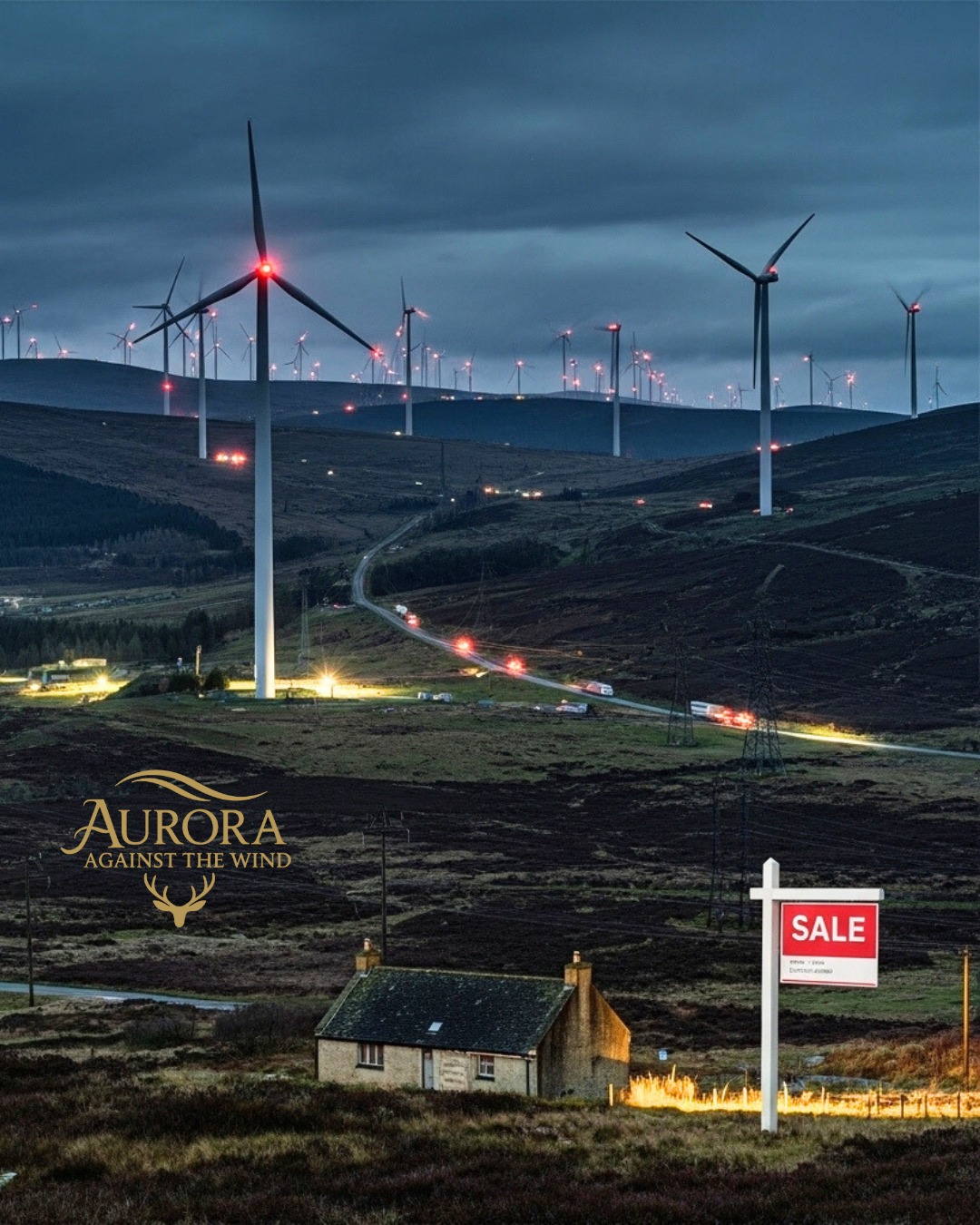
They will fill our skies with red, flashing lights,visible for miles!
A constant warning, the cold heartbeat of industry.
But for the creatures that live here,that light is death.
Bats are disoriented. Birds are drawn to their doom.
And for us, who once saw the aurora dance, it is deep sadness. It moves me to tears to think of what we will lose!
The Milky Way will disappear behind their towers.
The silence of darkness will be gone forever.
The darkness of old gives way to a constant blinking that neither man nor beast can rest.
Their promise of green jobs for us who live here—all false!
They bring contractors, workers, and convoys.
We locals are left with rising electricity prices, broken roads, and a never-ending hum. Radiation pollution day and night! Sound waves are our constant companions! Our houses are rapidly plummeting in price and becoming unsellable!
Instead of Highland idyll, construction noise!
The people of the Highlands are experiencing industrial colonization disguised as green energy. Communities are shrinking while wind turbines are growing.
In the Kyle of Sutherland, there will soon be almost one turbine per inhabitant.
Imagine that: one person, one monster turbine!
A land once characterized by loneliness, now trimmed by rotor blades and power pylons—all climate-neutral, of course!
They call it renewable. But what is being renewed? The money is in their pockets!
An endless hunger for more, disguised as green miracle energy!
A question for the powerful
Do you know what it feels like to live under a sky that never sleeps?
To feel the hum of the power grid in your bones?
To lose the stars one by one and call it progress?
You don’t live here.
You don’t walk these hills in the rain.
You’ve never seen the mist dance or watched the owl fly in the dark night.
You don’t stand by the river at dusk and listen.
You don’t know the natural sounds of the night or the silence when everything is asleep!
You don’t know the starry sky, a wonder with millions of lights that guide your way. You don’t feel the magic when the Northern Lights dance and enchant everything around them.
You only listen to the voice of money.
But let me tell you!
Scotland is not your factory.
The Highlands are not your testing ground.
You cannot pave the North with steel and call it salvation.
You cannot blind the sky and call it clean.
Look up.
The blinking lights that you love so much are not progress.
It is the wilderness’s last breath.
And when the final aurora fades behind your towers, remember:
It was not nature that failed you.
It was you who failed it.
I will fight for every blade of grass and every tree to save the Highlands a piece of their soul!
A Voice from the Highlands, for all who still believe that beauty and silence are worth defending.
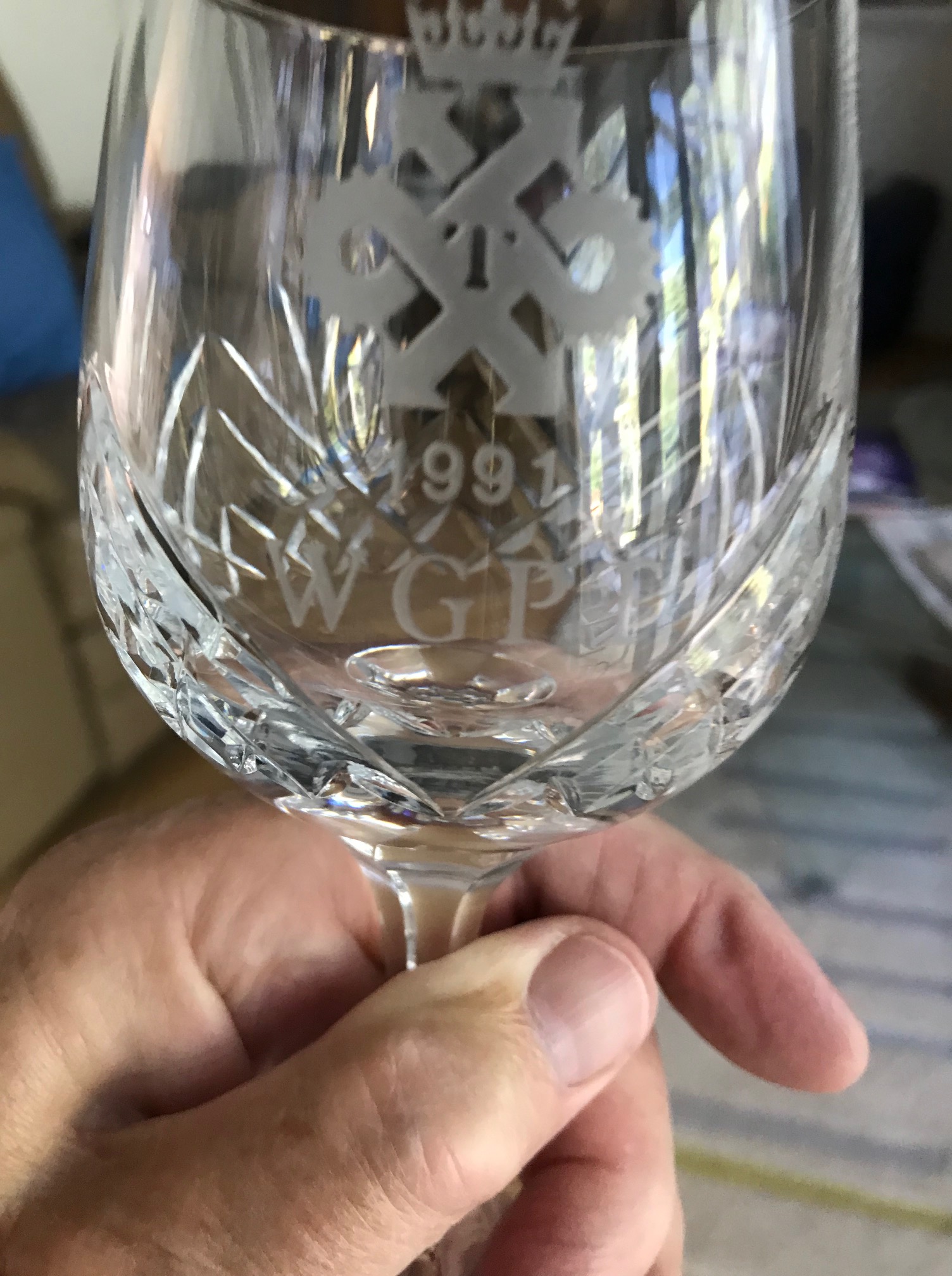
In 1991 Wood Group Production Technology (WGPT) received the Queen’s award for engineering innovation.
JL Daeschler, a pioneering subsea engineer who lives in Scotland, is saddened by the sale of the famous Wood Group engineering firm. After difficult financial losses, the Wood Group, headquartered in Aberdeen, has been sold at a cut-price to a Dubai based group.
Per JL: I knew Ian in the early North Sea development stage. He became Sir Ian Wood. We used to chat at various conferences in Houston, Stavanger, and Aberdeen. Ian was an energetic man, who had a friendly approach to our North Sea challenges. He was a true Aberdonian entrepreneur who employed 1000’s in offshore related disciplines worldwide. The crystal glass above was a gift by a University student I sponsored who later worked for the Wood group. In 1991 Wood Group Production Technology (WGPT) received the Queen’s award for engineering innovation. We worked closely on the development of down hole pressure censors and temperature gauges in the 1980’s.
JL reports that oil & gas is a hot subject in Scotland, but political commentary dwarfs technical discussion. To fix the economy, the govt should look at where people are struggling, and energy costs are their no. 1 concern.
While some politicians are belatedly vowing to maximize North Sea production, that will be difficult given the loss of operators, rigs, ships, installation and pipeline vessels, shipyards, and experienced workers. The infrastructure in Aberdeen is back to 1970 levels, and it’s difficult to build back what has been destroyed.
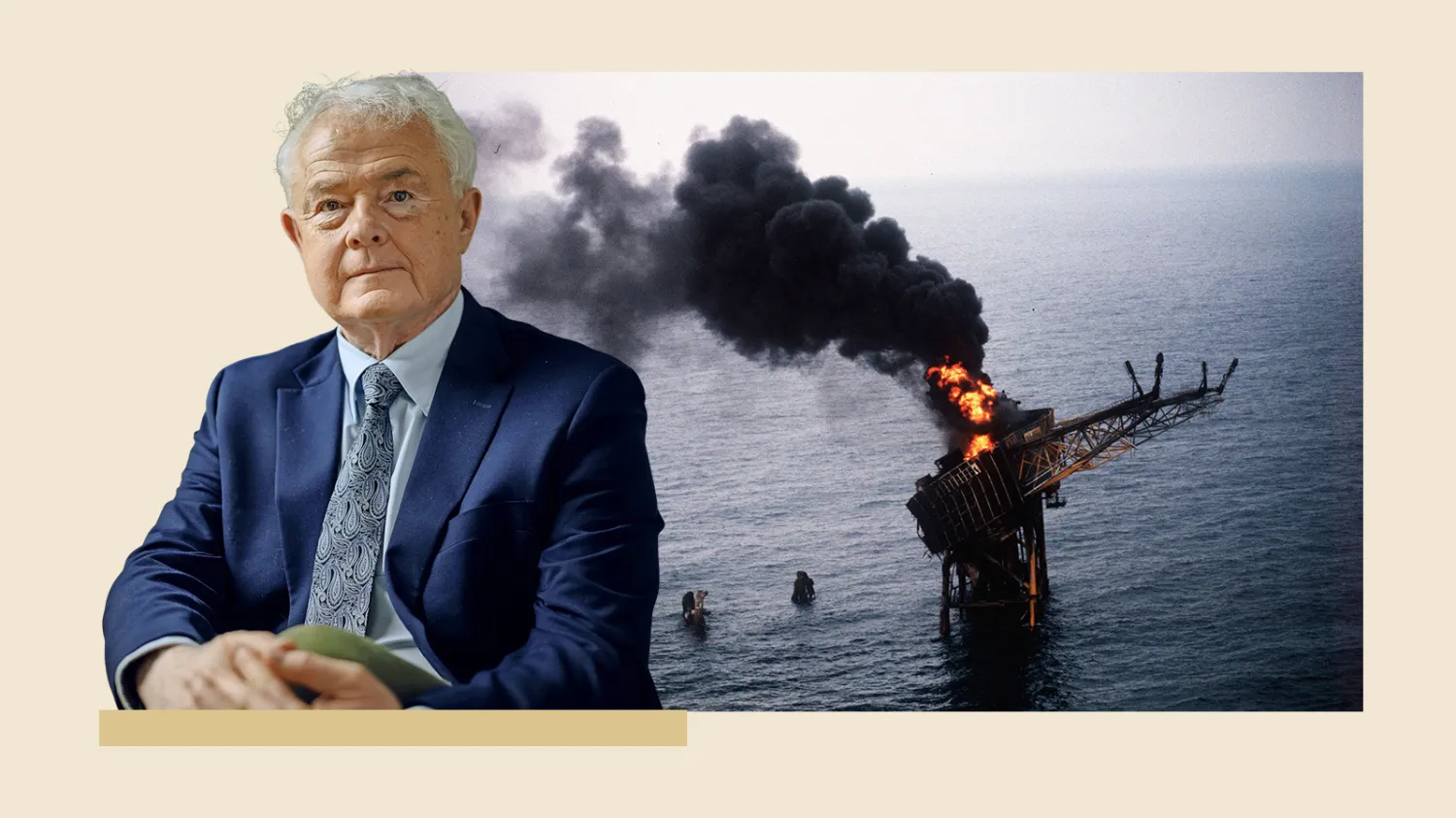
JL Daeschler shared a London Sunday Times piece about the Piper Alpha fire that killed 167 workers, the worst tragedy in the history of the offshore industry. We were troubled by the headline, because it seems inconceivable that any UK offshore worker could call July 6, 1988, the best day of their life. However, Punchard helped a number of workers escape the fire, so his mixed message is somewhat understandable.
Lord Cullen’s comprehensive inquiry into the Piper Alphatragedy challenged traditional thinking about regulation and how safety objectives could best be achieved, and was perhaps the most important report in the history of offshore oil and gas operations. That report and the US regulatory response to the tragedy are discussed in this post.
BSEE’s new downhole commingling rule, which responds to a Congressional mandate, is contrary to Cullen’s Safety Case principles in that it puts the burden of proof on the regulator to conclusively demonstrate that a potentially hazardous operation is unsafe.This is exactly the opposite of the approach recommended by Cullen. It’s also the first time in the history of the OCS program that Congress has dictated approval of complex downhole operations. More on this in a later post.
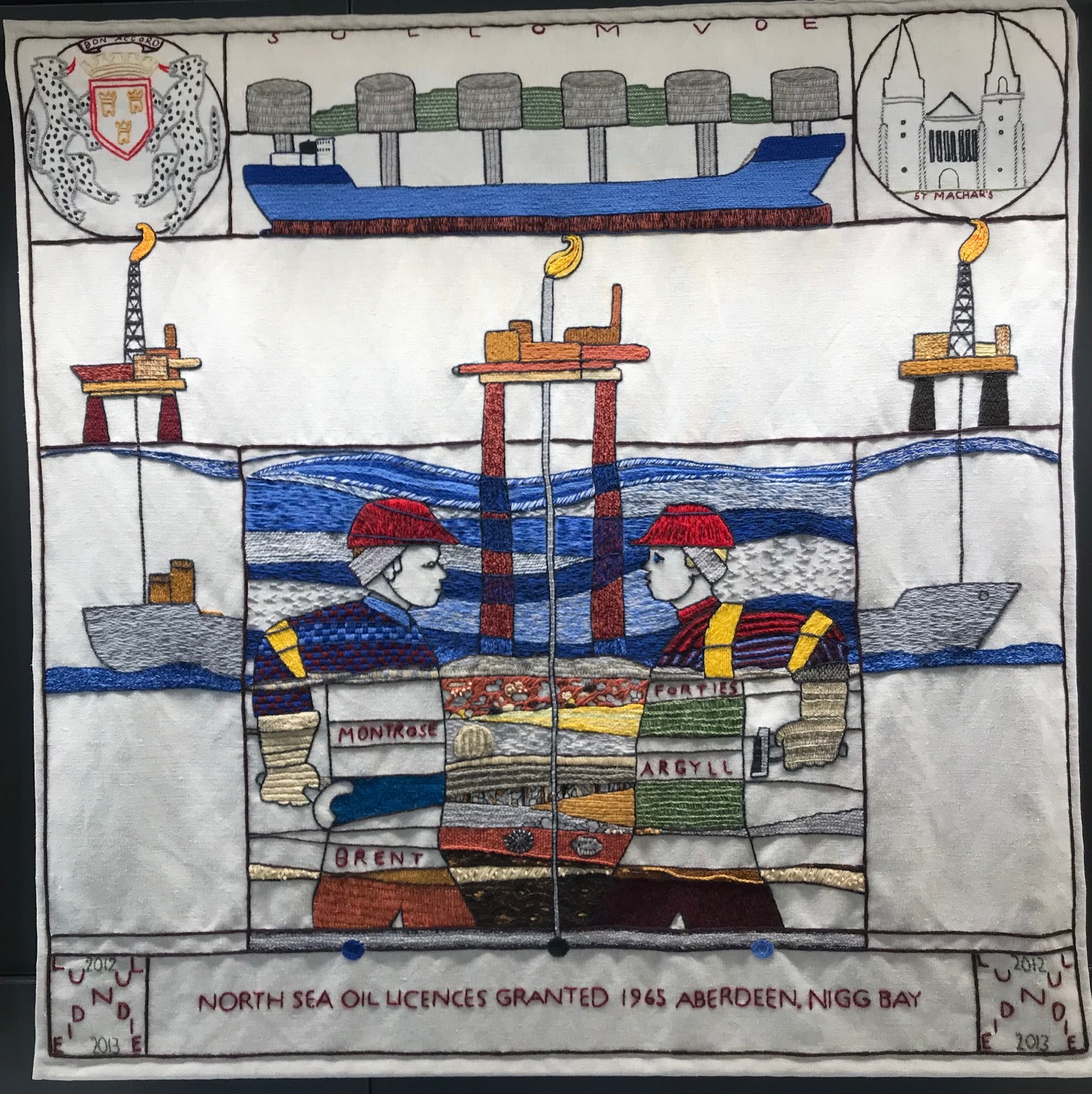
JL Daeschler, pioneering subsea engineer, artist, resident of Scotland, and BOE contributor, visited The Great Tapestry of Scotland exhibition in Galashiels. He shared this image of a tapestry tribute to North Sea workers.
JL reports that the Great Tapestry is 143 m long, and that more than 1000 people worked 50,000+ hours on the various historical panels!
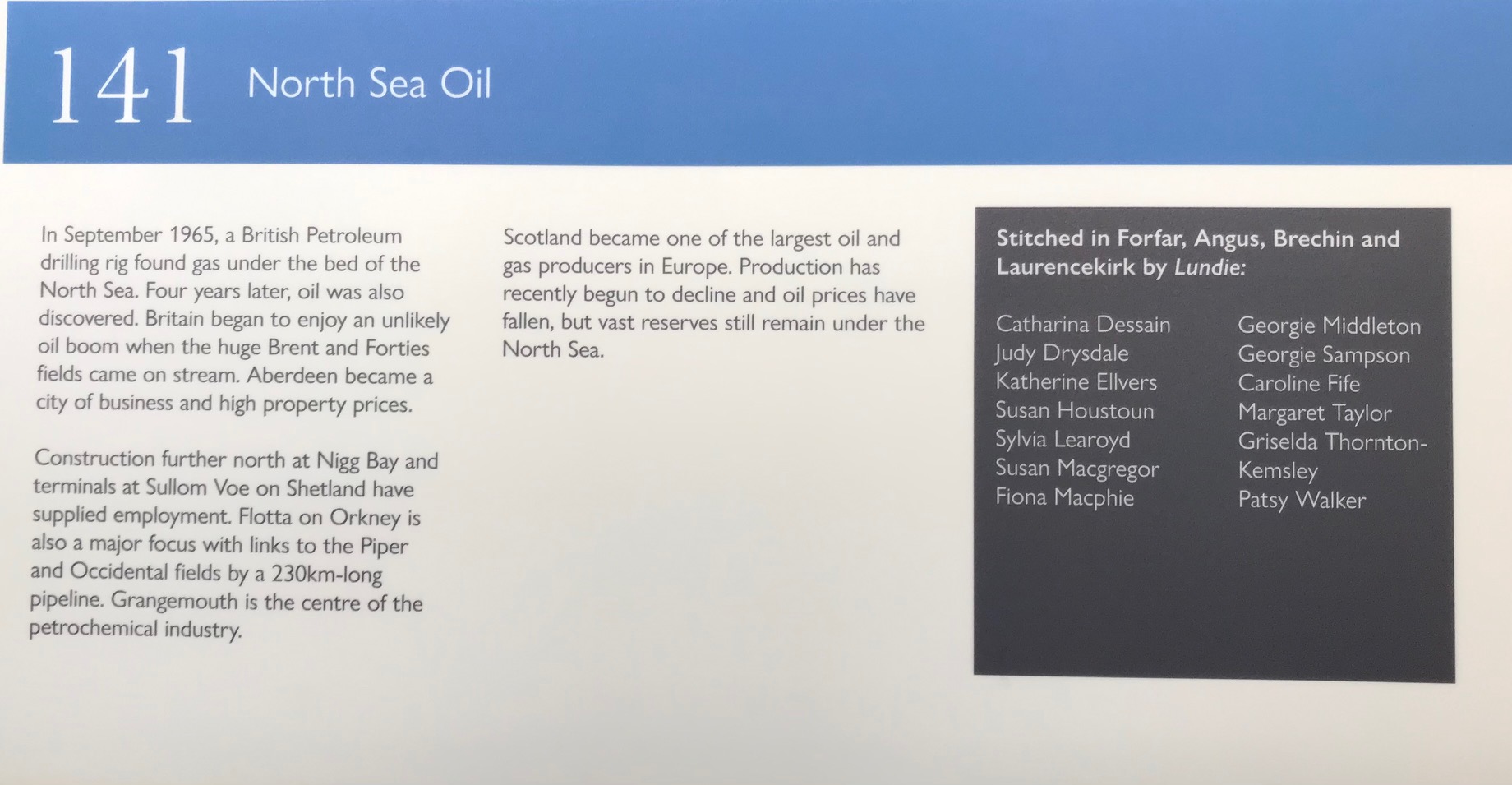
Beneath the North Sea oil panel is some historical information and the names of those who did the stitching:
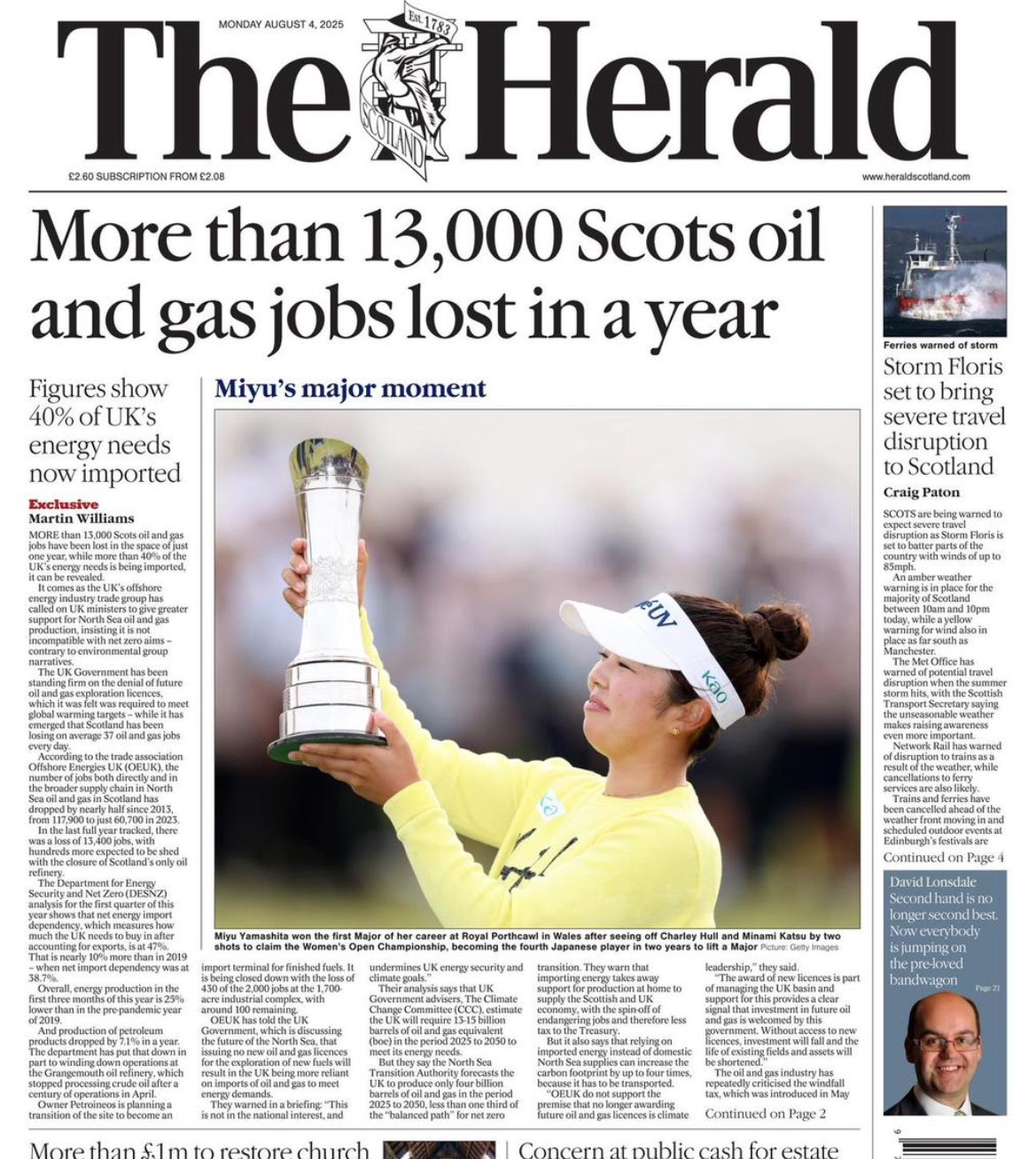
North Sea pioneer, JL Daeschler, reports from Scotland that “more than 13,000 Scots oil and gas jobs have been lost in the space of just one year while over 40% of the UK’s energy needs is being imported ….”
The UK’s self destructive energy policy, while sadly not unique, is particularly troubling because of the North Sea’s enormous contribution to the domestic economy over the past 50 years. As Gillian Bowditch aptly commented:
“We all want to protect our environment and Scotland, with its vast natural resources and expertise in energy, should be leading the way. Instead, we have squandered an opportunity in favour of a facile show of moral posturing.”
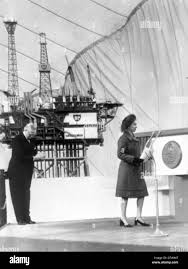
Argyll first productionQueen Elizabeth inaugurates the Forties fieldQueen Elizabeth: a day of “outstanding significance in the history of the United Kingdom” and a “critical milestone in the development of our energy resources.”
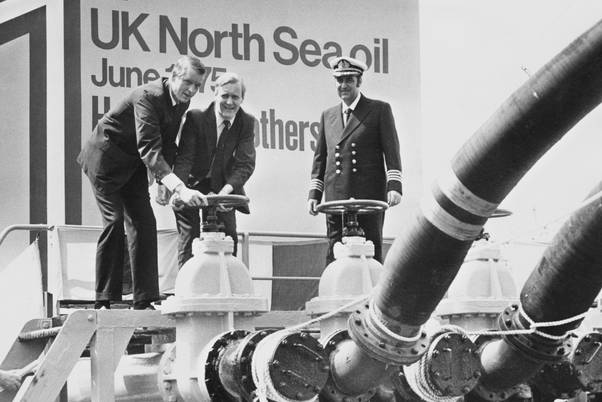
JL Daeschler recalls the inauguration of production at the Argyll field (18 June 1975) and Forties field (3 Nov 1975):
While some were bitter that Hamilton Brothers, a company owned by 2 brothers from Denver, was able to start production before British giant BP, there was never a race between the companies.
Instead there was a broad industry effort to initiate production during a financial crisis.
All operators exercized caution. We learned slowly with safety in mind. There was a great transfer of knowledge between operators small and big.
BP’s Forties field was a major achievement – designed for 400,000 bopd. 240 miles of 36″ pipeline were required (110 miles offshore and 130 miles onshore). The biggest delay was associated with the pipeline system, not the platform or wells.
The Hamilton Brothers Argyll field project (30,000 bopd) was not comparable in magnitude, requiring only a few wells and short infield flowlines.
The inauguration of Argyll (photo above) was with the UK Energy Minister, Ferris and Fred Hamilton, and a Greek tanker captain. There was minimal promotion and PR followup.
Contrast that with the Forties inauguration (photo above), a big event featuring Queen Elizabeth!
 What they will take from us
 The Death of the Dark Night