Approximately 2 miles south of Port Fourchon which took a direct hit from Ida. (Appears that the pipeline is in Louisiana State waters).
Water depth = 34′
Talos funding spill response, although the company said it was not their pipeline
Leak has slowed significantly; apparently production is not entering the line and the spill is limited to pipeline inventory
This type of incident is not surprising given the magnitude and track of Ida and the pipeline infrastructure that was exposed to major hurricane conditions
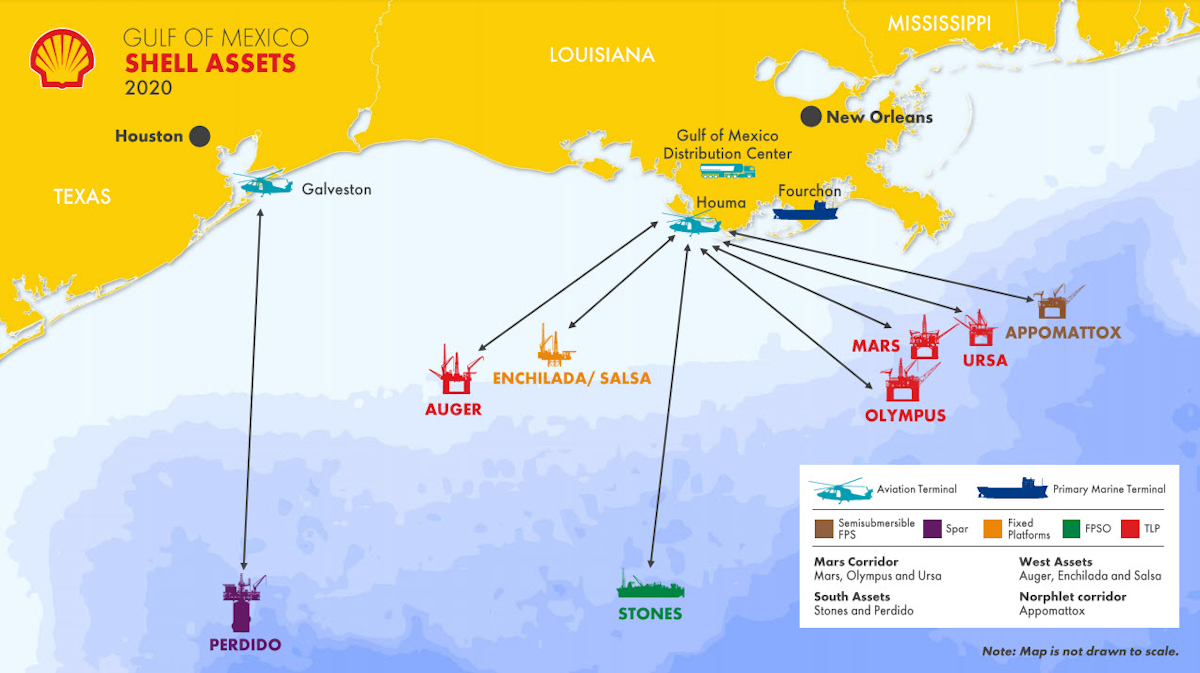
Shell Offshore Inc. (Shell), a subsidiary of Royal Dutch Shell plc, conducted an initial flyover of our assets in the path of Hurricane Ida. During this initial flight, we observed damage to our West Delta-143 (WD-143) offshore facilities. When it is safe to do so, we will send personnel offshore to provide a closer inspection of these facilities to understand the full extent of the damage and the degree to which our production in the Gulf of Mexico will likely be impacted.
This is a very significant report given the importance of the WD 143 platform in transferring all production from Shell facilities in the “Mars corridor.” These facilities include the Mars, Olympus, and Ursa platforms.
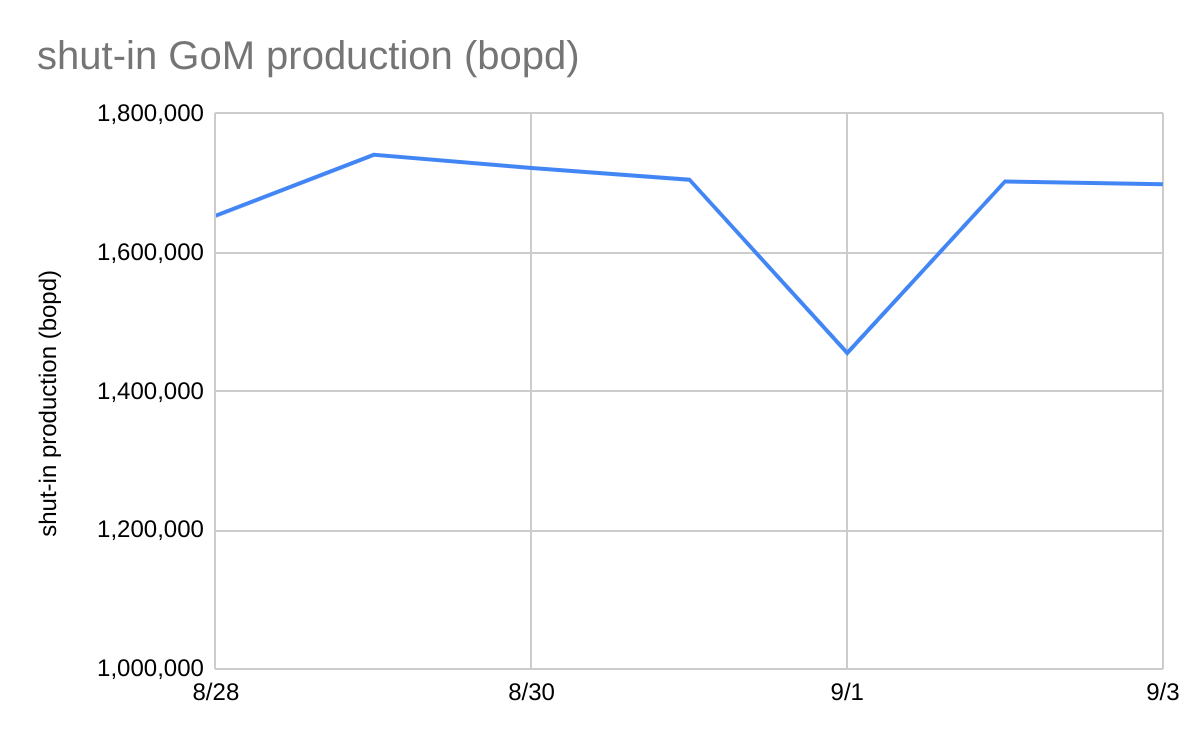
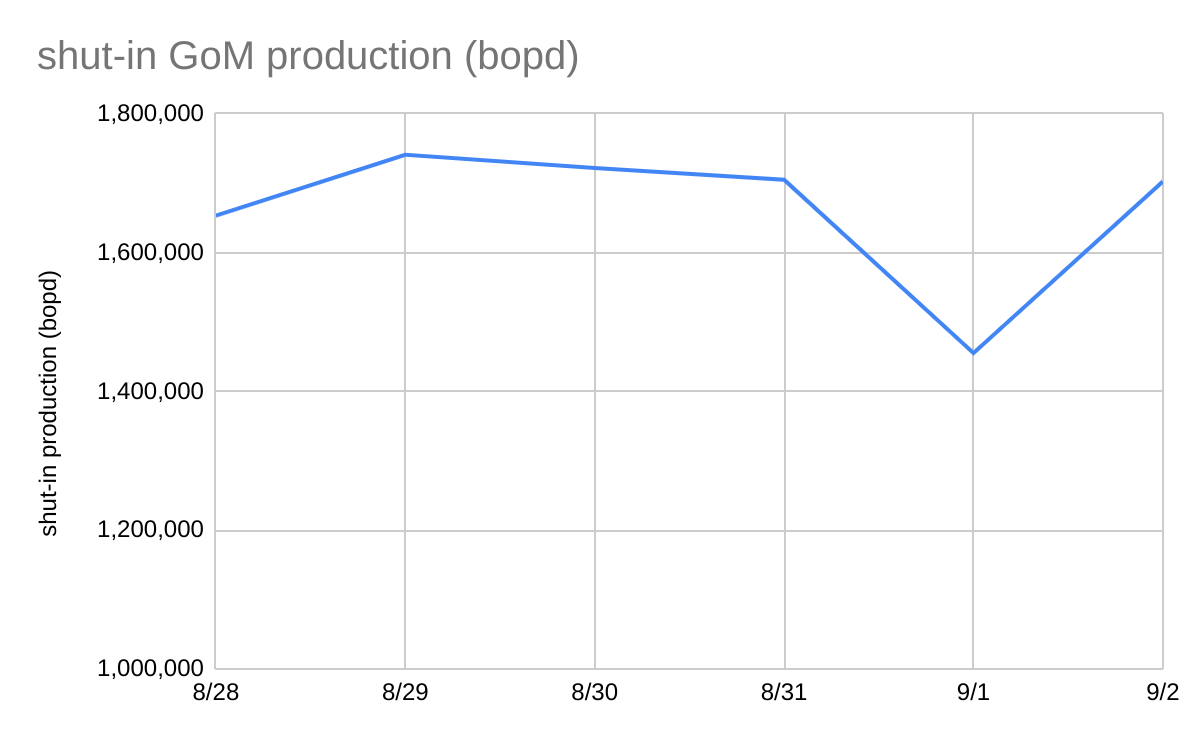
In a bit of a surprise, the volume of shut-in GoM oil production rebounded to more than 1.7 million BOPD (see BSEE’s 9/2 update). Because several deepwater platforms had reportedly resumed production, the sharp increase in shut-in volumes could have something to do with downstream facility damage or bottlenecks. The daily Ida shut-in volumes are plotted below.
Presumably, most of the restored GoM production is from platforms like Exxon Hoover that were not subjected to hurricane conditions. Per BSEE, the total oil production shut-in as of 9/1 is 1,455,279.
The latest EIA production report for June 2021 has just been released and GoM oil production averaged 1.825 million BOPD.
In light of the ongoing litigation regarding the Department of the Interior’s “leasing pause,” DOI’s Record of Decision for Sale 257 is most encouraging. The viewpoints expressed in the two quotes below are fundamental to the future of the OCS Oil and Gas Program. Hopefully, all parties can put aside their differences and build upon these consensus views.
While offshore exploration and development cannot be made risk free, OCS oil- and gas-related activities can be conducted safely and responsibly with strong regulatory oversight and appropriate measures to protect human safety and the environment.
ROD, p. 5
The decision to hold Lease Sale 257 recognizes the role that GOM oil and gas resources play in addressing the Nation’s demand for domestic energy sources and fosters economic benefits, including employment, labor income, and tax revenues, which are highest in Gulf Coast States and also distributed widely across the United States. Revenues from offshore oil and gas lease sales support national conservation programs and coastal resiliency for applicable coastal states and political subdivisions under the Gulf of Mexico Energy Security Act of 2006.
Per BSEE’s 8/28 update, 90.84% of GoM oil production is reported to be shut-in. Given that there is some uncertainty in both the numerator (production shut-in) and the denominator (base production), there is a margin of error (~5%?) in that figure. The large discrepancy in the % of manned facilities evacuated (only 50) and % of oil production shut-in (90+) illustrates the dominance of deepwater facilities, mostly shut-in, in GoM oil production.
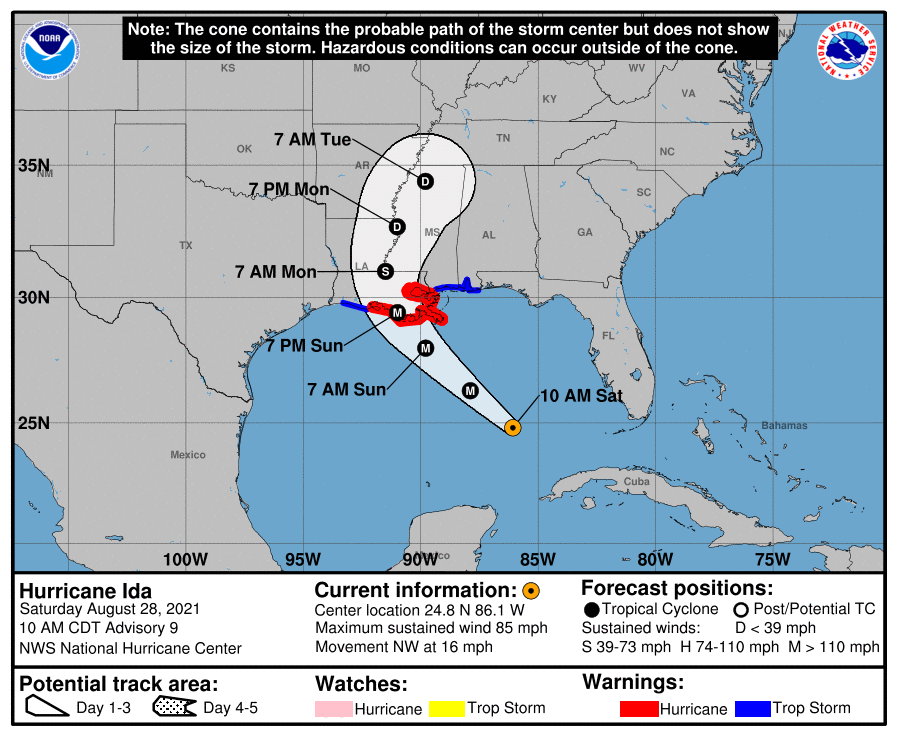
In light of the projected storm track for Ida, forecasting uncertainty, and the need to err on the side of caution in making evacuation and shut-in decisions, particularly for deepwater facilities, look for at least 75% of Gulf of Mexico oil production (approximately 1.3 million BOPD) to be shut-in temporarily.
In light of energy security and price considerations, rebounding oil demand, uncertainty about the long-term viability of non-conventional onshore production, and the elimination of most other offshore options, sustaining deepwater GoM production should be a high-priority U.S. policy objective. The deepwater GoM also offers significant environmental advantages in that approximately 1.6 million BOPD are produced from only 58 widely dispersed surface facilities that are well maintained, closely monitored and inspected, and distant from shore. Another advantage of US deepwater production is the low carbon intensity relative to other sources of petroleum (more on this in a later post).
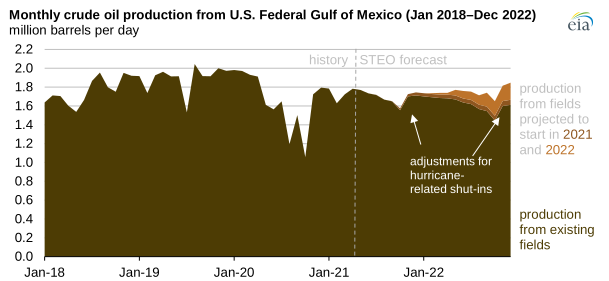
EIA (Chart 1) projects relatively stable GoM production over the next 2 years. Platt’s (Chart 2) is forecasting a slight decline in 2021 production primarily because of COVID-related delays in the initiation of production at Shell’s VIto and PowerNap and BP’s Mad Dog 2 and Thunder Horse South 2 facilities. Based on the latest available EIA data, current stabilized GoM oil production appears to be in the 1.7-1.8 million BOPD range.
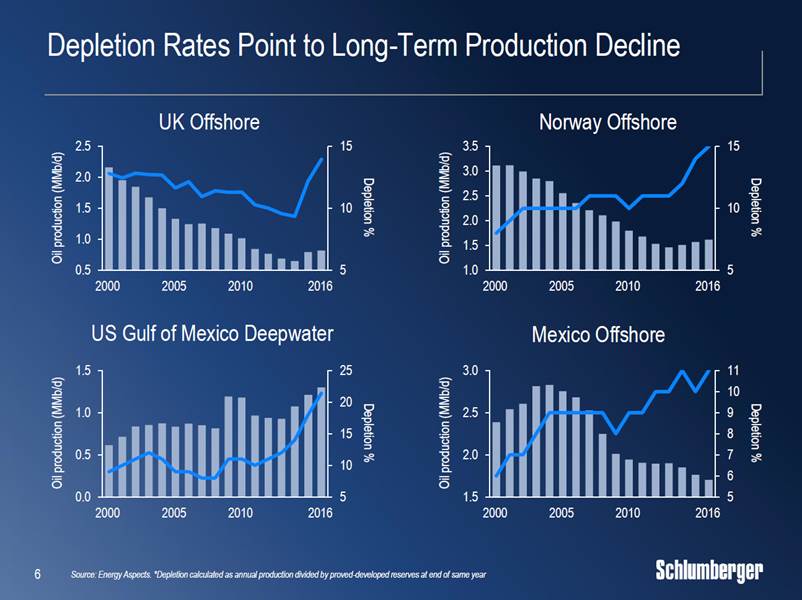
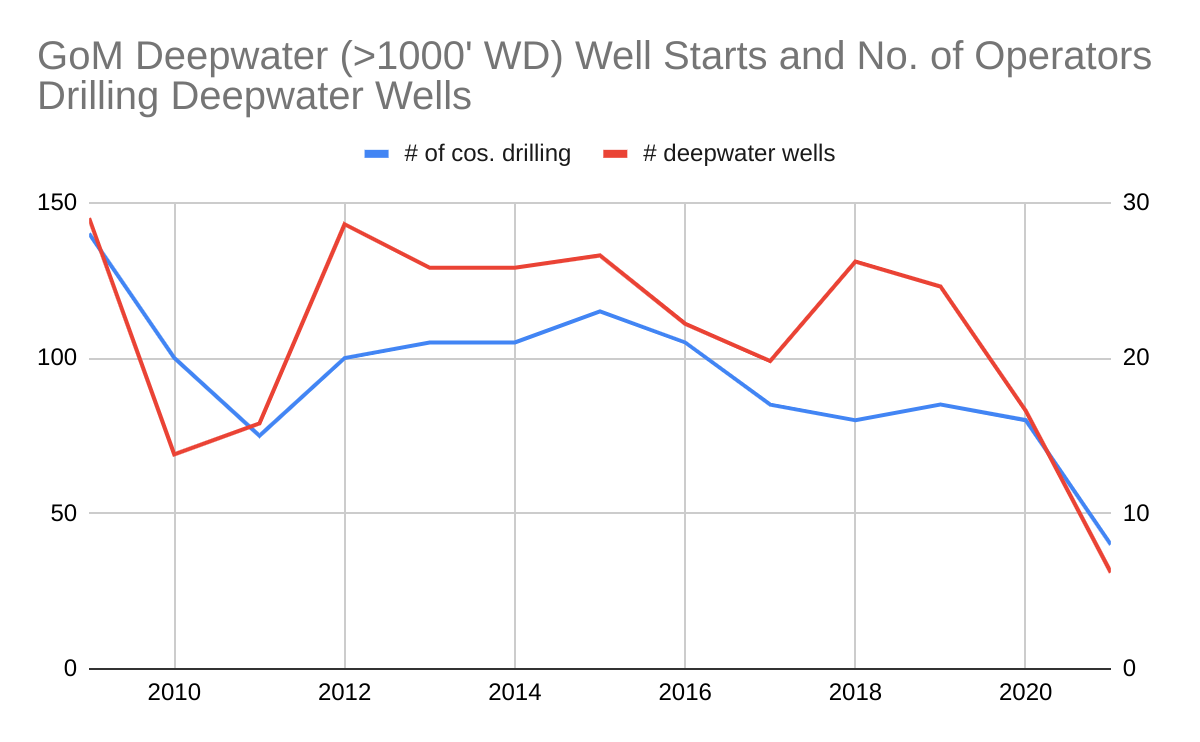
Going forward, the concern is the high rate of reserve depletion and the absence of drilling activity needed to replace reserves. Schlumberger data through 2016 (Chart 3) show depletion rates rising to above 20%, the highest (by far) of the offshore regions analyzed. I was unable to find more recent data, but unless this trend line has made a sharp turn, production declines are likely in the next 3-5 years. Further, drilling trends do not suggest the likelihood of significant reserve growth. Data from BSEE’s Borehole File (Chart 4) indicate deepwater well start activity that is comparable to the moratorium years of 2010 and 2011. Even more concerning is the absence of exploratory drilling (chart 5) and the very few operating companies that are drilling deepwater wells. Only five operators have spudded deepwater exploratory wells in 2021 YTD. One US supermajor hasn’t started a well since 2019, and another US major has essentially exited the Gulf.
Deepwater production trends are not easily reversed, so dialogue is urgently needed to assess the implications of declines in drilling, reserves, and industry interest. As the resource manager on behalf of the public, BOEM is the logical choice for initiating these discussions. BOEM’s Norwegian equivalent, the Norwegian Petroleum Directorate (NPD) demonstrates the importance of pro-active land management. The NPD has done an outstanding job of sustaining exploration activity and production consistent with Norwegian safety and environmental values, which are among the highest in the world. On their website, NPD provides ongoing updates on exploration, production, and reserve depletion parameters. Their competency and commitment to sustaining production on the Norwegian shelf is underscored in this news release, an excerpt from which is pasted below:
Exploration is of great importance for the long-term value creation on the shelf. The supply of oil and gas resources from new discoveries, as we have seen so far this year, is necessary so that activity in the petroleum industry does not fall sharply after 2030. Without new discoveries, production can fall by more than 70 percent in 2040 compared to 2020, says Torgeir Stordal, director of Technology and coexistence in the Norwegian Petroleum Directorate.
“Dubs” is a term used in Aberdeen and northeast Scotland to describe all varieties of mud. That is the first thing I learned in reading John Milne’s excellent book “DUBS, How the Oil Came North.” John’s first job in the offshore industry was with a drilling mud supplier back in 1969 when he was still a college student. John presents a series of amusing and informative anecdotes about hie work experiences between 1969 and 1973 during the early years of North Sea offshore exploration. The book is available through the publisher, PlashMill Press. Good read!
I also recommend Bjørn Vidar Lerøen’s excellent book “Drops of Black Gold,” which
chronicles the history of Statoil and Norwegian offshore oil and gas development. The book includes a now famous 1962 letter from Phillips Petroleum to the Norwegian government. In the letter, Phillips seeks exclusive rights to the entire Norwegian continental shelf in return for conducting a seismic survey program. Hey, nothing wrong with asking! 🙂





 Bud's Offshore Energy (BOE)