Feeds:
Posts
Comments

Archive for the ‘Gulf of Mexico’ Category

US Offshore Program:

Prior to April 20, 2010, 25,000 wells had been drilled in US Federal waters over the previous 25 years without a single well control fatality, an offshore safety record that was unprecedented in the U.S. and internationally. Well control was the keystone of every operator and drilling contractor’s safety program and the Minerals Management Service regulatory program, which included a pioneering well control research facility at LSU, standards, prescriptive rules, and comprehensive training requirements.

The future of the offshore program was bright. The Obama administration had included an Atlantic OCS lease sale in the 5-year OCS Oil and Gas Leasing Program for 2010-2015. This would have been the first Atlantic sale since 1983. I participated in a hearing held by a Florida Senate committee that was seriously considering oil and gas leasing in Florida State waters. Even in California, there was some support, led by a group known as Stop Oil Seeps, for new offshore exploration and production .

Everything changed on April 20, 2010, when BP’s Macondo well blew out. Eleven workers lost their lives, the most in a single US offshore incident since 1968, when 11 died in a fire and explosion at West Delta Block 23. In the history of the US offshore program, only a 1964 gas blowout (Eugene Island Block 273) caused more fatalities (22). (There were also tragic helicopter crashes in 1977 and 1984 at South Marsh Island Block 128 and Eugene Island Block 190 that killed 17 and 14 offshore workers respectively.) The Macondo blowout was more than a safety disaster, it was also a pollution spectacular that dominated the news for the next 3 months.

Pre-Macondo BP:

As is often the case with large organizations, the BP story is complex. BP said all the right things about safety and environmental protection, and seemed to mean them and practice them. They had comprehensive safety and risk management programs. They were at the vanguard in promoting personal safety among employees including the now common (and sometimes a bit contrived) practice of opening meetings with safety messages. All of that was no doubt consistent with their “beyond petroleum” rebranding (2002). However, the corporate image was badly tarnished by the 2005 Texas City refinery explosion that killed 15 workers and a 5000 barrel pipeline spill on the North Slope of Alaska in 2006.

BP’s deepwater Gulf of Mexico exploration programs had been very successful. BP produced more oil in the 2 years prior to the blowout than any other US offshore operator – 117 million barrels in 2008 and 188 million barrels in 2009. Their 2009 oil production total is still the highest in history for any US offshore operator (something I hadn’t realized until I checked the figures for this post.)

The compliance record for BP’s production facilities in 2008 and 2009 was “beyond” excellent. While BSEE does not publish the details needed to distinguish INCs by facility and operation, my recollection is that inspection of the thousands of components on their production platforms did not result in even a single incident of non-compliance (INC) in 2008, and there were no production safety or pollution incidents. BP was named a finalist for the MMS SAFE Award to be presented at OTC in May, 2009. However, pointing further to their corporate inconsistencies, BP’s drilling compliance record was not as good, and qualitative feedback from MMS inspection personnel indicated some safety and compliance issues. This input may have been a hint at the drilling program management issues that surfaced after the blowout. In light of these concerns about BP’s drilling operations, Devon Energy was presented the National SAFE Award in the “High Activity Operator” category.

I retired from MMS on 1/2/2010 and was thus not involved in the deliberations for the 2009 SAFE Awards. I understand that BP was the leading candidate to be presented the award in May 2010. However, the way the program worked was that finalists in each category were named in advance, but the winners were not announced until the awards luncheon. The reasons for this approach were to build suspense and avoid a situation where the winning company was involved in a significant incident prior to the presentation. This had never been an issue in the 30 year history of this awards program.

In light of the tragic events of April 20, the 2010 SAFE awards luncheon was cancelled, as it most definitely should have been. That said, I remain a strong believer in recognizing safety achievement. The MMS SAFE Awards were the only offshore safety awards determined by the safety regulator based on incident and compliance data and input from inspectors, the people who are most familiar with each company’s operations and the effectiveness of their safety programs. The awards program drew attention to best practices, information sharing, and safety leadership. The recipients and all staff that contributed to the company’s success were rightfully proud of their achievement. You could not nominate yourself or be nominated for SAFE awards; only the companies with the best safety and compliance records were considered. Past performance is never a guarantee of future success, but MMS SAFE Award winners earned the recognition they received and continued to be top performers.

Tomorrow: Macondo revisited, Part 3: The delayed cementing standard

Read Full Post »

This week I’ll be posting background information, new details, and personal opinions about the April 20, 2010 Macondo tragedy. As a prelude, I wanted to share this touching tribute to the 11 men who died on the Deepwater Horizon. These American heroes gave their lives exploring for energy to power our economy. The video is introduced by singer Trace Atkins, a former Gulf of Mexico rig worker.

Read Full Post »

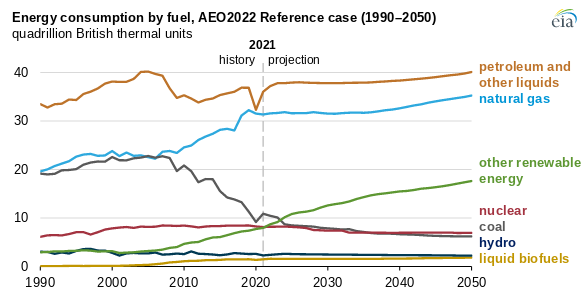
U.S. crude oil production in the forecast averages 12.0 million b/d in 2022, up 0.8 million b/d from 2021. We forecast production to increase another 0.9 million b/d in 2023 to average almost 13.0 million b/d, surpassing the previous annual average record of 12.3 million b/d set in 2019.

EIA

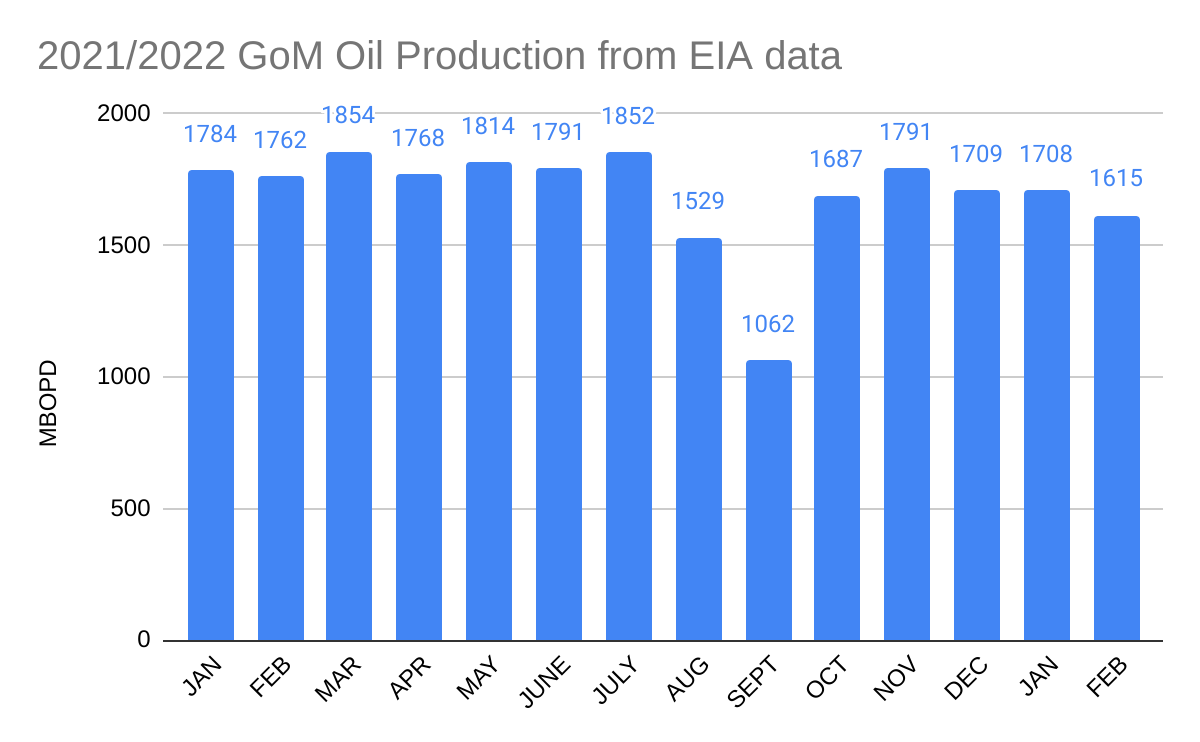
The short-term forecast doesn’t say how much of that production will come from the Gulf of Mexico. Last year, EIA forecast 2022 Gulf production to average 1.75 BOPD which seems about right based on the the most recent production data.

Read Full Post »

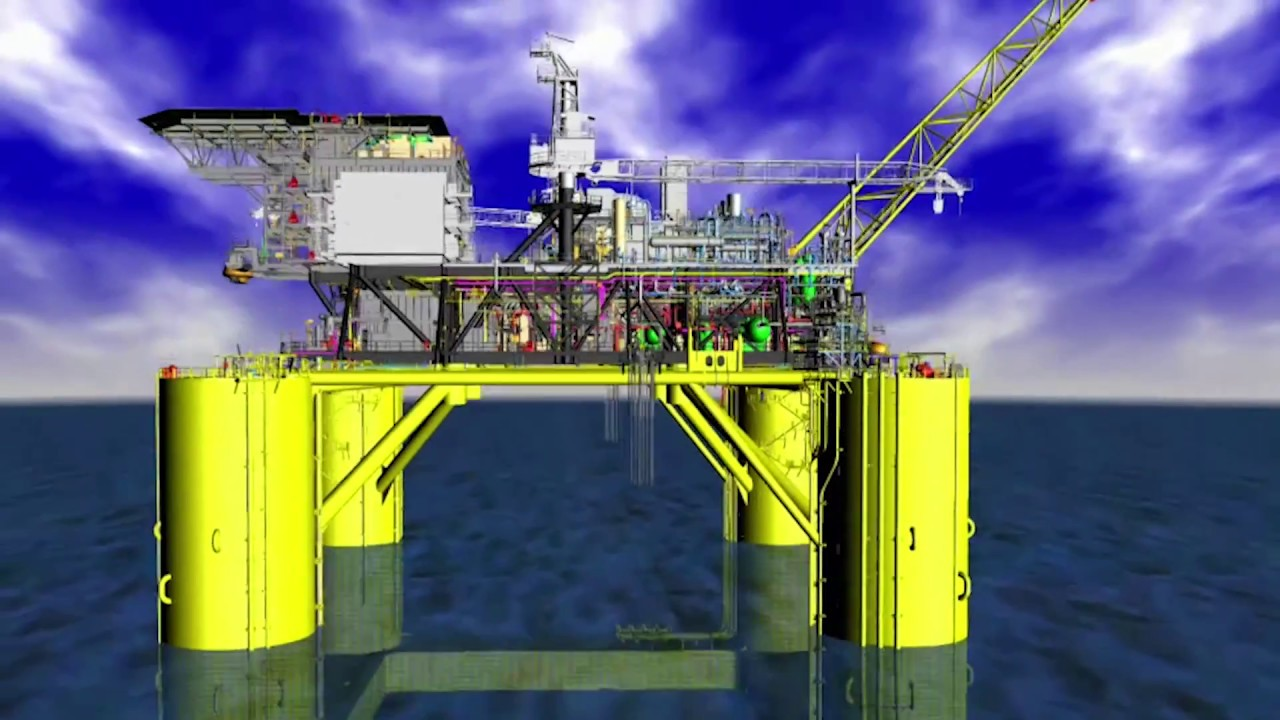
Murphy has announced first oil from the King’s Quay floating production unit in the Gulf of Mexico. The initial production rate has not been released, but the facility is expected to process up to 80,000 BOPD and 100 million cu ft of gas per day from subsea wells.

Murphy’s six partners all appear to be investment companies. This type of support is essential given the reduced Gulf of Mexico participation by some of the major oil companies. Ridgewood Energy has the largest stake among the Murphy partners. In the “old days,” the partners were typically other exploration and production companies.

Read Full Post »

These bills probably aren’t going anywhere at this time, but would help strengthen the integrity of the US offshore program. The bills are generally consistent with the views expressed by Senators Manchin (D-WV) and Kelly (D-AZ) in a letter to the President.

  • The Unleashing American Energy Act requires a minimum of two oil and gas lease sales to be held annually in available federal waters in the Central and Western Gulf of Mexico Planning Area, and in the Alaska Region of the Outer Continental Shelf.
  • The Securing American Energy and Investing in Resiliency Act requires the Department of the Interior to conduct all remaining offshore oil and gas lease sales in the current leasing plan and issue leases won as a result of Lease Sale 257.
  • The Strategy to Secure Offshore Energy Act requires the publications of the 2022-27 plan for offshore oil and gas lease sales by the time the current plan expires on June 30, 2022.

Read Full Post »

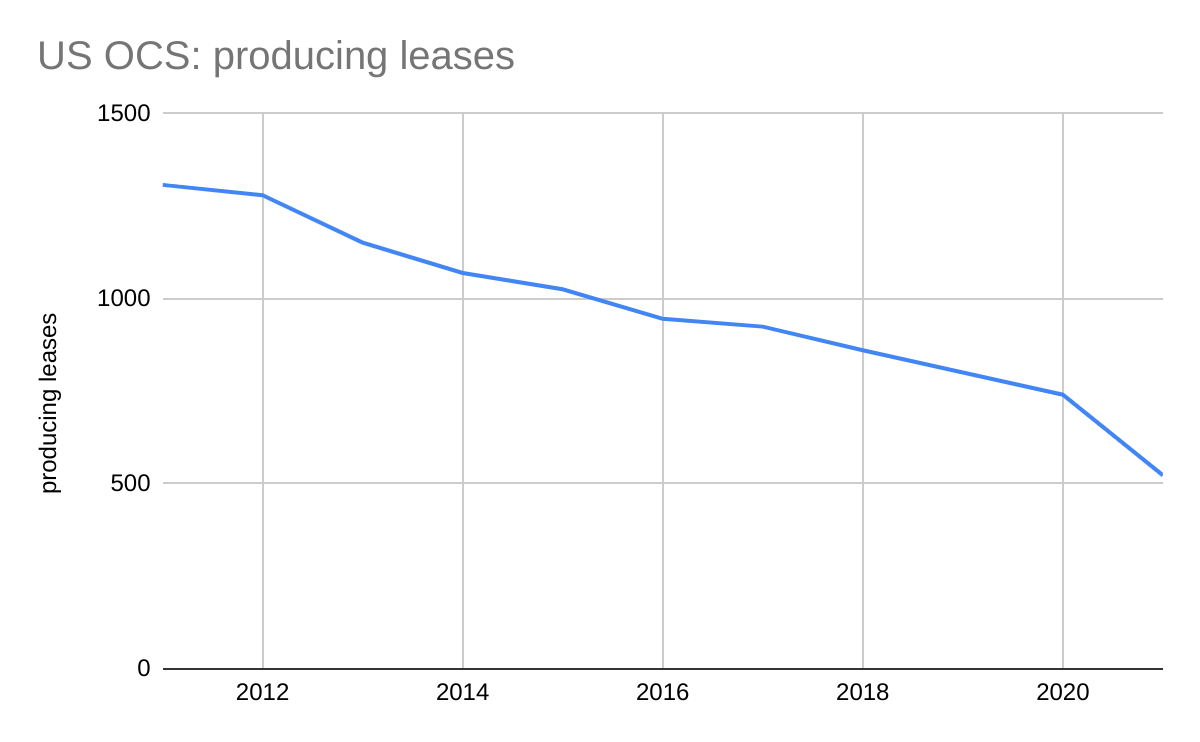
Deepwater production is noteworthy for widely dispersed surface structures supplemented with subsea systems. In the past 30 years, the total number of Gulf of Mexico platforms declined by 50% while the oil production doubled. Of course, this level of production is not sustainable without regular lease sales and increased exploration. In that regard, the signs are not good.

435 GoM shelf platforms have been removed in just the last 5 years (2017-2021). The loss of platforms is accompanied by a loss of marine habitat that the rigs-to-reefs program has partially compensated for. There have been a number of other interesting proposals for the use of old platforms, some more serious than others.

Current number of Gulf of Mexico platforms by water depth:

water depthfloating and fixed production platforms
all depths1757
>400 m52
>1000 m35
>1500 m16
>2000 m7

Read Full Post »

Read Full Post »

Per BSEE’s online Incident of Non-Compliance (INC) data, 4 operating companies accounted for 64% of the INCs during Q1 of 2022 (see chart below). Fieldwood was once again cited for the most INCs (132), but GOM Shelf LLC had the highest INC/inspection ratio (1.53). All 55 of the Whitney Oil & Gas INCs resulted in Facility Shut-In orders. Whitney was cited for failing to comply with damage inspection and records requirements following Hurricane Ida.

The overall violations rate during Q1 of 2022 was essentially unchanged from 2021. A number of companies had outstanding records. We’ll comment on them later in the year.

Read Full Post »

BSEE data

With regard to shelf drilling activity (<1000′ water depth), a total of 55 wells were started in 2021 and 2022 (first quarter). Only 2 of these wells, both by Walter Oil and Gas, were classified as exploratory. The most active drillers (by far) were Arena Offshore (30 well starts) and Cantium LLC (16 well starts). Ankor, EnVen, and Talos were the only other operators with drilling activity.

Reasons for concern:

Read Full Post »

500 days (and counting) since the last US offshore oil and gas lease sale. Abbreviated chronology:

Read Full Post »

« Newer Posts - Older Posts »