Feeds:
Posts
Comments

Archive for the ‘energy policy’ Category

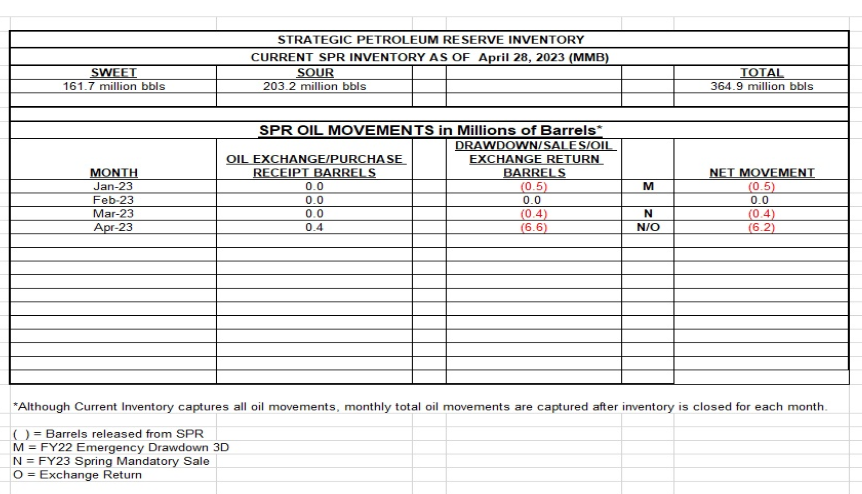
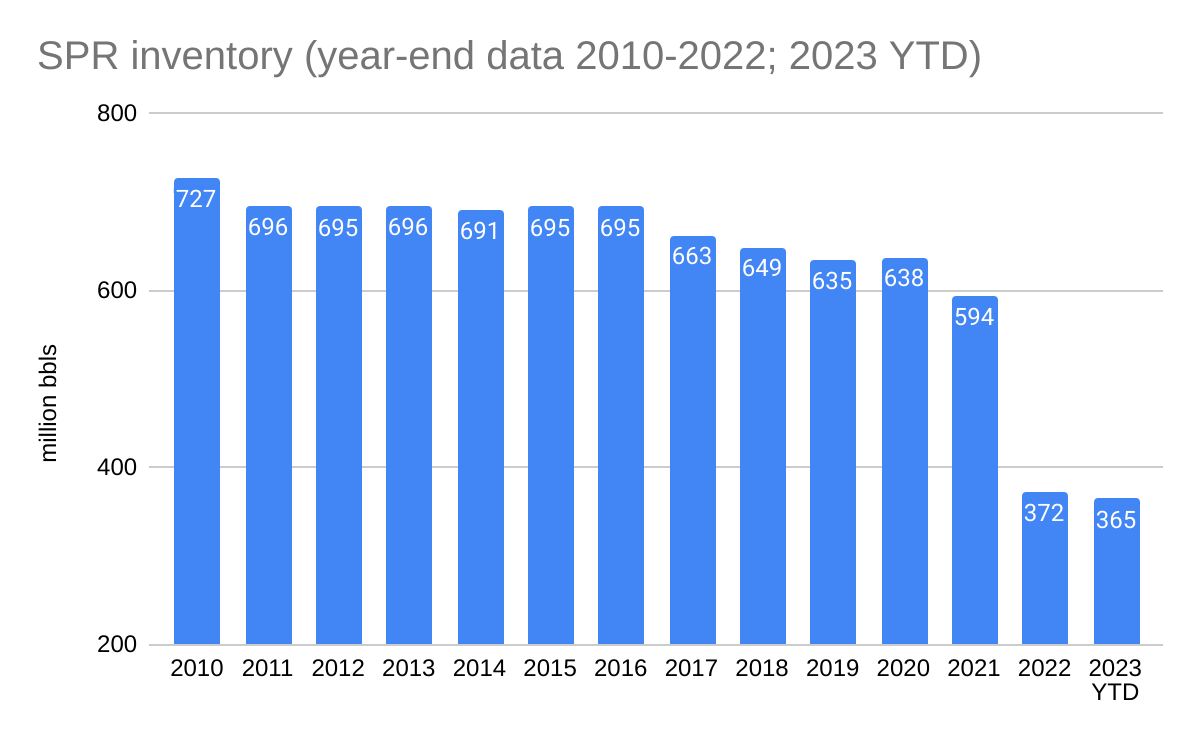
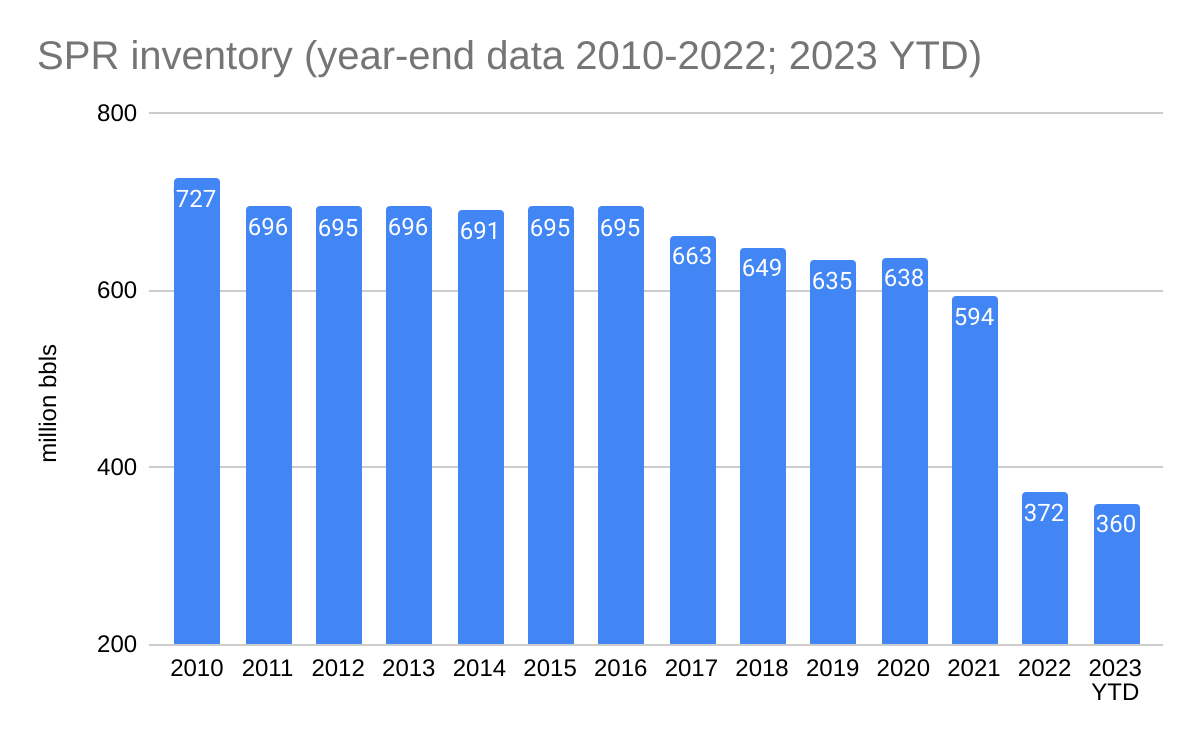
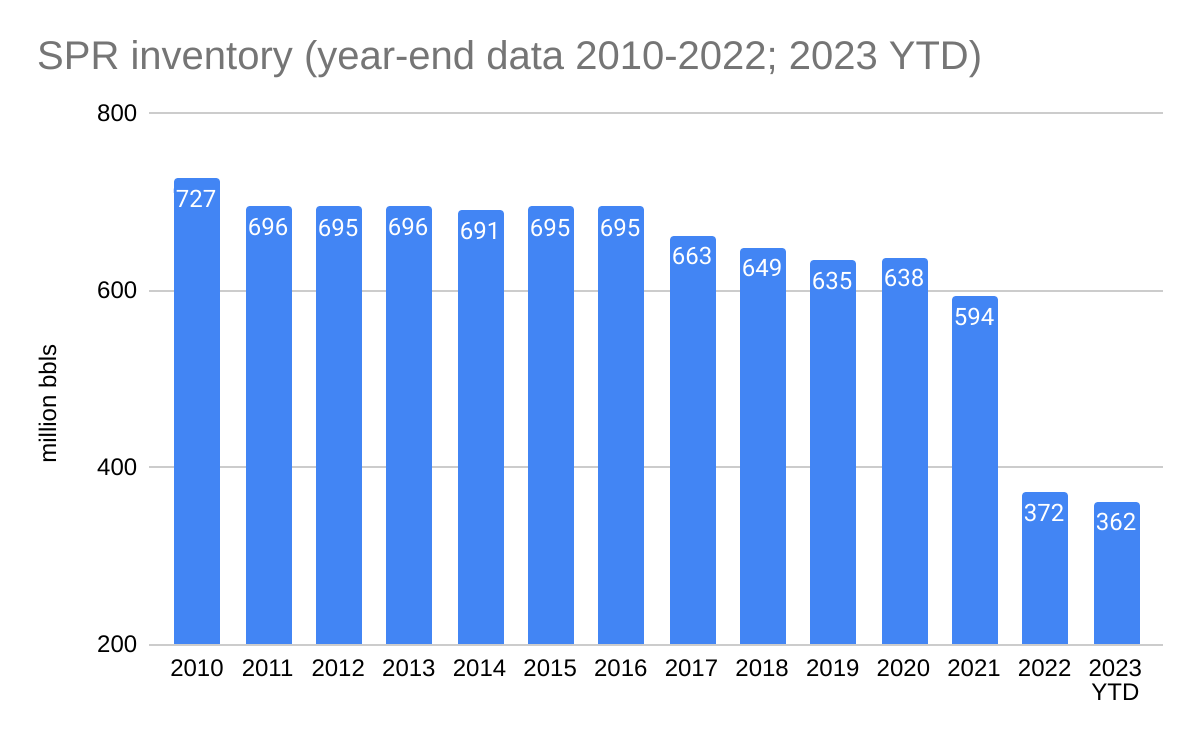
Per the latest update (5/12/2023), the Strategic Petroleum Reserve is down to 359.6 million barrels, more than 2 million bbls below the previous week. The “deficit” (i.e. the volume needed to completely refill the reserve) is now 367 million bbls, and you can’t print oil. The reserve volume is the lowest since 9/23/1983, when the SPR was still being filled.

Remember:

  • The maximum refill rate is 685,000 bopd. 
  • A complete refill at the maximum rate would require 536 days.
  • This excludes acquisition, operational, and maintenance delays, which are likely to be significant. 
  • Just adding 100 million barrels would require at least 146 days
  • Purchases of that magnitude significantly affect oil markets. Total US oil production is currently about 12 million bopd.
  • Filling the reserve to its 727 million barrel capacity was a 28 year process.

But fear not, DOE is soliciting the replacement of 0.1 to 1.0% of the oil that has been withdrawn from the SPR since January 2021. This amounts to only 2.5 to 25% of the oil sold from the reserve in 2023 alone (when we were supposedly refilling the reserve) and 0.04 to 0.4% of capacity!

DOE issued a solicitation May 15 for the oil, with delivery to occur Aug. 1-31, at a minimum offer quantity of 300,000 bbl and a maximum offer of 3 million bbl. Requests for earlier deliveries will be accommodated to the extent possible on a best-efforts basis.

OGJ
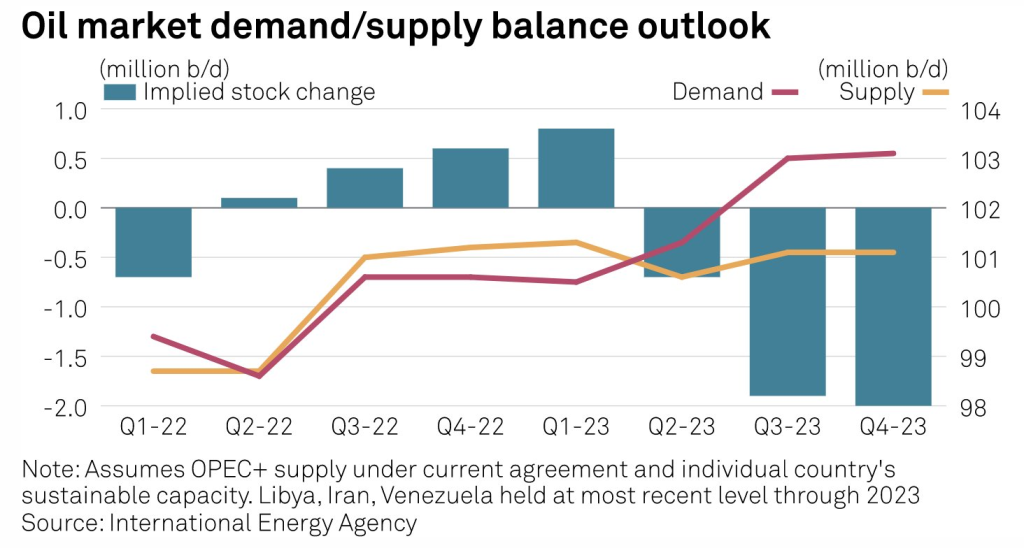
Meanwhile, oil demand and supply data do not look particularly favorable for any long term SPR purchases.
Read Full Post »

Per Bloomberg, DOE says they could begin refilling the reserve this fall “if the price is right.” What if it isn’t?

Keep in mind that the maximum refill rate is 685,000 bopd. A complete refill at the maximum rate would thus require 533 days, not counting acquisition, operational, and maintenance delays. Filling the reserve to its 727 million barrel capacity was a 28 year process.

Lastly, when will DOE conduct the strategic SPR review called for by the General Accountability Office (GAO) in 2018, well before DOE began rashly withdrawing oil to moderate prices? DOE concurred with GAO’s priority recommendation for periodic strategic reviews of the SPR that would be submitted to Congress. DOE told GAO that they “would complete a SPR Long-Term Strategic Review by the end of fiscal year 2021–5 years from the last review in 2016.” That review has still not been completed.

Update: Yesterday, members of Congress asked GAO to evaluate DOE’s management of the SPR and conduct an audit of the SPR modernization program.

Read Full Post »

Dr. Malcolm Sharples, a leading marine engineer and offshore safety advocate, brought this Supreme Court’s decision and the resulting regulatory confusion to my attention.

It turns out that the SOCTUS decision about this houseboat…..

has created regulatory uncertainty for floating production facilities like this:

In a 7-2 decision, the court ruled that a gray, two-story home that its owner said was permanently moored to a Riviera Beach, Florida, marina was not a vessel, depriving the city of power under U.S. maritime law to seize and destroy it.

Reuters

The floating production facilities are still subject to Coast Guard regulation and inspection pursuant to separate authority under the OCS Lands Act. The extent to which Coast Guard approval and inspection practices will change is not entirely clear. The Coast Guard will issue new certificates of inspection for these floating facilities, and new policy guidance is being developed.

Attached are answers that the Coast Guard provided to questions from the Offshore Operators Committee.

This may be a good warmup for an upcoming post on regulatory fragmentation.

Read Full Post »

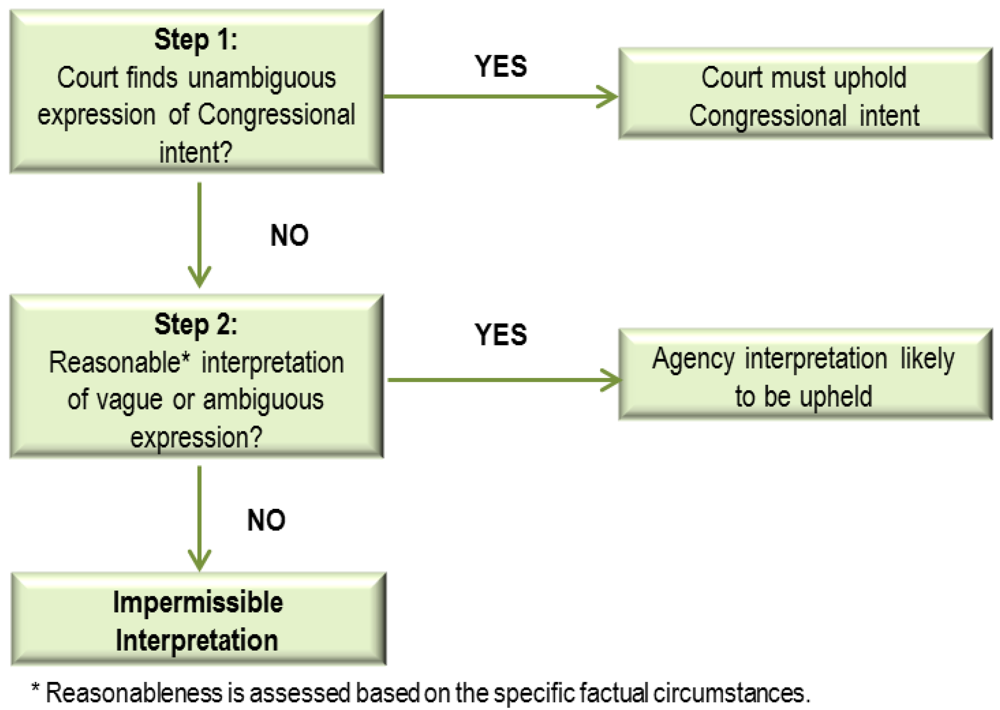
The Supreme Court will hear a case that could significantly scale back federal agencies’ authority, with implications for regulations affecting the US offshore program. The court could overturn a precedent known as the “Chevron doctrine” that instructs judges to defer to federal agencies when interpreting ambiguous federal laws.

Few Supreme Court doctrines have been stretched more by regulators and lower-court judges than Chevron deference, which says judges should defer to regulators’ interpretations when laws are supposedly ambiguous. The High Court agreed Monday to give Chevron a much-needed legal review.

WSJ

About the Chevron doctrine:

One of the most important principles in administrative law, the “Chevron deference” was coined after a landmark case, Chevron U.S.A., Inc. v. Natural Resources Defense Council, Inc., 468 U.S. 837 (1984). The Chevron deference is referring to the doctrine of judicial deference given to administrative actions. In Chevron, the Supreme Court set forth a legal test as to when the court should defer to the agency’s answer or interpretation, holding that such judicial deference is appropriate where the agency’s answer was not unreasonable, so long as Congress had not spoken directly to the precise issue at question. 

Cornell Law
Market Chess

Read Full Post »

More red ink.

Read Full Post »

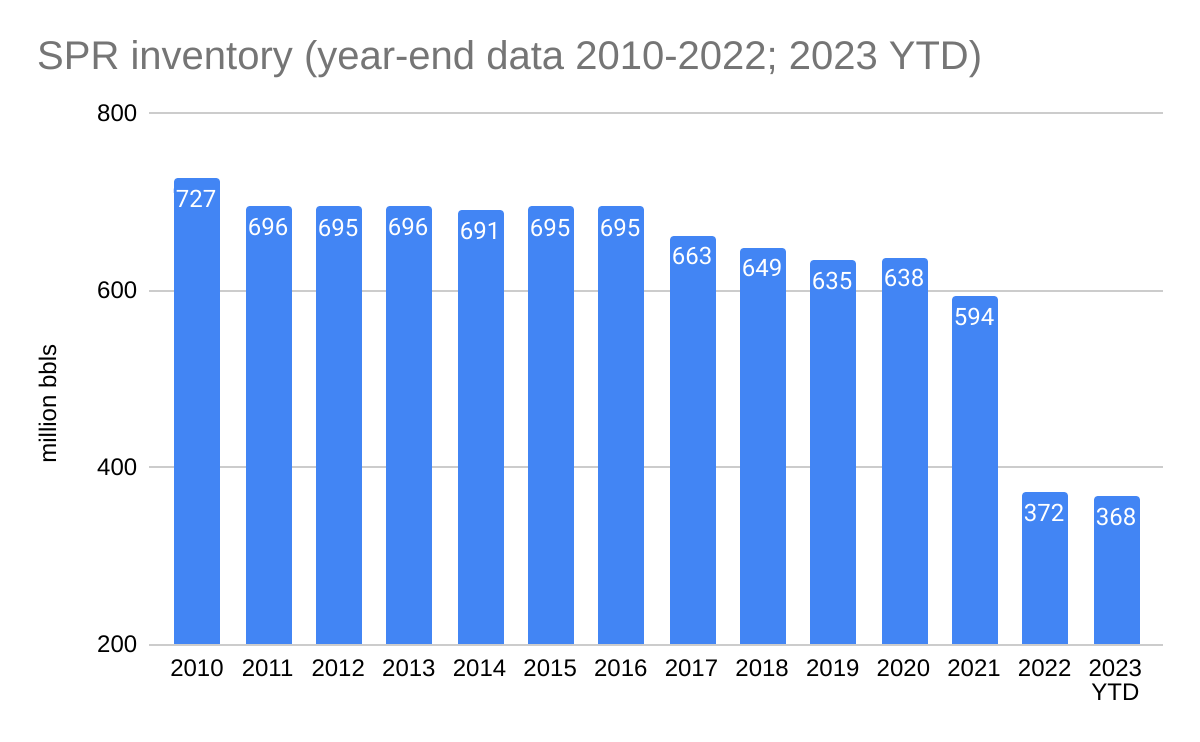
368 million barrels remain.

previous SPR udpate

Read Full Post »

  • Be grateful for energy production which gives us the economic means to address environmental issues
  • Appreciate the beauty and ecological significance of offshore facilities
  • Explore, study, and protect the marine environment
  • Strive for continuous improvement in safety and environmental performance
  • Acknowledge and learn from past mistakes
  • Live responsibly as individuals, families, and communities

Read Full Post »

This comment from Save LBI (Long Beach Island, NJ) on BOEM’s Renewable Energy Modernization Rule (proposed) highlights an important regulatory policy consideration:

Promoting the offshore wind program is a very high BOEM priority. The bureau is charged with deploying 30 gigawatts of offshore wind energy capacity by 2030, which requires extensive advocacy. However, BOEM is also a core regulator for offshore wind projects, and the concern is that their regulatory role could be compromised by their advocacy priorities.

Per Notice to Lessees 2023 N-01, which arguably should have been published for public comment given its regulatory significance, BOEM has retained important responsibilities for wind project development and operations. These include review and approval of construction and operations plans, site assessment plans, and general activities plans. BOEM may also exercise enforcement authority through the issuance of violation notices and the assessment of civil penalties.

BOEM exists because in 2010 the Administration wanted to separate the OCS program’s leasing (sales/advocacy) and safety (regulatory/enforcement) functions. The intent was to avoid conflicting missions (or the appearance thereof) in the post-Macondo era. (More on this in an upcoming post.)

Ironically, the Save LBI comment describes BSEE as “a distinct unit within BOEM.” That may seem to be the case, but BSEE is actually a separate bureau in the Department of the Interior.

Read Full Post »

A big step forward:

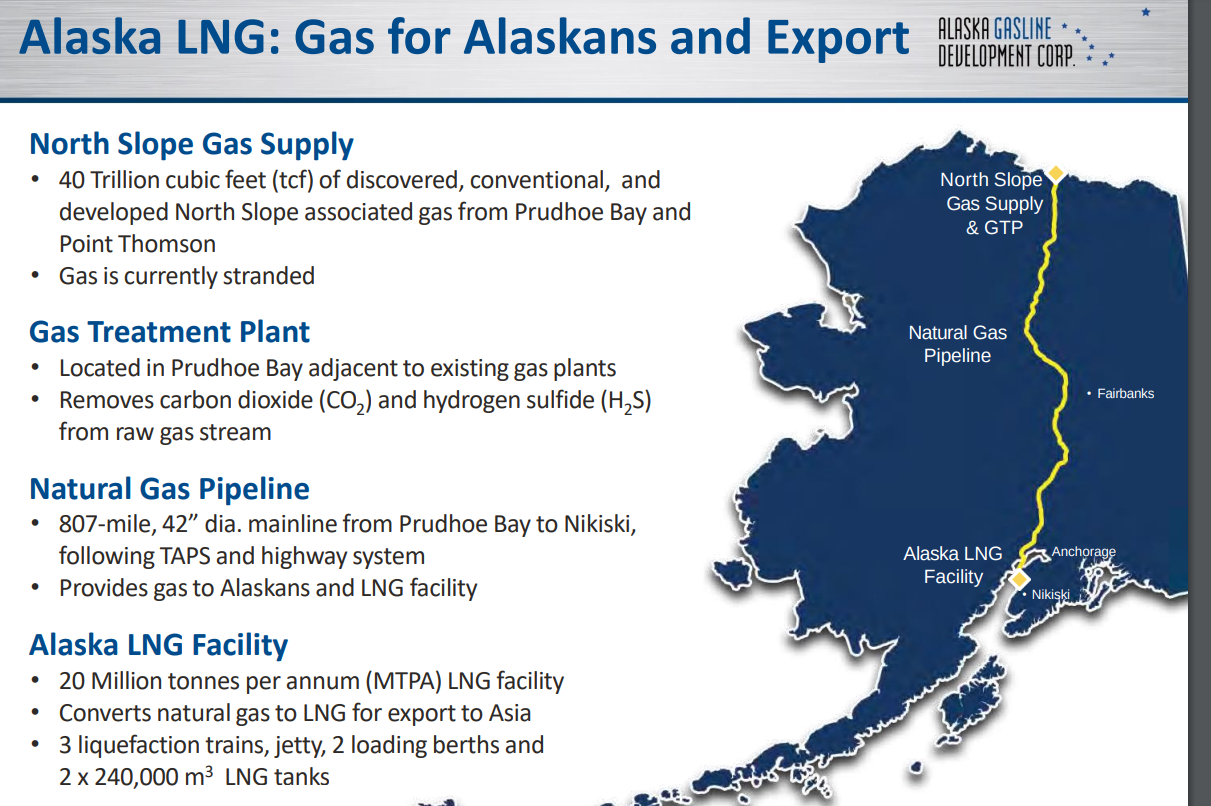
The Department of Energy approved Alaska Gasline Development Corp’s (AGDC) exports of LNG from the project to countries with which the United States does not have a free trade agreement.

Backers of the roughly $39 billion project hope it will be operational by 2030 if it gets investments and all required permits. The LNG would be exported mainly to countries in Asia.

Reuters

53 years of history in 93 seconds:

The basics:

Alaska LNG

Read Full Post »

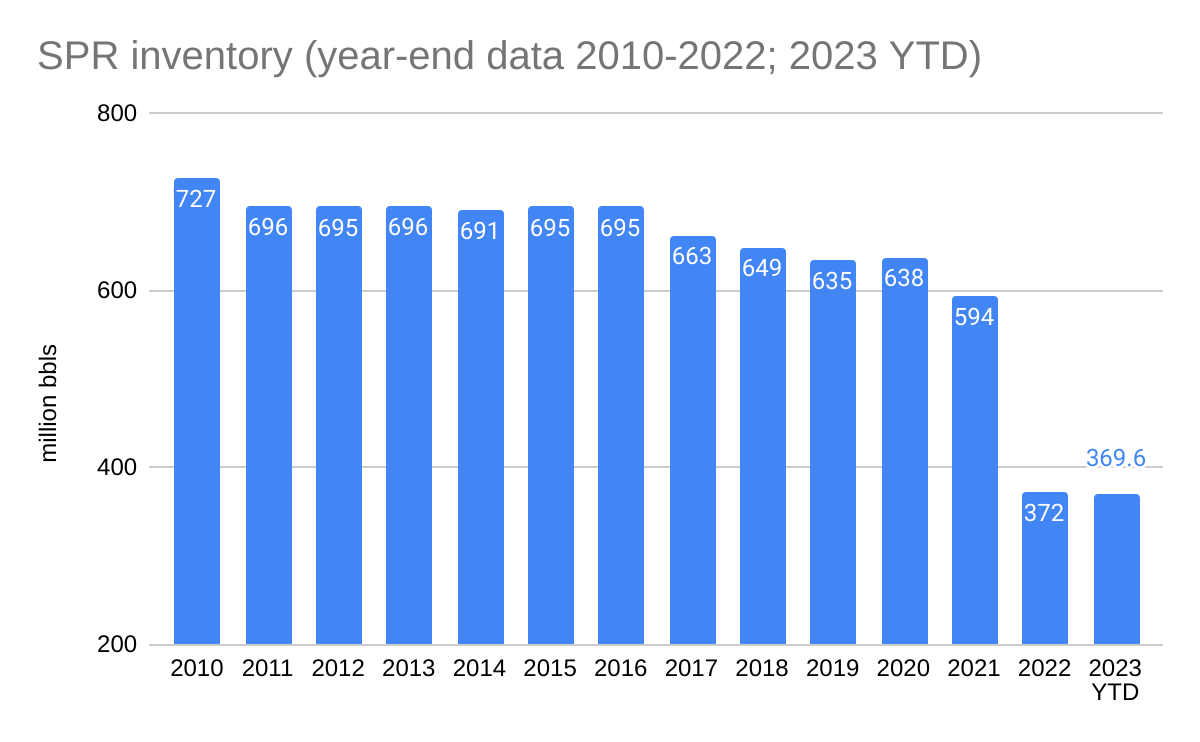
After 12 consecutive weeks at the 371.6 million barrel level, the SPR has declined another 2 million barrels to 369.6 million barrels as of 4/7/2022. The SPR is now at its lowest level since 11/11/1983 when the reserve was still being filled.

Keep in mind that the SPR deficit is now 357 million barrels, and the maximum refill rate is only 685,000 bopd. So a complete refill at the maximum rate would require 521 days plus acquisition, operational, and maintenance delays. Filling the reserve to its 727 million barrel capacity was a 28 year process.

DOE management nonetheless seems maddingly unconcerned.

DOE comments on the SPR refill.

Read Full Post »

« Newer Posts - Older Posts »