Feeds:
Posts
Comments

Archive for the ‘climate’ Category

EIA

Yet the proposed 5 Year OCS leasing program (p. 3) tells us that long term offshore production is not needed because the IEA’s “roadmap to net-zero emissions by 2050 for the global energy sector would require no new investment in fossil fuel supply projects (IEA 2021).”

Does the IEA dictate US energy policy? Dan Yergin has a far better grasp on the realities of energy consumption and transitions.

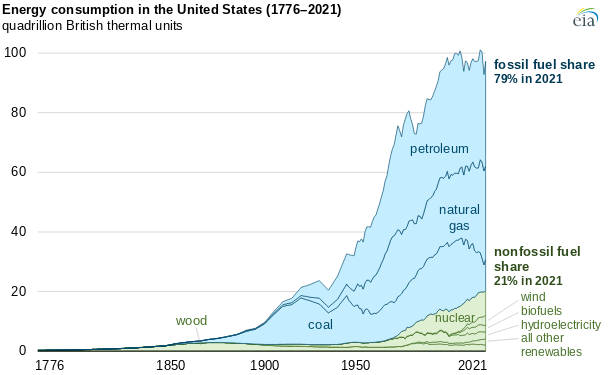
Oil, discovered in 1859, did not surpass coal as the world’s primary energy source until the 1960s, yet today the world uses almost three times as much coal as it did in the ’60s.

Read Full Post »

When Congress seems slow to solve problems, it may be only natural that those in the Executive Branch might seek to take matters into their own hands. But the Constitution does not authorize agencies to use pen-and-phone regulations as substitutes for laws passed by the people’s representatives.

Justice Gorsuch in concurrence

Capping carbon dioxide emissions at a level that will force a nationwide transition away from the use of coal to generate electricity may be a sensible “solution to the crisis of the day.” New York v. United States, 505 U. S. 144, 187 (1992). But it is not plausible that Congress gave EPA the authority to adopt on its own such a regulatory scheme in Section 111(d). A decision of such magnitude and consequence rests with Congress itself, or an agency acting pursuant to a clear delegation from that representative body.

Justice Roberts for the majority

At first glance, the SCOTUS decision would seem to affect the regulation of GHG emissions on the OCS and possibly the Lease Sale 257 decision (now being appeal), which was based on BOEM’s failure to estimate the effect of reduced OCS production on GHG emissions outside the US.

Read Full Post »

MIT Press

For others who are fascinated by ultradeep geothermal energy, MIT News has posted an update on Quaise Energy. Quaise wants to use x-rays to drill ultradeep geothermal wells at old coal and gas power plants.

“The company plans to vaporize enough rock to create the world’s deepest holes and harvest geothermal energy at a scale that could satisfy human energy consumption for millions of years. They haven’t yet solved all the related engineering challenges, but Quaise’s founders have set an ambitious timeline to begin harvesting energy from a pilot well by 2026.”

Quaise will use conventional rotary drilling technology to reach basement formations before switching to high-power millimeter waves that vaporize boreholes through rock and provide access to deep geothermal heat. See our previous post on this exciting concept.

Read Full Post »

Per their court filing, Montana, Alabama, Alaska, Arizona, Arkansas, Georgia, Kentucky, Mississippi, Missouri, Nebraska, Oklahoma, Texas, Utah, and West Virginia seek to protect oil and gas production in the Gulf of Mexico and throughout the United States. The States’ brief is rather political, which is not surprising given their support for offshore leasing and the apparent alignment of the Federal defendants and the plaintiffs in support of the decision by Judge Contreras to vacate the sale.

As was expected at the time of the ruling, the court decision on Sale 257 shut down offshore leasing for the remainder of the 2017-22 Five Year Plan. Secretary of the Interior Haaland has promised that a new proposed leasing plan will be released by 6/30/2022, but that is just the start of the lengthy planning process.

Interesting NEPA data from the States’ brief:

  • In 2018 CEQ found that, across the federal government, the average EIS completion time and issuance of a Record of Decision was over 4.5 years and the median was 3.6 years.
  • On average, Interior takes five years and the Department of Transportation 6.5 years to complete an EIS—and that’s not including the usual years of resulting litigation.
  • CEQ found that “across all Federal agencies, draft EISs averaged 586 pages in total, with a median document length of 403 pages.” As a result, “[t]he entire original purpose of doing NEPA analysis has been lost along the way to creating mountains of data and information in the hopes of successfully defending against inevitable litigation.”

Many thanks to the Texas AG for making the States’ brief readily available online. Unfortunately, that is not the case for the other briefs filed in support of the sale.

Read Full Post »

Per a very good OGJ update, API, Louisiana, Chevron, bp, Shell, NOIA, the EnerGeo trade group of geophysical contractors, 14 states filing jointly, and the US Chamber of Commerce have submitted briefs to the US Court of Appeals for the District of Columbia Circuit.

Don’t expect a decision soon. The environmental advocacy groups are not scheduled to file their responses until Aug. 26, after which replies can be filed. No decision is expected before November at the earliest.

Previous posts and background information on Lease Sale 257.

Read Full Post »

Celebrating with the 1960’s Chad and Jeremy classic “A Summer Song” and the beautiful “Song of Summer Solstice” (Sweden).

Read Full Post »

Per Politico:

Several Democrats both in and out of the administration laid out their discontent with the office, led by National Climate Adviser Gina McCarthy, over its involvement in other agencies’ work, saying it slowed down several high-profile agenda items.

The Democrats said the office has gotten in the way of agency rulemakings. A Democratic Hill staffer told Zack the office edited and chose the day after Thanksgiving to release last year’s long-awaited Interior Department report on the federal oil and gas leasing program.

More on the leasing report cited in the above quote.

I guess we can assume that the Climate Office is currently reviewing the Proposed 5 Year Leasing Program that the Department of the Interior has promised to release by June 30. Is DOI subordinate to the Climate Office?

Read Full Post »

His speech began with a slide declaring that “unsubstantiated, shrill, partisan, self-serving, apocalyptic warnings are ALWAYS wrong.”  Stuart Kirk, HSBC

Financial Times

Here is the presentation that caused the furor:

Sadly, any oil industry exec who dared to publicly question climate orthodoxy would face a similar or worse fate.

I do like this very sensible quote:

A former Blackrock executive focused on sustainable investment said Kirk’s remarks had “done us a service” in discussions on climate change risk by “infusing a dose of honesty into a debate that is otherwise leading us nowhere,”

NY Post

Read Full Post »

I vote for stupid comment.

The CEO of Italian power firm Enel has cast doubt on the continued benefit of using gas to produce electricity, telling CNBC it is “stupid” and that cheaper and better alternatives are now available.

“You can produce electricity better, cheaper, without using gas … Gas is a precious molecule and you should leave it for … applications where that is needed,” he added.

Francesco Starace to CNBC

Gas is scarce and expensive in Europe because of bad foreign and energy policy decisions, most notably dependence on Russia and unrealistic expectations regarding renewables. Mr. Starace seems intent on doubling down on the latter. Of course, Enel is a large renewable energy generator and a natural gas purchaser and consumer (not a producer). His comments are thus rather self-serving.

I do agree with Enel on CCS:

Although the company could rely on carbon offsets or carbon capture to hit that target, Bernabei said the technology has failed to take off, despite receiving funding from the EU and national governments. He said there is no reason to expect that situation to change, especially since carbon capture and storage, or CCS, technology is not guaranteed to eliminate 100% of emissions.

“These are very big and complex projects. And at the end, they will not solve the problem,” Bernabei said. “We already tried CCS in the past and it didn’t lead to success. So why do it again?”

SPGlobal

Read Full Post »

Through her research of Pennsylvania’s Marcellus Shale play, Lee found that highly concentrated lithium was found in the produced water (water produced as a byproduct during the extraction of oil and natural gas) along with produced natural gas and oil.

“We found lithium in the petroleum-based rock brines, which opens new pathways to address the shale plays as a substantial source of lithium, given that they are ubiquitous in the U.S.,” Lee said.

University of Houston

Read Full Post »

« Newer Posts - Older Posts »