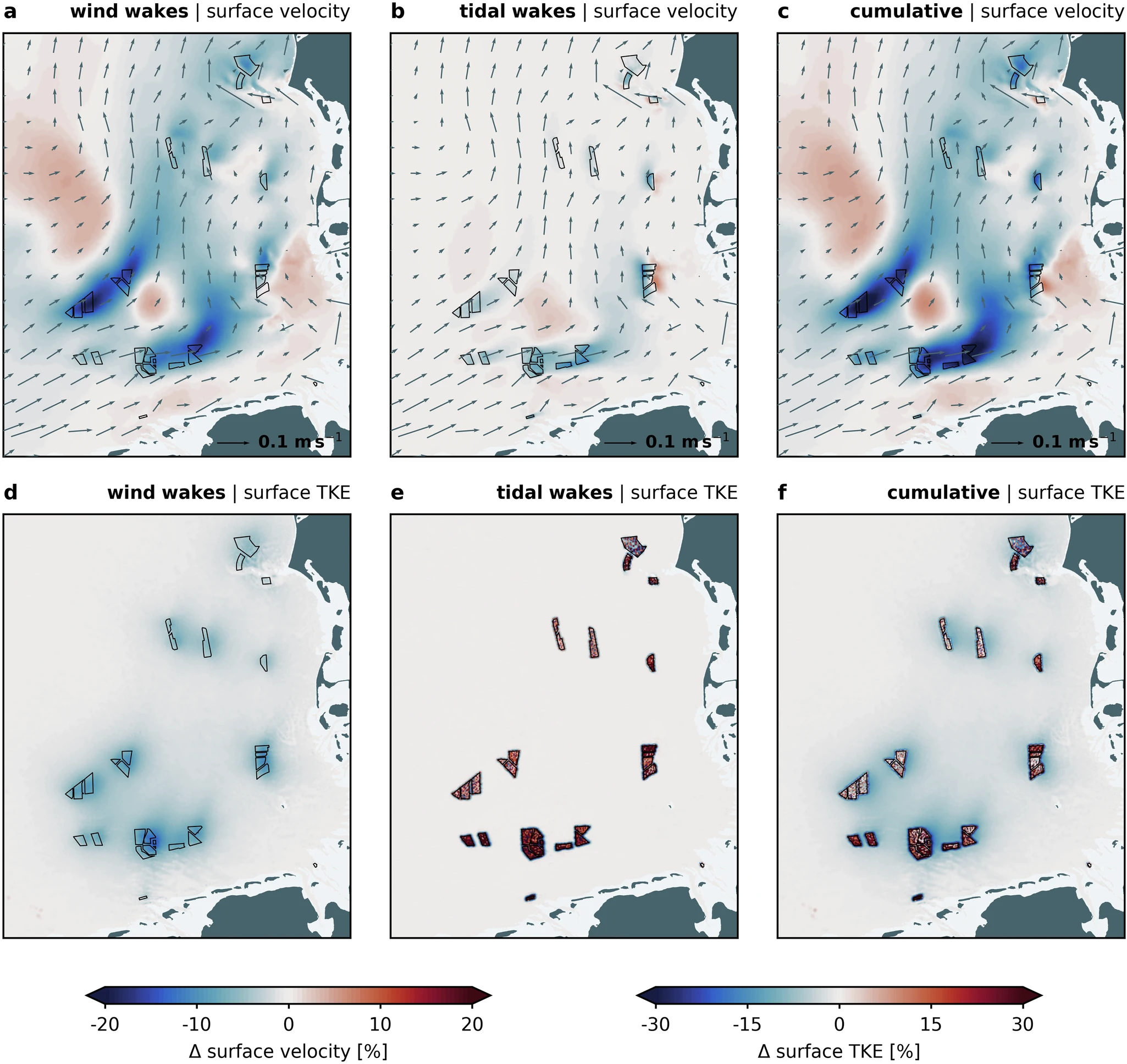
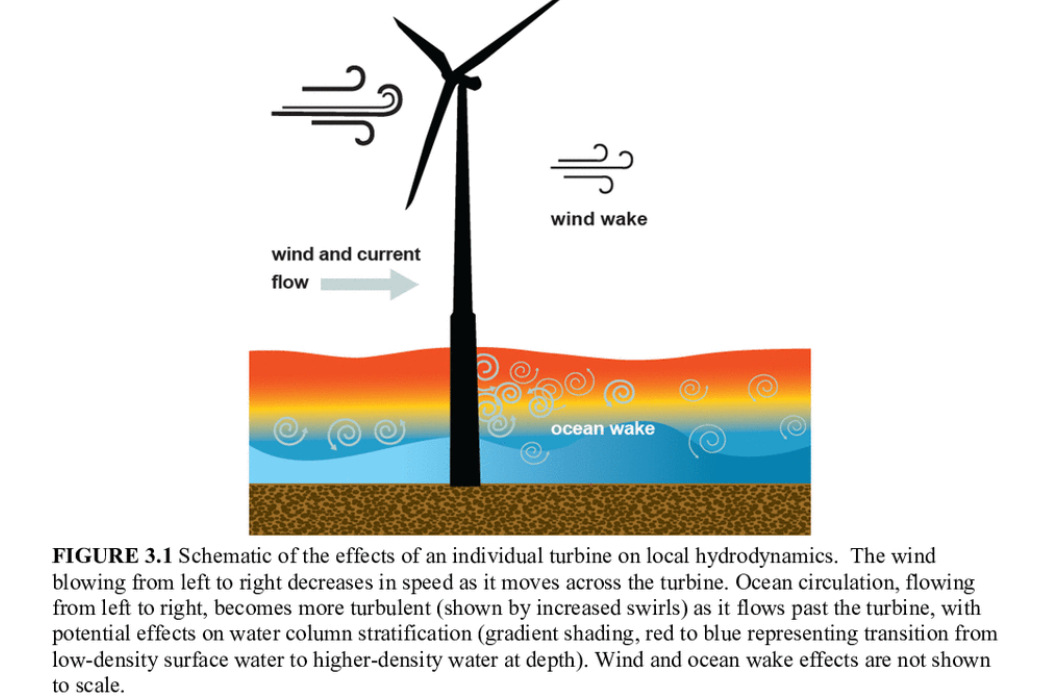
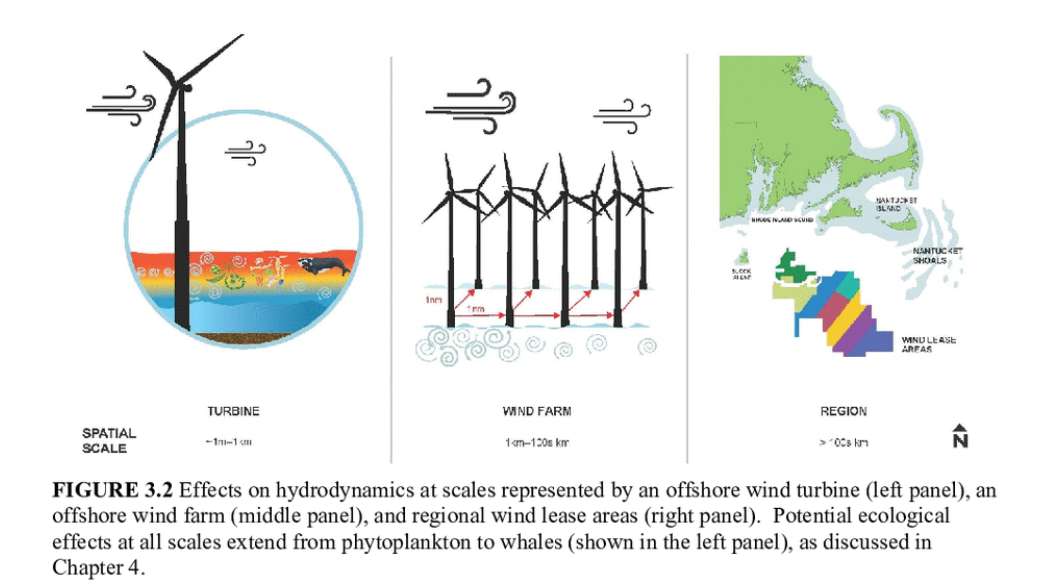
Per PHYS.ORG: Researchers at the Helmholtz Center Hereon have analyzed the long-term overall impact of this large number of wind farms on the hydrodynamics of the North Sea for the first time. They found that the current pattern could change on a large scale.
The peer reviewed German study is attached. Excerpt:
The near- and far-field wake effects affect vertical mixing and surface heat fluxes – primarily driven by large-scale wind stress reductions – leading to shallower mixed layers and long-term surface warming of up to 0.2 deg. C in wind farm areas. Our findings reveal a basin-scale physical footprint of offshore wind energy and highlight the need to account r hydrodynamic impacts in future offshore wind farm planning.
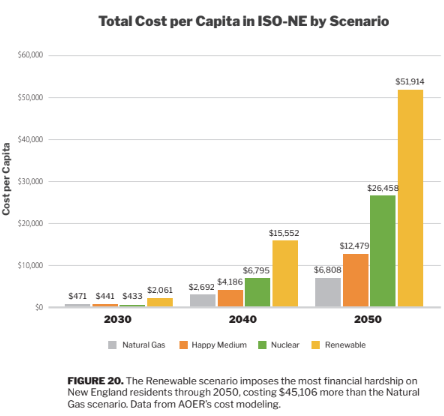
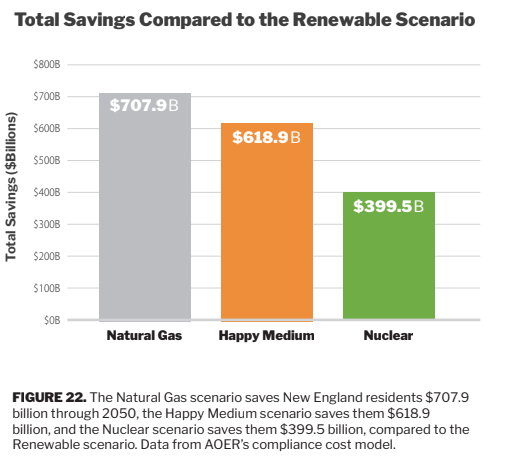
The Always On Energy Research report is attached. Conclusion:
“In other words, dispatchable generation saves New England hundreds of billions of dollars and avoids blackouts. In the end, the idea that New England can run its electric grid on wind turbines, solar panels, and batteries is a dangerous and unserious proposition.“
Fleming is opposed to carbon capture and sequestration: “If elected to the U.S. Senate, the first bill I will submit will be to fully defund and repeal the 45Q tax credits that pay for this. There’s no market for this. People don’t buy this technology.”
“This is purely crony capitalism, where you have the government paying wealthy companies that are going to make a lot of money out of this, and the average landowner is going to suffer from it. So I’ve committed that I will submit the bill that will defund it so that money will no longer be available, and it will stop all these projects.”
The President of Guyana, Irfaan Ali puts the BBC’s Stephen Sackur firmly in his place over his questions regarding Guyana’s policies on climate change & net zero. pic.twitter.com/irvtltPWyQ
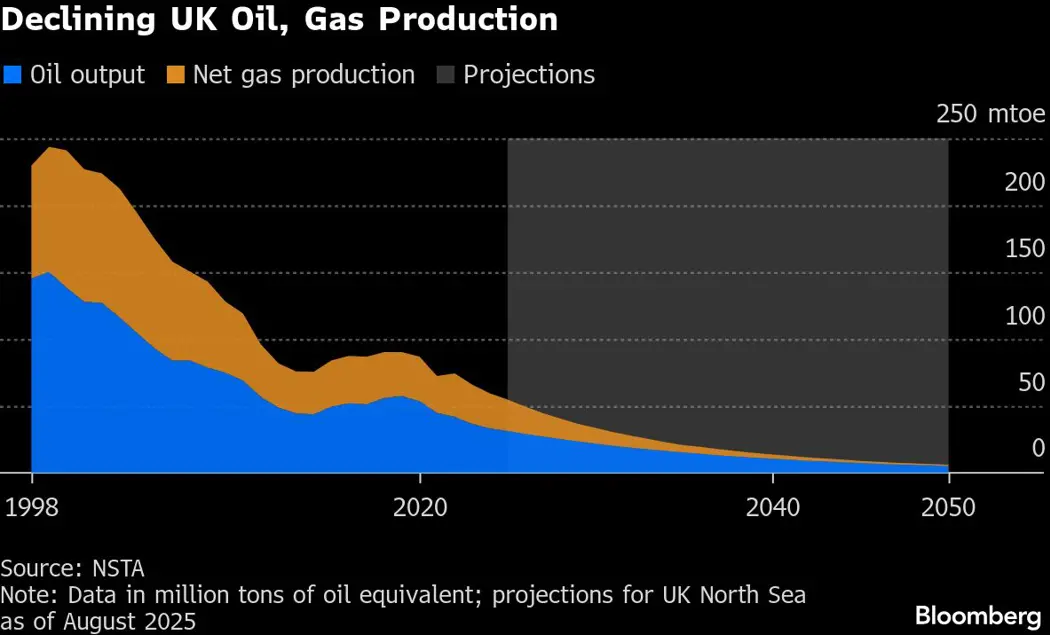
JL Daeschler, other North Sea veterans, and those of us who once admired the UK offshore program, lament the sad plight of their oil and gas industry and the destruction of the economy in northeast Scotland.
Incomprehensibly, the UK has retained the Energy Profits Levy, which requires North Sea operators to hand over 78% of their diminished profits to the Treasury. Most have regrettably chosen to do business elsewhere. Investment in the UK North Sea is at a record low and a study from Robert Gordon University says jobs are being “quietly” lost at a rate of 1,000 a month.
The UK government is grudgingly allowing some tieback production to existing facilities, but this will do little to stem the industry’s decline. JL notes that this limited infield development is not the type of new field investment needed to grow production and sustain the service industry (rigs, boats, helicopters, equipment, etc.).
“The term energy transition somehow sounds like it is a well-lubricated slide from one reality to another. In fact, it will be far more complex: Throughout history, energy transitions have been difficult, and this one is even more challenging than any previous shift.”
Related article in the WSJ: “Europe’s Green Energy Rush Slashed Emissions—and Crippled the Economy”
“European politicians pitched the continent’s green transition to voters as a win-win: Citizens would benefit from green jobs and cheap, abundant solar and wind energy alongside a sharp reduction in carbon emissions. Nearly two decades on, the promise has largely proved costly for consumers and damaging for the economy.”
“Europe largely took an “or” strategy: It raced to replace fossil fuels with solar, wind and biomass by taxing carbon heavily, subsidizing renewables and closing scores of fossil-fuel power plants. Britain, which pioneered the use of coal for energy, last year became the first large industrialized country to shut all of its coal-fired power plants. It has also banned new offshore oil-and-gas drilling. Denmark plans to eliminate gas for home heating by 2035. Around one-fifth of Germany’s municipal utilities plan to shut down their gas networks in coming years, according to an October survey by the utilities’ trade association.”
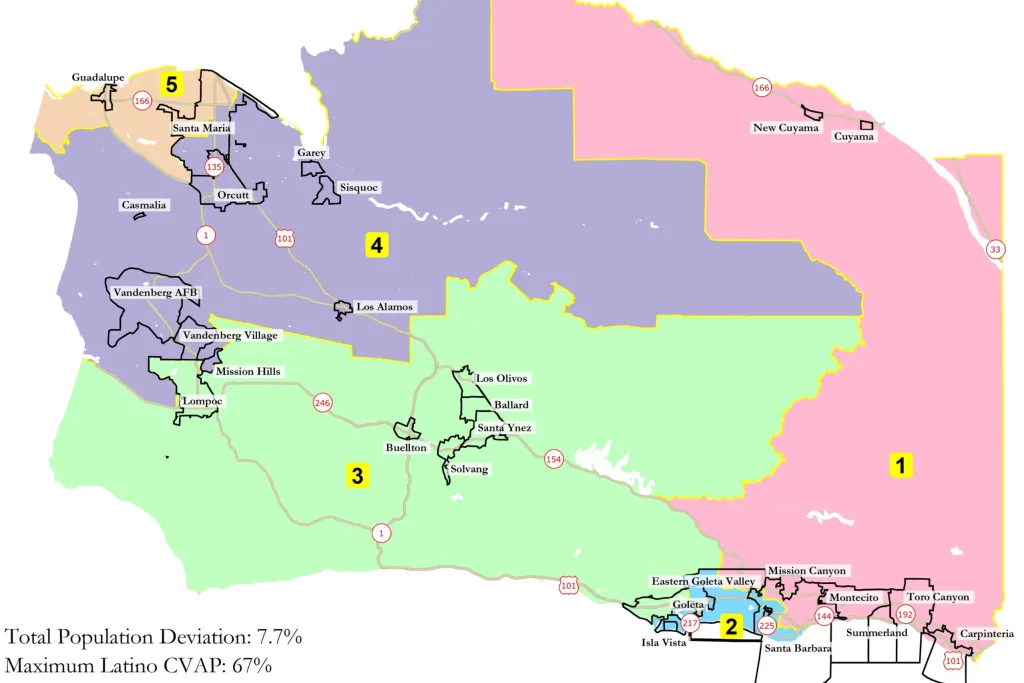
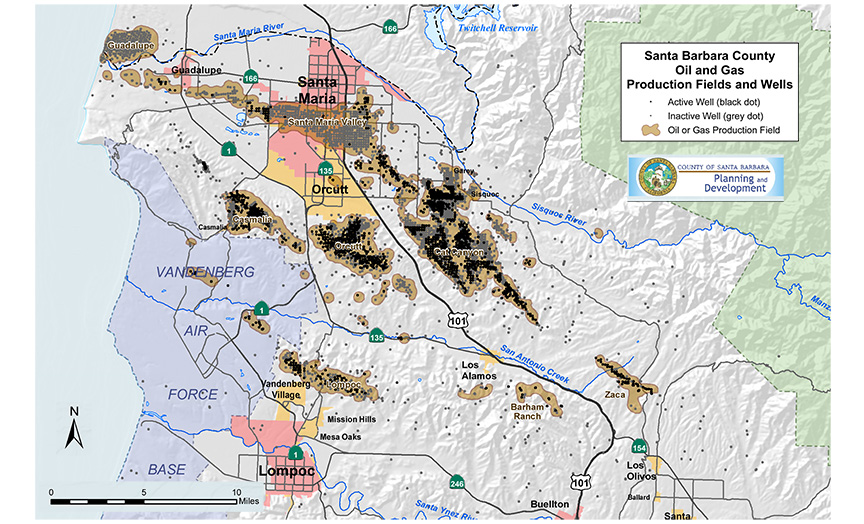
In essence, the 3 Supervisors from South County (Districts 1-3) voted to euthanize an industry that is largely in North County (Districts 4 and 5). Those 3 supervisors, not the marketplace, are terminating a historically important industry. See the maps below.
District BoundariesOil Wells
Supervisors Laura Capps of the Second District, Joan Hartmann of the Third District and Roy Lee of the First District voted for the ordinance.
Ah, but it’s the industry’s fault according to Supervisor Hartmann. She asserted that companies have known since the 1950s about the dangers of climate change, and could have led the way to be part of the solution. How dare they respond to market forces instead of climate ideologues!
Of course, this is the same three vote coalition that is aligned with the Coastal Commission in opposition to the restart of the Santa Ynez Unit, which would benefit the County significantly.
Finally, note that the three supervisors voting for the ordinance represent the districts with the highest income levels and lowest poverty rates. Those opposing the ordinance represent the districts that will be most affected, and have the lowest income levels and highest poverty rates. (See the table below; Information courtesy of Grok AI.)
District
Approx. Median Household Income (2022)
Key Areas Included
Notes
1
$120,000–$140,000
Carpinteria, Summerland, Montecito, parts of Santa Barbara
Affluent coastal communities; high home values (~$1.5M+ median)
2
$95,000–$115,000
Santa Barbara city, Goleta, Isla Vista
Mix of urban professionals, students, and tech; university influence lowers median slightly.
3
$80,000-$95,000
Santa Ynez Valley, Buellton, Solvang, Lompoc
Rural/agricultural with tourism; moderate incomes from wine industry and military base
4
$70,000–$85,000
Lompoc, Vandenberg area, parts of Santa Maria
industrial and defense-related; higher poverty rates (~15–20%).
5
$60,000–$75,000
Santa Maria, Guadalupe
Agricultural North County; majority Latino population; lowest incomes due to farm labor.
Poverty rates: ~8–10% in Districts 1–2 vs. 18–25% in Districts 4–5
The carbon disposal industry, which overplayed its hand on the OCS, has managed to alienate traditional oil and gas industry supporters, sparking grassroots opposition in conservative areas of Louisiana. Carbon Capture and Sequestration (CCS) is also opposed by climate activists and the environmental justice movement.
The Advocate has nicely summarized opponents concerns: “land rights; the impact on underground aquifers if CO2 leaks; skepticism of climate change; skepticism of its effectiveness in fully capturing CO2; and opposition to the use of federal money and tax credits to finance the effort.”
Gov. Landry issued an executive order on Oct. 15 in an apparent attempt to calm the opposition. Following 34 “whereas” clauses intended to justify carbon disposal in Louisiana, the EO directs a pause in the review of new Class VI CO2 disposal wells. As evidenced by the attached press release, Save My Louisiana and other opposition groups are far from satisfied.
The Snorre field is in 300-380m of water in the North Sea ~200 km west of Floro.
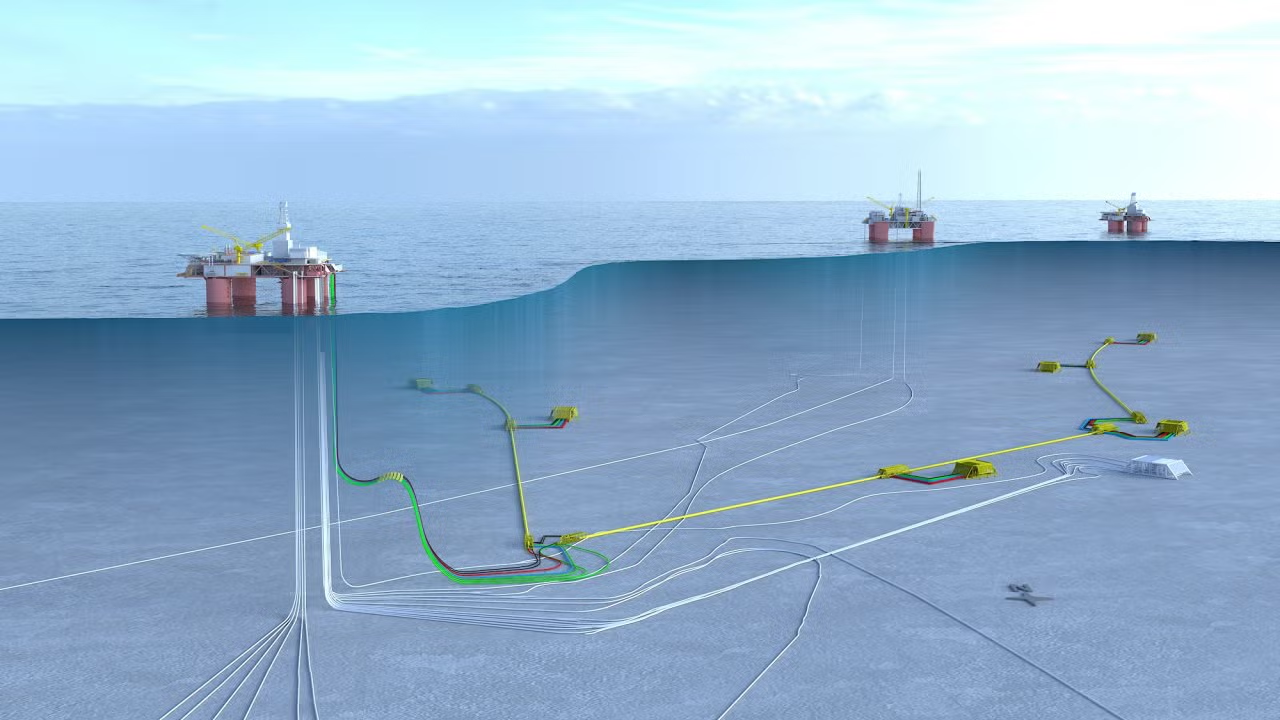
According to Reuters and others, Equinor will no longer pursue electrification of Snorre A and B, Heidrun, Aasgard B, and Kristin platforms, but still plans to proceed with projects at Grane and Balder fields.
A number of BOE posts since Jan. 2022 have questioned Norway’s electrification strategy for offshore platforms. Our reasons:
Most offshore platforms produce sufficient gas to support their power demands
Assuming gas that is not used to power a platform is marketed and consumed elsewhere, the net (global) reduction in CO2 emissions from electrifying offshore platforms is negligible. (Perhaps there is actually a small increase in net emissions given the power required to transport the gas to markets and the emissions associated with onshore power generation).
Offshore power demands are highly variable, especially when drilling operations are being conducted.
Gas turbines are reliable, and capable of responding to variable power demand. Excess generation capacity is typically provided.
Power from shore increases the cost of platform operations and could decrease ultimate recovery of oil and gas resources.
Per NPD, electrification of the shelf will increase electricity prices for onshore consumers and increase the need for onshore facility investment.
Gas turbines or diesel generators are still necessary to satisfy emergency power needs at the platforms.
Long power cables are vulnerable to damage (accidental or intentional), as are onshore power stations.
The reliability, cost, and cable vulnerability concerns have clearly been validated. The reality is that powering distant platforms from shore increases operating costs, safety risks, and onshore electricity prices with no net environmental benefit.
It also seems rather hypocritical for a major natural gas exporter to prevent offshore operators from powering their platforms with gas produced at their platforms.



 Bud's Offshore Energy (BOE)