Feeds:
Posts
Comments

Archive for the ‘Alaska’ Category

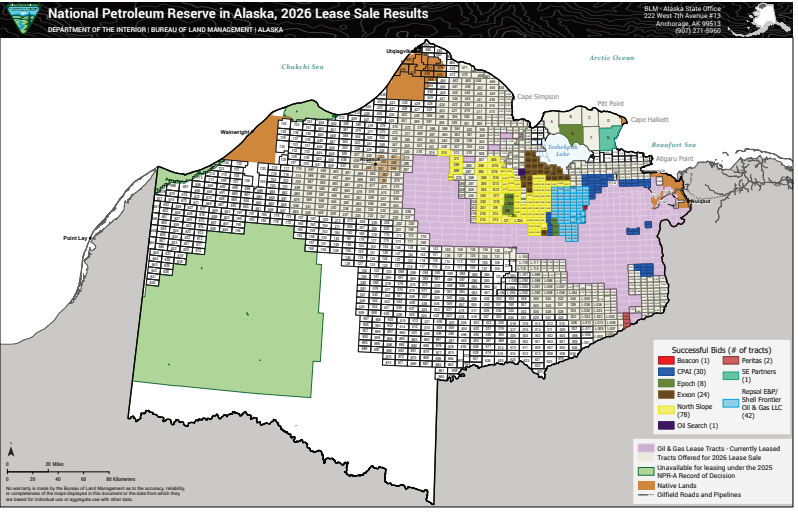
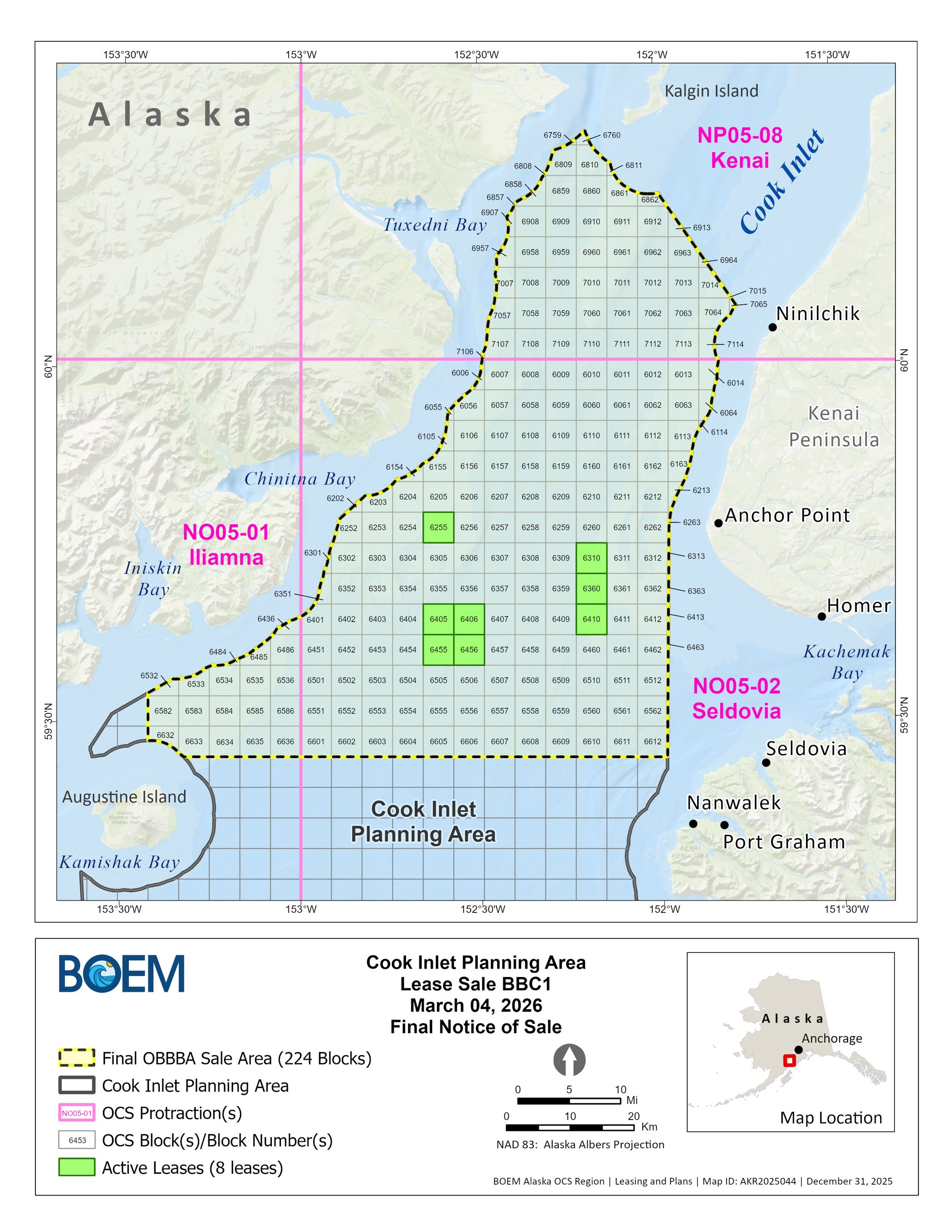
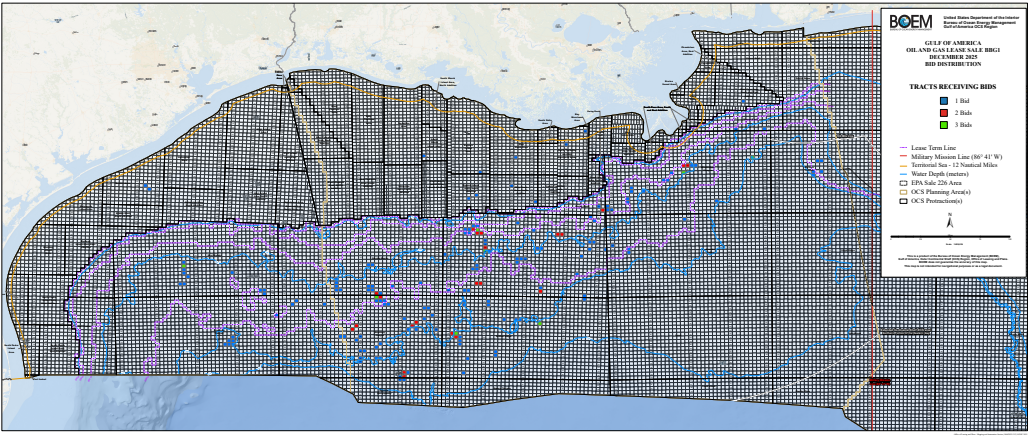
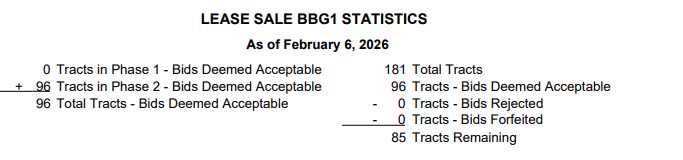
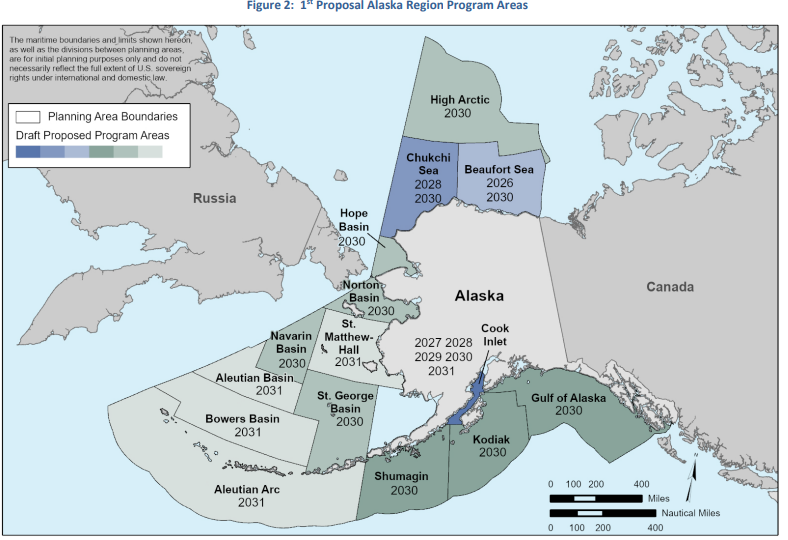
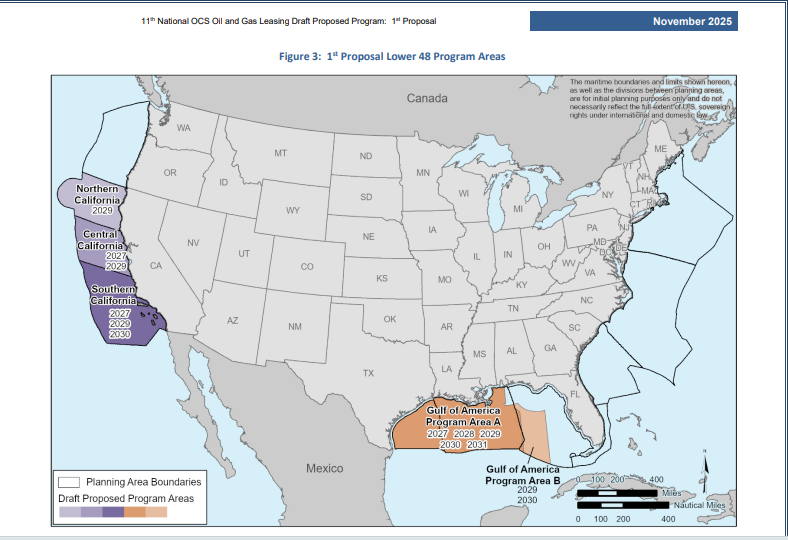
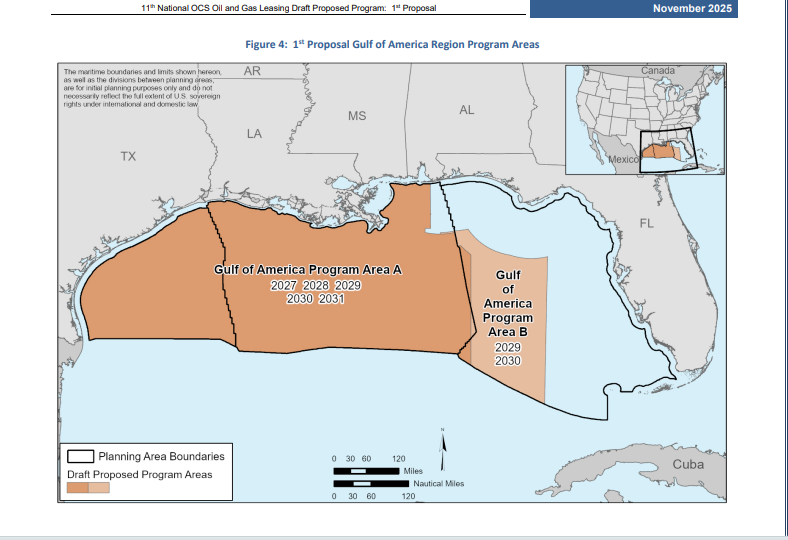
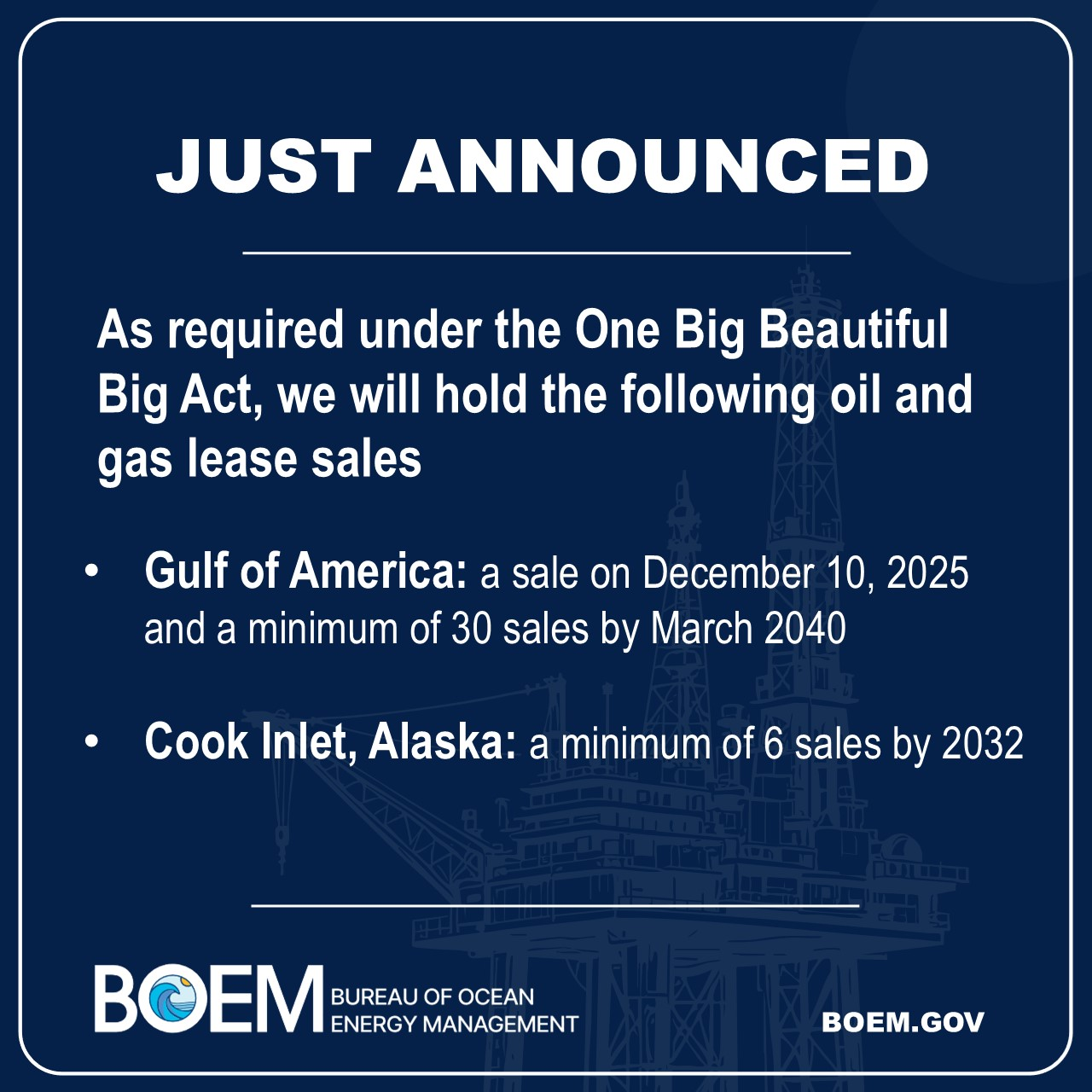
The press release and full program are linked. It looks like the most recent leaks were accurate. See the maps below with the locations and dates. This will stir the pot!

Read Full Post »

Offshore Lease Sale Schedule 

Year Cook Inlet Sale Gulf of America Sales 
2025 — Dec. 10 
2026 March March, August 
2027 March March, August 
2028 March March, August 
2029 — March, August 
2030 March March, August 
2031 March March, August 
2032 March March, August 
2033–2039 — March, August 
2040 — March 

Read Full Post »

Perdido: One Big Beautiful Platform 😀

The differences between the House and Senate versions of the Big Beautiful Bill are summarized in the table below. (See the previous post on the House version.)

The Senate bill includes royalty and lease terms that favor deepwater lessees, but excludes the provisions in the House bill that streamline the leasing process and minimize litigation risks. At least some of those House provisions were rejected by the Senate Parliamentarian.

The House will vote on the version that passes the Senate. So the Senate version is more likely to be enacted.

HouseSenateComment
royalty: 12.5% to 18.75%royalty: 12.5% to 16 2/3%Lowering the royalty cap to 1/6 (16 2/3%) unduly limits the Secretary’s discretion and may reduce revenues without significantly increasing production.
2 GOA sales/yr over next 15 yrs.same as HouseWould have liked the opportunity for consideration of very limited Atlantic leasing or stratigraphic test drilling, but that is not politically feasible at this time.
use Sale 254 form and stips 4-10, may update stips 1-3sale 254 lease form and stips 4-9, may update stips 1-3 and 10 The minor difference favors the Senate version. Stip 10 pertains to restrictions due to Rights-of-Use and Easement for Floating Production Facilities, and needs to be updated with each sale
mandates 10 year lease term for water depths >800 mAlthough a 10 year term for deepwater leases is generally prudent, the Secretary should be able to choose a shorter term if concerns about timely exploration and diligent development arise (more likely given the increase in leases that could be issued as a result of the 2 sales/yr mandate).
requires approval of subsurface commingling unless there is “conclusive evidence” of safety or ultimate recovery issuesAlthough BSEE’s policy change on downhole commingling was warranted, the legislative change removes essentially all discretion by mandating approval unless there is “conclusive evidence” to the contrary. Conclusive evidence is dependent on production history, at which point it may be too late.
Adherence with the Biological Opinion shall satisfy the Secretary’s obligations under the Endangered Species Act of 1973 and the Marine Mammal Protection Act of 1972This provision reduces govt/lessee litigation risks
Previous EIS’s for the Gulf of Mexico shall satisfy the Secretary’s NEPA obligation.Rejected by the Senate Parliamentarian.
Consistency determinations prepared by BOEM for Lease Sale 261 for the States of Texas, Louisiana, Mississippi, Alabama, and Florida will satisfy the Secretary’s CZMA obligations.

The States or Parliamentarian may not have been comfortable with this provision which simplifies plan approval processes.
The Secretary may waive any requirement under the Outer Continental Shelf Lands Act that the Secretary determines would delay issuance of a lease.Rejected by the Senate Parliamentarian?
A lease must be issued to the highest responsible qualified bidder not later than 90 days after the sale date.Rejected by the Senate Parliamentarian.
A Governor may nominate for leasing under a lease sale held under this section an area of the OCS that is adjacent to the waters of the StateNever understood the need for this provision.
G&G surveys must be approved within 30 days after a complete application is received.Not feasible in some cases given endangered species concerns.
A lease awarded under Lease Sale 259 or Lease Sale 261 shall not be set aside, vacated, enjoined, suspended, or cancelled except in accordance with section 5 the Outer Continental Shelf Lands Act (43 U.S.C. 1334). Also, new terms or conditions may not be added to these leases.Reduces litigation risks.
Any action to approve, require modification of, or disapprove any exploration plan, development and production plan, bidding procedure, lease sale, lease issuance, or permit or authorization related to oil and gas exploration, development, or production, or any inaction resulting in the failure to hold a lease sale shall be subject to judicial review only in a United States court of appeals for a circuit in which an affected State is located.This provision significantly reduces litigation risks. Rejected by Parliamentarian?
6+ Cook Inlet sales over next 10 yrs.6+ Cook Inlet sales over the next 7 years
90% of Cook Inlet revenues to the State of Alaska.70% of Cook Inlet revenues to the State of Alaska.The percentages are high, but the revenues are likely to be low.

Read Full Post »

Part VIII, Offshore OIl and Gas Leasing, is a good read for those interested in OCS leasing policy. This cleverly crafted part of the bill specifies leasing schedules, streamlines the leasing process, and minimizes litigation risks. Highlights:

  • Minimum royalty rates return to 12.5% from 16.67% post-IRA. (This is good for small, shelf producers.) The maximum rate remains 18.75%.
  • Requires a Gulf of America lease sale by 8/15/2025, a sale by 3/15 and 8/15 in each of the following 14 years (2026-2039), and a sale by 3/15/2040. 80+ million acres must be offered at each sale unless that amount of acreage is no longer available for leasing.
  • The lease form, lease terms, economic conditions, and stipulations 4 through 10 must be the same as for Lease Sale 254 (3/18/2020). Stipulations 1-3 may be updated.
  • Requires seven 1+ million acre (if available) Cook Inlet lease sales from 2026 – 2032. Beginning in 2035, 90% of the revenues go to the State of Alaska.
  • The required lease sales may be in addition to the lease sales held under the 2024-2029 National Outer Continental Shelf Oil and Gas Leasing Program.
  • Adherence with the Biological Opinion shall satisfy the Secretary’s obligations under the Endangered Species Act of 1973 and the Marine Mammal Protection Act of 1972
  • Previous EIS’s for the Gulf of Mexico shall satisfy the Secretary’s NEPA obligation.
  • Consistency determinations prepared by BOEM for Lease Sale 261 for the States of Texas, Louisiana, Mississippi, Alabama, and Florida will satisfy the Secretary’s CZMA obligations.
  • The Secretary may waive any requirement under the Outer Continental Shelf Lands Act that the Secretary determines would delay issuance of a lease.
  • A lease must be issued to the highest responsible qualified bidder not later than 90 days after the sale date.
  • The Secretary shall establish a process through which a Governor may nominate for leasing under a lease sale held under this section an area of the OCS that is adjacent to the waters of the State; and is unleased and available for leasing. If the Governor of a State nominates an area, the Secretary shall include the area in the next scheduled sale. (It appears that this provision applies only to the Gulf of America. Objective?)
  • G&G surveys must be approved within 30 days after a complete application is received.
  • A lease awarded under Lease Sale 259 or Lease Sale 261 shall not be set aside, vacated, enjoined, suspended, or cancelled except in accordance with section 5 the Outer Continental Shelf Lands Act (43 U.S.C. 1334). Also, new terms or conditions may not be added to these leases. (This protects lessees from pending litigation related to these leases).
  • Any action to approve, require modification of, or disapprove any exploration plan, development and production plan, bidding procedure, lease sale, lease issuance, or permit or authorization related to oil and gas exploration, development, or production, or any inaction resulting in the failure to hold a lease sale shall be subject to judicial review only in a United States court of appeals for a circuit in which an affected State is located.

Read Full Post »

The attached bill not only nullifies most OCS leasing bans, but fundamentally changes the OCS Lands Act provision (Sec. 12(a)) that authorizes such Presidential withdrawals.

The well constructed bill addresses the issues previously raised on the blog. The bill would:

  • Revoke all Presidential leasing bans except for the 2020 withdrawals, which could presumably be reversed by President Trump.
  • Limit withdrawals to under 150,000 acres (the equivalent of 26 lease blocks of typical size) in total or contiguous with any other withdrawal.
  • Limit cumulative withdrawals to 500,000 acres (87 lease blocks) without congressional approval.
  • Sunset withdrawals after 20 years.
  • Require geological, economic, and security assessments for any future withdrawals.
  • Give Congress the authority to review and potentially overturn future withdrawals.
  • Ensure that future withdrawals do not contradict an approved Five-Year Offshore Oil and Gas Leasing Program.

Does this bill have a chance? Realistically, the prospects are probably not good. Although the bill currently has an impressive list of 24 sponsors, all are Republicans and none are from Florida. Absent support from Florida Republicans and some interior state Democrats, it will be difficult to gain traction.

Interactive map showing OCS areas where oil and gas leasing is now prohibited (I.e everywhere but the Central and Western Gulf of Mexico and the Cook Inlet)

Read Full Post »

Withdrawal from the Paris Climate Change Agreement:The US Ambassador to the UN shall immediately submit formal written notification of the US withdrawal from the Paris Agreement under the United Nations Framework Convention on Climate Change. 

Regulatory Freeze: Agencies may not propose or issue a rule until approved by a Presidential appointee. OMB may exempt emergency or urgent rules (déjà vu for regulators 😉).

Alaska: Withdraws a Secretarial Order intended to halt ANWR oil and gas leasing. Rescinds cancellation of ANWR leases.

Gulf of America: Renaming the Gulf of Mexico.

Unleashing American Energy (long, main items highlighted below):

  • Encourage energy exploration and production on Federal lands and waters, including on the Outer Continental Shelf.
  • Eliminate the electric vehicle (EV) mandate.
  • Requires immediate review of actions that could burden the development of energy resources.
  • Develop and begin implementing action plans to suspend, revise, or rescind all unduly burdensome agency actions.
  • Revoke climate change and “clean energy” EOs.
  • Terminate all activities, programs, and operations associated with the American Climate Corps (RIP 😉).
  • Expedite and simplify permitting processes.
  • Facilitate the permitting and construction of interstate energy transportation and other critical energy infrastructure, including pipelines.
  • Disband the Interagency Working Group on the Social Cost of Greenhouse Gases.
  • Terminate the Green New Deal.  All agencies must immediately pause the disbursement of funds appropriated through the Inflation Reduction Act of 2022 (Public Law 117-169) or the Infrastructure Investment and Jobs Act (Public Law 117-58).
  • The Secretary of Energy is directed to restart reviews of applications for LNG export projects as expeditiously as possible.

Offshore Wind

Read Full Post »

As expected, the White House announced the largest ever permanent ban on offshore oil and gas leasing in the US, and to the best of my knowledge, anywhere in the world.

The sheer magnitude of the ban makes other such withdrawals appear modest by comparison. It’s amazing how bold Presidents (and their handlers) become when they are about to leave office.

The permanent ban includes:

  • The entire Atlantic Outer Continental Shelf (OCS): While there are no current oil and gas leases in the US Atlantic, the region is highly prospective and could contain more than 20 billion barrels of oil equivalent (BOE).
  • The Eastern Gulf of Mexico: This is the OCS area that many petroleum geologists find most attractive. The best prospects are >100 miles from shore which minimizes coastal risks, and the high natural gas potential aligns with Florida legislation supporting the use of gas for power generation.
  • The entire Pacific OCS: While the resources are substantial, their loss has been a foregone conclusion for 25 years. When you can’t even decommission old platforms or restore production on important existing facilities (i.e. the Santa Ynez Unit), how can you possibly expect to issue new leases?
  • The remainder of the OCS offshore western Alaska. The wishes of the majority of Alaskans, who support offshore exploration and development, have been largely ignored for decades.

President-elect Trump has vowed to reverse President Biden’s leasing ban, but that may not be so easy. This is not a matter of simply reversing an executive order. Sec. 12(a) of OCSLA grants the authority to withdraw lands to the President and does not provide for reversal by future Presidents. The attached NYU Law brief concludes that “a subsequent president lacks authority to restore previously withdrawn lands to the federal oil and gas leasing inventory.”

The new Administration will no doubt have a different view than that expressed in the NYU Law brief, but any reversal decision will likely be challenged in court.

Those who wrote and approved Sec. 12(a) should have had more foresight. However, 72 years ago the authors presumably thought Presidents would only use the authority to remove small, especially sensitive areas from leasing consideration, and never thought that a President would remove both of our oceans and much of the Gulf of Mexico!

Congress could of course reverse the Biden bans, but given the complexity of offshore energy issues, such legislation may be difficult to pass.

Read Full Post »

United Oil and Gas excels at promotion and isn’t shy about making bold statements. Can they find a strong partner and move their Jamaican exploration program forward?

The term “string of pearls” was used about 30 years ago to describe discoveries in the Beaufort Sea and on adjacent Alaska lands. Although they were modest individually (by Arctic standards), the sense was that these discoveries would collectively support sustained production in the region. While there has been some success in that regard, the optimistic expectations have not been realized.

Below is a recent United Oil & Gas presentation to prospective investors. Previous Jamaica posts.

Read Full Post »

….as long as they are aligned with the preordained political decision. 😠

No where has this been more apparent over the years than in Alaska. Most recently, the North Slope Borough filed suit to challenge the Bureau of Land Management (BLM) rule making the National Petroleum Reserve in Alaska (NPR-A) off limits to oil and gas development.

Mayor Josiah Patkotak of the North Slope Borough

“The rule would significantly and irrevocably harm the North Slope’s right to self-determination and ability to provide essential services for residents. This suit is filed alongside the complaints of the Voice of the Arctic Inupiat and the State of Alaska, demonstrating the unity of North Slope communities and Alaskans in opposing the BLM’s unjust and unilateral action to harm the livelihoods of the residents of the North Slope,” the borough explained in a press statement.

“When I was sworn in as Mayor of the North Slope Borough, I made a solemn promise to protect and provide essential services for the people of the North Slope Borough. The BLM claims to act on our behalf but what they are truly doing is undermining my ability to fulfill that fiduciary obligation,” said Mayor Josiah Patkotak. “We on the North Slope don’t have the luxury of keeping quiet and waiting for a new industry to swoop in and replace our largest economic driver. We have to speak up for our future as a people.”

Other important points raised in the Must Read Alaska article:

  • NPR-A is entirely within the boundaries of the North Slope Borough (NSB).
  • The NSB represents the ancestral homelands of the Inupiat people.
  • The NSB is the largest employer in the region and provides the majority of essential services depended upon by residents.
  • Taxes on infrastructure account for 95% of the Borough’s revenue.
  • Members of the North Slope Inupiat Tribes, Village Corporations, Regional Corporations, and their elected leaders have been unanimous in their opposition to the rule.
  • The Supreme Court’s decision in Loper, which removed the Chevron Deference, restricts the authority of Federal agencies to take regulatory actions without clear legislative authority.
  • The State of Alaska also filed a lawsuit claiming that the Fed govt had not consulted with affected parties, and that the BLM had exceeded its congressional authorization.

This should be an easy win for Alaska and the NSB.

Read Full Post »

After the announcement of further restrictions on resource development in the National Petroleum Reserve of Alaska (NPR-A), Senator Sullivan (AK) called on the administration to stop sanctioning Alaska and to instead restore sanctions on Iran

The US OCS is being similarly sanctioned by its own government. The 5 year OCS “leasing plan” not only excludes all areas except the Gulf of Mexico, but authorizes a maximum of only 3 sales, the fewest ever for a 5 year program. The number of sales may well have been zero were it not for the requirement to hold an oil and gas sale during the year prior to the issuance of a lease for wind development.

2024–2029 Proposed Final Program Lease Sale Schedule
CountSale NumberSale YearOCS Region and Program Area
12622025Gulf of Mexico:  GOM Program Area
22632027Gulf of Mexico:  GOM Program Area
32642029Gulf of Mexico:  GOM Program Area
Most limited 5 year leasing program in history

Read Full Post »

Older Posts »