Sharing this touching tribute to the 11 men who died on the Deepwater Horizon on April 20, 2010. These American heroes gave their lives exploring for energy to power our economy. The video is introduced by singer Trace Atkins, a former Gulf of Mexico rig worker. Please take a moment to watch.
Archive for the ‘well control incidents’ Category
Macondo: On the 13th anniversary, a tribute to the 11 heroes
Posted in accidents, drilling, Gulf of Mexico, Offshore Energy - General, well control incidents, tagged 4/20/2010, Deepwater Horizon, macondo, Trace Atkins on April 20, 2023| Leave a Comment »
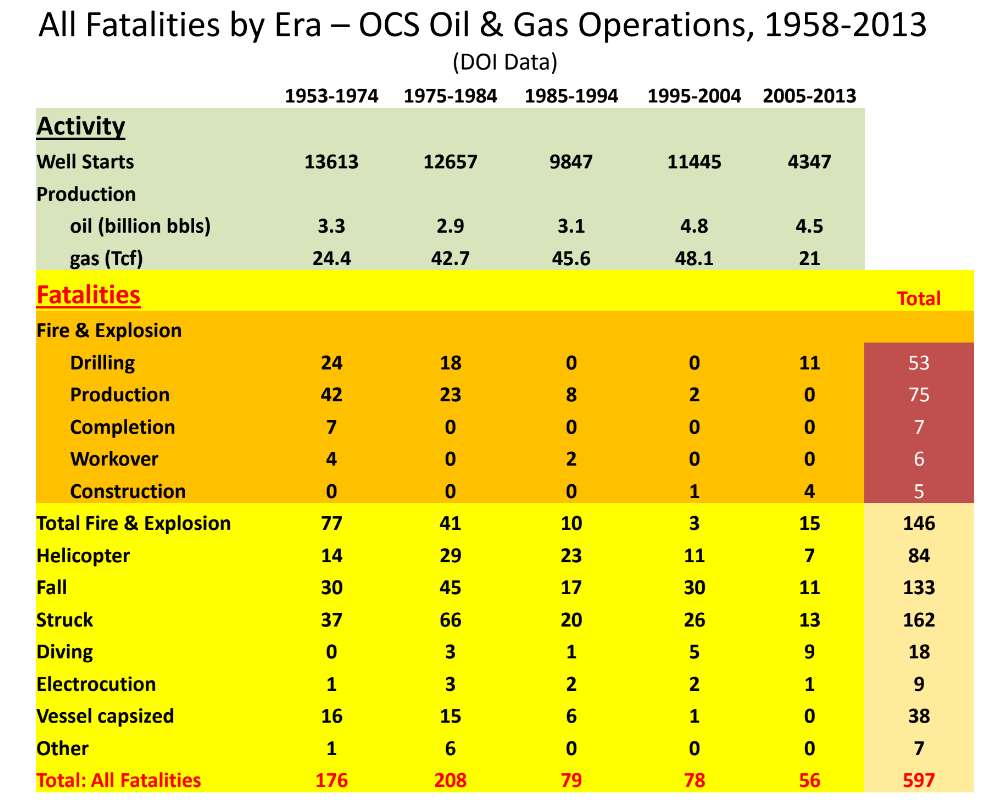
Historic fatalities data – US OCS
Posted in accidents, Gulf of Mexico, Offshore Energy - General, well control incidents, tagged falls, fires and explosions, helicopter incidents, OCS fatalities, struck by equipment on March 14, 2023| Leave a Comment »
Per yesterday’s post, below are US OCS fatality data from a 2014 presentation. Ten year intervals were selected for 1975-2004. The longer 1953-1974 era was selected so the activity indicators (well starts and production) would be comparable with the next 3 intervals. The last interval (2005-2013) was limited because the presentation was prepared in 2014.
Fire/explosion fatalities exceeded fall/struck fatalities only in the first interval (1953-1974). As one would expect, the fire/explosion deaths were associated with a limited number of better known incidents (e.g. Main Pass 41, Bay Marchand, Macondo). While the overall trend is favorable, fall/struck incidents and helicopter fatalities at offshore platforms have proven to be more chronic.
I hope to update these data in the not too distant future.
2021 losses of well control – US OCS
Posted in accidents, Gulf of Mexico, well control incidents, tagged 2022 incidents, blowouts, BSEE Director, Gulf of Mexico, losses of well control, shallow water flows, well completion incident on February 8, 2023| Leave a Comment »
Now that the 2021 US OCS incident spreadsheet has been posted and I have commented on the fatalities, I’ll be looking at some incidents by category starting with losses of well control (LWCs). Incident summaries and links to investigation reports follow the bullet points.
- 4 LWCs incidents in 2021
- None posed a significant threat to worker safety or the environment
- All were deepwater wells
- 3 were during exploratory drilling and 1 was during completion operations
- All 3 drilling incidents involved water flows after setting 22″ surface casing.
- Gas/water flows during/after cementing operations continue to be the leading cause of LWCs.
- At least one resulted in the loss of the well; unclear regarding the other 2.
- All 3 were exploration wells
- Per the Lars Herbst review, there were 29 new deepwater exploration well spuds in 2021, so >10% of these experienced losses of well control due to water flows. Much work has been done on preventing top-hole water flows while drilling deepwater wells, but it appears there is more work to do.
- The completion LWC was the result of the inadvertent opening of fluid control devices. The report on this incident provides important information for well completion risk assessments.
Incident summaries
Spreadsheet incident 19: Well completion operation. Inadvertent shearing and opening of the fluid loss control devices were not adequately assessed during the planning and review phases of the completion. While displacing the wellbore from 14.8 ZnBr to 14.8 packer fluid, the downhole equivalent circulating density sheared the upper and lower fluid loss control devices. The rig immediately began to experience fluid losses of 600 bph. A 50 bbl fluid loss pill was spotted and losses slowed to 345 bph. A second fluid loss pill was pumped which significantly decreased the losses eventually resulting in zero losses. After losses stopped, the rig experienced approximately a 14 bbl gain on the trip tank. The well was shut in on the annular and circulated out using the driller’s method. Oil was observed in the returns. While waiting on additional fluids and materials, wellhead pressure was managed by bullheading 14.8 brine when required. The well was killed via bullheading down the annulus followed by bullheading down the workstring with 3 CaCo3 pills. investigation report
BOE comment: While the cause of this incident is classified as “human error,” the failure to properly assess and plan for risks associated with the inadvertent shearing and opening of the fluid loss control devices is an organizational/management issue.
Incident 186: Shallow water flow during exploration drilling. Lost well. A shallow water flow was observed from one of the ports in the 38″ wellhead housing following cementation of the 22″ riserless casing string at Caramel Keg (GB 962 #1). Additional wireline logging (casing bond log and temperature log) runs were performed to gain additional insights into the potential source/location of the flow, as well as the quality and presence of cement behind the 22″ casing string. Approval from BSEE Lafayette district was received on April 1st to proceed with running the riser/BOP and continue with subsequent planned operations. Flow from the wellhead was monitored and a general reduction trend in flow from wellhead port was observed. Approval was received from BSEE on April 19th to install and close ball valves on two wellhead ports to isolate flow from wellbore. On April 20th, the ball valves were closed and flow from the wellbore ceased approximately 23 days after initial observation. Approval to temporarily abandon the well was received from BSEE on April 25, along with a monitoring plan of the wellbore and the surrounding area. TA operations concluded on April 27th. The ongoing monitoring program has since identified no indications of flow/broaching at or near the GB 962 #1 wellbore as of May 7th. No personnel were injured or evacuated as a result of this subsurface shallow water flow. report
Comment: The BSEE incident investigation team determined that salt contamination probably caused the cement to go under-balanced triggering flow and channeling behind the 22-in casing.
Incident 478: Exploration well – 7188′ WD; exploration. The 22″ casing cement job went as planned with positive cement returns to the mudline from dye and pH meter. The rig observed post cementing flow. Flow was predominantly gas. The flow started with a single source from the seabed, about 20 ft away from the wellhead. Within the next 2-3 hours, two other flow sources developed, one immediately adjacent to the jetpipe while another flow source surfaced about 10ft away from the wellhead. The rig continued to monitor the post cementing flow and completed multiple ROV wagon wheel surveys. No new seafloor anomalies or active flow points were identified away from the wellhead. Minor flow of water and gas continued at the wellhead. No investigation report.
Incident 507: Post Cement Flow Summary: The 22″ casing was cemented in place at 2:30 AM on August 18, 2021. At approximately 5:45 AM, a minor post cementing flow was observed by the ROV. The flow was only observed from 1 cement port/ball valve connected to the 28″x22″ annulus. The flow composition was predominately cement and absent hydrocarbons. The ROV continued to monitor the flow. No investigation report.
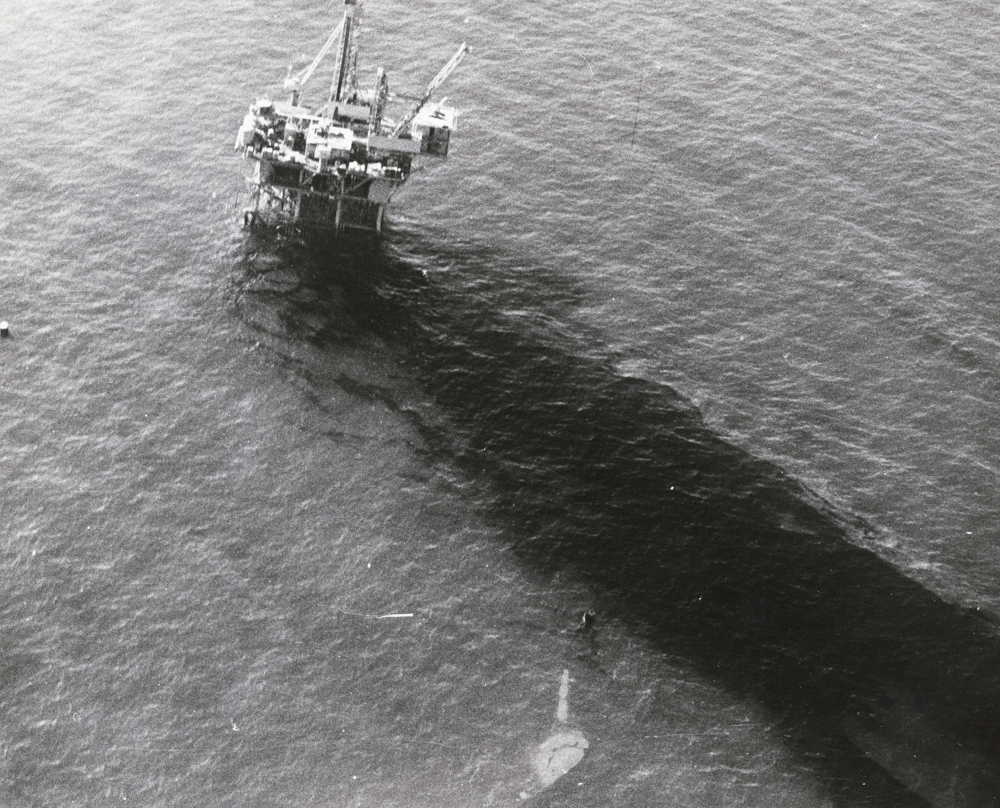
54 years ago today a reckless well plan scarred the US offshore program and ignited the environmental movement
Posted in California, Offshore Energy - General, oil spill response, seeps, well control incidents, tagged 1969, Dos Cuadras field, Platform A, Santa Barbara blowout, Union Oil Company on January 28, 2023| Leave a Comment »

Raphael Moura (ANP Brazil) interview
Posted in IRF, Offshore Energy - General, Regulation, well control incidents, tagged ANP Brazil, IRF, offshore safety, Raphael Mouro, well control on December 22, 2022| Leave a Comment »
Raphael is a highly regarded offshore safety leader and a positive force for continuous safety achievement in Brazil and internationally.
OK, but what do you think about the revisions to the Well Control Rule? 😀
Posted in Offshore Energy - General, Regulation, well control incidents, tagged BSEE Director, comments, Well Control Rule on November 23, 2022| Leave a Comment »
I recommend we Nationalize the Oil and gas industry. I think the government is the right entity at this time to seize all the assets and infrastructure of the cartels. The resources mostly on public lands and water, belong to the USA anyway. It is time we transition more rapidly to renewables to break the leverage of the cartels on governments, and people, to stop wars and profiteering.
People are paying high prices and cartels like API, Exxon, Sinclair are making record profits from American’s purses. All the while escaping the costs of oil spills and leaks, and denying responsibility for climate change disasters and their costs.
Anonymous WCR commenter (0010)
Diverse input on proposed regulations is healthy and desirable. However, comments should not be posted at Regulations.gov unless (1) the commenter is identified and (2) the comments include at least one sentence about the regulation being proposed.
Well Control Rule commenters
Posted in Offshore Energy - General, Regulation, well control incidents, tagged BSEE, commenters, Well Control Rule on November 22, 2022| Leave a Comment »
Per Regulations.gov. BSEE received 30 comments on the proposed revisions to the Well Control Rule, 25 of which have been posted. The other comments were presumably deemed inappropriate for posting per the guidance at Regulations.gov.
Two of the responses were submitted collectively by 8 industry trade associations. Only 3 operating companies commented and their comments largely echoed the trade association responses. Only 2 drilling contractors responded independently. Four service and engineering companies commented.
Three environmental organizations, a group of Atlantic states, a government watchdog, and a law school provided comments.
Three individuals and 4 anonymous or unknown parties commented.
Below is a list of the respondents preceded by their comment identifiers. More to follow.
- 0003 Foley Engineering
- 0004 Frank Adamek
- 0005 Anonymous
- 0006 Project on Government Oversight (POGO)
- 0007 E.P. Danenberger
- 0008 Chevron
- 0009 B. Mercier
- 0010 Anonymous
- 0011 Anonymous
- 0012 Foley Engineering (2nd comment)
- 0013 HMH (?)
- 0014 NYU School of Law
- 0015 Beacon Offshore
- 0016 Shell
- 0017 Diamond Offshore
- 0018 7 industry trade associations: API, IADC, IPAA, NOIA, OOC, EWTC, USOGA
- 0019 NOV (service company)
- 0020 NRDC
- 0021 Oceana
- 0022 Transocean
- 0023 Louisiana Mid-Continent Oil & Gas Association
- 0024 Kinetic Pressure Control Limited
- 0025 Attorneys General of Maryland, Connecticut, Maine, Massachusetts, New York, and North Carolina
- 0026 Ocean Conservancy
- 0027 Rigscope International
Comments on revisions to BSEE’s Well Control Rule
Posted in Offshore Energy - General, Regulation, well control incidents, tagged BSEE, comments, Well Control Rule on November 10, 2022| Leave a Comment »
Comments on the proposed revisions to BSEE’s Well Control Rule are due on Monday (11/14/2022). My comments were submitted yesterday, and I have attached a copy for those who might be interested. Bud
Comments on BSEE’s proposed Well Control Rule are due by Nov. 14
Posted in drilling, Offshore Energy - General, Regulation, well control incidents, tagged BOP, BSEE, comments, Well Control Rule on October 18, 2022| Leave a Comment »

Comments on BSEE’s proposed revisions to the Well Control Rule are due in 27 days (by Nov. 14). Given the fundamental importance of well control to offshore safety and pollution prevention, all interested parties are encouraged to comment. Although some of the proposed revisions are rather nuanced, the document is neither long nor complex.
My completely independent comments are being drafted and will be posted here after they have been submitted to Regulations.gov.
My comments will explain why the proposal may reduce the rigor of the BOP system performance standard and will address a related shear ram issue. The comments will also discuss the management of BOP equipment failure and other safety data, the use of independent third parties and standards development organizations, dual shear rams on surface BOP stacks, ROV intervention capabilities, and BOP test data reporting and management.
 Bud's Offshore Energy (BOE)
This Well Control Rule comment, endorsed by 7 trade associations, hit a nerve. Here’s why.
Posted in drilling, Offshore Energy - General, Regulation, well control incidents, tagged BSEE, NTTAA, standards, standards vs. regulations, trade association comments, Well Control Rule on November 30, 2022| Leave a Comment »
The comment (pasted below) by the trade associations asserts that BSEE ignored the requirements of the National Technology Transfer and Advancement Act (NTTAA).
Reaction:
Read Full Post »