Feeds:
Posts
Comments

Posts Tagged ‘World Bank’

World Bank flaring data have some limitations as discussed in a previous BOE post. However, they provide an objective means of estimating and comparing flaring volumes worldwide, and therefore merit close attention.

The latest World Bank data tell us that significant gas flaring issues persist. Worldwide, 138,549 million m3 of gas were flared in 2022. This equates to a massive 4 tcf, the equivalent of the reserves in a major gas field and more than 5 times the total gas production in the Gulf of Mexico in 2022.

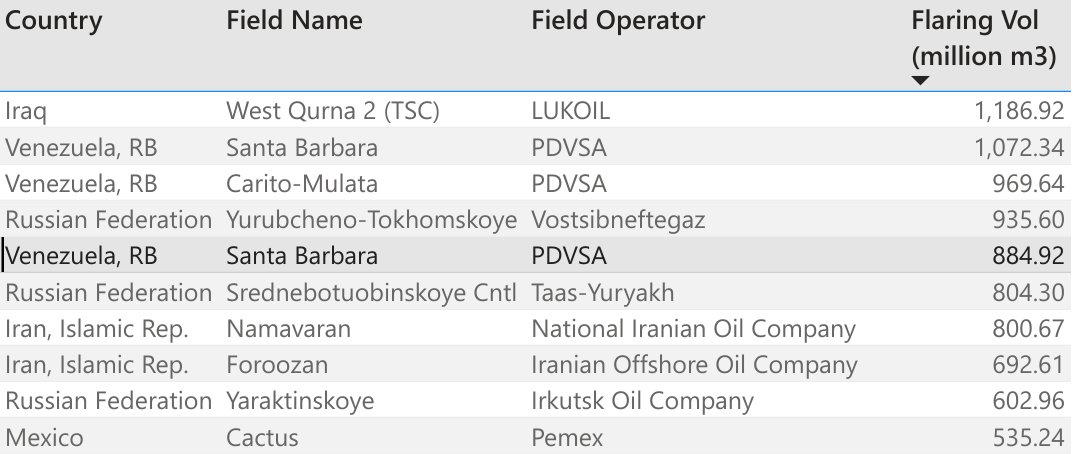
The top ten “flarers” are listed below. Each of these fields flared from 19 to 42 bcf. For comparison, the top ten GoM gas producers in 2022 produced 10 to 57 bcf, so single fields are flaring more than GoM companies are producing in total. Assuming for discussion purposes a gas-oil ratio of 1000 cu ft/bbl, all of the gas associated with 19 million to 42 million barrels of oil production was wasted from each field.
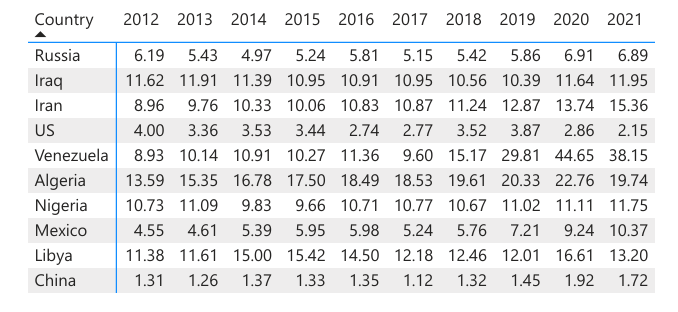
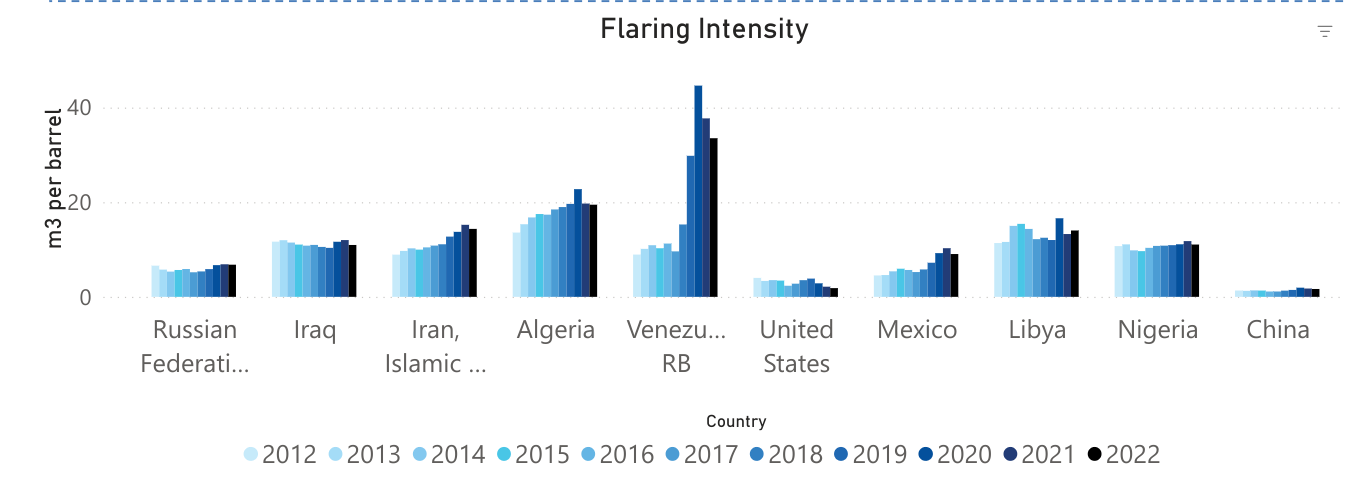
Posted below are the World Bank’s flaring intensity data (m3 of gas flared per bbl of oil produced) for the 10 countries with the highest flaring volumes. Venezuela’s flaring intensity rose to 44.6 m3/bbl in 2020, before declining moderately the following 2 years. 44.6 m3/bbl equates to 1575 cu ft/bbl. This gas flaring to oil production ratio implies that a very high percentage of Venezuela’s associated gas production was flared.
Here in North America, we have flaring issues of our own. Mexico’s Cactus Field is a top ten flarer (first table above) with 534.5 million m3 flared in 2022. The World Bank also lists 6 Permian Basin fields with >50 million m3 of gas flared in 2022.

Zeroing in on the US/Canada offshore sectors, fields with >1 million m3 of gas flared (2022) are listed below. Four of the top 7 are offshore Alaska and Newfoundland where the gas cannot currently be marketed and reinjection, field use, and flaring are the only options. Can production from these fields be better managed to reduce flaring volumes?

fieldoperatorm3 (millions)f3 (millions)
White Rose (Nfld)Cenovus41.691472
Hibernia (Nfld)HMDC40.991448
ShenziBHP31.341107
Northstar (AK)Hilcorp11.23397
ConstitutionOxy10.76380
PompanoTalos10.54372
Endicott (AK)Hilcorp10.07356
UrsaShell8.19289
MarmalardMurphy6.62234
LuciusOxy3.09109
MarlinOxy3.08109
MarsShell2.278
HolsteinOxy1.4852

The extraordinary 1.1 bcf of gas that was flared at the Shenzi field may help explain the large (1 bcf) increase in oil well gas flaring in the Gulf of Mexico in 2022. Based on the World Bank data and ONRR data for the GoM, Shenzi accounted for 16% of GoM oil-well gas flaring in 2022. As noted in that post, more regulator/industry transparency on lease and field specific flaring is needed. ONRR’s posting of flaring and venting data is a positive step, but it doesn’t include lease specific data and doesn’t explain major flaring episodes.

Read Full Post »

This misleading headline was featured in Reuters’ “Power Up” newsletter (26 Jan 2023):

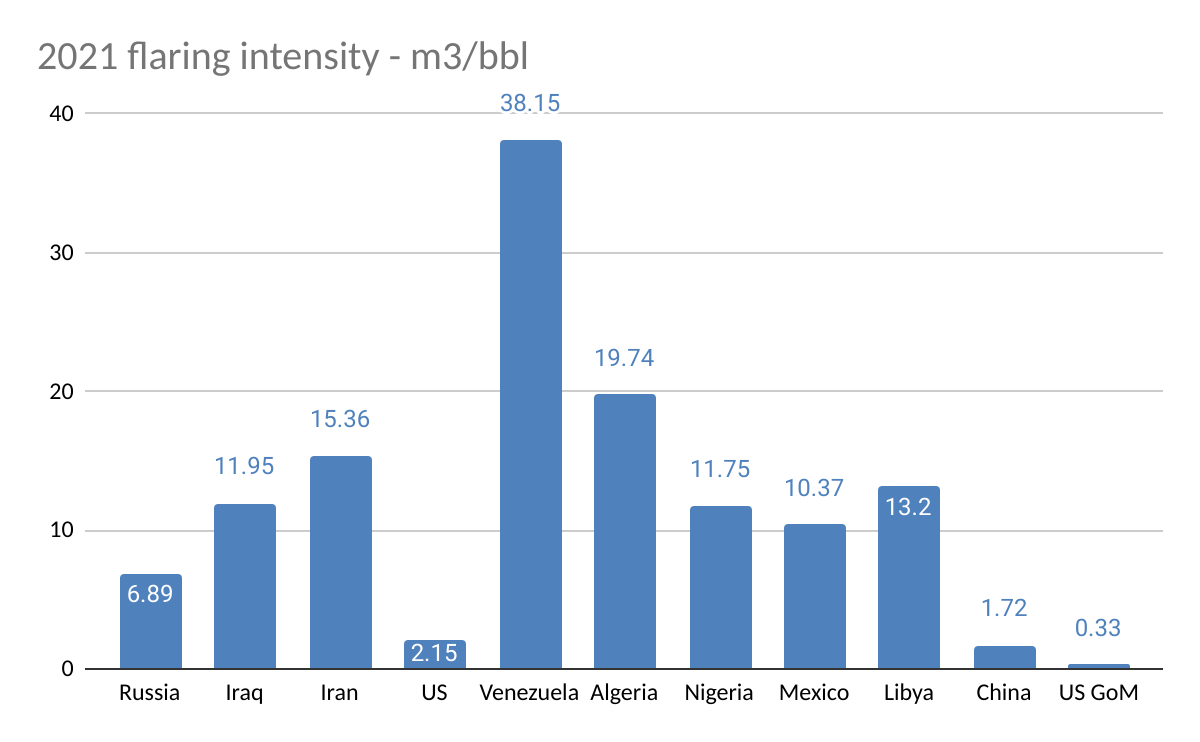
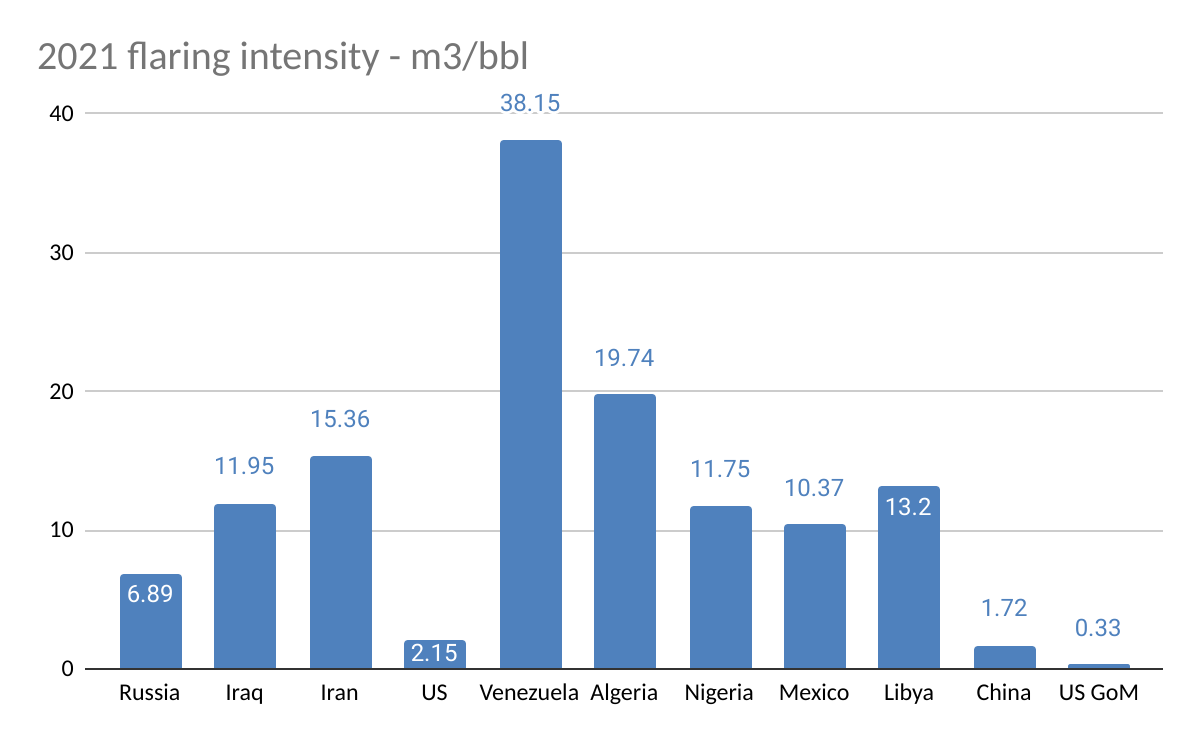
An objective flaring assessment would have also considered the volume of oil and gas produced. The World Bank uses flaring intensity (m3 flared per bbl of oil produced) to normalize their flaring data and provide perspective. The chart below is derived from World Bank flaring intensity data and Gulf of Mexico data from mandatory flaring and venting reports for the same year (2021). These normalized data sharply contradict the Reuters message.

Reuters might also have noted (World Bank table below) that the US flaring intensity score declined by 46% between 2012 and 2021. Each of the other “top flaring” countries had flaring intensity increases during that period.

World Bank

Finally, while I applaud the World Bank’s efforts to monitor worldwide flaring, some issues with their methodology were identified in a prior BOE post.

Read Full Post »

Using the World Bank’s worldwide flaring data and ONRR flaring and venting data for the GoM, I compared GoM flaring intensity for 2021 with that of the World Bank’s top ten flaring nations. This is just one example of why US offshore production is a preferred and vital component of our energy mix.

Further discussion: Kudos to the World Bank for their use of satellite data to estimate flaring volumes worldwide. Their primary performance indicator is flaring intensity (volume flared per bbl of oil produced). Absent better worldwide reporting regimes, satellite data are essential. However, there are issues with the World Bank’s system that merit further consideration:

  • Satellites miss some flares and vented gas (a more significant GHG concern) is not detected
  • A prior review of Gulf of Mexico data indicated that the World Bank flaring estimates are low.
  • The flaring intensity indicator penalizes higher gas-oil ratio (GOR) wells. Production upsets of the same duration yield higher flaring intensity scores at higher GOR facilities.
  • Associated gas is an environmentally favorable energy source that should not be discouraged. Most Gulf of Mexico gas production is now from oil wells. Efficient collection and utilization is the key.
  • There will always be some production upsets that result in flaring. The objective should be to minimize the % of oil-well and gas-well gas that is flared, irrespective of the amount of oil production. See the recent GoM summary data posted here and here.

Read Full Post »

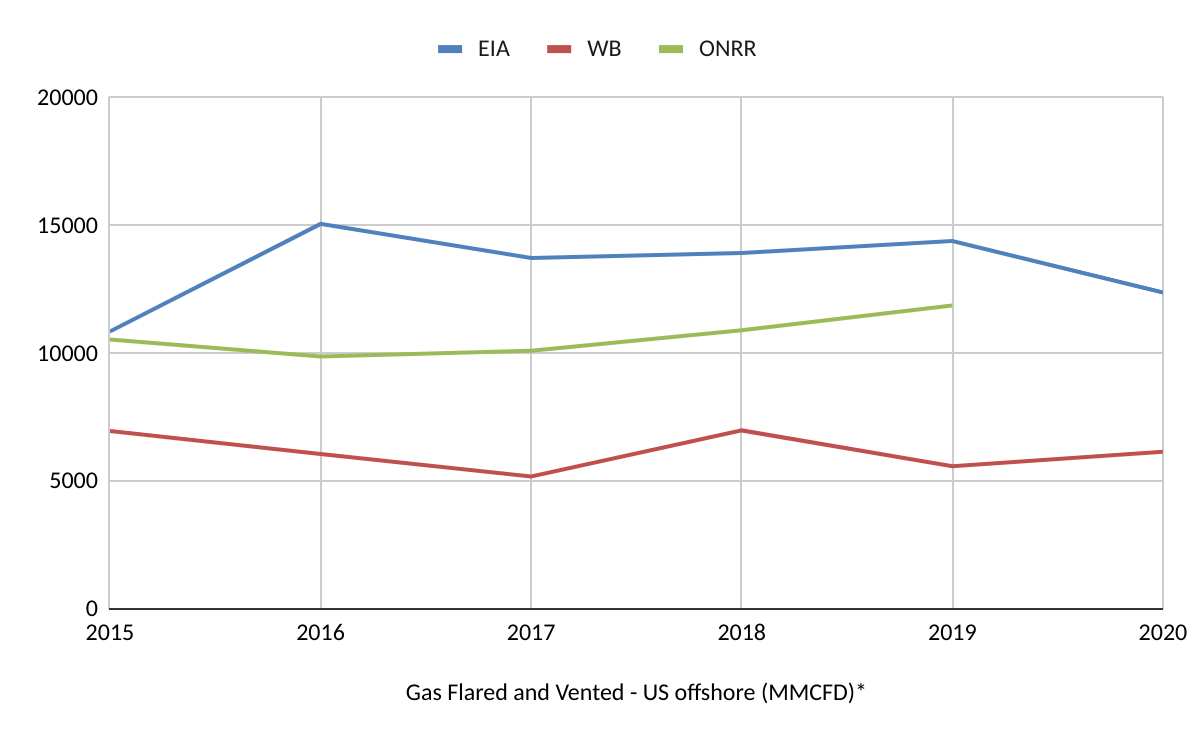
Given the importance of flaring and venting from both environmental and resource conservation standpoints, accurate and reliable data are necessary and should be readily available to the public. ONRR has advised me that they will begin posting flaring and venting data on their website within 2 months. This is a positive step. Currently, data from the 3 primary sources differ considerably.

Data Sources:

Comments:

  • The EIA (from BSEE) and ONRR flaring/venting numbers should be the same given that the ONRR data are reported in accordance with BSEE regulations, and BSEE is presumably providing ONRR data to EIA. This needs to be clarified.
  • The World Bank’s gas flaring estimates are based on observations from satellites. This explains their lower numbers given that vented gas would not be detected and some flares might be missed.
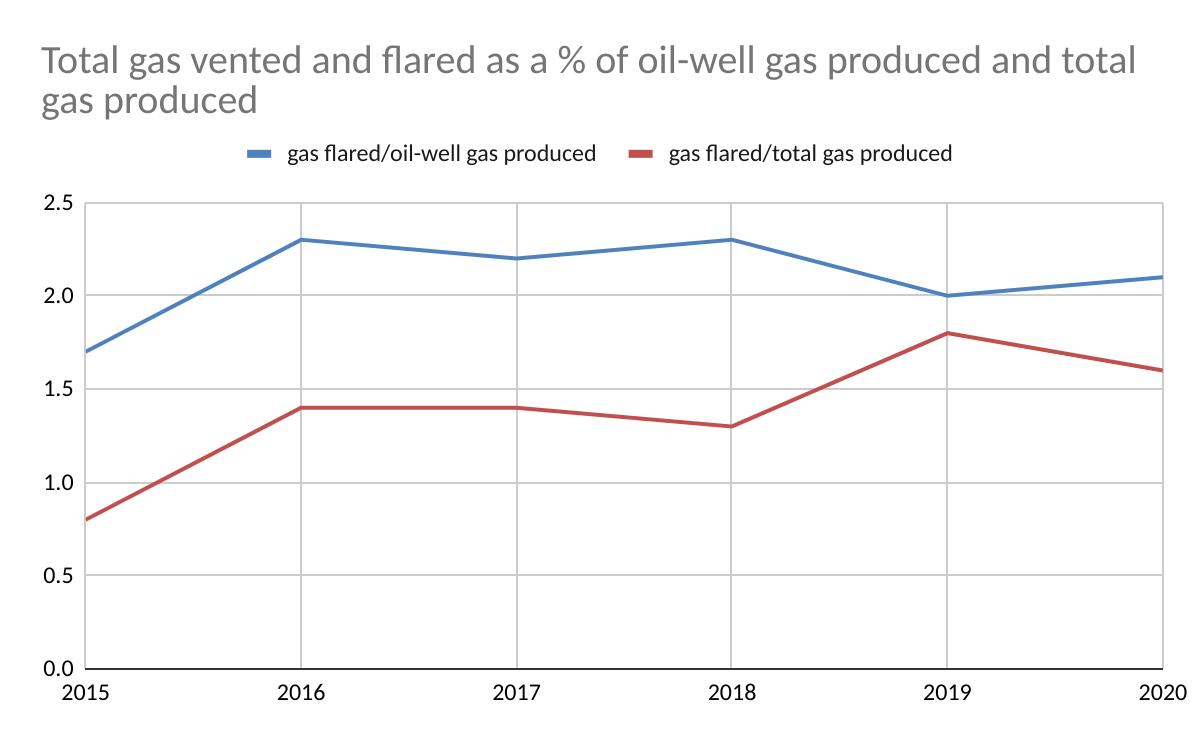
  • In a 1/2021 interview with World Oil, the exiting BSEE Director commented that the “industry has consistently achieved a ratio of less than 1.25% of flared, vented gas to produced gas.” However, based on EIA flaring and venting data (from BSEE per EIA) and EIA gas production data, the volume of gas flared/vented exceeded 1.25% of the gas produced from 2016-2020 and was as high as 1.8% in 2019. (See the chart below.) Even if the lower ONRR flaring/venting totals are used, those volumes exceeded 1.25% in 2019 (1.5%).
  • BSEE/ONRR should make more detailed flaring/venting data available so that the differences between facilities and sectors (e.g. deepwater vs. shelf) could be assessed. Efforts should also be made to post these data in a more timely manner. At this time, 2021 data are still not available.

Reports of interest:

  • Argonne report for BSEE (2017):
    • p. 17 – “The 2015 BSEE/BOEM study on reducing methane emissions observed that “while natural gas production has declined, …vented and flared gas volumes as a percentage of produced natural gas are increasing” and noted that additional investigation is needed to determine why.” This is consistent with my observations and is probably due in large part to the fact that most gas production is now from oil-wells (e.g. associated gas).
    • p. 24 – “Argonne estimates, in 2015, platform startups for deep-water floating structures accounted for roughly 15% of the total annual flaring volume on the OCS and an additional 20% of the annual total resulted from monthly spikes associated with compressor outage, pipeline maintenance, and well-unloading.”
  • Univ. of Michigan study (2020): “Large, older facilities situated in shallow waters tended to produce episodic, disproportionally high spikes of methane emissions. These facilities, which have more than seven platforms apiece, contribute to nearly 40% of emissions, yet consist of less than 1% of total platforms.” 

Read Full Post »