Feeds:
Posts
Comments

Posts Tagged ‘well control’

This well-written draft report is fascinating reading for those who closely followed the various attempts to contain and kill the Macondo well.

A couple of concerns:

  1. The report relies heavily on anecdotes and qualitative judgments attributed to unnamed individuals. For example, twelve sources are cited in the footnotes on page 6, but only one is mentioned by name.  No information is provided about the qualifications or responsibilities of the unnamed sources, so it is difficult to assess the significance of their comments.
  2. The narrative ends rather abruptly without any discussion about the decision to continue with the relief well after the successful static kill operation.  The report simply states that BP proceeded with the relief well to finally kill Macondo.  As indicated previously on BOE, this is not entirely accurate. Macondo was already killed, and the well could have been secured through conventional plugging and abandonment procedures.  The relief well was presumably continued to verify that the annulus was sealed and provide information that might be useful as part of the investigation.  However, the relief well did not kill the well and the intercept was not necessary for that purpose.

Read Full Post »

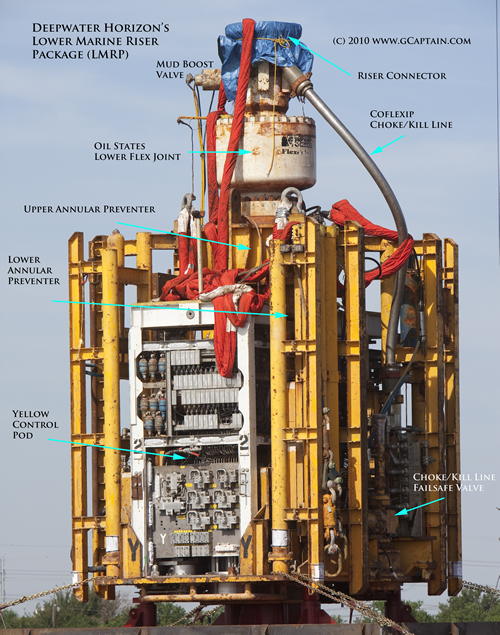
BOP stack awaiting post-Macondo inspection (from gCaptain.com)

In my 11 May 2010 testimony before the Senate Energy and Natural Resources Committee, I made ten recommendations. While many of the issues raised in that testimony are being addressed, one of the more important recommendations (no. 4) has received little or no attention. This recommendation calls for a public or private system for collecting and assessing failure date for blowout prevention equipment.  To the best of my knowledge, the only publicly available performance data for BOPE were collected by MMS and SINTEF and pertain to failures during BOP pressure testing, not failures during other operations.  How can we have a credible safety system without comprehensive failure data for such critical well control equipment?

Dr. Malcolm Sharples, an important BOE contributor, identified a number of BOP performance issues since Macondo.  Here are a few examples:

  1. During routine tests on the device, the locking system of one of the rams jammed in a locked position. Sevan is working with Petrobras and the supplier, Cameron, to find a solution.
  2. Reliance suspended all drilling work in the block after the Transocean rig Deepwater Expedition developed technical problems in its BOP. Reliance was drilling the KGV-D3-W1 well in the contract area since April 2010.
  3. The rig was offshore Australia for Shell early last month when newly installed BOP components failed during operations. Following several unsuccessful attempts to rectify the problems in the field, the failing BOP component is currently undergoing repairs in Singapore.

How is this information not important to every operator, regulator, and drilling contractor?  A comprehensive BOP failure reporting system should be a high and immediate priority for the offshore industry.  The information should be verified and published so that all may learn and future performance improved. Requirements for providing such information should be included in contracts and, if necessary, regulations.

An other major void that I have been talking about for years, without much success, is the absence of a comprehensive and verified international incident reporting system.  I assumed this would be universally recognized immediate necessity, and a critical element of the offshore industry’s initiatives agenda. Apparently that is not the case.  More on this to follow.

Read Full Post »

Deepwater Horizon

Nothing new, but a but a very good Macondo commentary by Bill Campell, a retired Shell employee. Worth reading.

In my opinion this event is not so much about the well as designed but the well as installed. Installing a well is similar to any other civil engineering project in that what is installed has to be tested or commissioned before it is put into use, just as you would test a vessel or pipeline designed to contain hydrocarbons under pressure.   Wells, which are discovered to have a problem during integrity tests indicating for example a connection between the well and the reservoir, are worked over to rectify the problem and in a few hours after remedial activities have been undertaken, the integrity testing is re-commenced. Bill Campbell

Read Full Post »

The Petroleum Safety Authority of Norway has commented on Statoil’s report on the well control incident at Gullfaks C:

The PSA regards the incident as very serious. It involved the lengthy loss of a barrier. Only chance averted a sub-surface blowout and/or explosion, and prevented the incident from developing into a major accident.

PSA had directed Statoil to do the following:

  1. To review and assess compliance with the work processes established to safeguard the quality and robustness of the well construction process on Gullfaks. This must include an investigation of why important deficiencies were not picked up during the work. Necessary improvement measures related to the work processes and their use must be identified and implemented.
  2. To conduct an independent assessment of why measures adopted after earlier incidents, including the gas blowout on Snorre A in 2004 with similar causes, have not had the desired effect on Gullfaks. Based on the results of this work, the company must assess the need for and implement new and tailored improvement measures on Gullfaks.
  3. To assess the results of the work done under items 1 and 2 and – on that basis – implement measures in the rest of the company.
  4. To prepare a binding plan for the way this work is to be executed and followed up. This plan must be submitted to the PSA.

Read Full Post »

Link

The National Academy of Engineering and the National Research Council have released the interim report of the Committee on the Analysis of Causes of the Deepwater Horizon Explosion, Fire, and Oil Spill to Identify Measures to Prevent Similar Accidents in the Future. The interim report includes the committee’s preliminary findings and observations on various actions and decisions including well design, cementing operations, well monitoring, and well control actions. The interim report also considers management, oversight, and regulation of offshore operations.

Comment: No significant surprises.

Read Full Post »

BOP stack awaiting post-Macondo inspection (from gCaptain.com)

Other than the mildly amusing skirmish about the positioning of representatives of the various factions during the inspection process (Hey, how about access for bloggers!) and some silly comments about the independence of the inspection contractor, there has been very little attention paid to the Deepwater Horizon BOP examination that is scheduled to begin today at NASA’s Michoud facility in New Orleans. The absence of media interest is surprising given the importance of this part of the Macondo investigation. Presumably, there will be more extensive coverage beginning today.

While the inspection and testing will be quite technical, some important aspects should be rather straightforward.  What is the position of the rams, particularly the shear ram?  What is the condition of the ram elements and annular preventer?  Is there evidence of control line leakage?  What can be determined about the electronics and the sequencing system designed to automatically actuate the shear ram when power is lost or when the riser is disconnected?

Hopefully, the official investigation website, which currently has no information on the BOP inspection program, will provide updates.  While we don’t expect immediate information on the findings, there should be reports explaining how the inspection program is being conducted and what has been accomplished.

Read Full Post »

With all of the discussion about the float collar issues, I thought I was listening to the Montara hearings this morning.   I’m surprised that neither the Commission questioners nor the panelists have mentioned Montara. When you have two major blowouts within 8 months and they have very similar root causes, the similarities should be of enormous interest. The absence of information transfer that might have prevented Macondo should be a major consideration in these and other hearings.

We have been talking about the similarities between Montara and Macondo for months.  Colin Leach’s 28 September post draws further attention to this issue.  Colin also hit the nail on the head with his comment that an additional barrier should have been installed above the float collar before proceeding.

Read Full Post »

Hats off to the Commission attorneys and staff for today’s presentations and questioning.  They were very well prepared, conducted themselves in a professional manner, and focused on the causes (not who should be blamed). The format was excellent with the Commission presenting their tentative findings and then asking the industry panel how they felt about each finding.

Oddly, the only real speculation was by the industry panelists, most notably the comments below about the flow path and BOP performance. Not very subtle!

Read Full Post »

Based on lower than expected pressure readings during the cementing operation, Halliburton (Richard Vargo) contends that hydrocarbons entered the annulus (outside production casing) during cementing, rose to the wellhead before the seal assembly was set, and raised the seal assembly after it was set.  They believe that subsequent flow was inside production casing, but that the initial burst was up the annulus. This position is inconsistent with current view of the Commission and all of the other parties.

Read Full Post »

The incident occurred on 19 May 2010.  We appreciate Statoil’s timely completion and public release of the report.  The report is in Norwegian, but an English summary is provided.

What happened:

  1. A platform well on Gullfaks C was drilled in managed pressure drilling (MPD) mode to a total depth of 4800 meters.
  2. During the final circulation and hole cleaning of the reservoir section, a leak in the 13 3/8” casing resulted in loss of drilling fluid (mud) to the formation.
  3. The loss of back pressure led to an influx of hydrocarbons from the exposed reservoirs until solids or cuttings packed off the well by the 9 5/8” liner shoe.
  4. The well control operation continued for almost two months before the well barriers were reinstated.

Statoil’s near-term action items:

  1. Develop new acceptance criteria and best practices for MPD on Gullfaks.
  2. Update pressure prognoses for the field.
  3. Document that the shear ram is capable of cutting the drill string.
  4. Change the shift relief plan for the Drilling Supervisor and Toolpusher on Gullfaks C.
  5. Review the procedures for communication and mustering with the emergency preparedness organization.

Read Full Post »

« Newer Posts - Older Posts »