Feeds:
Posts
Comments

Posts Tagged ‘unified command’

After 5 months of investigation, the Main Pass Oil Gathering (MPOG) system has finally been cleared for production. (The Coast Guard update only says that the pipeline passed the integrity test, but I assume the operators may resume production though the MPOG system.)

Only a small connector leak that was previously reported was identified during the extensive integrity testing. The Coast Guard had advised that the connector leak was not the source of the large sheen that was observed in November.

So what was the source of the November sheen and what was the basis for the 1.1 million gallon spill volume estimate? The sheen was not indicative of a spill of that magnitude. Did the Coast Guard et al assume a worst case loss from the MPOG system, even though no leak had been identified?

Is this the most oversight ever for a pipeline integrity test?

The removal and replacement of the spool piece and the subsequent integrity test of the MPOG line were conducted under the close supervision of the Unified Command and Pipeline and Hazardous Materials Safety Administration. During both operations, spill response vessels were on site, along with divers, remotely operated vehicles, helicopters equipped with trained oil observers and multi-spectral imaging cameras, and other containment and recovery equipment. No material discharge of oil was observed during these operations.

Unified Command

The NTSB has the lead in the investigation into the source of the sheen. Don’t expect any findings soon.

Read Full Post »

Per the latest update from the Unified Command, a total of only 75 barrels of oil have been recovered (up from 29 bbls reported on Sunday). The 75 bbls no doubt includes some water. It’s unclear as to why so little oil has been recovered (unfavorable offshore conditions? response focused on the shoreline?). Perhaps the volume of oil spilled was less than the 3000 barrel estimate. A few hundred barrels of oil can generate a very large slick.

As BOE and others have suggested, the most likely cause of the spill was a ship’s anchor. SkyTruth’s review of satellite data points to that possibility.

SkyTruth image

The Orange County District attorney seems unhappy with the possibility that (1) the pipeline was struck by an anchor and (2) the leak was in Federal waters:

The Orange County district attorney, Todd Spitzer, said he has investigators looking into whether he can bring state charges for the spill. Spitzer said his jurisdiction ends 3 miles offshore.

Spitzer also said Amplify’s divers should not be allowed near the pipeline without an independent authority alongside them.

AP article

The DA’s insistence that independent divers accompany the company’s divers may be a first in the history of the US offshore program. Isn’t video documentation sufficient? Diving is not risk free.

Read Full Post »

BOE has previously commented that completion of the Macondo relief well appeared to be unnecessary, and and that the intercept adds additional risk to the plugging and abandonment operation.  Pasted below are disconcerting Unified Command and BP statements about the intercept followed by BOE comments:

I have stated over and over again, let me be perfectly clear. I am the National Incident Commander. I issue the orders. This will not be done until we complete the bottom kill. Admiral Allen, 5 August 2010

Comment: While I believe Admiral Allen has performed well in the difficult and thankless job of incident commander (as did Admiral Landry before him) and wanted to make it clear that the government was in charge of this operation, this strong statement appears to have painted the Unified Command into a corner.

… in response to BP’s request to consider foregoing the relief well, the government scientific technical team has determined that the benefits of the bottom kill procedure outweighs the risks. (14 August letter from Admiral Allen to BP)

Comment: Reading between the lines, we assume that at least some BP engineers favored foregoing the relief well intercept, and wanted to proceed with a conventional plugging and abandonment operation.  Was their proposal given serious consideration?  How could it have been given the Admiral’s prior statements about completing the relief well?

We are currently working with BP engineers and our science team to look at test results and do investigations to lead us to the best way to mitigate any risk of intercepting the annulus and increasing the pressure in the annulus. Admiral Allen, 16 August

Comment: Much attention continues to be focused on mitigating the risks of an operation that appears to be unnecessary.

There are several reasons for the relief well to be completed, including demonstrating that the difficult procedure can be done, providing more scientific data about the leak and giving closure to an oil-weary public. BP CEO Bob Dudley, 29 August

Comments: This BP statement seems to contradict their prior request to forgo completion of the relief well.  With regard to Mr. Dudley’s rationale for completing the relief well, I’ll offer the following:

  1. If BP believes they need to demonstrate relief well intercept capability (not necessary in my view), they should drill into one of the thousands of depleted wells in the Gulf, not Macondo.
  2. This is not a risk-free science project.  Are the risks and delays justified?
  3. The “oil-weary public” needs an offshore industry that is committed to safety and pollution prevention, not symbolic gestures.

And in order to speed the process up, but also ensure that we had the right pressure controls on the well, I’ve signed a directive out to BP earlier this morning, directing them to take a series of measurements on the well head that would allow us to ascertain whether or not the seal in the ring – in the casing hanger were in place and had not lifted and, if that was the case, then to be able to put what we call a sleeve over the top of it that would basically walk that down to the point where it could withstand over one million pounds of pressure and would obviate the need to be able to cement the annulus at the top.

And subject to BP providing me the plans and the results of those tests, that would allow us to go ahead and proceed more quickly without having to cement the top of the annulus.  And based on a revised schedule from BP, we might be able to accelerate going ahead and finishing out the relief well. Admiral Allen, 10 September

Comment: Let me get this straight.  They are going to put off the cementing of the annulus, which will have to be done anyway and would provide a barrier should something go wrong with the intercept, so they can conduct tests (that would be unnecessary if they first cemented the annulus) for the purpose of expediting completion of the long-delayed relief well? Huh?

Read Full Post »
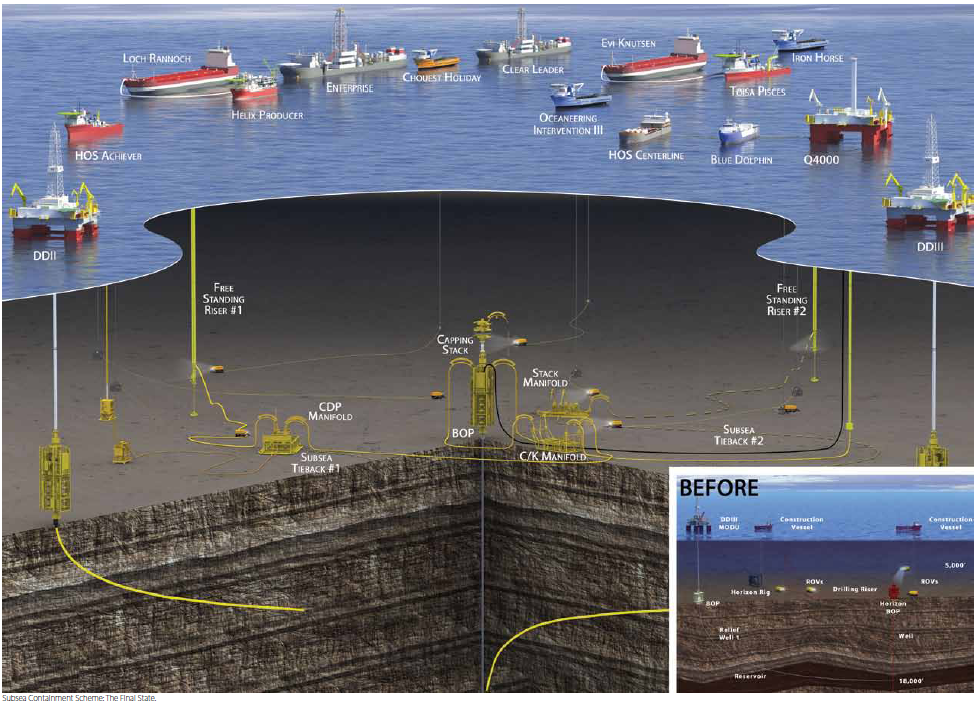
BP has issued a report on the response capabilities and innovative new technology and procedures demonstrated following the Macondo blowout. While the report is somewhat promotional (understandably), the information is summarized and compiled in a useful manner and underscores the magnitude of the response.  Although most close observers probably have issues with certain actions taken by BP or the Unified Command, one cannot deny the unprecedented size and complexity of the response.  We can only imagine how chaotic this response could have been if the operator did not have the resources and the will to mount such an enormous effort.

I hope BP will be similarly forthcoming with the results of their internal review of the blowout’s causes.  When will that very important report be released?

At some point, BP’s candid observations on the functioning and effectiveness of the Unified Command system would also be helpful. The more we can learn about the differences of opinion and problems that arose during the response, the better we can prepare for future incidents.  Will any of the official investigations be looking into these aspects of the response?  At BOE, we are particularly interested in the well intervention, capping, containment, and relief well decisions.

Read Full Post »

Those of us on the “Deepwater Response External Affairs” Mailing List received ten email updates yesterday.  Not one included relief well information. The relief well information that has been provided has been inconsistent and contradictory.

Given the importance of these wells and the apparent confusion among observers (a number of whom have contacted BOE), a daily relief well update would be appreciated, at least for the primary well.  It would be helpful if the subject line said “relief well update.”  This update should include the precise relief well depth, whether the depth is measured (total length) or true vertical, and the point of reference (e.g. below the sea floor).   A short summary of the operations over the past 24 hours would also be helpful.

Read Full Post »