Feeds:
Posts
Comments

Posts Tagged ‘UK’

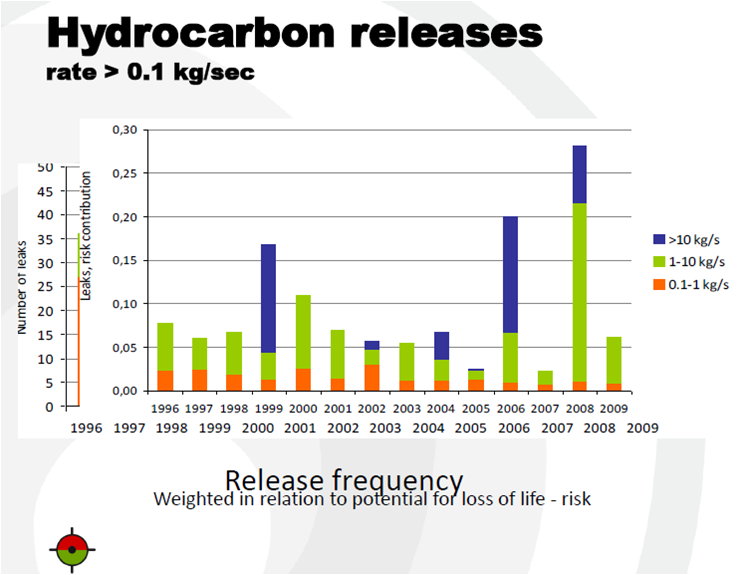
The above slide is excerpted from Torleif Husebo’s presentation at the Vancouver conference.  Since Piper Alpha in 1988, offshore safety leaders have been gathering and assessing hydrocarbon release data.  Norway, the UK, Australia, the Netherlands and other nations track these data because they are an important indicator of fire and explosion risks. The IRF reports these data as part of their performance measurement project.

Obviously, when hydrocarbons are unintentionally released at an offshore facility you have the potential for a very dangerous situation.   However, because of objections voiced when the MMS updated incident reporting requirements 5 years ago, the US government does not collect the detailed information needed to track the size and cause of these releases.  The US is thus unable to monitor trends and benchmark against other nations around the world.

Offshore companies have done well in responding to the drilling issues raised following the blowout.  However, the post-Macondo offshore industry needs to provide broad safety leadership.  A commitment to collecting performance data and assessing risk trends at OCS oil and gas facilities is absolutely essential.  A good place to start would be to initiate a cooperative hydrocarbon release data gathering program.

Read Full Post »

Greenpeace Photo

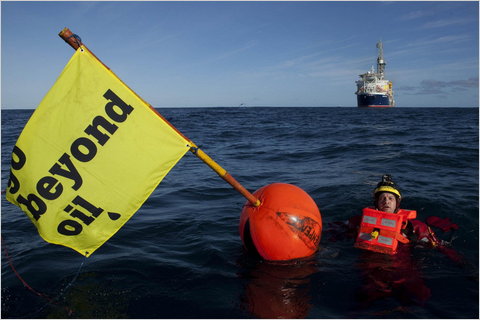
Despite protests, the UK has approved Chevron’s exploratory well in 1640′ of water west of the Shetland Islands.

It was a choice between producing oil and gas here in U.K. waters, where we have one of the most robust safety and regulatory regimes in the world, with all the economic benefits that will bring, or paying to import oil and gas from elsewhere. UK Department of Energy and Climate Change statement

It’s pretty hard to argue with that logic.

Read Full Post »

From the Huffington Post:

Oil-producing countries on Thursday rejected a German proposal for a moratorium on deep-water drilling in the Northeast Atlantic that reflected environmental concerns after the BP Gulf of Mexico oil spill.

So Germany, which has essentially no offshore oil and gas production in its sliver of the North Sea, proposed a ban on deepwater drilling at an OSPAR meeting in Bergen, Norway?  Does the word chutzpah come to mind?  The equivalent might be a Norwegian proposal to ban the manufacturer of luxury cars at a meeting in Stuttgart!

The German proposal also called for making sure that offshore operations meet the highest safety standards and demanded an analysis of whether the circumstances that led to the Deepwater Horizon accident could also occur in the Northeast Atlantic.

Now there is some original thinking.  No one has ever suggested that before! (sarcasm intended)  Don’t you think Norway, the UK, Denmark, the Netherlands, and other countries that actually produce oil and gas might be looking into these issues?  I can assure you that they are, but that they are doing so quietly and professionally without the type of “grandstanding” demonstrated by Germany at the OSPAR meeting in Bergen.

Representatives from Germany and other nations with concerns about the safety of offshore oil and gas operations are encouraged to join us in Vancouver next month for serious discussions about the regulatory practices, technology, and management systems that minimize safety risks.

Read Full Post »

from The Sun

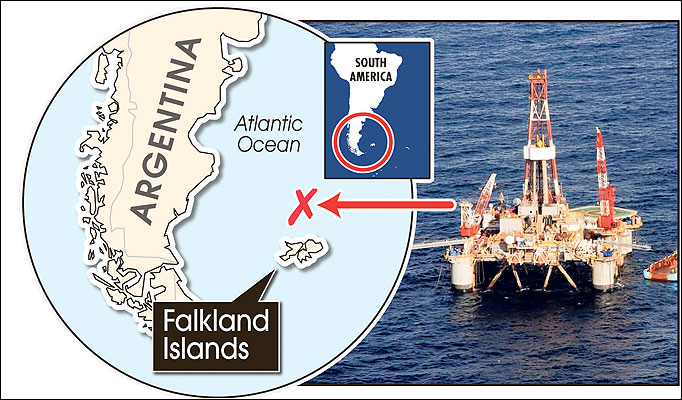
Deepwater drilling may be on hold in US waters, but that is not the case elsewhere.  However, drilling in other parts of the world is not free from political tension and intrigue. Of particular interest is a recent discovery well in 450m of water in the North Falkland Basin. From the Buenos Aires Herald:

As President Cristina Fernández de Kirchner prepares to address the UN General Assembly and renew the Argentine claim on the Malvinas Islands sovereignty, British explorer Rockhopper said its controversial oil discovery offshore the islands could have produced double the amount of oil had a test not been besieged by technical problems.

According to the Sun:

Analysts believe up to 60 BILLION barrels of oil lie in waters off the UK territory.

That estimate would seem to be a considerable stretch (to say the least), but will no doubt complicate the diplomatic challenge facing the UK and Argentina.

Read Full Post »

If you haven’t heard BP executives answer the same questions  (long string, centralizers, cement bond log, BOP failure, etc, etc) often enough during appearances before Congress, you can watch a UK House of Commons committee ask them to Tony Hayward and Mark Bly on cspan’s recording of yesterday’s hearing.  This excellent legislative teamwork is further evidence of that special relationship between the US and UK.

I do wish that both government’s would show more interest in some of the lower profile incidents that also have major international significance. Perhaps they can coax Venezuela to release information about the Aban Pearl sinking. Even though I follow Hugo Chavez’s tweets :), I’ve learned nothing of significance about that accident.

In light of yesterday’s post about negative pressure testing, I was interested in this comment by Tony Hayward at the Common’s hearing:

We clearly have taken a lot of action to clarify and provided much greater rigor around the assessment of the negative pressure test.

Can BP tell us more?

Read Full Post »

“Can’t happen again” was the mantra of the OCS oil and gas program for 40 years after the Santa Barbara blowout.  “Can’t happen here” was the short-lived message of government and industry after last year’s Montara blowout in the Timor Sea.   Surprisingly, new versions of the “can’t happen” message have been heard since Macondo.  Companies have boasted that “it couldn’t happen to us,” and some government representatives have claimed that their regulatory regimes would have prevented the blowout.  The beat goes on.

Macondo will not be the blowout that ends all blowouts, and Macondo will not be the last major offshore accident.  We need to focus on reducing the risks of another disaster during drilling, production, or transportation, in deep or shallow water, arctic ice, and every other environment where operations are conducted. The new mantra, no matter where you operate or regulate, should be “CAN HAPPEN AGAIN.”  That is the attitude we need if we are to prevent future accidents.  We should preach the “CAN HAPPEN AGAIN” message loudly and clearly, no matter how many years (hopefully decades) elapse before the next major accident.

We’ve heard a lot of details about the shortcomings of the well design, the companies involved, and one of the regulators.  However, consistent with the CAN HAPPEN AGAIN message, we need to also look at the high-level management, leadership, and regulatory issues. How do we sustain outstanding performance and minimize the risks of major accidents?  Here are four suggestions that have received little attention since the blowout:

  1. Challenge industry.  One lesson I have learned from the Norwegians is to make industry take ownership for their problems. Instead of halting deepwater drilling for six months while the government attempts to fix the problems (real and perceived), we should have given offshore operators six months to develop a plan for not only preventing another Macondo, but reducing the risks of any major drilling, production, and pipeline accidents.  If the government wasn’t satisfied with the industry plan, operations could be curtailed until a good plan was developed.
  2. Improve management systems and cooperative industry programs.  US operators and contractors are understandably in a reactive mode with a goal of lifting the moratorium. However, the next disaster will not duplicate this one.  The offshore industry must provide the leadership needed to improve management systems and develop cooperative programs that will monitor performance, evaluate technology and procedures, and asses risks.
  3. Truly reorganize the OCS regulatory program by consolidating safety and pollution prevention functions into a single authority. Wells, platforms, and pipelines are integrated systems.  You can’t divide the components among regulators and expect the regime to function effectively and efficiently. That’s not possible. A few examples (there are may more): separate agencies should not regulate connecting OCS pipelines; separate agencies should not regulate offshore cranes based on the type of facility; and multiple agencies should not regulate the integrity of floating structures.  Because of the complexity of the OCS regime, regulatory and industry personnel spend too much time resolving and coordinating administrative and procedural matters.  This time would be better spent focusing on mission critical safety issues.   A single agency should be responsible and accountable for safety and pollution prevention at offshore facilities, including the review of plans, permit applications, and management systems, and the conduct of inspections and audits needed to assess performance and verify compliance.
  4. Request assistance from international regulatory partners. While numerous US entities have questioned regulators in Norway, the UK, Australia, Canada, and elsewhere, no one has actually asked these organizations for assistance.  In lieu of one or more of the official US inquiries, international regulators should have been called on to review the accident and the regulatory regime. Who has spent more time assessing regulatory options than other regulators?  Who knows more about establishing and achieving safety performance objectives? Who else is knowledgeable and objective, yet insulated from US political influences?

Read Full Post »
Courtesy of Upstream:

UK Workers Accuse Transocean of Bullying and Intimidation.

Union Calls for Shutdown of the P-31, 33, and 35 Floating Production Facilities offshore Brazil.

Read Full Post »

« Newer Posts