Feeds:
Posts
Comments

Posts Tagged ‘Strategic Petroleum Reserve’

Reuters and others report that zinc from a new Chevron well has contaminated oil production destined for an Exxon refinery via Shell’s Mars Pipeline System. Because contaminated crude may cause maintenance issues and reduces the quality of refined products, Exxon will not accept crude from the Mars system until the zinc issue has been resolved.

The Mars system delivers about 575,000 bopd raising concerns about supplies to Gulf Coast refineries. But fear not, DOE authorized the delivery of up to 1 million barrels of oil from the Strategic Petroleum Reserve to the Exxon’s Baton Rouge refinery.

(Ironically, yesterday’s post pointed to the importance of the SPR and questioned the decision to drastically reduce crude oil purchases. This zinc incident is likely to be minor, and Exxon will repay the SPR in kind. However, more serious regional, domestic, and international events could call for much greater SPR withdrawals.)

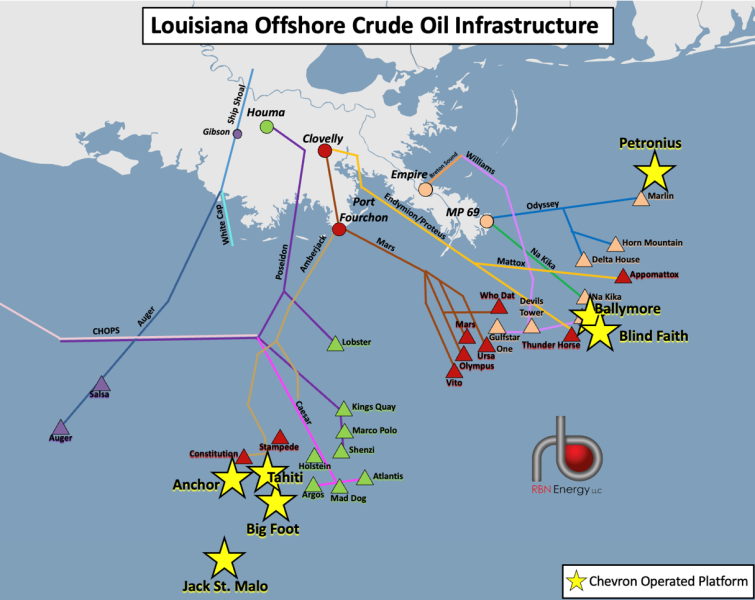
The above map shows Chevron platforms that connect with the Mars system at Port Fourchon.

Speculation/commentary:

  • The well/platform responsible for the zinc contamination has not been identified. Given that production is ramping up at Chevron’s Anchor facility, a new well on that platform may be the source of the zinc. Other Chevron platforms that connect to the Mars system are indicated in the diagram above.
  • Given that zinc in crude oil is rare, a well completion fluid containing zinc bromide may be the culprit.
  • Note the integration of offshore production streams, and the involvement of 3 industry super-majors. These companies are highly competitive, as evidenced by the Chevron-Exxon Stabroek dispute, but are also cooperative in producing, transporting, and refining oil and gas. However, they and other majors are restricted (rather illogically) from bidding jointly for leases.

Read Full Post »

During the 2024 presidential campaign and early in his second term, President Trump repeatedly pledged to “immediately refill” the Strategic Petroleum Reserve (SPR) to its maximum capacity, emphasizing its role in ensuring energy security and stabilizing oil markets during global supply disruptions.

The Big Beautiful Bill (BBB) sends a much different message, providing only $171 million for petroleum acquisition and $218 million for maintenance of SPR facilities through 2029. This is an 87% reduction in the acquisition funding from the House version that proposed $1.3 billion for crude oil purchases.

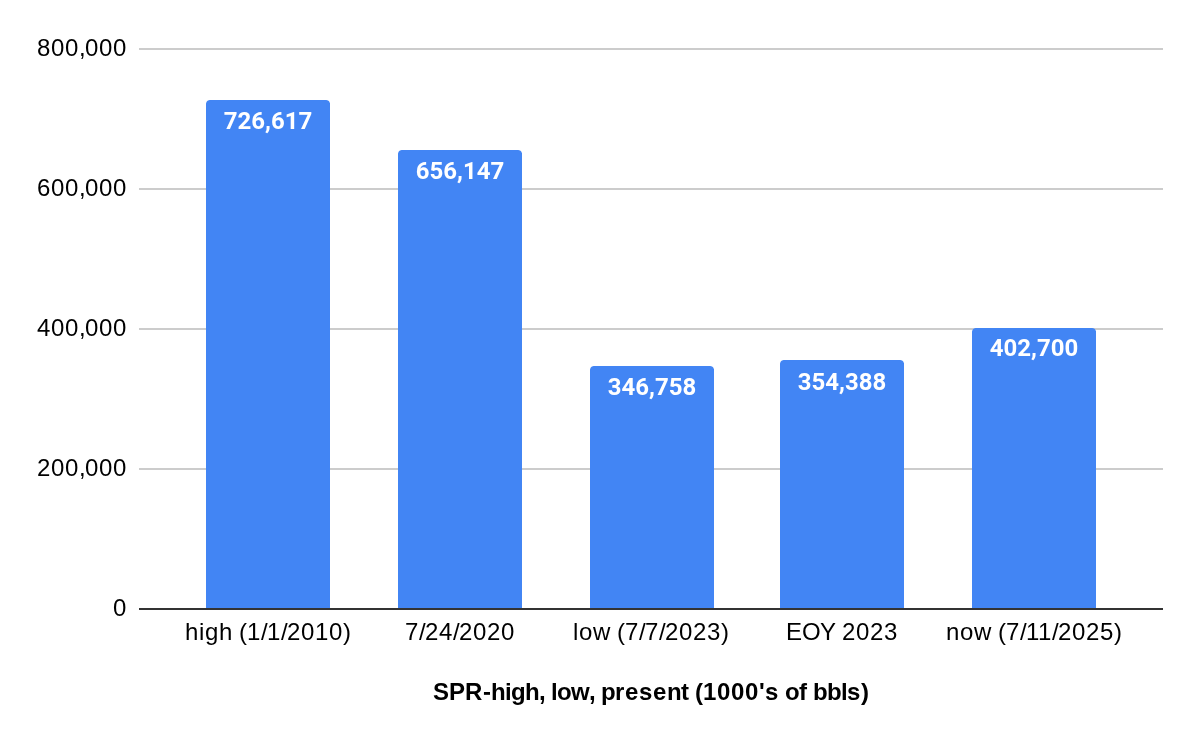
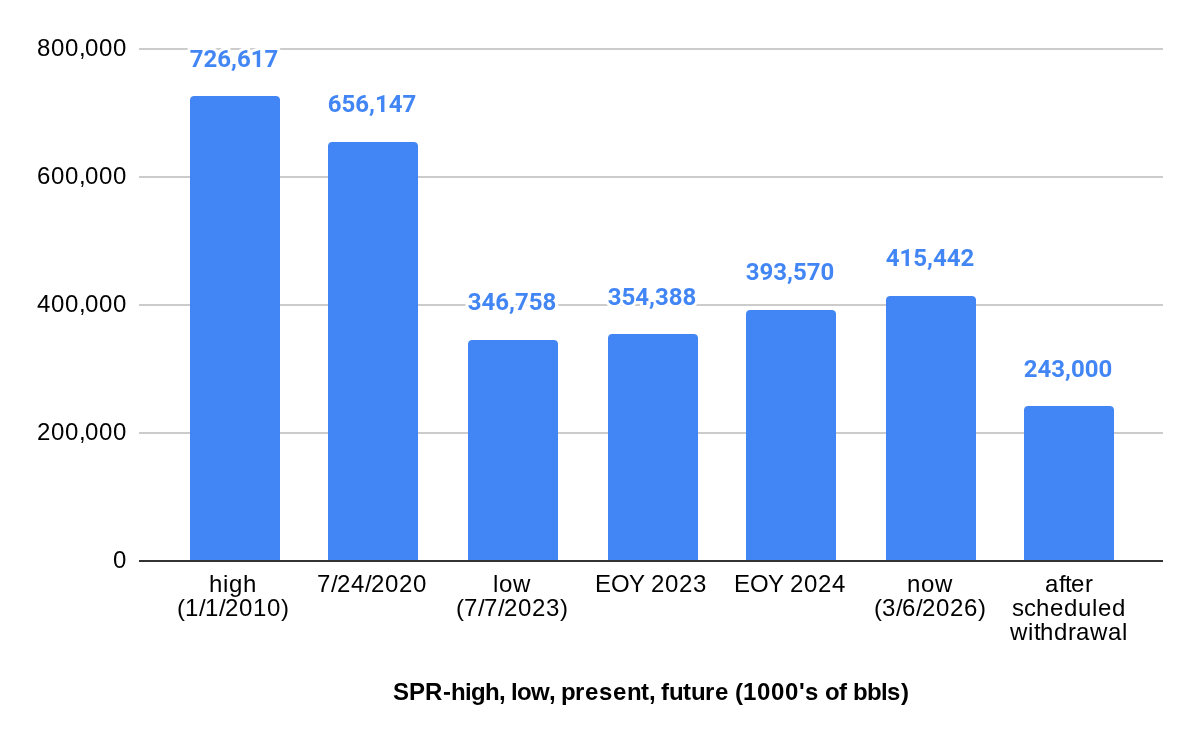
The Administration has offered no comment on the BBB’s surprise SPR language. Meanwhile, the SPR will likely remain at or near the current level, which is 324 million bbls below the 2010 high and only 56 million bbls above the 2023 low. (See the above chart.)

Read Full Post »

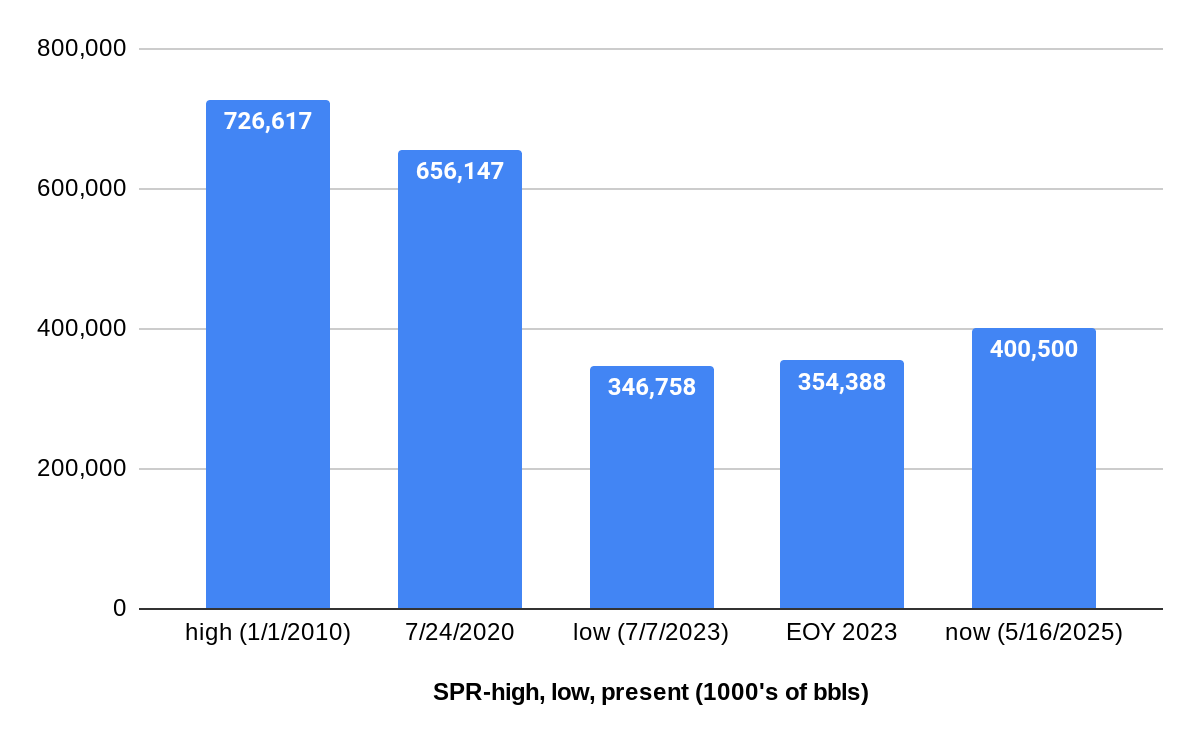
The House Energy and Commerce Committee has proposed $2 billion to repair, replenish, and maintain the Strategic Petroleum Reserve. The proposal includes $1.32 billion for oil purchases and $218 m for maintenance, with the remaining funding allocated for the buyback of previously mandated SPR sales.

Energy Sec. Wright has called for the SPR to be refilled, for the infrastructure to be reviewed, and for plans to be developed to safeguard this strategically important asset.

Although not ostensibly a reason for refilling the reserve, doing so will reduce the risk of a freefall in oil prices and the associated economic turmoil.

Read Full Post »

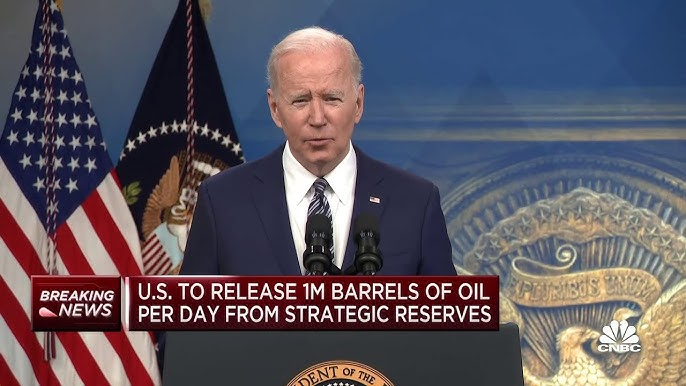
CNBC image: April 1, 2022

Closing the books on the Biden administration’s management of the Strategic Petroleum Reserve:

  • Incoming reserve as of 1/22/2021: 638.086 million bbls (This was also the max. volume during the Biden administration.)
  • Outgoing reserve as of 1/17/2025: 394.566 million bbls
  • Net loss: 234.520 million bbls
  • % loss: 38.2%
  • Cost to replace (assuming $70/bbl ave. oil price): $16.416 billion
  • Time required to refill at max. rate of 685,000 bopd: 342.5 days (Taking into consideration acquisition, operational, and maintenance delays, and concerns about oil price impacts, a more realistic estimate would be 5 years, and this would require a concerted effort.)

Read Full Post »

The Strategic Petroleum Reserve would have no doubt been tapped again, as the Administration implied in June, if prices had exceeded $80/bbl for a sustained period prior to the upcoming elections. Fortunately, for the consumer and the SPR, that has not been the case.

Prior to the 2022 midterm elections, oil prices reached as high as $122/bbl in June and remained above $90/bbl through July. The SPR was tapped hard with a massive reduction of 123 million bbls in the 5 months prior to the elections.

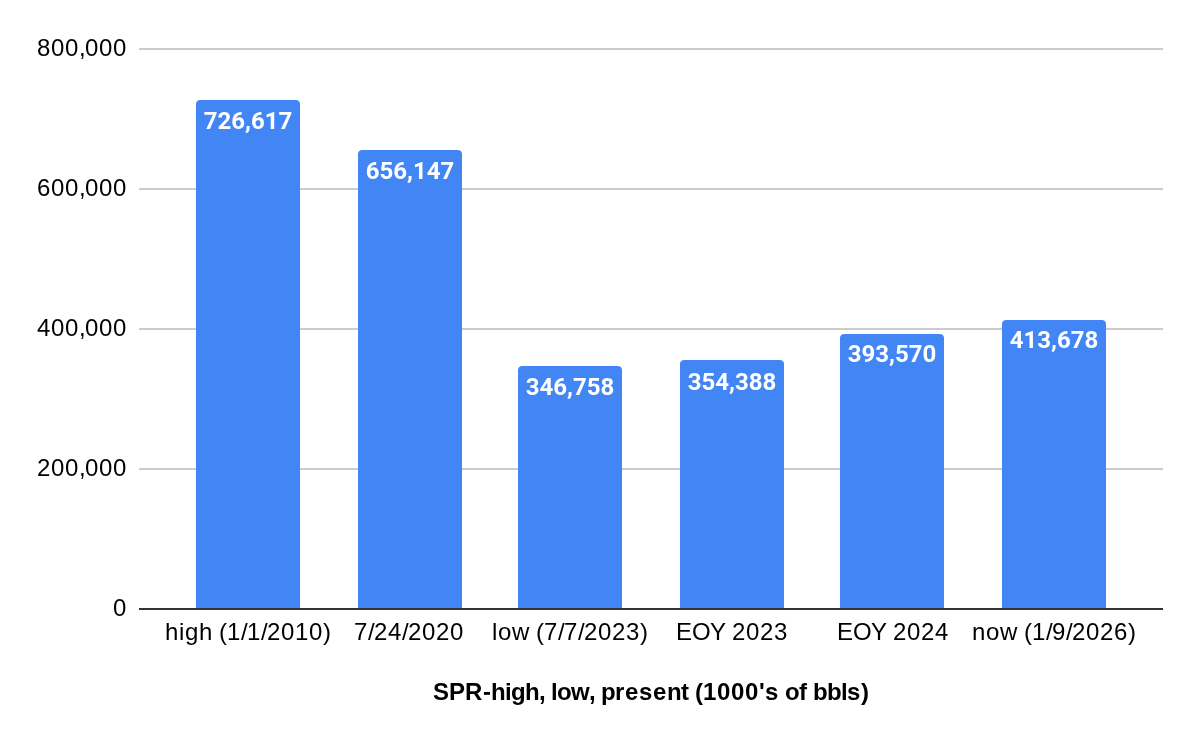
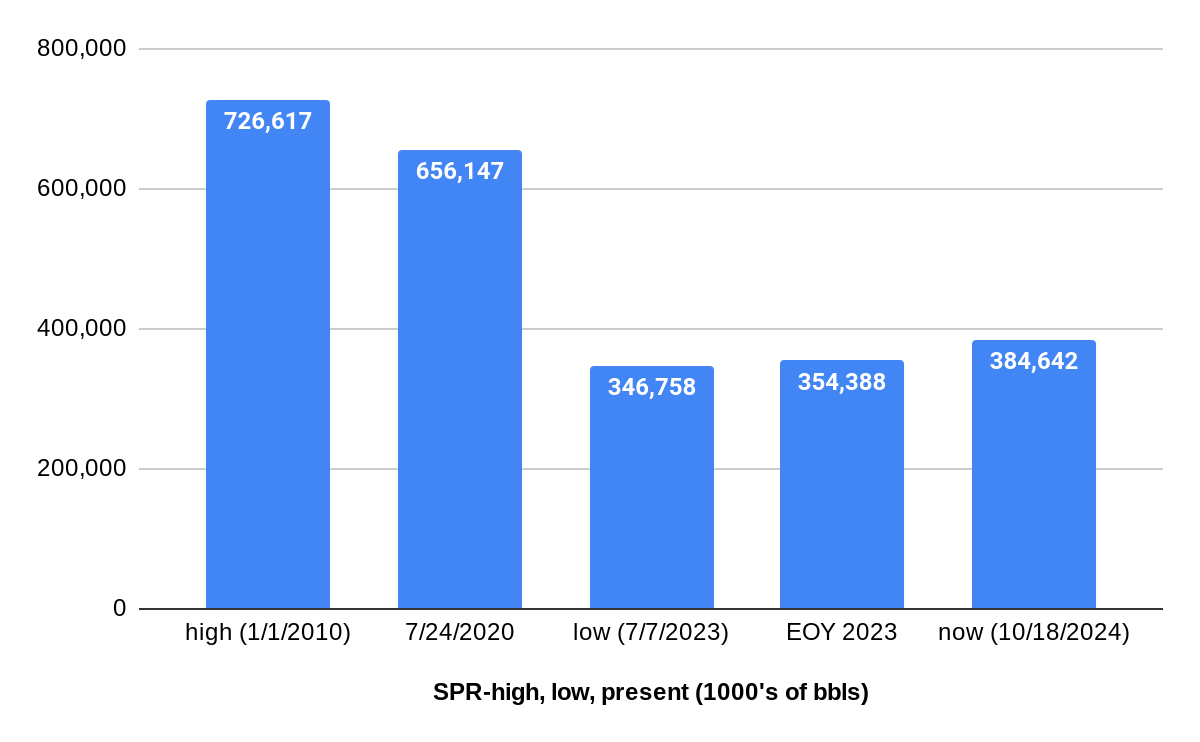
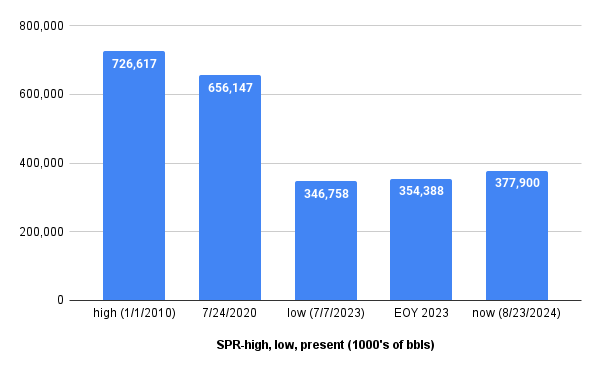
Despite the modest additions to the SPR in 2024, the reserve is only about one-half of capacity and 11% above the all-time low (7/7/2023).

Read Full Post »

Given the relatively moderate oil prices during much of 2024, DOE has made some progress in adding to the Strategic Petroleum Reserve. However, the 31 million bbls added since July 2023 only amount to about 10% of the reserves withdrawn during the 3 years prior (July 2020 to July 2023) and about 4% of the SPR’s capacity.

Read Full Post »

“We will do everything we can to make sure that the market is supplied well enough to ensure as low price as possible for American consumers,” Hochstein told the newspaper. “I think that we have enough in the SPR if it’s necessary.” ~Amos Hochstein, Special Presidential Coordinator for Global Infrastructure and Energy Security.

Maybe they should remove “Energy Security” from his impressive title since that seems to be a low priority.

Apparently it’s fine (and environmentally friendly) to deplete strategic oil reserves to reduce prices prior to an election, but not to hold regular oil and gas lease sales in the adjacent Gulf of Mexico. 2024 will be the first year without an OCS lease sale since 1958, and the Administration bragged about the new 5 year leasing plan having the fewest proposed sales in history!

5 Year Leasing Plan Announcement:

Consistent with the requirements of the Inflation Reduction Act (IRA) concerning offshore conventional and renewable energy leasing, the Department of the Interior today published the final 2024–2029 National Outer Continental Shelf Oil and Gas Leasing Program (Program) with the fewest oil and gas lease sales in history.

These three lease sales are the minimum number that will enable the Interior Department’s offshore wind energy program to continue issuing leases in a way that will ensure continued progress towards the Administration’s goal of 30 gigawatts of offshore wind by 2030.”  

Read Full Post »

or moving in reverse!

24 million bbls have been added since the reserve was drained to the historic low of 347 million bbls last July. At this rate and assuming no further sales, the SPR will be refilled in a scant 15 years!

Read Full Post »

After announcing that the planned 40 million barrel SPR refill would be the equivalent of the massive 180 million barrel withdrawal, DOE has halted the refill at < half the planned amount. There is no end in sight for the SPR deficit (chart below).

Citing rising oil prices, the DOE said, “We will not award the current solicitations for the Bayou Choctaw SPR site and will solicit available capacity as market conditions allow.” Three million barrels of oil had been slated for delivery to the Bayou Choctaw SPR site in August and September.

Forbes

Read Full Post »

from EIA data

Last May, Cathy Rodgers, Chair of the House Committee on Energy and Commerce, requested that the General Accountability Office (GAO) address the following questions (letter attached):

  1. Has the Biden administration conducted a long-term strategic review of the SPR, and if so, is the review adequate to inform decision making and protect the nation from energy supply disruptions in both current and future scenarios?
  2. What damage and increased maintenance requirements, including well remediation, cavern closure, and both pipeline and pump replacements, have resulted from the recent drawdowns?
  3. What physical or cybersecurity threats are there to the SPR facilities?
  4. How thorough are DOE’s studies and assessments of the SPR’s structural integrity?
  5. Has the DOE developed an adequate plan for replenishing the SPR? If so, please explain.

The GAO has not yet published their report.

Read Full Post »

Older Posts »