Feeds:
Posts
Comments

Posts Tagged ‘Permian Basin’

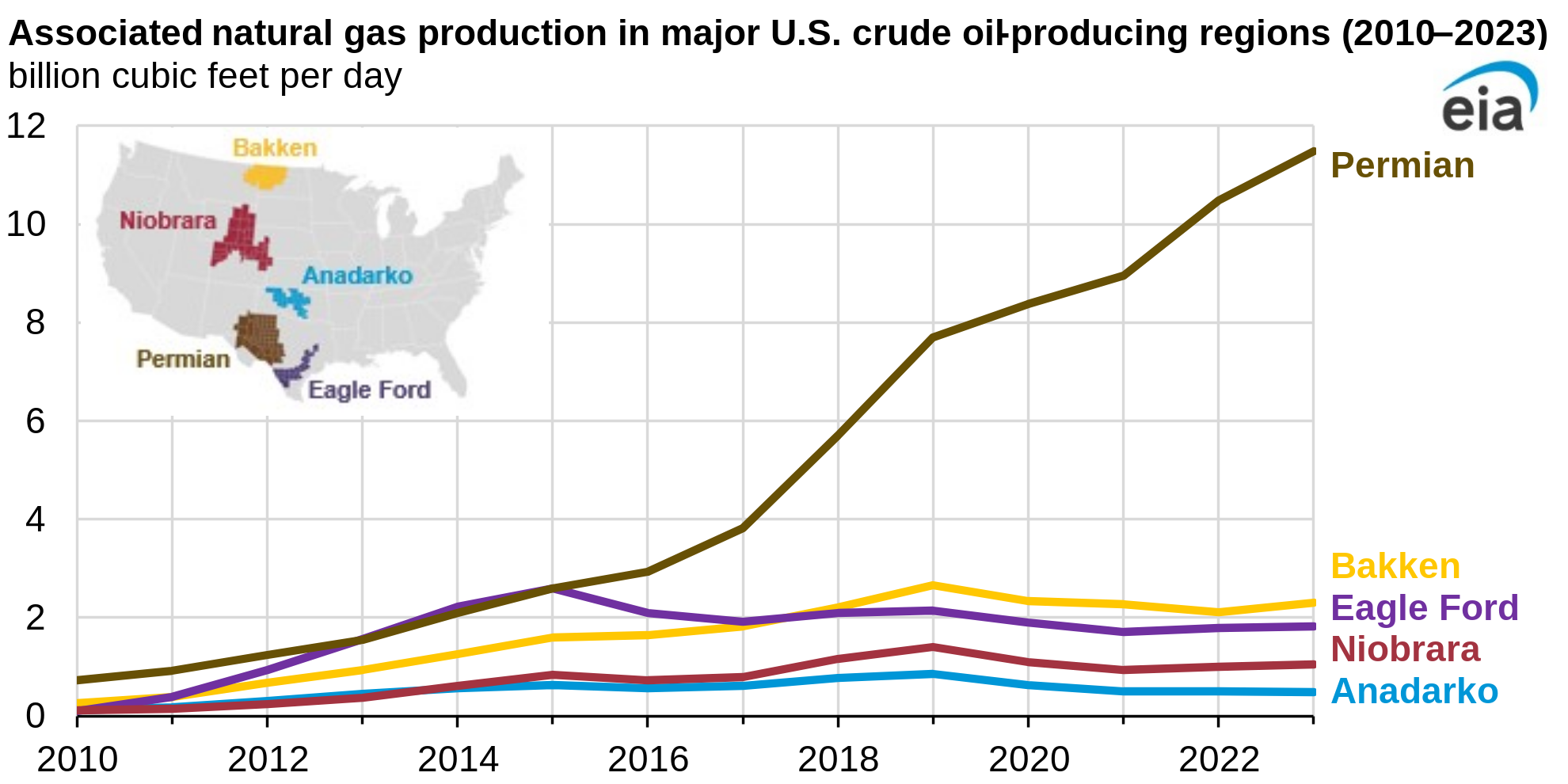
The EIA reports an 8% increase in 2023 US associated gas production as crude oil production rose to record levels.  The Permian Basin, the dominant US crude oil producer, is unsurprisingly the leading associated gas producer.

EIA’s analysis inexplicably ignores the Gulf of Mexico OCS. The Gulf produced an average of 1.64 bcf/d of casinghead (associated) gas in 2023, ranking the GoM just behind the Eagle Ford and significantly above the Niobrara and Anadarko regions (see chart above). It’s also noteworthy that most production from the regions on the EIA chart is from private land, and is not constrained by 5 year leasing plans and other restrictive Federal policies.

80% of GoM gas production is from deepwater leases. The % of associated gas produced on deepwater leases is even higher. The 2 leading GoM gas producers, Shell and bp, only operate deepwater leases. The % of their 2023 gas production that was associated gas was 93% for Shell and 100% for bp.

Read Full Post »

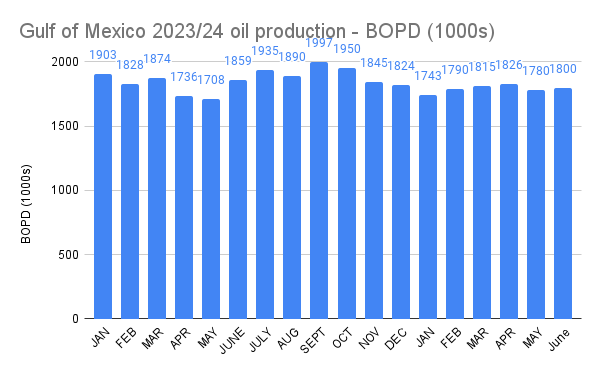
EIA has posted the June 2024 US production data. Gulf of Mexico production was remarkably flat from February through June, with a maximum deviation of only 2.0% (FEB vs. APR) and a deviation of only 0.5% from the beginning of this 5 month period to the end. Looking at the historical EIA data, this is about as stable of a 5 month period as I could find. Presumably, production from the new deepwater facilities is offsetting declines elsewhere as anticipated.

Unfortunately, the production growth forecasted by BOEM is not being realized. BOEM’s 2024 production forecast of 2.013 million bopd will likely be more than 200,000 bopd too high. Their forecast of >2 million bopd through 2027 is increasingly doubtful.  These production forecasts contributed to (or were an excuse for) unprecedented leasing policies intended to prevent production from rising too high for too long.

Per ONRR data, the Gulf of Mexico continued to be the top oil producer for Federal lands in 2023. An additional 72.7 million bbls were produced on Native American lands. New Mexico, which has experienced significant Permian basin production growth, ranked second. The Texas Permian was the dominant US oil producer, but that production is almost exclusively on private lands (a big factor in the Permian success story).

Location (Federal lands)2023 production (bbls)
Gulf of Mexico680,548,975
New Mexico409,987,014
Wyoming47,232,043
North Dakota43,225,104
Other33,635,796

Read Full Post »

As we approach the 4th of July, remember this:

In 1979 Gulf of Mexico oil production had declined to 263 million barrels and many believed that further declines were inevitable. 40 years later, a record 693 million barrels were produced.

Onshore, lateral drilling and hydraulic fracturing capabilities are continuing. As a result, Exxon and others are predicting projecting higher recovery factors in the Permian Basin. Per Exxon CEO Darren Woods: “We are beginning to see the signs of some very promising new technologies that will significantly improve recovery.”

Opportunity + Ingenuity ➡ Energy Independence + Prosperity

Read Full Post »

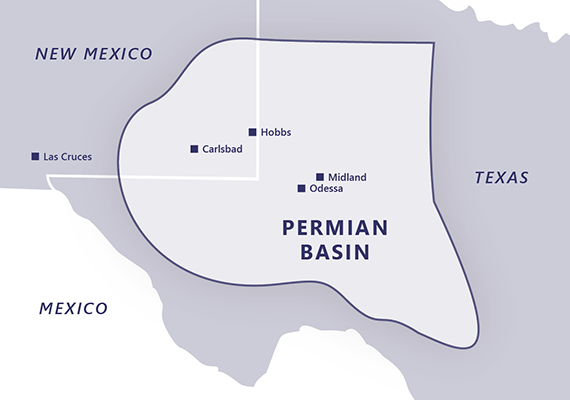
Like its salty neighbor to the east, the Permian Basin of west Texas and southeastern New Mexico has been proclaimed dead on many occasions. Such proclamations of their demise, however, are mere exaggerations as the Gulf of Mexico and the Permian Basin continue to thrive.

These historic oil and gas production powerhouses have delivered to global markets billions of barrels of oil and trillions of cubic feet of natural gas over the past century. Through the booms and the busts, the resiliency of each was made possible by the combination of ingenuity and perseverance and by advancements in techniques and technologies.

JPT

Thirty years ago the Gulf of Mexico was called “the Dead Sea” because of the decline in drilling and production activity. Deepwater technology reversed that trend and led to record Gulf of Mexico oil production averaging 1.9 million BOPD in 2019.

Similarly, horizontal drilling and hydraulic fracturing technology launched the shale revolution, and Permian oil production has risen impressively to 5.4 million BOPD.

Both the Permian and the GoM have the potential to sustain or increase production. The Permian Basin, much of which is privately owned, is more adaptable to market conditions and less exposed to political risks. The offshore program is dependent on effective long-term planning and supportive lease management policies. Unfortunately, the proposed 5 year leasing plan suggests a commitment to throttling offshore production rather than sustaining it. When will our energy policy pendulum swing back to a more balanced position?

Read Full Post »

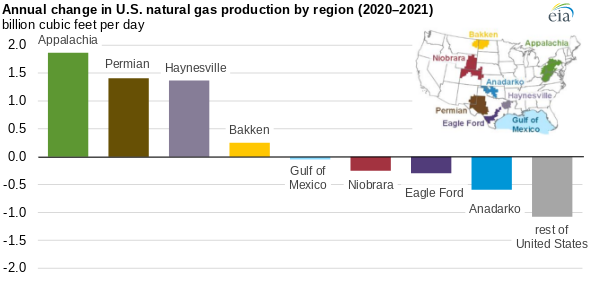
The administration has taken steps toward a resumption of leasing on Federal onshore lands, which account for only 7% of domestically produced oil and 8% of our natural gas. While this is a positive step, our economy is largely being driven by production on private lands, absent which we would have a serious supply crunch. This new EIA graphic illustrates where the growth in natural gas production has been, and most of that growth has been on private land.

The growth in US oil production has been largely dependent on the Permian Basin:

Industry leaders have raised concerns about the extent to which Permian production can continue to grow and the country’s over-reliance on shale production.

There are no private offshore lands, and the future of US offshore production is almost entirely in the hands of the Federal government. It has now been 525 days since the last offshore lease sale. The Administration chose not to appeal the DC Federal Court decision vacating Sale 257, leaving that to the State of Louisiana and API (parties that actually support offshore oil and gas leasing).

It’s disappointing that the reasoning behind the judge’s Sale 257 decision has received so little attention, especially given that it hinged on BOEM not analyzing the benefit of high oil prices. (i.e. <leasing = <production = >prices = <intl consumption = < CO2) The decision was issued as Russian troops were amassing on the Ukraine border only 28 days before the invasion. Oil prices (WTI) had already reached $87/bbl and would soon spike to $120/bbl, so the decision embracing higher oil prices was (at best) bad timing. Keep in mind that this was not a matter of BOEM failing to consider GHG issues; BOEM had conducted those assessments. The judge’s decision was specific to BOEM not analyzing the GHG benefits of reduced foreign consumption as a result of the higher prices associated with reduced leasing.

Meanwhile, The 5 year program, without which offshore leasing cannot proceed, expires in June. Fellow Democrats Manchin and Kelly sent a letter to the President on 31 March urging the Administration to develop and implement a new 5 year program without delay. There is no online evidence of a response. Presumably, the 5 year program issue will be addressed in the bipartisan energy legislation that Senator Manchin is drafting.

Read Full Post »

Consistent with our concerns about the lack of investment in offshore exploration and production, Aramco CEO Amin Nasser made this comment at CERAWeek in Houston:

“Today, we only have 2% of effective spare capacity, which is an imbalance,” Nasser said. “You need a resilient and strong spare capacity to make sure that you can absorb any supply shocks. Look at what’s happening. Before the Ukraine crisis, the spare capacity was declining fast.

Oxy CEO Vicki Hollub’s comments further justify our concerns about US over-reliance on shale production. She noted these impediments to production growth in the Permian Basin, the world’s largest shale basin:

  • Severe supply-chain constraints 
  • Labor shortages
  • Few already drilled wells ready to be completed
  • Rig shortages

Read Full Post »