DUBAI, June 13 (Reuters) – OPEC does not see a peak in oil demand in its long-term forecast and expects demand to grow to 116 million barrels a day by 2045, and may be higher, the secretary general said on Thursday.
The International Energy Agency said in a report on Wednesday it sees oil demand peaking by 2029, levelling off at around 106 million barrels per day (bpd) towards the end of the decade.
Hathaim Al Ghais, writing in Energy Aspects, called the IEA report “dangerous commentary, especially for consumers, and will only lead to energy volatility on a potentially unprecedented scale”.
The IEA’s assessments face criticism, particularly in terms of the agency’s optimistic outlook on the growth and impact of renewable energy worldwide. The report suggests that renewables will meet half of the world’s power demand by 2030, based on optimistic scenarios, including the proliferation of electric vehicles (EVs) and substantial investments in offshore wind, solar, green hydrogen, and ammonia. The IEA emphasizes the idea that consumers worldwide are enthusiastic about changing their heating systems to electricity or heat pumps.
Simultaneously, the ongoing contentious relationship between the IEA and OPEC is poised to reach new levels of disagreement. The release of the IEA’s report shortly after OPEC’s relatively optimistic oil market report gives the impression that Paris is attempting to alarm markets without substantial grounds. It’s worth noting that, despite its inherent bias, OPEC’s reports have historically demonstrated a higher level of accuracy compared to the IEA reports from the early 21st century. Even OPEC’s most optimistic scenarios regarding hydrocarbon demand growth have been realized sooner than expected. The current IEA report appears to resemble a modern-day version of “Crying Wolf.” It’s possible that the underlying strategy of Paris and its supporters is to induce significant fear among investors, including clients, in the hope that their biased outlook becomes a reality. However, at present, such a scenario appears unlikely. It’s essential to keep in mind that the IEA will need to present a doomsday scenario for hydrocarbons, as it faces a different audience in Dubai in the coming weeks.
WP: “Chevron is acquiring oil driller Hess in a $53 billion all-stock deal announced Monday, bringing the energy giant deeper into the fossil fuel business at a time when policymakers are pressing for a broader transition to renewables.”
Comment: Many who live and work outside of the Post’s policy bubble differ on the urgency and practicality of the transition. Their primary concerns are reliable, secure, and affordable energy. Many elected representatives agree, which is why there is little national support for legislation restricting fossil fuels and imposing rigid transition timelines. Administrative actions, like the 5 year leasing plan, that handicap US offshore production are also being questioned.
And what are we transitioning to? Wind and solar are intermittent energy sources that can complement fossil fuel power generation, but not replace it. Nuclear energy has strong proponents, but faces stiff opposition, much of which is from the same groups that oppose fossil fuels. Other energy alternatives like ultradeep geothermal are very promising but are still years away.
WP: “The investments run counter to U.S. and global climate policies, which aim to rapidly phase out the internal combustion engine and shift power grids to zero emissions energy. The International Energy Agency reported last month that demand for oil, gas and coal will peak by 2030 before going into a steady decline, leading its executive director, Fatih Birol, to warn oil company executives that decisions to double down on fossil fuel infrastructure could prove misguided.“
Comment: Fortunately, IEA does not dictate corporate investment decisions. Perhaps IEA should look more closely at their own forecasts which show essentially no decline in oil or gas demand through 2050. Their assertion that demand for all fossil fuels will peak by 2030 is based on their speculative forecast calling for a sharp decline in coal demand, even though coal consumption is currently at record levels. IEA’s forecasts are also dependent on questionable assumptions such as this: “50% of new US car registrations will be electric in 2030.”
WP: “Still, the massive acquisitions from both Chevron and Exxon indicate their executives believe fossil fuels will continue to drive their business well into the future. Emphasizing affordability, company executives have said they see oil and gas alongside renewables.”
Comment: Spot-on. The WP could have shortened their commentary to these 2 sentences.
WP: Alex Witt, senior adviser for oil and gas at the advocacy group Climate Power, said the Hess acquisition shows the company’s true priorities. “Today’s news proves what we already knew — Chevron executives only care about the short-term, putting potential profits over the lives of families and the future of our planet,” Witt said in a statement Monday.
Comment: Or perhaps both Chevron and the lives of families will benefit, as they have in the past.
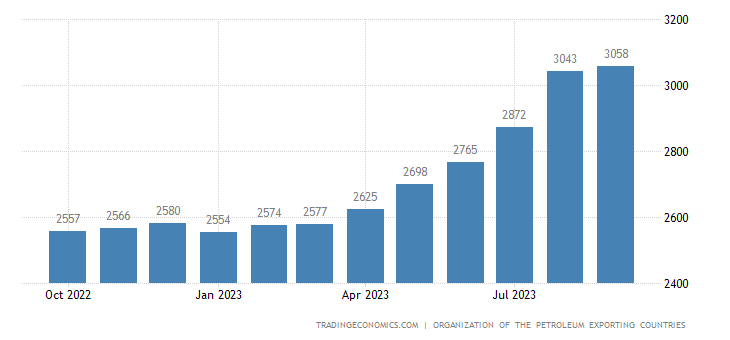
Given that further depletion of the SPR was no longer politically acceptable, a cynic might suggest that oil market considerations associated with the end of SPR withdrawals and OPEC tightening (Iran is currently exempt from OPEC quotas) factored into decisions regarding the relaxation of sanctions on Iran.
Energy Secretary Jennifer Granholm last month said it would be difficult for the U.S. to take advantage of low oil prices to replenish the Strategic Petroleum Reserve because of maintenance at two of the four sites.
The Financial Times reported, citing people familiar with Saudi Arabia’s thinking, that Riyadh was “irritated” by that comment. In any case, it came on top of stress in the financial sector that had dragged oil prices as low as $64 in March.
“The long-term nature of OCS oil and gas development, such that production on a lease can continue for decades makes consideration of future climate pathways relevant to the Secretary’s determinations with respect to how the OCS leasing program best meets the Nation’s energy needs.“
Basing offshore leasing decisions on “future climate pathways” is a high risk strategy that may be inconsistent with the recent SCOTUS decision in West Virginia vs. EPA. A planned or phased shutdown of the offshore oil and gas program would dramatically increase economic and security risks, and has not been authorized by legislation.
Per Offshore-Energy.biz, comments by Aramco President and CEO, Amin H. Nasser, at the Schlumberger Digital Forum:
“When you shame oil and gas investors, dismantle oil- and coal-fired power plants, fail to diversify energy supplies (especially gas), oppose LNG receiving terminals, and reject nuclear power, your transition plan had better be right. Instead, as this crisis has shown, the plan was just a chain of sandcastles that waves of reality have washed away.”
“the warning signs in global energy policies were flashing red for almost a decade,” adding that investments in oil and gas decreased from $700 billion to a little over $300 billion, which is more than 50 per cent between 2014 and 2021.
“this is the moment to increase oil and gas investments, especially capacity development.”
Aramco is working to increase its oil production capacity to 13 million barrels per day by 2027 and grow its gas production by more than half through 2030.
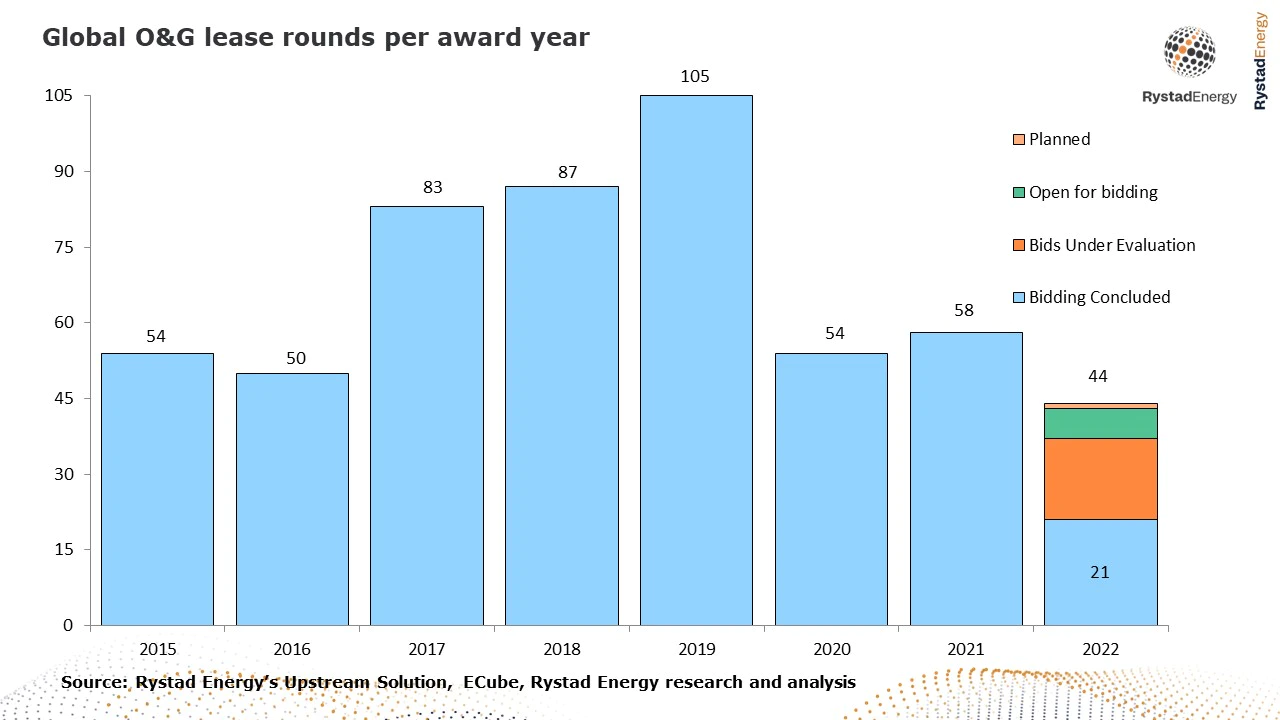
Meanwhile, Rystad reports a further reduction in global oil and gas licensing, with help from the US govt:
Note the NOPEC language pasted below, particularly the highlighted text. Our government has proven quite capable of limiting production without OPEC’s help. This is especially true for the US offshore sector, which could be responsibly producing at least 1 million more BOPD with fewer access restrictions and timely leasing. Less than 0.5% of the US OCS is currently open to exploration and development.
Other than for grandstanding purposes, how is this bill helpful? Haven’t we been pleading with OPEC to increase production? Even the White House seems to think NOPEC is a bad idea:
White House spokesperson Jen Psaki said the administration has concerns about the “potential implications and unintended consequences” of the legislation, particularly amid the Ukraine crisis. She said the White House is still studying the bill.
“(a) In General.—It shall be illegal and a violation of this Act for any foreign state, or any instrumentality or agent of any foreign state, to act collectively or in combination with any other foreign state, any instrumentality or agent of any other foreign state, or any other person, whether by cartel or any other association or form of cooperation or joint action—
“(1) to limit the production or distribution of oil, natural gas, or any other petroleum product;
“(2) to set or maintain the price of oil, natural gas, or any petroleum product; or
“(3) to otherwise take any action in restraint of trade for oil, natural gas, or any petroleum product,when such action, combination, or collective action has a direct, substantial, and reasonably foreseeable effect on the market, supply, price, or distribution of oil, natural gas, or other petroleum product in the United States.
UAE Energy Minister Suhail al-Mazrouei has most definitely not forgotten:
“I think in COP 26 all the producers felt they were uninvited and unwanted but now we are again superheroes, it’s not going to work like that,” he said.




 Bud's Offshore Energy (BOE)