Feeds:
Posts
Comments

Posts Tagged ‘offshore oil’

OMNI-MAX Anchor

Pasted below is a note from Evan Zimmerman that I am posting with his approval.  As many of you know, MODU station-keeping has historically been a major problem during hurricanes.  For the past 5 years, industry and government leaders have worked hard to improve hurricane and deepwater mooring capabilities.  Evan has been a key participant in this effort.  His company developed advanced anchors (see above picture) and mooring lines, and new risk assessment tools for assessing mooring system failure probabilities and their consequences.   The Gulf of Mexico will not be a safer place if deepwater technology leaders like Delmar are forced to close or move their equipment and personnel overseas.

The moratorium on drilling has put more than 70% of all that risk reducing mooring equipment on its way to the beach without contracts.  For a company like Delmar that derives more than 95% of its income from deepwater OCS drilling activity, its clear that we will have to immediately start shipping equipment outside of the US to find work.  Its my expert opinion that without a doubt, the offshore station keeping safety options will be reduced once drilling activities resume.  Its also clear the longer the moratorium continues, the fewer moored rigs will be left to drill not only the intermediate water depth areas the DP rigs cannot, but also the ultra deepwater wells they have been so busy drilling safely.  The longer this moratorium continues, the higher the station keeping risks for both DP and moored rigs the MMS will have to approve to keep the few rigs left in the Gulf working.  It’s the single biggest disappointment in my career to see all the hard work that MMS, Delmar and industry have done to increase station keeping safety quickly slip between our fingers here domestically.  I leave overseas again week after next to try to secure work for half (two sets) of OMNI-Max anchors as well as most of our other risk reducing equipment that now is no longer on contract due to the moratorium.

We are the last US owned deepwater anchor handling company that has brought the safest and most technically advantageous equipment to the mooring industry, and it looks like we will have to drastically change inclusive of cutting jobs domestically and moving outside of the US.
Read Full Post »

We know about the Macondo victims, most notably the 11 men who died and their families, but who stand to benefit from the blowout?

  1. OPEC – Will OPEC’s market share grow as the US and others prevent or delay production?
  2. West Africa and Brazil – Better rates and availability for deepwater rigs?
  3. PTTEP (Montara) – Not receiving much attention as BP draws all the flack
  4. Shale gas – Can the huge promise be realized?  Will natural gas gain an increased share of the transportation market?
  5. Alternative Energy – Are these industries ready to step up?
  6. Spill response research – Government and industry oil spill research funding always jumps after major spills.
  7. Nuclear industry – Perhaps, but Macondo may remind people that “the unthinkable” can happen.
  8. Lawyers – The only sure winners.  The litigation spectacular has already begun.

Read Full Post »

No Love for Long Strings – The rest of the industry has distanced itself from BP’s casing program, swearing their allegiance to tiebacks.

CEO sails while “small people” suffer – The PR disaster continues for BP.

BP partner seeks annulment – The first shots in the multi-billion dollar BP-Anadarko dispute have been fired.  Look for new liability clauses in operating agreements and regulations.

Who is in charge and accountable? – Macondo, like Montara, was entirely preventable.  Know who is in charge, and make sure they are competent and cautious leaders.  As a friend told me yesterday, the best technology can be undone by human arrogance.

Just ‘Roo It! – Australia’s investigation process works great until it comes to releasing reports.  Varanus Island deja vu?

Storm watch – Another common concern for Montara and Macondo – the onset of hurricane/cyclone season.  We need about six more weeks (preferably more) until the first hurricane evacuations in the Gulf.

Sad irony – The first FPSO production in the Gulf of Mexico is at the Macondo field.

90+% recovery – Promised soon with new well cap and production systems.

Relief? – First relief well is ahead of schedule.  Has a well ever been more anticipated and needed?

Aftermath – While the chance of BP operating Macondo is virtually zero, will PTTEP be allowed to continue operating Montara?

Read Full Post »

BP Gas Station

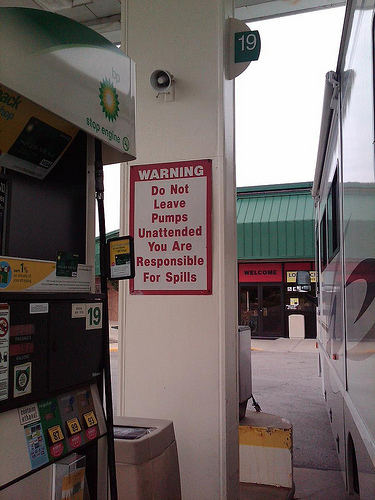
In addition to the obvious irony in this BP gas station’s warning sign, perhaps there is a separate and unintended message in the sign’s last 3 lines – “you are responsible for spills.”  The gasoline that we purchase at the pump does not just arrive there magically.  That gasoline is the end product of a complex exploration, production, transportation, and refining process.  When we consume petroleum products (and other forms of energy), we are tacitly accepting the associated environmental risks.  If we aren’t comfortable with those risks, we should look at our own habits and how they contribute.

BP is responsible for the Macondo spill.  However, our own lifestyle decisions are the reason for the extraordinary demand for the oil that BP and other companies produce.  We can’t blame BP for the intractable sprawl, congestion, and pollution that have resulted from those decisions.

Read Full Post »

If the contrast between the Montara and Macondo political responses wasn’t already evident, take a look at today’s events.  While Tony Hayward was being hammered once again at a congressional hearing despite establishing a $20 billion damage payment fund, Australian Resources Minister Martin Ferguson seems to be in no hurry to release the Montara Inquiry Report.  According to Australia Broadcasting, Mr. Ferguson says he has to take into account legal considerations:

So as to ensure that I do not prejudice any potential further investigations which could include criminal offenses, or undermine any natural justice considerations of any individuals.

Say what?  How about preventing future accidents?

Read Full Post »

Michael Bromwich

Michael Bromwich, a former Federal prosecutor, will lead the reorganization of the Minerals Management Service into two new bureaus and a minerals revenue office.  I hope he meets as many MMS personnel as time allows.  He will be pleasantly surprised by their knowledge, integrity, and commitment.

In addition to former Senator Bob Graham and former EPA Administrator Bill Reilly, President Obama named the following individuals to head the National Commission on the BP Deepwater Horizon Oil Spill and Offshore Drilling:

Frances G. Beinecke: President of the Natural Resources Defense Council (NRDC), a non-profit corporation that works to advance environmental policy in the United States and across the world.

Donald “Don” Boesch: President of the University of Maryland Center for Environmental Science, where he is also a professor of Marine Science and vice chancellor for Environmental Sustainability for the University System of Maryland.

Terry D. Garcia: Executive vice president for mission programs for the National Geographic Society.

Cherry A. Murray: Appointed dean of the Harvard School of Engineering and Applied Sciences (SEAS) and the John A. and Elizabeth S. Armstrong Professor of Engineering and Applied Sciences in July 2009, and the past president of the American Physical Society.

Frances Ulmer: Chancellor of the University of Alaska Anchorage (UAA), Alaska’s largest public university.

Read Full Post »

BOP Testing Timeline

Transocean’s interim report is circulating online.  Click here: Transocean Investigation

Read Full Post »

A BP plan review prepared in mid-April recommended against the full string of casing because it would create “an open annulus to the wellhead” and make the seal assembly at the wellhead the “only barrier” to gas flow if the cement job failed. Despite this and other warnings, BP chose the more risky casing option, apparently because the liner option would have cost $7 to $10 million more and taken longer.

While the circumstances and details differ significantly, Montara (Timor Sea blowout) flashed across my mind repeatedly while reading this informative letter from Chairmen Waxman and Stupak to BP.  Common themes:

  1. Well integrity roulette: high risk well design
  2. Suspect production casing cement job
  3. Only one questionable barrier above the cement
  4. Multiple poor decisions on barriers
  5. Schedule concerns, time and efficiency pressure
  6. Failure to run Cement Bond Log and conduct confirming tests
  7. Mud weight and conditioning issues

Read Full Post »

The Unified Command’s collegial atmosphere seems to have given way to letter writing and public posturing.  Agency and company logos are no longer side-by-side on the official response website banner and joint briefings ended shortly after the Top Kill disappointment.  What all this means for future emergency response operations and the Unified Command concept remains to be determined.  Major spill response exercises and table-top drills cannot simulate the stress associated with a long battle like Macondo, and the resulting legal, administrative, and political tension.

In any event, a 13 June letter from Doug Suttles to Admiral Watson outlines BP’s impressive production strategy for the Macondo, pending completion of the relief well.  Most elements of this collection and production plan had been previously identified.  However, I was surprised by the following sentence on page 3:

Install a new LMRP cap with sufficient seal integrity to ensure a successful relief well kill operation.

I believe this is the first time BP has suggested that the success of the relief well was in any way linked to seafloor capping or wellhead intervention operations.  I assume BP is simply acknowledging that the kill operation would be easier if flow from the cap is constrained and back-pressure imposed on the flowing well.  Perhaps BP would like to elaborate.

Read Full Post »

Ponder this: What if the responsible party was not BP or one of the other “supermajors” (i.e. Shell, Chevron, ConocoPhillips, ExxonMobil, and Total)? This would have been the likely scenario:

  1. The responsible party, which we’ll call Company XYZ, would have quickly exhausted its financial resources, including insurance.  Bankruptcy would be a high probability.
  2. XYZ would have to control costs and would not contract a second relief well rig, employ an armada of support vessels and ROVs, fund protective barrier islands, or install a complex floating production system for oil containment and recovery purposes.  The Federal government could, of course, direct XYZ to do all of these things, but how could XYZ comply?
  3. The Oil Spill Liability Trust Fund would be exhausted.  The per barrel production and transportation fees would have to be quickly and  significantly increased to pay the ongoing spill response costs.
  4. XYZ would limit damage payments to the $75 million maximum specified in the Oil Pollution Act of 1990.  Congress could, of course, change that limit, but could they do so retroactively?
  5. In light of the above, the entire mess would become the responsibility of the Federal government.  The government would have to design and manage the relief well operations, subsea collection programs, and all aspects of the spill response.  All this would have to be accomplished amidst loud (think vuvuzela noise levels) public criticism, finger-pointing, and emergency hearings and litigation.  Multiply the current level of acrimony and discontent by 100 and you get a sense of how ugly this would be.

What happens to the Macondo field? We don’t know much about the size of the Macondo reservoir(s), but we have certainly learned about the impressive flow potential.  After the well is plugged and the regulatory issues are addressed, will BP seek to develop the field, assign their interests to other companies, or relinquish their leases?  Will BP even have the option of making these choices, or will the Federal government seek to disqualify the company from developing the field?

Relief well plans: While BP has done a better job of providing technical information, the precise relief well target has not been specified.  In that regard, BOE has received a number of complaints from engineers and other interested parties.  Since the region and nation are literally and figuratively dependent on this well for relief, the public needs to know more about the plan.  We now have the casing program details for the well that is flowing (thanks to DOE), so the key piece of information needed is the specific intercept point in the well bore.   We also need to know the suspected flow path(s) for the oil.  Surely BP and the Unified Command have an informed opinion on that important matter.  Again, the right to confidentiality on these matters was forfeited when the well blew out.

Read Full Post »

« Newer Posts - Older Posts »