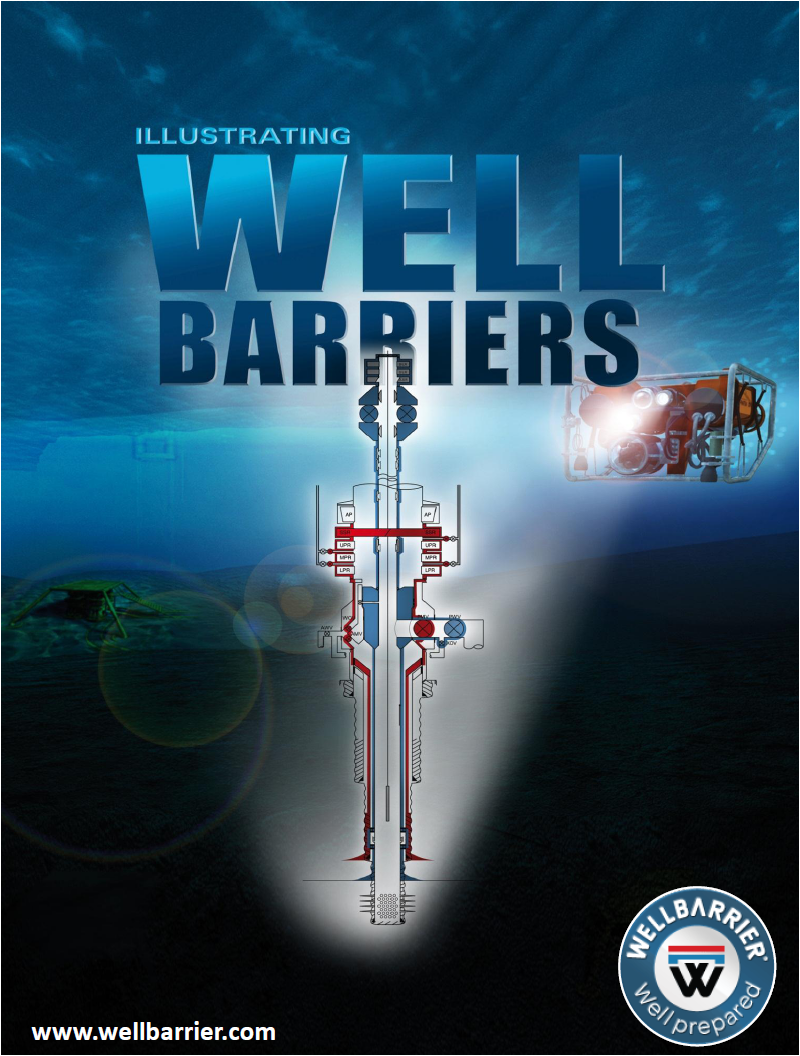
Our friend Tore Fjågesund from WellBarrier sent us this clever poster.
Posted in drilling, tagged barriers, offshore drilling, safety, well control, well integrity, WellBarrier AS on July 18, 2011| Leave a Comment »
Posted in drilling, Offshore Energy - General, tagged offshore drilling, Virginia on July 8, 2011| Leave a Comment »
The Commonwealth of Virginia, home of BOE headquarters, continues to provide national leadership on energy issues, most notably offshore oil and gas exploration. The Governor (Republican), both US Senators (Democrats), and both candidates for the US Senate support offshore leasing.
“Opening up and expanding Virginia’s offshore resources to responsible natural gas and oil exploration holds significant promise for boosting needed domestic energy production while bolstering the commonwealth’s economy.” Quote from Senator Jim Webb in the Richmond Times Dispatch
Posted in Uncategorized, tagged accidents, crack, drilling, evacuation, Nigeria, offshore drilling, safety, sinking, Transocean Marianas on July 6, 2011| 10 Comments »
This information is unconfirmed but the source is highly reputable:
 We just received word this morning that the Transocean Marianas rig has developed a large crack in one of the pontoons on the #5/#6 anchor chain locker while they were picking up anchors, and is currently taking on water and listing. The bilge pumps are keeping up (barely), but there’s certainly concern that it might sink on location. So far, 68 people have been evacuated from location.
According to RigZone, the Marianas was working offshore Nigeria. [Per one of our readers, (see comment below) Petrodata shows the rig operating offshore Ghana.]
More: The Marianas, spudded the Macondo in October, 2009, but was damaged by Hurricane Ida and towed to shore. The Deepwater Horizon was the rig that replaced the Marianas.
Posted in accidents, well control incidents, tagged accidents, blowouts, bp, Deepwater Horizon, drilling, float collar, Gulf of Mexico, macondo, Montara, offshore drilling, safety, Weatherford, well control on June 21, 2011| 2 Comments »
BP settled Macondo litigation with Weatherford, manufacturer of the float equipment equipment used in the Macondo well. The failure of this equipment was a key contributing factor in the Macondo blowout. Under the agreement, Weatherford will pay BP $75 million. This money will be applied to the $20 billion Macondo trust fund.
Weatherford is the first of BP’s contractors to formally agree with BP that the entire industry can and should learn from the Deepwater Horizon incident. Accordingly, Weatherford has committed to working with BP to take actions to improve processes and procedures, managerial systems, and safety and best practices in offshore drilling operations. BP and Weatherford will encourage other companies in the drilling industry to join them in this improvement and reform effort.
Comments:
Posted in accidents, well control incidents, tagged accidents, Australia, blowouts, Montara, offshore drilling, well control, Western Australia on June 18, 2011| Leave a Comment »
Resources Minister Martin Ferguson is determined to establish a single national regulator after the Montara oil spill in the Timor Sea leaked oil and gas condensate for more than two months in 2009.
The WA government is at odds with Mr Ferguson over plans for a national regulator and wants to maintain responsibility for oversight of the industry in the state.
Senator Eggleston and Senator David Bushby said the federal government had introduced the legislation to parliament before concluding ongoing negotiations with the WA government. Herald Sun
Meanwhile, still no news regarding any penalties for Montara operator PTTEP. Will there be none?
Posted in Uncategorized, tagged Anthony Weiner, offshore drilling, offshore energy on June 17, 2011| Leave a Comment »

No New Drilling Act of 2011: Amends the Outer Continental Shelf Lands Act to prohibit the issuance of any lease for the exploration, development, or production of oil, gas, or any other mineral on the outer Continental Shelf.
Alaska Oil Drilling Leases: To prohibit the Secretary of the Interior from selling any oil and gas lease for any tract in the Lease Sale 193 Area of the Alaska Outer Continental Shelf Region until the Secretary determines whether to list the polar bear as a threatened species or an endangered species under the Endangered Species Act of 1973, and for other purposes.
Posted in accidents, Norway, Regulation, well control incidents, tagged accidents, blowouts, BOP, Deepwater Horizon, macondo, offshore drilling, safety, SIL on June 16, 2011| 2 Comments »
Because of recent involvement with products and systems that have Safety Integrity Level (SIL) ratings, I read the comment (below) in the PSA Deepwater Horizon review with interest. While administrative and effectiveness issues must be carefully assessed, the application of SIL should be part of the BOP performance dialogue. SIL ratings may also be appropriate for entire well control or well integrity systems.
Today’s requirements stipulate a risk analysis for the control system of a drilling BOP, with specified minimum requirements for its safety integrity level (SIL). As a result of the DwH incident and of the fact that blowouts are not confined to drilling operations, the question is whether such an analysis, with a specified minimum SIL level, should also apply to all types of BOPs, including well-intervention models. In addition, consideration should be given in this context to whether other control and management systems related to well integrity/control exist which should be subject to such requirements.
Posted in accidents, Norway, well control incidents, tagged accidents, blowouts, BOP, Deepwater Horizon, drilling, macondo, Montara, Norway, offshore drilling, offshore oil, PSA, safety, well control on June 11, 2011| Leave a Comment »

I have pasted (below) comments about information management – one of the many important topics considered in the report – and hope you take time to read the entire summary. It is only 12 pages.
Conducting a critical review of the information used to manage major accident risk is one of the measures relevant for the companies. This work could include an assessment of
the relevance, reliability and modernity of the indicators used to follow up risk trends
inappropriate use of indicators, incentives and reward systems
the need for better indicators and other information about the business which can be used to secure an early warning about a weakening in safety-critical barrier elements.
The PSA is of the opinion that the quality of information applied in managing major accident risk is also a question of what overview the players have of their own business, and thereby a question of the players’ own control. The PSA assumes that managing major accident risk cannot be outsourced. In light of the DwH accident, it could be relevant for the companies to review the processes intended to provide the necessary information about the business, assess in part how these processes support a culture of accountability and how various management and audit functions, third-party verifications and so forth contribute in this connection.
Posted in accidents, tagged accidents, crane, fatality, Jack Ryan, Nigeria, offshore drilling, safety on June 8, 2011| Leave a Comment »
At BOE our highest priority is drawing attention to and disseminating information on offshore accidents. In that regard, we greatly appreciate the support we have received from readers.
Excerpt:
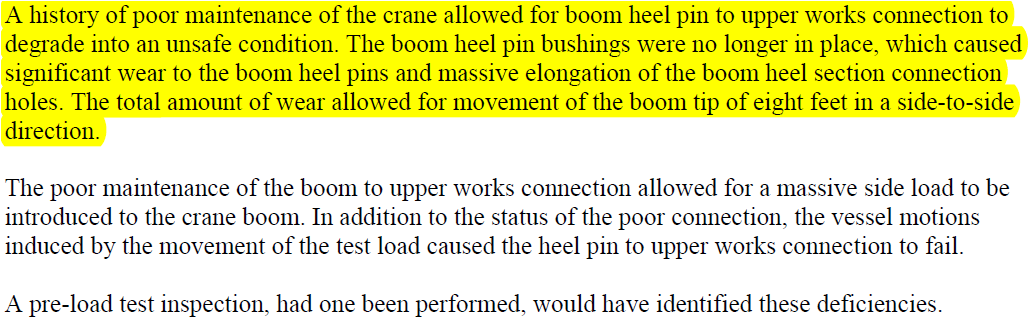
We understand that Total is conducting an inquiry, and assume that Transocean has also investigated this accident. We hope those reports are made publicly available.
Posted in accidents, tagged aban pearl, accidents, offshore drilling, safety on June 3, 2011| Leave a Comment »
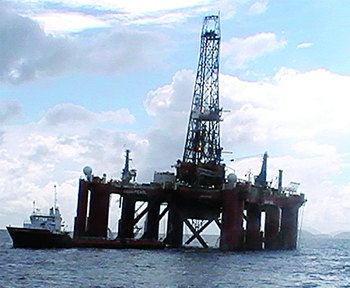
Aban Pearl listing off Trinidad in August 2009
While our interest in the sinking of the Aban Pearl pertains to what went wrong and why, former PDVSA board member Gustavo Colonel continues to question Aban Pearl contracting irregularities. Is PDVSA refusing to release the report on the Aban Pearl sinking so as not to draw further attention to these contracting issues?
The whole Board is responsible for the loss of about 800,000 barrels per day of oil production; for the fraudulent certification of “proven oil reserves” in the Orinoco heavy oil region; for the irregular contracting, with a ghost company, of the offshore drilling barge Aban Pearl for twice the amount really paid to the owners of the barge; for the importing of 180,000 tons of food that later went to rot in Venezuelan ports but provided some of the members of the board with millions of dollars in criminal profits; and in numerous other corrupt practices that are well documented.
 Bud's Offshore Energy (BOE)