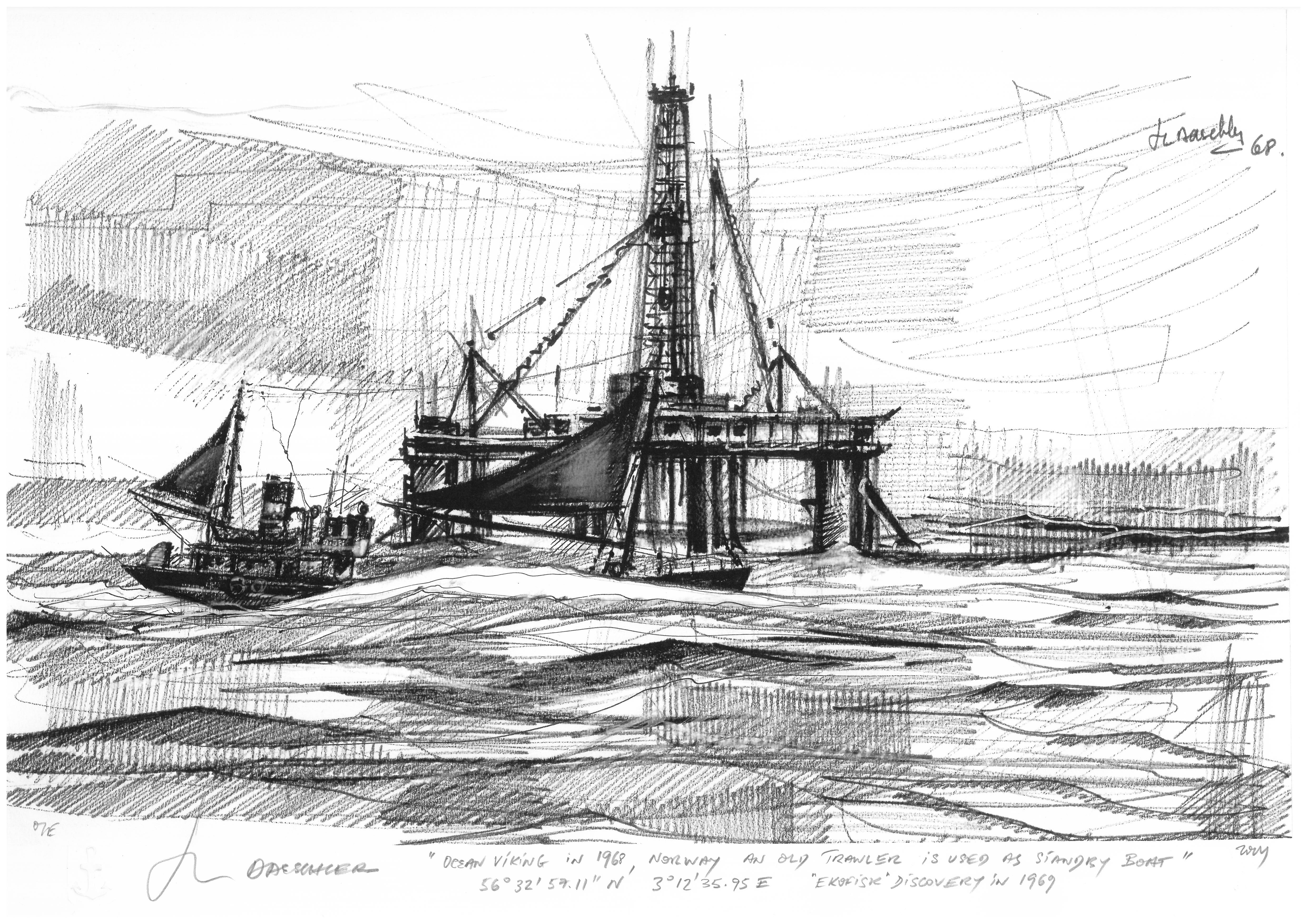
JL Daeschler is a pioneering subsea engineer and artist extraordinaire who is a native of France (Brittany) and lives in Scotland. He has shared 2 more of his exceptional drawings. (Click on the images to enlarge.)
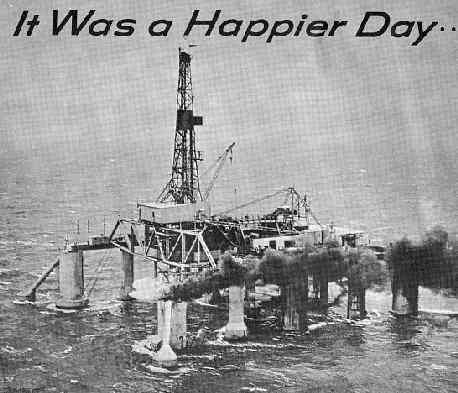
This is a drawing of the Ocean Viking (Odeco) in the Norwegian North Sea in 1968. The rig was built in Oslo as a sister ship to the Ocean Traveler, which was already working at the same location. The Ekofisk field was discovered later in 1969. The mast-type derrick could be lowered for long ocean tow or bridge clearance. It would have been difficult to evacuate a 100 + personnel to the standby vessel, a decommissioned trawler. Things have changed so much in 56 years!Inclined jack up legs with rack and pinion drive ( Marathon Le Tourneau), Gulf of Mexico
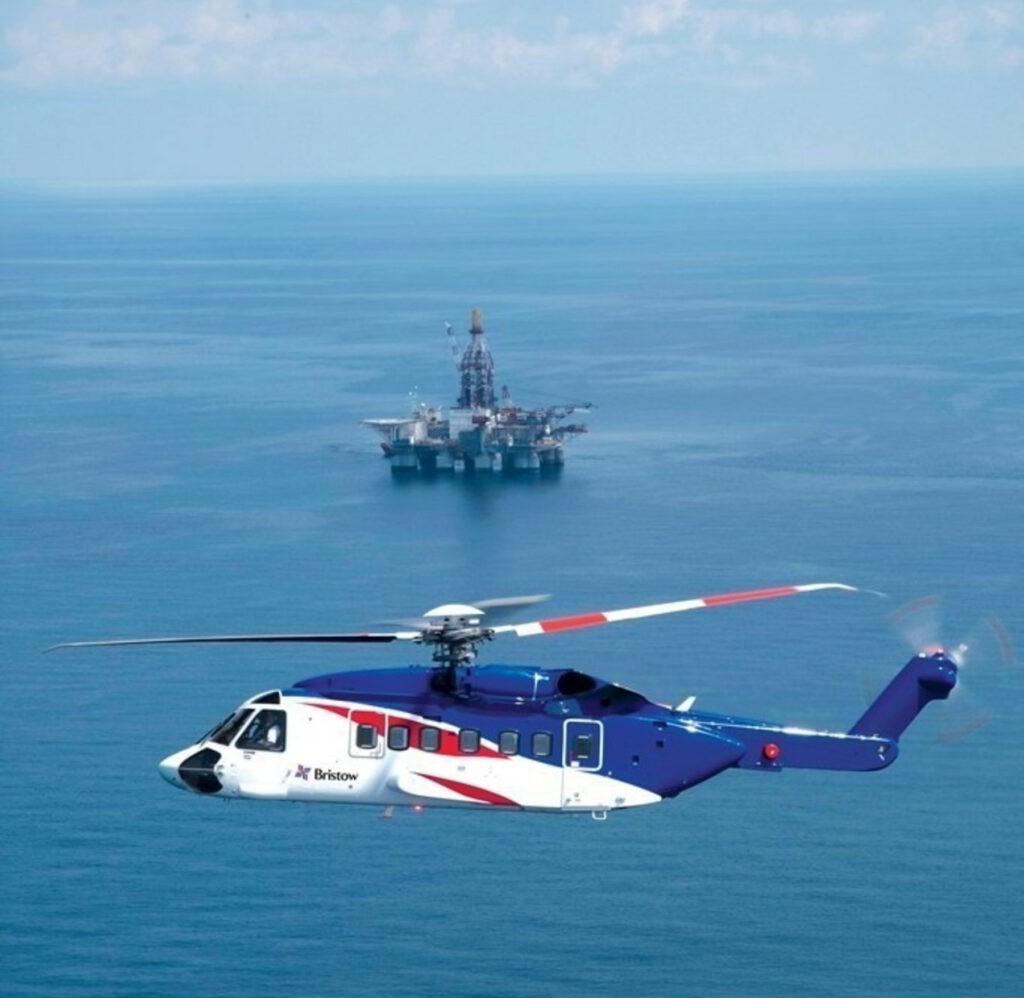
One person has died following the helicopter crash outside Bergen in Norway on the night of Wednesday 28th February. The helicopter was on a training assignment for Equinor ’s SAR service for the Oseberg area in the North Sea.
Search and rescue service is critical to offshore safety, and North Sea operators have excellent SAR capabilities. Sadly, one person died and five were injured (two seriously) when a Sikorsky S-92 helicopter, owned by Bristow and under contract to Equinor, crashed offshore Bergen last night. The crew was training to serve offshore workers in need.
converted semi-submersible initiates production at the Argyll field
JL Daeschler, a pioneering subsea engineer who lives in Scotland, has fond memories of his interactions with Fred and Ferris Hamilton, the brothers whose company was the first to produce oil in the UK sector of the North Sea (1975). Their small company aced the super-majors by initiating production at the Argyll Field with subsea wells and the Transworld 58, a converted semi-submersible drilling rig. Their rig conversion was an early predecessor to the modern floating production units that have become the surface facilities of choice for deepwater development.
JL recalls that Ferris and Fred took time to discuss any problem with any employee. Should there be arguments, they were often followed by more relaxed discussions about sailing, cars, cooking, and other topics of mutual interest. The brothers would travel from Denver for the annual Christmas dinner in Aberdeen, and invited everyone from the warehouse crew to the production manager. There was a great sense of community among the employees and contractors.
As JL notes, there were no satellite positioning systems, and real time communications with the rig were short and limited to the normal marine radio channels. This was a remarkable era of achievement for the North Sea and the offshore industry, as operations expanded and technology advanced to support them. I have much respect for these offshore pioneers and their contributions to societies around the world.
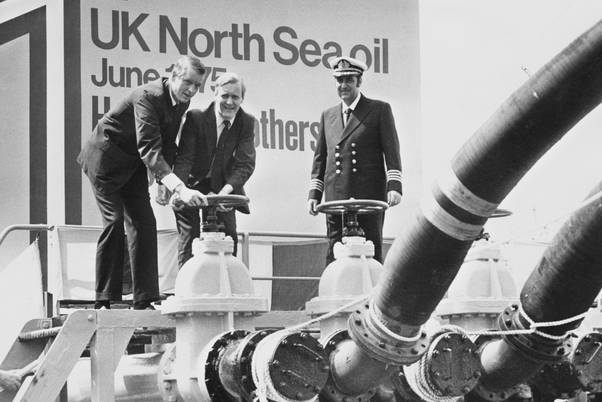
British Secretary of State for Energy Tony Benn, center, with Frederic Hamilton and Captain Harry Koutsoukos opening a valve to release the first oil from the North Sea into the BP refinery on the Isle of Grain in 1975.
Each annual licensing round will only take place if key tests are met that support the transition to net zero. The first test is that the UK must be projected to import more oil and gas from other countries than it produces at home.
The second is that the carbon emissions associated with the production of UK gas are lower than the equivalent emissions from imported liquefied natural gas.
If both these tests are met, the NSTA will be required to invite applications for new licences annually.
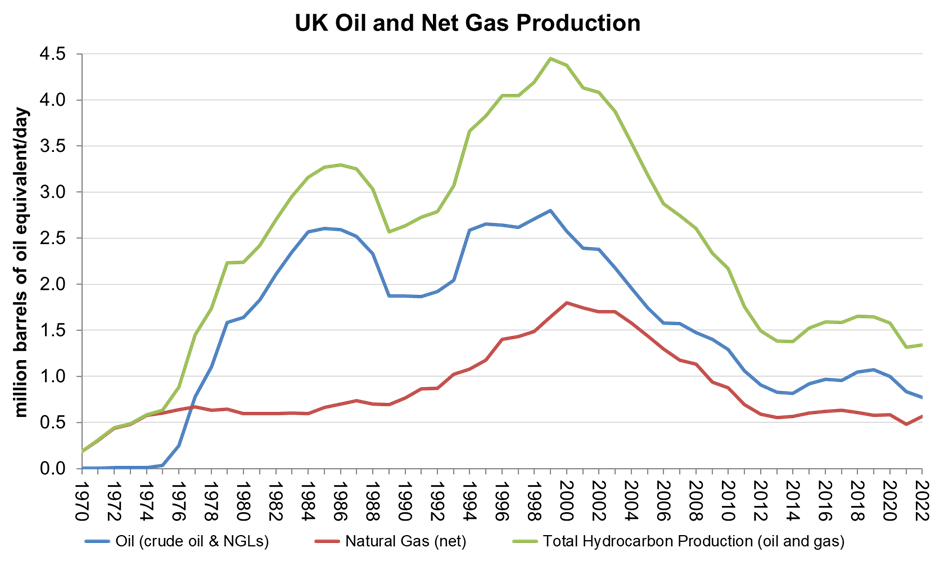
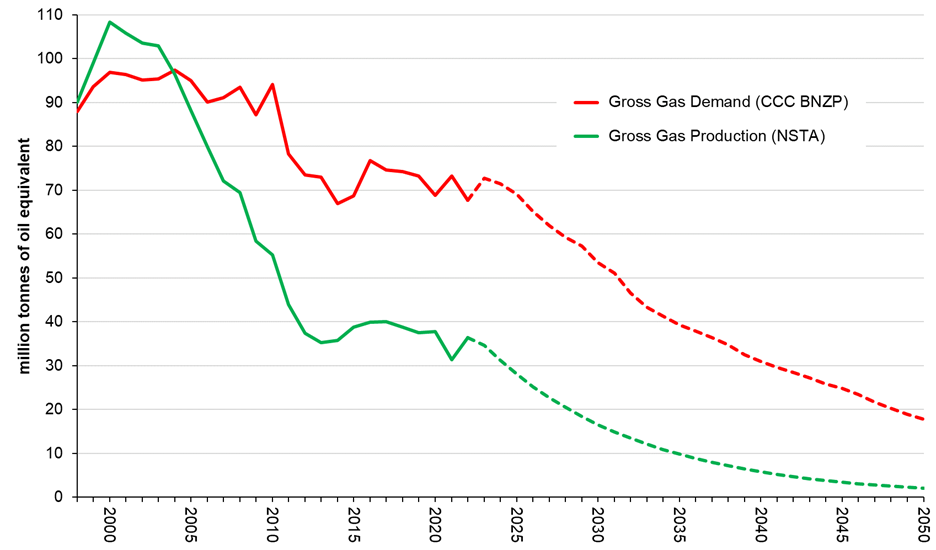
The “key tests” would seem to ensure annual licensing rounds for the foreseeable future. The charts below are from UK EiTi. The first chart illustrates the sharp decline in UK production over the past 20 years. The second and third charts illustrate the large projected gaps between supply and demand, particularly for natural gas.
In 2050, total production of oil and gas is estimated at ~10 million tonnes of oil equivalent. The projected 2050 demand is estimated at ~35 tonnes. For domestic production to exceed imports over the next 20-30 years, resource licensing and field development would have to be very successful and efficient.
Projections of UK Gas Demand and ProductionProjections of UK Gas Demand and Production
With regard to the second test, carbon emissions from the production of UK gas should maintain their advantage over imported LNG given the energy required to liquefy and transport that gas.
It would have perhaps been more transparent to simply stipulate annual licensing rounds, but that would probably not have been politically acceptable.
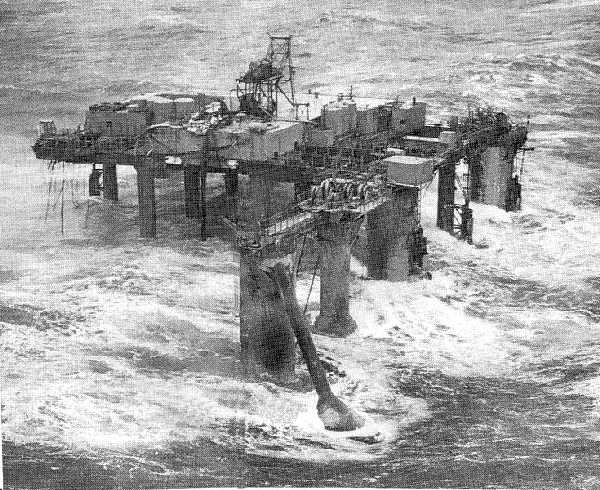
“At about 2 am on the day of the storm, the rig’s superstructure was torn off during a gale. By 7:10 am about a third of the drilling plattform had dissapared under 60 feet water.”
I didn’t realize that some early North Sea wells were drilled with semisubmersible rigs that were sitting on bottom, ala submersibles.
Per JL Daeschler, “the barge master on Ocean Prince was unsettled about sitting on a sandbank in the North Sea with waves as deep as the water depth, hence accelerating the scouring around the pontoon on the sea bed and distorting the forces on an unsupported hull. On a semisubmersible floating rig there is a great level of compliance between the mooring system and the forces on the leg and bracing. Worst case, you let the mooring go and drift.
It’s noteworthy that: “During the same storm which claimed the ”Ocean Prince,” the rig’s sister ship ”Ocean Viking,” while drilling afloat, withstood winds and waves of equal force.”
The entire crew of the Ocean Prince was safely evacuated.The helicopter pilot’s last name was fitting given his bravery during the rescue!
“Hero of the rescue effort was Capt. Robert Balls, 32, a former naval pilot who was alerted to remove the stranded crewmen. Within 45 minutes after he was awakened at Scarborough Hotel at 6 a.m., he was piloting a Wessex 60 helicopter across the North Sea fighting gale winds 400 feet up.”
“Captain Balls flew the copter with a minimum load of fuel in order to carry more than a full passenger load to the oil rig ”Constellation,” which was drilling about 20 miles south of the ”Ocean Prince.” On the first lift he transported 19 men. Usually, the capacity of the Wessex 60 is 16. On the second trip he took 18 crewmen. The final trip, he flew eight men directly to Scarborough.”
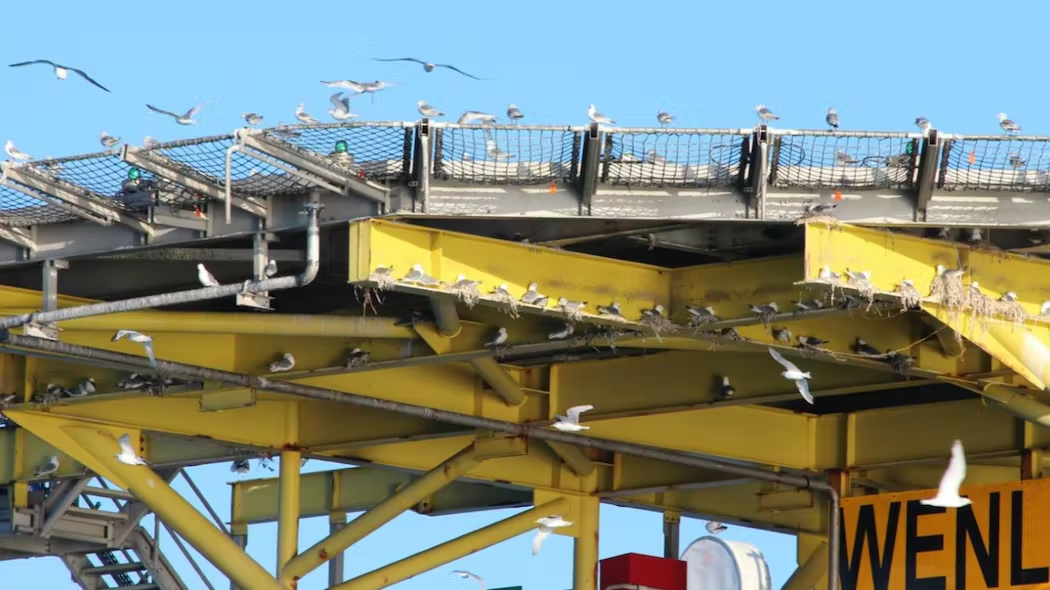
GUILDFORD, UK — Alpha Petroleum Resources, Energean UK and Orsted Hornsea Project Four will consider repurposing the Wenlock gas platform in the UK southern North Sea, which is nearing the end of its productive life.
One possibility is to reuse the facility as an artificial nesting site to offset the impact on certain bird species of offshore wind developments in the area.
Black-legged kittiwakes have set up nests on various North Sea platforms, according to Orsted’s recent surveys. Repurposing an existing platform as an artificial nesting structure is seen as an alternative to building a new artificial nesting structure to support the local development of the Hornsea Four offshore wind farm.
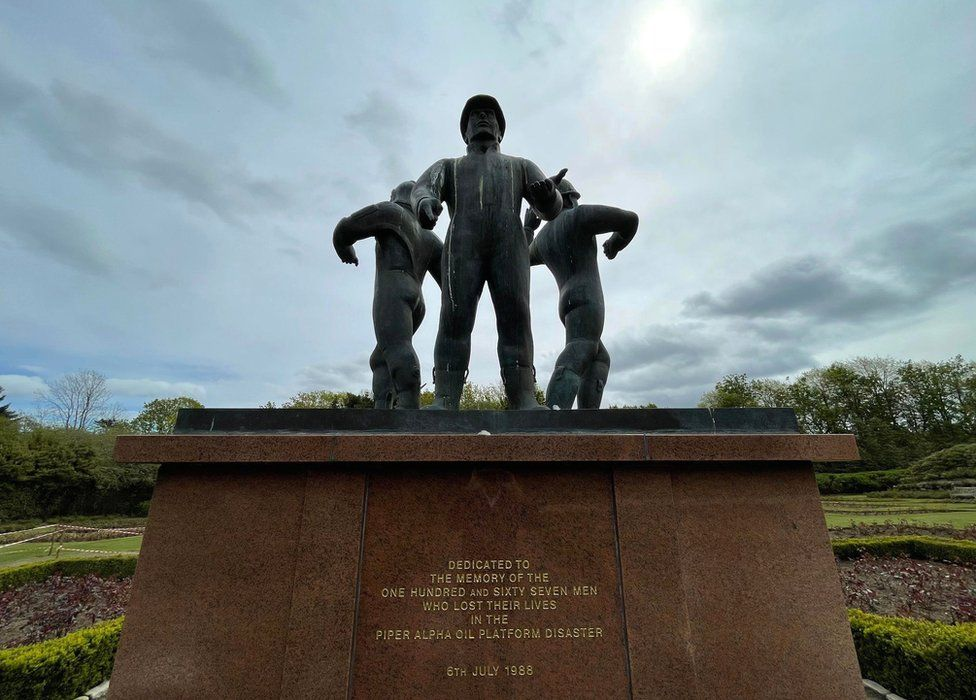
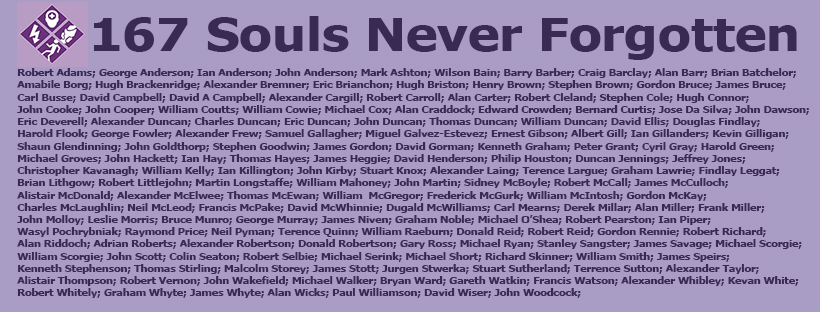
In terms of the total number of fatalities, the Piper Alpha fire was the worst disaster in the history of offshore oil and gas operations and sent shock waves around the world. Eight months later another interactive pipeline-platform fire killed 7 workers at the South Pass 60 “B” facility in the Gulf of Mexico. A US Minerals Management Service task group reviewed the investigation reports for both fires and recommended regulatory changes with regard to:
the identification and notification procedures for out-of-service safety devices and systems,
location and protection of pipeline risers,
diesel and helicopter fuel storage areas and tanks,
Lord Cullen’s comprehensive inquiry into the Piper Alpha tragedy challenged traditional thinking about regulation and how safety objectives could best be achieved, and was perhaps the most important report in the history of offshore oil and gas operations. Per Cullen:
“Many current safety regulations are unduly restrictive because they impose solutions rather than objectives. They also are out of date in relation to technological advances. Guidance notes lend themselves to interpretations that discourage alternatives.There is a danger that compliance takes precedence over wider safety considerations and that sound innovations are discouraged.“
Cullen advocated management systems that describe the safety objectives, the system by which those objectives were to be achieved, the performance standards to be met, and the means by which adherence to those standards was to be monitored. He called for safety cases that describe major hazards on an installation and provide appropriate safety measures. Per Cullen, each operator should be required in the safety case to demonstrate that the safety management systems of the company and the installation are adequate to assure that design and operation of the platform and its equipment are safe.
Tiå går og di seie tiå lege adle sår Men ein mista bror e sår som aldri gror Kanskje vil dårr gå vinter og vår Sei oss klart kor dokker står Håpte på at han sko komma At han sko komma hjem igjen
Time is gone, they said; time would heal all wounds But to lose a brother is a wound that will never heal It could take as long as the never-ending winter and spring [i.e., never] I hope that he should come That he should come home again
Britain sees a “good, solid” future for the North Sea’s oil and gas industry and will issue new licences to expand output in the future, Energy Minister Greg Hands said on Tuesday.
“We need continued investment into the North Sea,” Hands told the International Energy Week online conference.
Meanwhile, the US government seems intent on supporting legal and administrative actions that stymie offshore exploration and development. The US is sanctioning its own offshore industry during an international crisis centered around energy.
2021 was the first year in the history of the US offshore program dating back to the passage of the OCS Lands Act in 1953 without a single oil and gas sale, and there is no lease sale on the horizon.Most years have had multiple sales, regardless of the party in power. The only attempted 2021 sale (no. 257) was required by a Federal Court decision in Louisiana. That sale was annulled by a questionable DC court decision that the Federal government chose not to appeal.
European power prices have spiraled to multi-year highs on a variety of factors in recent weeks, ranging from extremely strong commodity and carbon prices to low wind output.
Equinor and its partners have received permission to increase gas exports from two fields on the the Norwegian continental shelf to supply the tight European market. Production permits for the Oseberg and Troll fields have each been increased by 1 billion cubic meters (bcm) for the gas year starting 1 October.