Feeds:
Posts
Comments

Posts Tagged ‘macondo’

“The goal of our efforts is a culture of safety, in which protecting human life and preventing environmental disasters are the highest priorities, while making leasing and production safer and more sustainable,” said Assistant Secretary Wilma Lewis, who chaired the Safety Oversight Board.

The report of the Department of the Interior’s Safety Oversight Board has been posted on the DOI website.  The report recommends certain improvements in DOI’s offshore oil and gas regulatory program. Because of my participation in this project, I won’t comment on the specifics of the report.  I will say that I was impressed by the professionalism of the Board and the DOI staff who assisted with the project.  All views were openly discussed and carefully considered.

Read Full Post »

Here is the link.

Our main interest was in the flow path and BOP issues:

Flow path:

The investigation team concluded that hydrocarbon ingress was through the shoe track, rather than through a failure in the production casing itself or up the wellbore annulus and through the casing hanger seal assembly.

BOP:

  1. The explosions and fire very likely disabled the emergency disconnect sequence
  2. The condition of critical components in the yellow and blue control pods on the BOP very likely prevented activation of another emergency method of well control, the automatic mode function (AMF), which was designed to seal the well without rig personnel intervention upon loss of hydraulic pressure, electric power and communications from the rig to the BOP control pods. An examination of the BOP control pods following the accident revealed that there was a fault in a critical solenoid valve in the yellow control pod and that the blue control pod AMF batteries had insufficient charge; these faults likely existed at the time of the accident.
  3. Remotely operated vehicle intervention to initiate the autoshear function, another emergency method of operating the BOP, likely resulted in closing the BOP’s blind shear ram (BSR) 33 hours after the explosions, but the BSR failed to seal the well.
BP’s flow path assessment is consistent with our expectations.  Early on, while most of the attention was focused on the annulus, we thought that flow inside the production casing was a distinct possibility.  With regard to the BOPs, BP’s explanation is a more complete than we expected at this time, given that the stack has just been recovered.
More to follow.

    Read Full Post »

    While we wait for the Bly Report (BP), Colin Leach (without the benefit of staff and access) has issued his concise and credible report on Macondo. I recommend that you take a few minutes to read it. Many thanks to Colin for his continued leadership on offshore safety issues.

    Read Full Post »

    BOE has received unconfirmed reports that BP’s internal investigation into the causes of the Macondo blowout will be released on Wednesday (8 September) in Washington, DC.  The investigation team of more than 70 engineers and other staff has been headed by Mark Bly, BP’s Group VP for Safety and Operations.  Stay tuned!

    Read Full Post »

    if

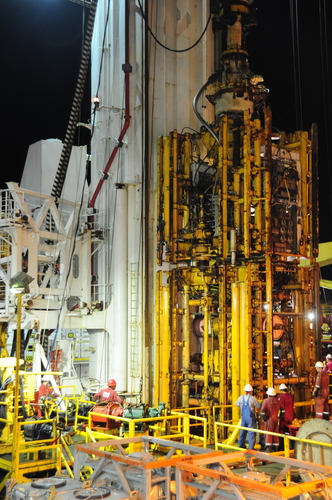
    Deepwater Horizon BOP Stack

    Oh, what might have been …..

    If this BOP had prevented the explosion, fire, and blowout, 11 offshore workers would still be alive, a mega-spill would have been prevented, tens of billions of dollars would have been saved, the Gulf region would have avoided a major crisis, the national economy would be stronger, and our energy future would be much brighter.

    Read Full Post »

    This article is nicely done, but like most commentary on the factors contributing to the Macondo blowout, it assumes that the well flowed in the annulus outside the production casing.  Steps 1-3 would be irrelevant if the well flowed up through the shoe track and inside the production casing (ala Montara).

    Read Full Post »

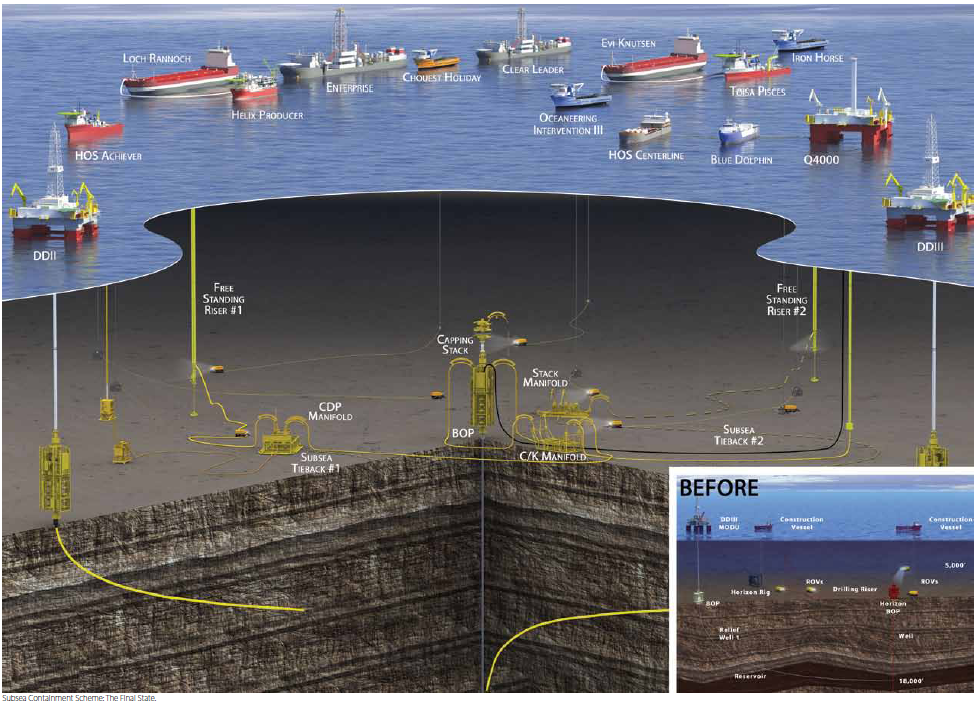
    Under the direction of the federal science team and U.S. government engineers, BP used the Development Driller II to successfully install a fully functioning and tested Blow Out Preventer (BOP) on the cemented Macondo 252 well. Earlier today, BP lifted the damaged BOP, which will now be lifted to the surface and recovered. During the period of time between the removal of the damaged BOP and installation of the replacement BOP, there was no observable release of hydrocarbons from the well head. This procedure was undertaken in accordance with specific conditions I set forth last week in a directive authorizing this procedure. This is an important milestone as we move toward completing the relief well and permanently killing the Macondo 252 well. I will continue to provide updates as necessary.” Admiral Allen

    You have to love the wording of these Unified Command announcements.  I trust (hope) that the language in bold is added by the public relations staff, and that the Admiral and the science team are secure enough in their leadership roles that they don’t need to continuously remind people about their importance.

    Have the Admiral and the science team also directed the operations that have not gone so well, or only the successes?  In particular, we would be interested in learning about the decision making process that led to the early cessation of the dynamic top-kill, the Unified Command’s insistence that pressure be vented after the well had been capped (fortunately, this decision was reversed), and the rationale for finishing the relief well intercept.

    Read Full Post »

    BP has issued a report on the response capabilities and innovative new technology and procedures demonstrated following the Macondo blowout. While the report is somewhat promotional (understandably), the information is summarized and compiled in a useful manner and underscores the magnitude of the response.  Although most close observers probably have issues with certain actions taken by BP or the Unified Command, one cannot deny the unprecedented size and complexity of the response.  We can only imagine how chaotic this response could have been if the operator did not have the resources and the will to mount such an enormous effort.

    I hope BP will be similarly forthcoming with the results of their internal review of the blowout’s causes.  When will that very important report be released?

    At some point, BP’s candid observations on the functioning and effectiveness of the Unified Command system would also be helpful. The more we can learn about the differences of opinion and problems that arose during the response, the better we can prepare for future incidents.  Will any of the official investigations be looking into these aspects of the response?  At BOE, we are particularly interested in the well intervention, capping, containment, and relief well decisions.

    Read Full Post »

    While BP has established a $20 billion damage fund that is being administered by the Federal government, PTTEP, the party responsible for the Montara blowout in the Timor Sea, is taking a different approach.  PTTEP has denied all claims from the Indonesian government arguing that oil spill damages were limited to the immediate vicinity of the Montara field.  However, information presented at the Montara hearings indicates that the slick extended into Indonesian waters.

    PTTEP Australia (PTTEP AA), a subsidiary of the Thai-listed PTT Exploration and Production Public Company Limited today (2 September 2010) confirmed the Government of Indonesia that it has not accepted any claims for compensation relating to the claimed impacts of oil released from the company’s Montara field in the Timor Sea last year.

    What if PTTEP was the operator at Macondo?

    PTTEP news release

    Upstream report on the claim

    Read Full Post »

    Click for an excellent summary of what may have gone wrong at Macondo and what can be done to prevent future incidents.

    While there are no new details on the causes of the blowout, available information on the possible contributing factors is nicely summarized.  The presentation also includes a very good summary of risk management considerations.

    Barriers against accidents are not only technical and operational and “physical” but are also non-physical built around strategic and organizational measures and decisions

    During the Montara hearings and later in Macondo discussions, we raised concerns about the timing of the production casing pressure test. This issue has not received enough attention in our view, possibly because most of the Macondo focus has been on annulus flow and barriers.  It was good to see this comment in the presentation:

    Pressure tested well far too early – could have blown out cement of shoe track

    Read Full Post »

    « Newer Posts - Older Posts »