Feeds:
Posts
Comments

Posts Tagged ‘macondo’

West Atlas Jackup and Montara Wellhead Platform

While there has been much post-Macondo discussion about the complexity of subsea containment and capping operations for deepwater wells, Macondo was ultimately capped and killed before being intersected by the relief well. The same cannot be said for the shallow water Montara well, which was killed by a relief well after flowing for 74 days.

Capping a flowing well is never routine, regardless of the water depth. However, the safety risks are greater for surface wells.  Those risks combined with the low probability of success are why a capping operation was not even attempted at Montara.  These were the concerns:

  1. The risk of a fatality was estimated at an alarming 25-30%.
  2. The risk of ignition while retracting the cantilever of the West Atlas jackup, a necessary step in the capping operation, was high.
  3. Only the 20-inch casing was tied-back to the wellhead platform. The 13 3/8″ casing was suspended just above the water surface. (According to testimony during the inquiry, the 13 3/8″ casing was not cemented back inside the 20″ casing.)
  4. Unless they were going to tie-back the 13 3/8″ casing while the well was flowing (probably not feasible and not mentioned as a possibility in the Inquiry report), they would have had to install a specially made BOP on the 20.”  If they were able to install this BOP and shut-in the well, flow would have undoubtedly broached the casing at the 20″ inch shoe.  One possible alternative may have been to install a diverter under the BOP and attempt a dynamic kill operation (i.e. direct the flow downwind and away from the rig while pumping mud down the well).  This too would have been complex and risky.

Given the very high safety risk and the low probability of success, I believe the regulator and operator made the correct decision in forgoing a capping attempt. The experiences at Macondo and Montara indicate that capping considerations must be taken into account during well planning activities for both subsea and surface wells, and that they latter pose greater safety risks.  Given the fire potential, having the wellhead at the surface is not an advantage when it comes to capping a flowing well.  It’s better to have the wellhead on the seafloor where the robotic equipment is doing the work.

Read Full Post »

I was unaware of the Halliburton study referenced in the Montara Inquiry Report:

A 2001 Halliburton study of USA Gulf of Mexico cementing failures in 4000 wells showed that (i) approximately one in six casing shoes required remedial work after primary cementing (by way of a so‐called ‘squeeze job’); and (ii) intermediate casing shoes failed shoe tests 70 per cent more often than shallower casings because they were more likely to be over‐displaced.

This paper was presented at an SPE conference in New Orleans.  Click here to purchase the paper or read a good abstract.

Questions:

  1. Have other analyses and reports been prepared using these data?
  2. Would Halliburton make the data base available for the common good if they receive legal protection?
  3. In light of the worldwide interest in better understanding well integrity risks, would Halliburton and others expand the data base to include other regions?
  4. Surely, there must be other private data bases that would be useful for assessing operational risks and developing mitigations. Are the owners willing to identify these data bases? Can they be protected from liability risks if they agree to make the information accessible?

Read Full Post »

This well-written draft report is fascinating reading for those who closely followed the various attempts to contain and kill the Macondo well.

A couple of concerns:

  1. The report relies heavily on anecdotes and qualitative judgments attributed to unnamed individuals. For example, twelve sources are cited in the footnotes on page 6, but only one is mentioned by name.  No information is provided about the qualifications or responsibilities of the unnamed sources, so it is difficult to assess the significance of their comments.
  2. The narrative ends rather abruptly without any discussion about the decision to continue with the relief well after the successful static kill operation.  The report simply states that BP proceeded with the relief well to finally kill Macondo.  As indicated previously on BOE, this is not entirely accurate. Macondo was already killed, and the well could have been secured through conventional plugging and abandonment procedures.  The relief well was presumably continued to verify that the annulus was sealed and provide information that might be useful as part of the investigation.  However, the relief well did not kill the well and the intercept was not necessary for that purpose.

Read Full Post »

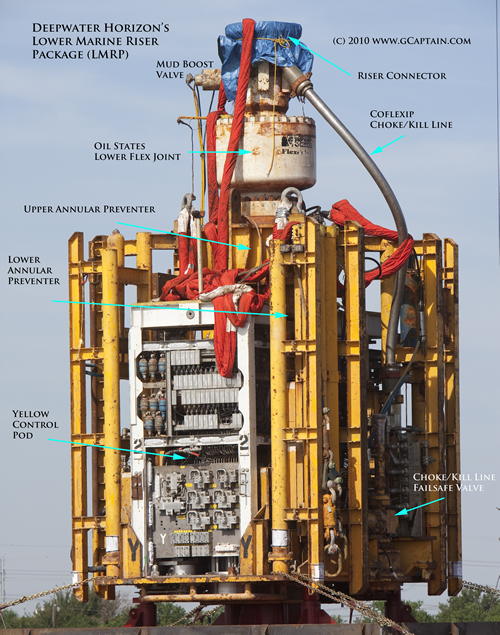
BOP stack awaiting post-Macondo inspection (from gCaptain.com)

In my 11 May 2010 testimony before the Senate Energy and Natural Resources Committee, I made ten recommendations. While many of the issues raised in that testimony are being addressed, one of the more important recommendations (no. 4) has received little or no attention. This recommendation calls for a public or private system for collecting and assessing failure date for blowout prevention equipment.  To the best of my knowledge, the only publicly available performance data for BOPE were collected by MMS and SINTEF and pertain to failures during BOP pressure testing, not failures during other operations.  How can we have a credible safety system without comprehensive failure data for such critical well control equipment?

Dr. Malcolm Sharples, an important BOE contributor, identified a number of BOP performance issues since Macondo.  Here are a few examples:

  1. During routine tests on the device, the locking system of one of the rams jammed in a locked position. Sevan is working with Petrobras and the supplier, Cameron, to find a solution.
  2. Reliance suspended all drilling work in the block after the Transocean rig Deepwater Expedition developed technical problems in its BOP. Reliance was drilling the KGV-D3-W1 well in the contract area since April 2010.
  3. The rig was offshore Australia for Shell early last month when newly installed BOP components failed during operations. Following several unsuccessful attempts to rectify the problems in the field, the failing BOP component is currently undergoing repairs in Singapore.

How is this information not important to every operator, regulator, and drilling contractor?  A comprehensive BOP failure reporting system should be a high and immediate priority for the offshore industry.  The information should be verified and published so that all may learn and future performance improved. Requirements for providing such information should be included in contracts and, if necessary, regulations.

An other major void that I have been talking about for years, without much success, is the absence of a comprehensive and verified international incident reporting system.  I assumed this would be universally recognized immediate necessity, and a critical element of the offshore industry’s initiatives agenda. Apparently that is not the case.  More on this to follow.

Read Full Post »

Link

The National Academy of Engineering and the National Research Council have released the interim report of the Committee on the Analysis of Causes of the Deepwater Horizon Explosion, Fire, and Oil Spill to Identify Measures to Prevent Similar Accidents in the Future. The interim report includes the committee’s preliminary findings and observations on various actions and decisions including well design, cementing operations, well monitoring, and well control actions. The interim report also considers management, oversight, and regulation of offshore operations.

Comment: No significant surprises.

Read Full Post »

In conveying our deep condolences and solidarity to the United States Government and while sharing in the anguish of those whose livelihoods had been seriously affected, I asked that the report ofthe investigation into the accident be submitted to IMO as soon as possible after it has been concluded, so that we may move swiftly to introduce, into the regulatory regime of the Organization, whatever lessons may be learned from the incident in order to enhance safetyand environmental protection in the offshore industry and strengthen, should that prove necessary, the provisions of any relevant IMO instrument. Remarks by Secretary-General Efthimios Mitropoulos

The Secretary-General seems to be committed to an expanded role for IMO in regulating offshore oil and gas facilities.  Questions:

  1. Is an organization with a shipping history and culture the right body to be regulating drilling and production operations? While IMO has experience with mobile drilling units, primarily the vessel aspects, the organization has had little or no involvement with well construction and integrity, production operations or pipelines.
  2. What would an expanded IMO role  mean for existing offshore regulators and their cooperative efforts (primarily through the International Regulators’ Forum) to coordinate activities and improve safety performance?  Generally speaking, the principal safety regulators for offshore facilities have had a very limited role in IMO activities.

Read Full Post »

BOP stack awaiting post-Macondo inspection (from gCaptain.com)

Other than the mildly amusing skirmish about the positioning of representatives of the various factions during the inspection process (Hey, how about access for bloggers!) and some silly comments about the independence of the inspection contractor, there has been very little attention paid to the Deepwater Horizon BOP examination that is scheduled to begin today at NASA’s Michoud facility in New Orleans. The absence of media interest is surprising given the importance of this part of the Macondo investigation. Presumably, there will be more extensive coverage beginning today.

While the inspection and testing will be quite technical, some important aspects should be rather straightforward.  What is the position of the rams, particularly the shear ram?  What is the condition of the ram elements and annular preventer?  Is there evidence of control line leakage?  What can be determined about the electronics and the sequencing system designed to automatically actuate the shear ram when power is lost or when the riser is disconnected?

Hopefully, the official investigation website, which currently has no information on the BOP inspection program, will provide updates.  While we don’t expect immediate information on the findings, there should be reports explaining how the inspection program is being conducted and what has been accomplished.

Read Full Post »

I hate to say nice things about lawyers :), but the Commission attorneys handled the two days of hearings very effectively.  The outstanding staff preparation and support were quite obvious.

BOE has have long advocated more industry leadership on guiding principles, incident data gathering and verification, risk assessment, peer-audits, standards improvements, cooperative research, and failure data for critical equipment.  In that regard, we are pleased that Chairmen Reilly and Graham, the other Commissioners, and the industry and government witnesses commented positively on some of these important programs.

We need to effectively manage the safety and environmental risks associated with offshore exploration and production, because we can’t afford the economic and security risks associated with a diminished offshore oil and gas program. BOE advocates conservation and renewables, but projections by IEA and other leading energy forecasters make it clear that oil and gas will continue to be an important part of our energy mix for decades.

Read Full Post »

With all of the discussion about the float collar issues, I thought I was listening to the Montara hearings this morning.   I’m surprised that neither the Commission questioners nor the panelists have mentioned Montara. When you have two major blowouts within 8 months and they have very similar root causes, the similarities should be of enormous interest. The absence of information transfer that might have prevented Macondo should be a major consideration in these and other hearings.

We have been talking about the similarities between Montara and Macondo for months.  Colin Leach’s 28 September post draws further attention to this issue.  Colin also hit the nail on the head with his comment that an additional barrier should have been installed above the float collar before proceeding.

Read Full Post »

Hats off to the Commission attorneys and staff for today’s presentations and questioning.  They were very well prepared, conducted themselves in a professional manner, and focused on the causes (not who should be blamed). The format was excellent with the Commission presenting their tentative findings and then asking the industry panel how they felt about each finding.

Oddly, the only real speculation was by the industry panelists, most notably the comments below about the flow path and BOP performance. Not very subtle!

Read Full Post »

« Newer Posts - Older Posts »