The carbon disposal industry, which overplayed its hand on the OCS, has managed to alienate traditional oil and gas industry supporters, sparking grassroots opposition in conservative areas of Louisiana. Carbon Capture and Sequestration (CCS) is also opposed by climate activists and the environmental justice movement.
The Advocate has nicely summarized opponents concerns: “land rights; the impact on underground aquifers if CO2 leaks; skepticism of climate change; skepticism of its effectiveness in fully capturing CO2; and opposition to the use of federal money and tax credits to finance the effort.”
Gov. Landry issued an executive order on Oct. 15 in an apparent attempt to calm the opposition. Following 34 “whereas” clauses intended to justify carbon disposal in Louisiana, the EO directs a pause in the review of new Class VI CO2 disposal wells. As evidenced by the attached press release, Save My Louisiana and other opposition groups are far from satisfied.
Their filing is attached. I found the following points to be particularly compelling:
p.3: “Despite no evidence that an Oil and Gas Program vessel has ever struck a Rice’s whale, the 2025 BiOp projects that Oil and Gas Program vessels will lethally strike numerous Rice’s whales over the term of the 2025 BiOp. On that basis alone, the Service found that the Oil and Gas Program will jeopardize the continued existence of the Rice’s whale, and developed a multi-step reasonable and prudent alternative which it asserts will reduce projected vessel strikes to zero.“
p. 4: “The Rice’s whale is a rarely found animal that the Service first identified as a new species (separate from the non-endangered Bryde’s whale) in 2021. 86 Fed. Reg. 47,022 (Aug. 23, 2021). There is no evidence that an Oil and Gas Program vessel has ever struck a Rice’s whale (or a Bryde’s whale) despite continued operation in the Gulf over many decades.”
p. 5: “The 2025 BiOp disregards the Bureaus’ logical, fact-based conclusion. Instead, the Service’s 2025 BiOp engages in speculation and guess-work to surmise that Oil and Gas Program vessels could be striking and killing Rice’s whales on a regular basis. The Service ignores the best available data (i.e., showing no recorded observations of an oil and gas vessel striking a Rice’s whale) and instead presumes that forceable and lethal collisions between oil and gas service vessels and 60,000-pound whales are regularly occurring but somehow going unnoticed by the vessels and their crews and that the carcasses silently disappear into the water, never to be seen again.“
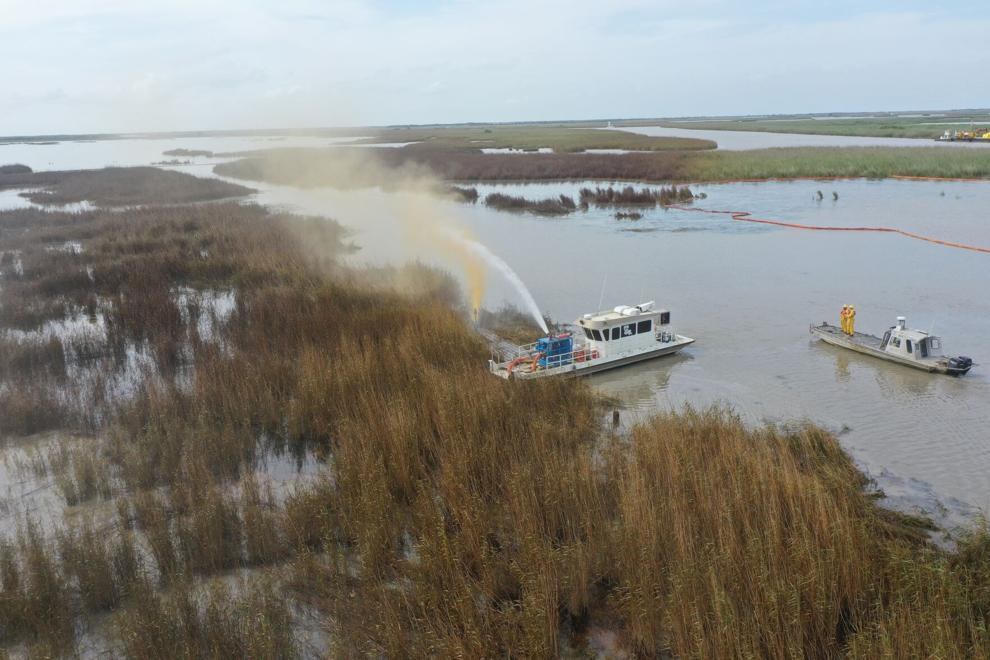
Coast Guard photo. Thanks to Lars Herbst for bringing this incident to my attention.
In what the Coast Guard is describing as an “uncontrolled discharge” (euphemism for blowout), an 82-year-old oil well has been spewing oil, gas, and water into the coastal marshes of southern Plaquemines Parish, Louisiana, for more than a week.
In hopes of future production, prior and current owners had elected not to permanently plug the well, apparently with the State’s acquiescence.
The Coast Guard has taken over the response and has accessed the Oil Spill Liability Trust Fund.
We don’t need relaxed decommissioning and financial assurance requirements. We need a cooperative Federal, State, and industry effort to ensure that wells are plugged in a timely manner and that financial assurance is provided to protect the public interest.
Bayou Bend CCS LLC commenced drilling an offshore (Texas State waters) and an onshore stratigraphic well for carbon sequestration in the first quarter 2024.
Is offshore carbon disposal ocean dumping?One of the provisions that was slipped into the “2021 Infrastructure Bill” exempted carbon sequestration from the Marine Protection, Research, and Sanctuaries Act of 1972 (Ocean Dumping Act). This exemption revises the OCS Lands Act and thus does not apply to State offshore lands. The Texas offshore wells must therefore be permitted by EPA as “Class VI wells,” as is the case for onshore disposal wells. However, Texas and Louisiana have asked the EPA for “primacy,” which would allow state agencies to approve and oversee these operations.
Meanwhile, the regulations for carbon disposal on the OCS, which the Infrastructure Bill mandated by November 2022, have yet to be published for comment. The latest Federal regulatory agenda indicates a publication date of 12/00/2023 for these regulations. Presumably the staff work has been completed and the rule is stalled in the review process.
Despite the absence of a regulatory framework, BOEM has accepted sequestration bids at the last three oil and gas lease sales. These bids were evaluated as if the leases were being acquired for oil and gas exploration and production, even though the bidders’ intentions were widely known. Why was BOEM a willing participant in this charade, not just at one sale, but at three sales in succession?
Given that the perceived carbon disposal bonanza is dependent on mandates and subsidies, one has to wonder about the massive revenue projections for this industry and raise concerns about the associated public and private financial risks. What is the long term business plan for this industry? Who will be monitoring the offshore wells (in perpetuity)? How will the public be protected from financial assurance and leakage risks? We will see how the myriad of carbon sequestration issues are addressed in the proposed regulations.
IT IS ORDERED and ADJUDGED that the Intervenors’ appeal is DISMISSED. As for BOEM’s limited appeal as to the timing of the sale, we hereby AMEND the district court’s preliminary injunction only to the extent that the deadline for conducting Lease Sale 261 shall now be thirtyseven days from the date of the issuance of the mandate in this appeal. IT IS FURTHER ORDERED that each party bear its own costs on appeal.
BOEM is allowed to delay the sale until Nov. 8, which is consistent with the Federal government’s request.
All other aspects of the Preliminary Injunction remain in place, but the 5th Cir. still needs to hear and decide the government’s appeal of the PI. Monday’s decision was on the emergency motion and not the merits of the Preliminary Injunction.
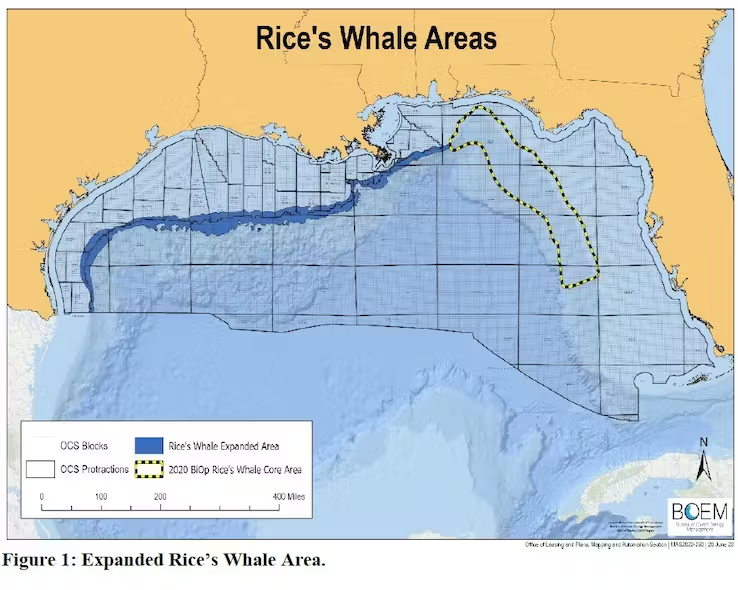
The challenged lease term for the expanded Rice’s whale area only arose in a July 2023 district court filing and then appeared in the FNOS for Lease Sale 261 on August 25, 2023—one month before the statutory deadline for the sale. BOEM failed to follow its own procedures by making significant changes to the FNOS, thereby depriving both affected states and the public the opportunity for meaningful review and comment. The procedural error is particularly grave here, because of both the compressed timeline and BOEM’s inexplicable about-face on the scientific record it had previously developed. (p.19)
The challenged provisions inserted into these leases at the eleventh hour, and the acreage withdrawal, are based only on an unexplained change in position by BOEM on a single study a few months after that supplemental EIS. The process followed here looks more like a weaponization of the Endangered Species Act than the collaborative, reasoned approach prescribed by the applicable laws and regulations. (p.22).
According to an affidavit from Shell’s commercial manager, the new restrictions on vessel traffic apply to an area of the northern Gulf that separates Shell’s existing offshore leases from the onshore infrastructure that supports them. Shell Offshore Inc., No. 2:23-cv-1167, at doc. 4, att. 2, ¶¶ 23–27. (p. 23).
Given the shaky justification offered by BOEM, the court cannot find that the challenged provisions are so necessary that withholding them even on a preliminary basis will outweigh the risk of irreparable economic harm shown by plaintiffs. Additionally, “there is generally no public interest in the perpetuation of unlawful agency action.” (p. 26)
For the reasons stated above, the court hereby ORDERS that the Motions for Preliminary Injunction be GRANTED. Accordingly, the government defendants are enjoined from implementing the acreage withdrawal and Stipulation 4(B)(4) as described in the Final Notice of Sale and Record of Decision for Lease Sale 261. Government defendants are ordered to proceed with Lease Sale 261, absent the challenged terms, by September 30, 2023.
This Court should grant Plaintiffs—the State of Louisiana, the American Petroleum Institute (“API”), and Chevron U.S.A. Inc. (“Chevron”)—a preliminary injunction and prevent those unlawful provisions from permanently disrupting the result of the fast-approaching lease sale (which Congress has directed must occur by September 30, and which cannot be delayed without causing Plaintiffs even more serious injury).
From a regulatory policy standpoint, this appears to be a strong filing. Operationally, the most important points pertain to the costly and premature Rice’s whale restrictions first discussed on this blog.
Most notably, the plaintiffs seek (p.39):
A preliminary and permanent injunction striking, setting aside, and enjoining BOEM from implementing the specific challenged provisions of the Final Notice of Sale and Record of Decision for Lease Sale 261;
An order vacating the specific challenged provisions of the Final Notice of Sale and Record of Decision for Lease Sale 261;
An order compelling Defendants to proceed with Lease Sale 261 on September 27, 2023, without the challenged provisions;





 Bud's Offshore Energy (BOE)