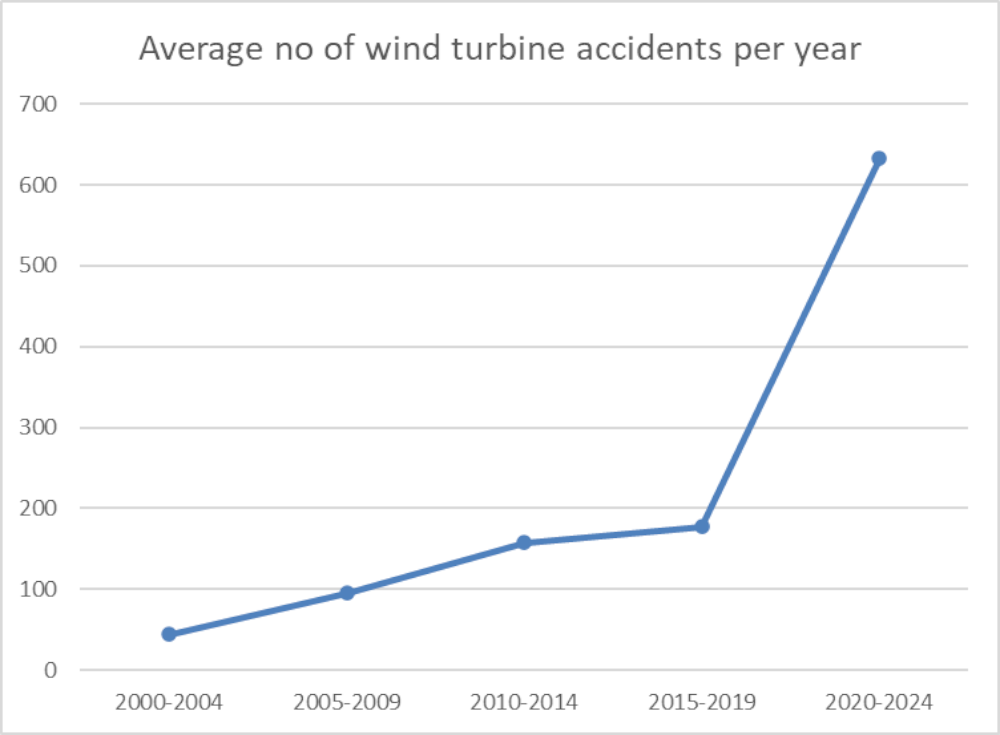
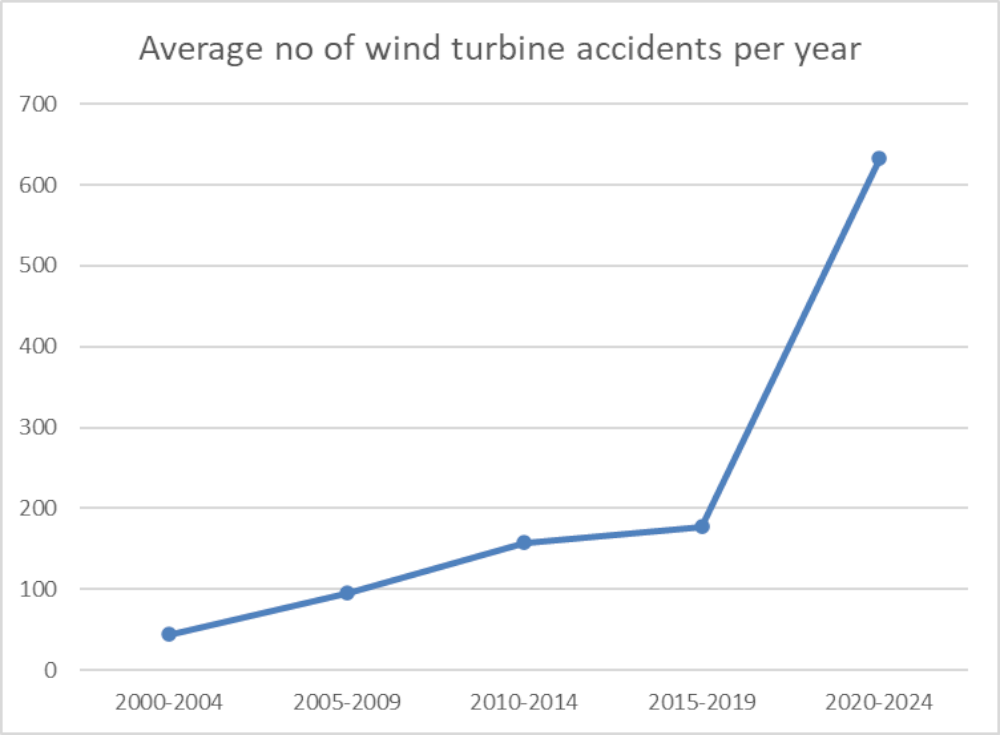
The SAS data indicate that the number of wind turbine incidents has risen sharply in recent years (see chart below). The increased number of turbines worldwide, and perhaps better news coverage of incidents, presumably contributed to the sharp increase. Nonetheless, the growing number of incidents is disconcerting, as is the absence of industry and government summaries and reports.
SAS acknowledges that their list, which is dependent on publicly available reports, is merely the “tip of the iceberg.” For example, the list does not include the June 2, 2025, Empire Wind project fatality.
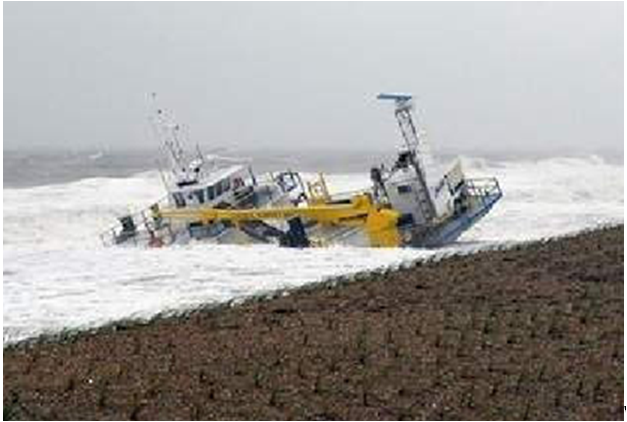
The SAS list does capture the 2008 collapse of the Russell Peterson liftboat, which was collecting data offshore Delaware for a wind project. One worker died and another was rescued. The Coast Guard never issued a report on this tragic incident. Serious questions remain about the positioning of a liftboat in the Mid-Atlantic for several months beginning in March when major storms are likely, the liftboat’s failure mechanisms, the operator’s authority to be conducting this research, and the actions that were taken in preparation for storm conditions.
The Russell Peterson toppled in May 2008 while gathering data for a proposed offshore wind project.
The SAS data indicate that the number of wind turbine incidents has risen sharply in recent years (see chart below). The increased number of turbines worldwide, and perhaps better news coverage of incidents, presumably contributed to the sharp increase. Nonetheless, the growing number of incidents is disconcerting, as is the absence of industry and government summaries and reports.
SAS acknowledges that their list, which is dependent on publicly available reports, is merely the “tip of the iceberg.” For example, the list does not include the June 2, 2025, Empire Wind project fatality.
The SAS list does capture the 2018 collapse of the Russell Peterson liftboat, which was collecting data offshore Delaware for a wind project. One worker died and another was seriously endangered. The Coast Guard never issued a report on this tragic incident. Serious questions remain about the positioning of a liftboat in the Mid-Atlantic for several months beginning in March when major storms are likely, the liftboat’s failure mechanisms, the operator’s authority to be conducting this research, and the actions that were taken in preparation for storm conditions.
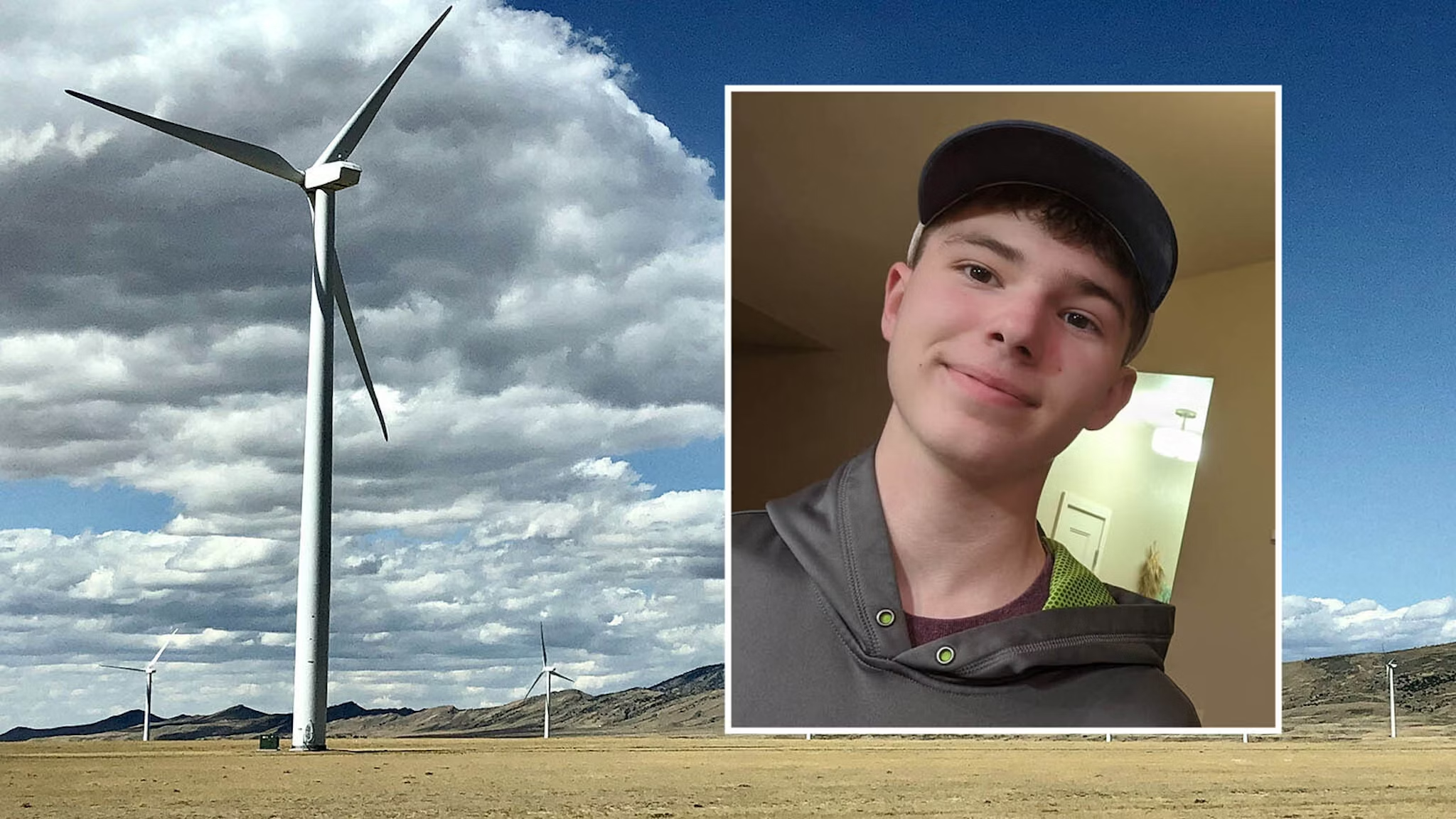
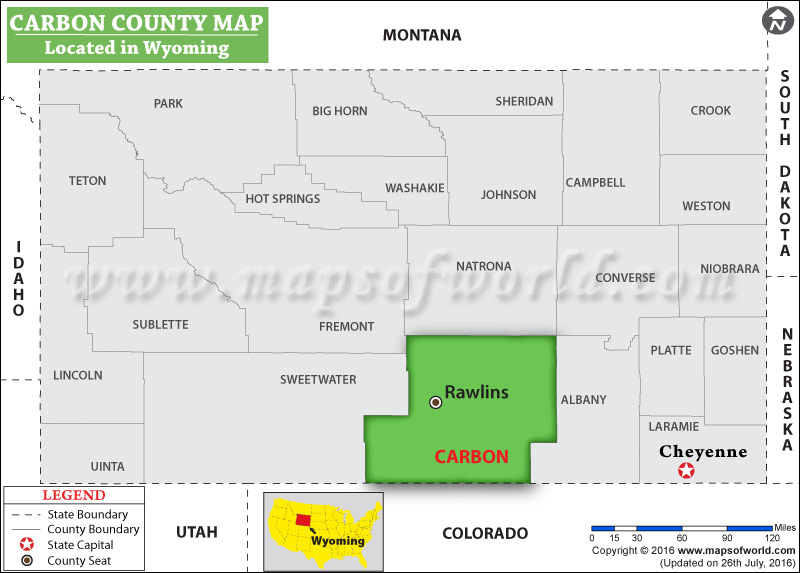
“Liam Cobb died Wednesday while working on a wind turbine near Medicine Bow in Carbon County. Anna Cobb said her nephew fell while working his job as a wind turbine technician.”
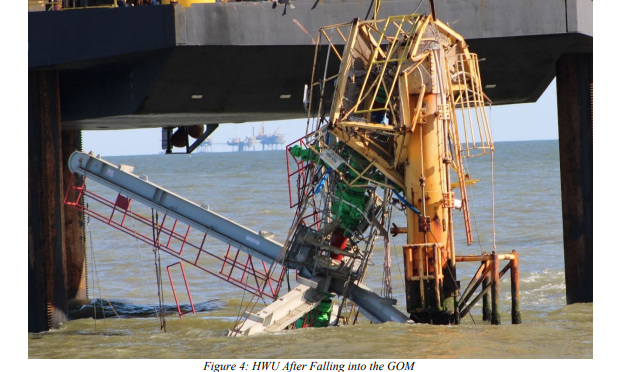
2 sentence summary: The well’s degraded 20″ structural casing could not support the hydraulic workover unit (HWU), which included an oversized BOP stack. The HWU began to sway and fell into the water with the victim attached by his fall protection to the top of the unit.
The full report is attached. The report is quite good, but something is seriously amiss when it takes 28 months to finalize a panel report. I suspect that the work of the panel and the regional reviewers was completed in a fraction of that time. Where are the bottlenecks?
Firstly, taking 2.5 years to publish an investigation report is unacceptable for an organization with BSEE’s talent, resources, and safety mandate. Unfortunately, such delays now seem to be the rule as the summary table (below) for the last 4 panel reports demonstrates. The most recent report implies that the actual investigation was completed in 2-3 months. Why were another 2+ years needed to publish the report? (Note that the lengthy and complex National Commission, BOEMRE, Chief Counsel, and NAE reports on the Macondo blowout were published 6 to to 17 months after the well was shut-in.)
incident date
report date
elapsed time (months)
incident type
5/15/2021
10/31/2023
29.5
fatality
1/24/2021
7/24/2023
30
fatality
8/23/2020
2/15/2023
30
fatality
7/25/2020
2/15/2023
31
spill
Four most recent BSEE panel reports
The subject (May 2021) fatality occurred during a casing integrity pressure test, and some of the risk factors were familiar:
The platform was installed 52 years prior to the incident, and had been shut-in for more than a year.
The well of concern (#27) was drilled in 1970, sidetracked in 1995, and last produced in February 2013.
Diagnostic tests clearly demonstrated communication between the tubing, production casing, and surface casing.
In light of the known well integrity issues and the absence of production for more than 8 years, the prudent action would have been to plug and abandon the well in a timely manner. However, under 30 CFR 250.526 as interpreted at the time, Fieldwood had another option – submit a casing pressure request to BSEE to confirm the integrity of the outermost 16″ casing and (per p. 10 of the report) “continue to operate the well in its existing condition.” Given that the well had not produced for 8 years and that the platform had been shut-in for more than a year, the option to continue operating the well should not have been applicable.
The only issue for Fieldwood to resolve with the regulator should have been the timing of the plugging operation. Additional well diagnostics would only serve to create new risks and further delay the well’s abandonment.
The resulting pressure test of the outermost (16″) casing was solely for the purpose of confirming a second well bore barrier. Per the report (p.10), there is a “known frequency of outermost casings in the GOM experiencing a loss of integrity as a result of corrosion.” Whether or not the 16″ casing passed the test, the inactive well had clear integrity issues and should have been plugged.
Fieldwood proceeded with the pressure test rather than correcting the problem. The regulations, as interpreted, thus facilitated the unsafe actions that followed. These factors heightened the operational risks:
Extensive scaffolding and a standby boat were needed for the test.
Process gas via temporary test equipment was used to conduct the test.
The Field-Person In Charge (PIC) heard about the test for the first time on the morning of the incident.
The PIC and victim had no procedures to follow, and had to figure out how to conduct the test on the fly.
A high pressure hose was connected without a pressure regulator or pressure safety valve.
The digital pressure gauge had two measurement modes, one to display pressure in psi and the other in bars. (One bar is equivalent to 14.5 psi. Assuming that the readings were in psi rather than bars would thus result in serious overpressure of the casing.)
Seconds after the victim told the field-PIC the pressure was 175 psi (presumably 175 bar and 2538 psi), the casing ruptured. The force of the explosion propelled the victim into the handrail approximately 4 feet away, which bent from the impact. The victim’s hardhat was projected 60 to 80 feet upwards, lodging into the piping.
The investigation report fails to address the wisdom of conducting the pressure test and the regulatory weaknesses that enabled Fieldwood to defer safety critical well plugging operations. The pressure test option in 30 CFR § 250.526, was not intended for long out-of-service wells with demonstrated well integrity issues. The only acceptable option was corrective action (plugging the well) without further delay. The pressure test option added risks without addressing the fundamental problem and helped enable the operator to further delay decommissioning obligations.
Postscript: According to BOEM data, the lease where the fatal incident occurred expired on 7/31/2021. Per the BSEE Borehole and structures files, neither the platform (#14) nor any of the other 4 structures remaining on the lease have been removed, and the well (#27) has yet to be plugged.
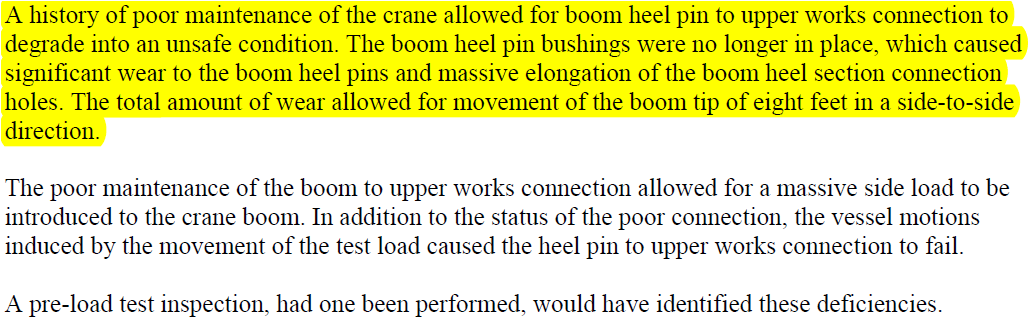
Thanks to a reader, we have obtained a copy of a report on the Jack Ryan crane failure (August 2010) that killed one worker and injured three offshore Nigeria. As BOE readers know, we have been pursuing information on this accident for months.
At BOE our highest priority is drawing attention to and disseminating information on offshore accidents. In that regard, we greatly appreciate the support we have received from readers.
We understand that Total is conducting an inquiry, and assume that Transocean has also investigated this accident. We hope those reports are made publicly available.
An employee on a non-producing offshore natural gas platform died after falling through a deck opening on Monday, the U.S. offshore drilling regulator said.
The employee of Alliance Oilfield Services was working on a Hilcorp Energy platform in 375 feet of water about 129 miles off the Louisiana coast in the Gulf of Mexico, the Bureau of Ocean Energy Management, Regulation and Enforcement said in a statement. Hilcorp and Alliance are both privately-held companies. Reuters

 Bud's Offshore Energy (BOE)