Feeds:
Posts
Comments

Posts Tagged ‘EIA’

The administration has taken steps toward a resumption of leasing on Federal onshore lands, which account for only 7% of domestically produced oil and 8% of our natural gas. While this is a positive step, our economy is largely being driven by production on private lands, absent which we would have a serious supply crunch. This new EIA graphic illustrates where the growth in natural gas production has been, and most of that growth has been on private land.
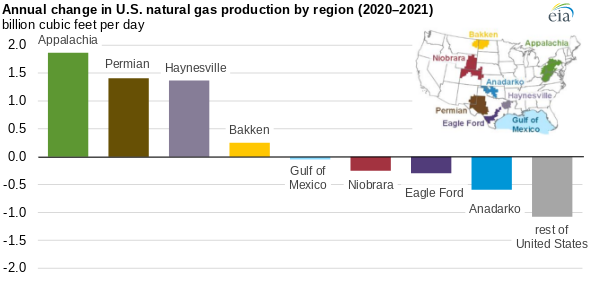
The growth in US oil production has been largely dependent on the Permian Basin:

Industry leaders have raised concerns about the extent to which Permian production can continue to grow and the country’s over-reliance on shale production.

There are no private offshore lands, and the future of US offshore production is almost entirely in the hands of the Federal government. It has now been 525 days since the last offshore lease sale. The Administration chose not to appeal the DC Federal Court decision vacating Sale 257, leaving that to the State of Louisiana and API (parties that actually support offshore oil and gas leasing).

It’s disappointing that the reasoning behind the judge’s Sale 257 decision has received so little attention, especially given that it hinged on BOEM not analyzing the benefit of high oil prices. (i.e. <leasing = <production = >prices = <intl consumption = < CO2) The decision was issued as Russian troops were amassing on the Ukraine border only 28 days before the invasion. Oil prices (WTI) had already reached $87/bbl and would soon spike to $120/bbl, so the decision embracing higher oil prices was (at best) bad timing. Keep in mind that this was not a matter of BOEM failing to consider GHG issues; BOEM had conducted those assessments. The judge’s decision was specific to BOEM not analyzing the GHG benefits of reduced foreign consumption as a result of the higher prices associated with reduced leasing.

Meanwhile, The 5 year program, without which offshore leasing cannot proceed, expires in June. Fellow Democrats Manchin and Kelly sent a letter to the President on 31 March urging the Administration to develop and implement a new 5 year program without delay. There is no online evidence of a response. Presumably, the 5 year program issue will be addressed in the bipartisan energy legislation that Senator Manchin is drafting.

Read Full Post »

U.S. crude oil production in the forecast averages 12.0 million b/d in 2022, up 0.8 million b/d from 2021. We forecast production to increase another 0.9 million b/d in 2023 to average almost 13.0 million b/d, surpassing the previous annual average record of 12.3 million b/d set in 2019.

EIA

The short-term forecast doesn’t say how much of that production will come from the Gulf of Mexico. Last year, EIA forecast 2022 Gulf production to average 1.75 BOPD which seems about right based on the the most recent production data.

Read Full Post »

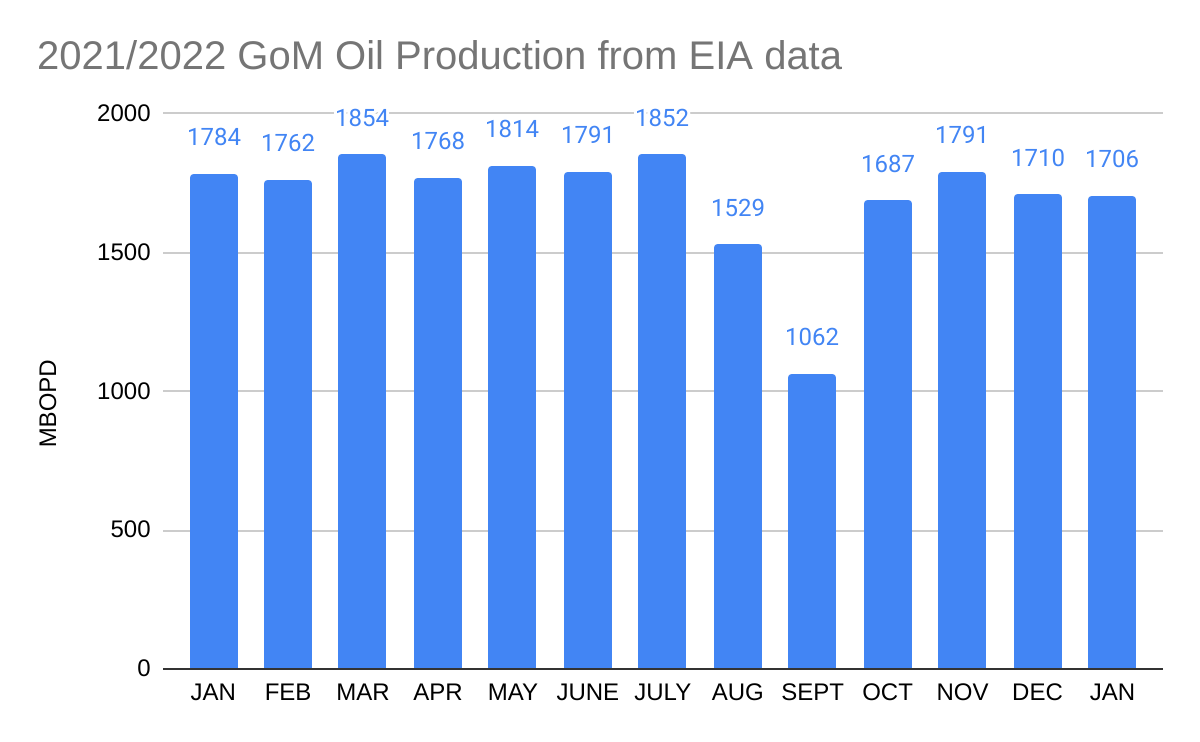
Even after full recovery from Hurricane Ida, Gulf of Mexico production remained well below the August 2019 monthly peak of 2.044 million BOPD. Production should trend upward in the near term as the Vito, Anchor, Argos, King’s Quay, and Whale floating production units come online. However, to sustain production near or above 2 million BOPD, exploration activity needs to be stimulated. This will be difficult given the suspension of leasing, and the continuous legal and administrative challenges.

Meanwhile the April 1 rig count held steady at 14.

Read Full Post »

Data from EIA

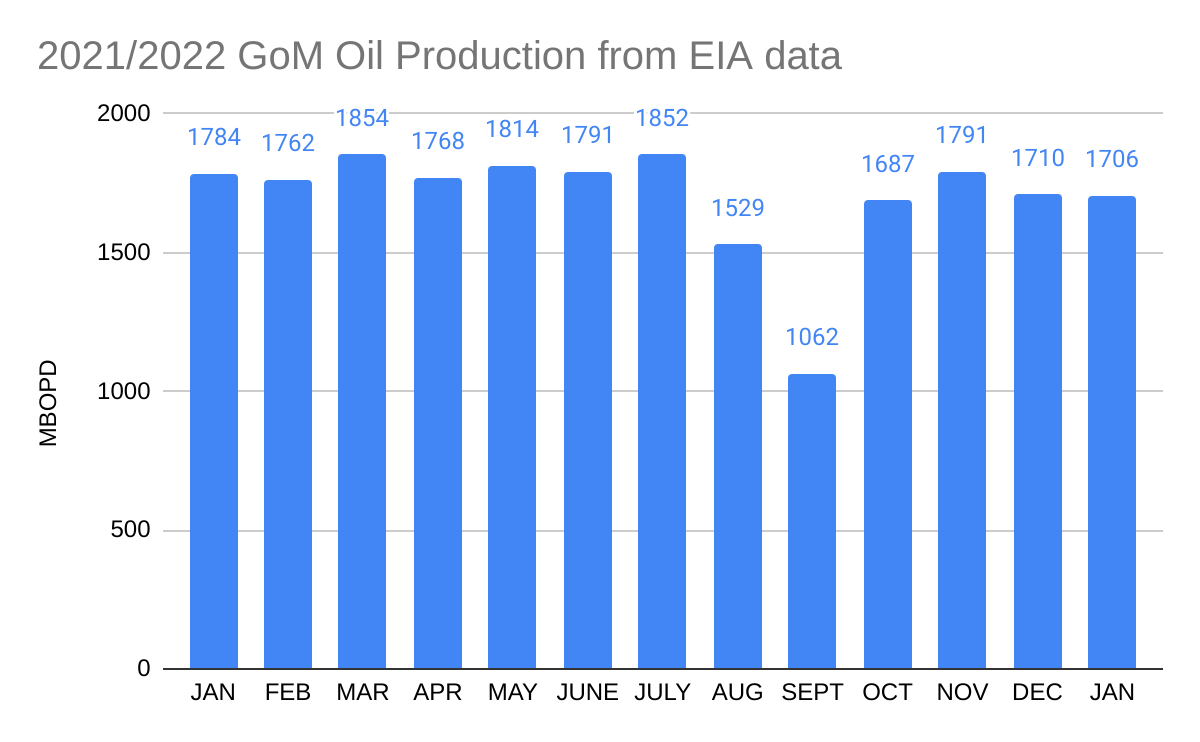
More than half of GoM oil production was shut-in for 13 days in September and several hundred thousand BOPD were shut-in for the rest of the month. The result was a 42% reduction in production from pre-Ida (July) levels.

All production has now been restored so the December EIA figures should give us a good read on stablized post-Ida production.

Read Full Post »

Data from EIA

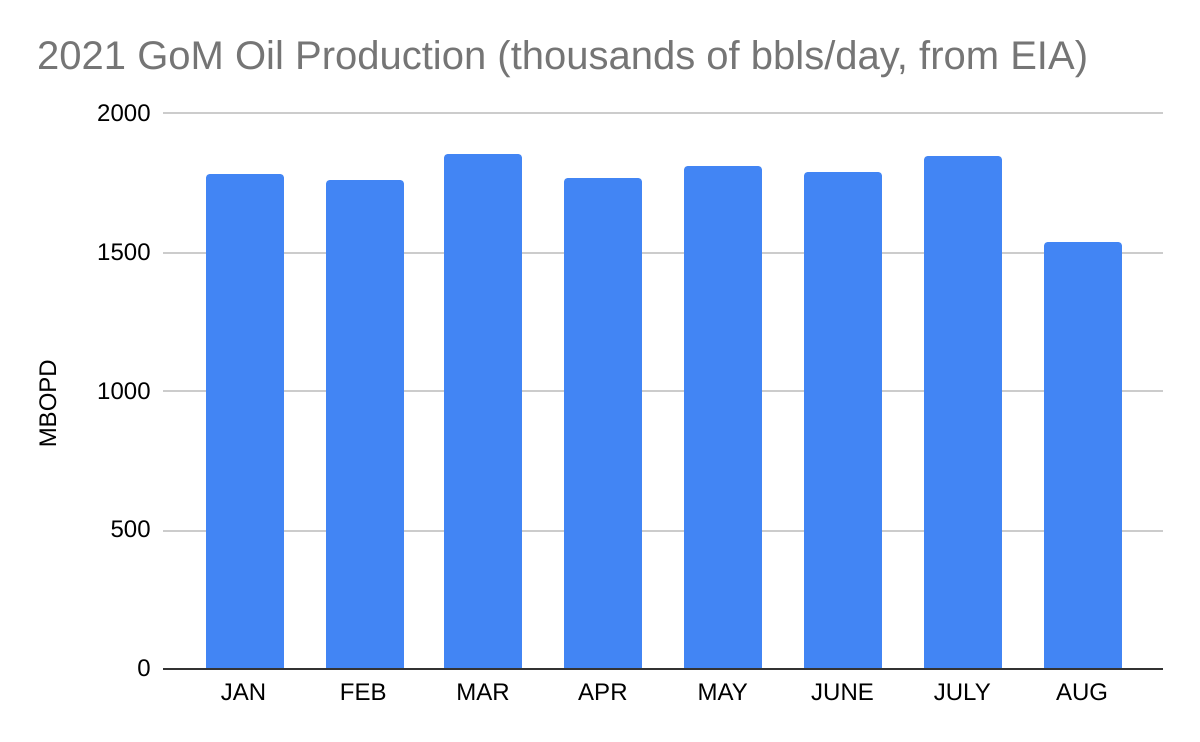
1.60 to 1.74 million BOPD were shut-in from 8/28 to 8/31, reducing the average daily production for August to 1.535 million barrels per day, a net reduction of 312,000 BOPD from July. The September production figure will be significantly lower given that more than half of the GoM production was shut-in for 13 days in September and several hundred thousand BOPD were shut-in for the rest of the month. September production will be released at the end of November.

Shell is now anticipating that their GoM production will be fully restored by mid-November.

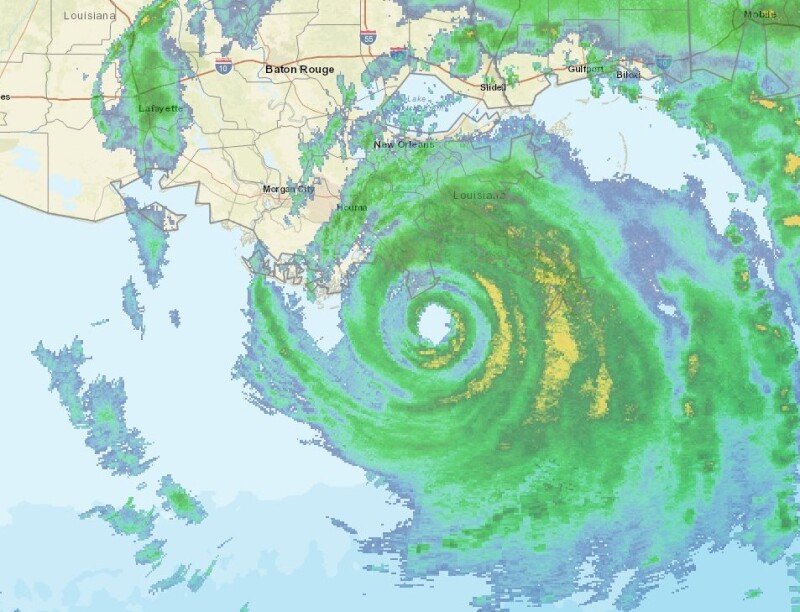
Hurricane_Ida_landfall.jpg
Hurricane Ida – JPT graphic

Read Full Post »

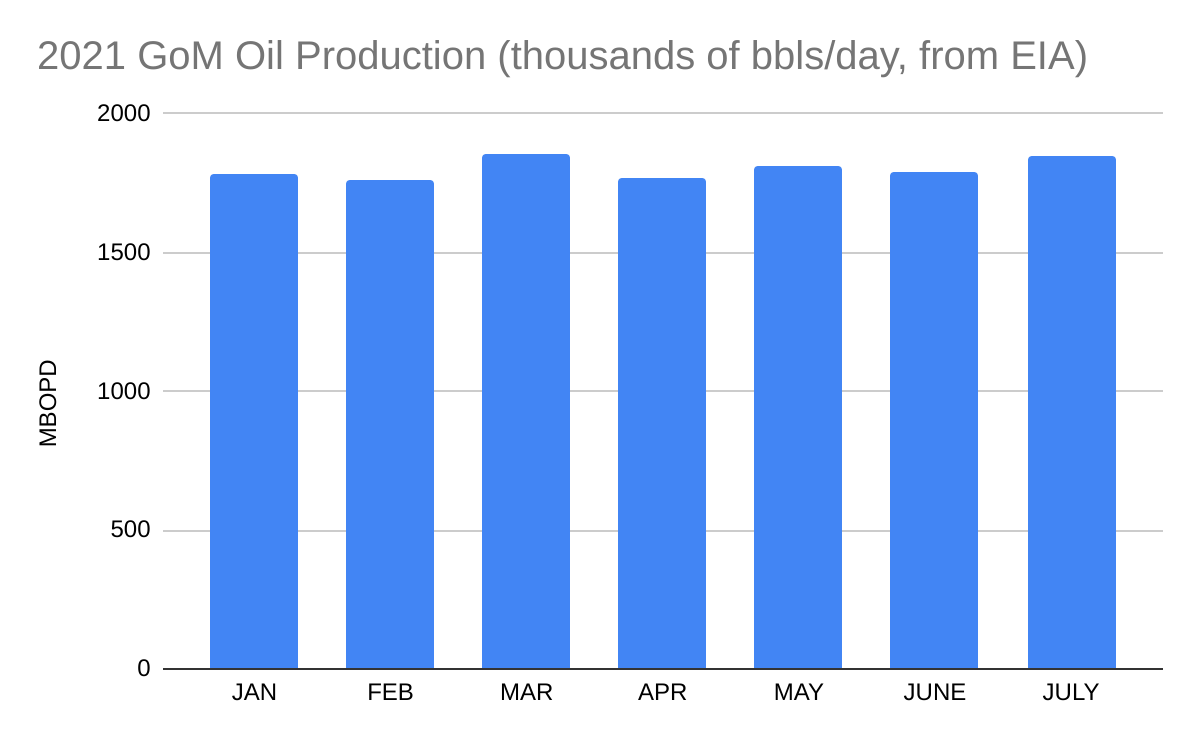
EIA just released the July data, and GoM oil production averaged 1.845 million BOPD, which was consistent with expectations. 2021 production through July was relatively stable averaging from 1.762 to 1.845 million BOPD. This will, of course, change dramatically when the August data are released, and even more so for September. Most production was shut-in for Ida beginning on 8/28 and some production has not yet been restored. Per BSEE’s final update (9/23), about 300,000 BOPD remained shut-in.

The EIA data are plotted below:

Read Full Post »

Presumably, most of the restored GoM production is from platforms like Exxon Hoover that were not subjected to hurricane conditions. Per BSEE, the total oil production shut-in as of 9/1 is 1,455,279.

The latest EIA production report for June 2021 has just been released and GoM oil production averaged 1.825 million BOPD.

from EIA data

Read Full Post »

Brazil and Angola share more than a common language. Both aspire to be presalt production leaders.  According to Platts Oilgram News (not available online):

BP, Total, Eni and other international majors have been awarded concessions to explore in Angola’s ultra deepwater presalt blocks, a ministry of energy official told Platts January 26, as companies hope to replicate in the southwest African country the successof the pre-salt plays offshore Brazil.

Per a separate Platts article:

According to the US Energy Information Administration website as of January 2010, Angola had proven oil reserves of 9.5 billion barrels while government statements in December 2009 put total reserve numbers as high as 13.1 billion barrels.

Read Full Post »

« Newer Posts