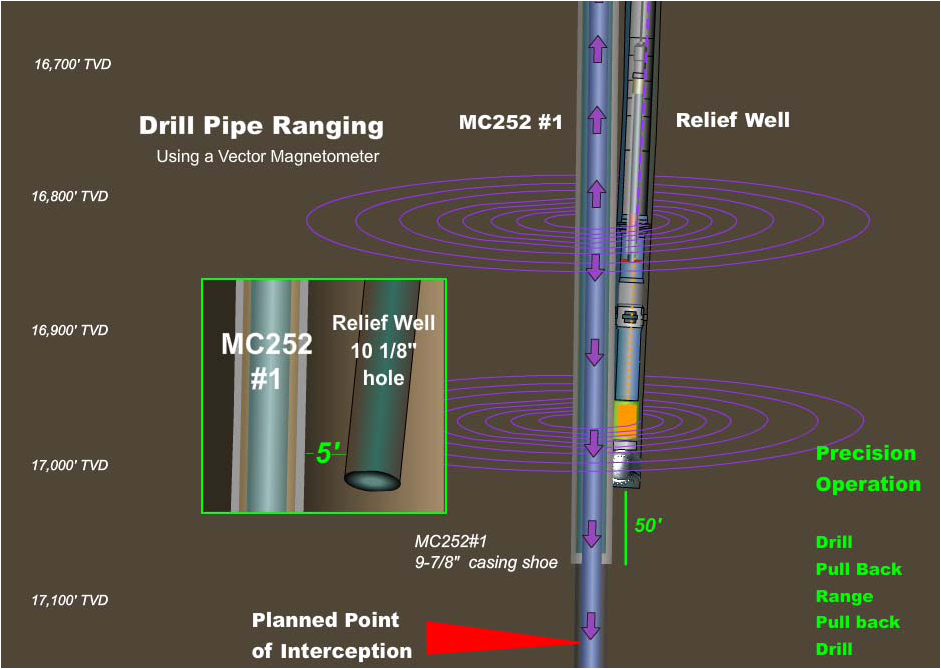
Based on the latest information provided by Admiral Allen, the relief well has reached 11817′ below the sea floor and is thus only 273′ above the 9 7/8″ casing shoe on the flowing Macondo well. After drilling another 200+ feet, they will open (enlarge) the relief well and install a 9 7/8″ liner. They will then drill a few hundred feet beneath the liner and intercept the flowing well. They will presumably kill the flow in the annulus outside the casing (assuming that is a flow path) with heavy mud before milling into the 7″ casing, killing any flow inside that casing, and plugging the well bore with cement. Stay tuned.
Posts Tagged ‘drilling’
Relief Well Down to 11817′ TVD BOF
Posted in accidents, well control incidents, tagged accidents, blowouts, Deepwater Horizon, drilling, Gulf of Mexico, macondo, relief well, safety, well control on July 2, 2010| Leave a Comment »
Updates on the relief wells
Posted in accidents, well control incidents, tagged accidents, blowouts, Deepwater Horizon, drilling, Gulf of Mexico, macondo, offshore oil, oil spill, relief well, safety, well control on June 29, 2010| Leave a Comment »
BP has released a slide presentation and animation on the relief wells showing the intercept point below the 9 7/8″ casing shoe. The exact sequence of operations once they reach the intercept point will be interesting to observe. They should encounter flow when they reach the 7″ casing annulus (assuming that is a flow path; there still seems to be some uncertainty in that regard). Will they attempt to kill the flow in the annulus before milling into the 7″ casing? Is there flow inside the 7″ casing via channels in the casing shoe? Is there drill pipe inside the casing?
Interesting Comments from Admiral Allen
Posted in accidents, well control incidents, tagged accidents, blowouts, BOE, Deepwater Horizon, drilling, Gulf of Mexico, macondo, offshore oil, oil spill, safety, well control on June 23, 2010| Leave a Comment »
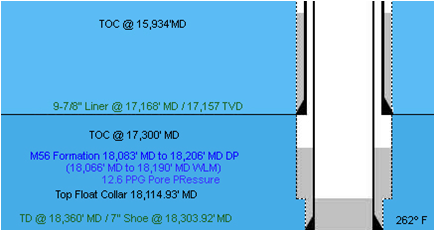
I believe they’re going to try and intercept somewhere around between 16,700 and 17,000 feet. We will confirm that for you and put out a statement tomorrow.
Comment: I pasted that portion of the well cross-section above. It looks like the plan is to drill into the 7″ x 9 7/8″ annulus (the most likely flow path) and secure that annulus. Based on the float and casing shoe issues that have been reported, the flow could also be inside the 7″ production casing or both inside the casing and in the annulus. (Also, sealing the annulus could force flow through possible shoe channels inside the production casing). They will presumably have to drill through the 7″ casing (after the annulus has been secured?) and set a cement plug inside the casing.
They decided not to use the blowout preventer because of the uncertainty regarding the status of the wellbore and what pressure might do going down. That’s the reason they abandoned the Top Kill and the capping exercise at that point.
Comment: Admiral Allen confirms reports that the second BOP option was dropped because of downhole issues. Poor well integrity sure makes things difficult. Concerns have been raised about the strength of the 16″ casing, and possible fracture paths outside casing. If the ROV had been able to actuate the BOP and seal the well, would casing failure and formation fracturing have occurred; or are subsequent events (erosion?) the primary reason for these well integrity concerns?
Secretary Salazar and Secretary Chu had a meeting last week in Washington with other industry representatives beyond BP, other oil-producing companies that are out there, and we’ve actually identified a couple of platforms that are in the area that might be capable of taking the product coming out of the wellbore through pipelines and either producing it or putting it back down into the reservoir. We’re exploring that over the next couple of days.
Comment: Yikes!
Unintended Consequences
Posted in accidents, well control incidents, tagged accidents, blowouts, BOE, drilling, Gulf of Mexico, macondo, offshore oil, oil spill, safety, well control on June 22, 2010| 1 Comment »
Pasted below is a note from Evan Zimmerman that I am posting with his approval. As many of you know, MODU station-keeping has historically been a major problem during hurricanes. For the past 5 years, industry and government leaders have worked hard to improve hurricane and deepwater mooring capabilities. Evan has been a key participant in this effort. His company developed advanced anchors (see above picture) and mooring lines, and new risk assessment tools for assessing mooring system failure probabilities and their consequences. The Gulf of Mexico will not be a safer place if deepwater technology leaders like Delmar are forced to close or move their equipment and personnel overseas.
The moratorium on drilling has put more than 70% of all that risk reducing mooring equipment on its way to the beach without contracts. For a company like Delmar that derives more than 95% of its income from deepwater OCS drilling activity, its clear that we will have to immediately start shipping equipment outside of the US to find work. Its my expert opinion that without a doubt, the offshore station keeping safety options will be reduced once drilling activities resume. Its also clear the longer the moratorium continues, the fewer moored rigs will be left to drill not only the intermediate water depth areas the DP rigs cannot, but also the ultra deepwater wells they have been so busy drilling safely. The longer this moratorium continues, the higher the station keeping risks for both DP and moored rigs the MMS will have to approve to keep the few rigs left in the Gulf working. It’s the single biggest disappointment in my career to see all the hard work that MMS, Delmar and industry have done to increase station keeping safety quickly slip between our fingers here domestically. I leave overseas again week after next to try to secure work for half (two sets) of OMNI-Max anchors as well as most of our other risk reducing equipment that now is no longer on contract due to the moratorium.
We are the last US owned deepwater anchor handling company that has brought the safest and most technically advantageous equipment to the mooring industry, and it looks like we will have to drastically change inclusive of cutting jobs domestically and moving outside of the US.
Who Benefits from Macondo?
Posted in accidents, well control incidents, tagged accidents, blowouts, Deepwater Horizon, drilling, Gulf of Mexico, macondo, Montara, offshore oil, oil spill, safety, well control on June 22, 2010| 1 Comment »
We know about the Macondo victims, most notably the 11 men who died and their families, but who stand to benefit from the blowout?
- OPEC – Will OPEC’s market share grow as the US and others prevent or delay production?
- West Africa and Brazil – Better rates and availability for deepwater rigs?
- PTTEP (Montara) – Not receiving much attention as BP draws all the flack
- Shale gas – Can the huge promise be realized? Will natural gas gain an increased share of the transportation market?
- Alternative Energy – Are these industries ready to step up?
- Spill response research – Government and industry oil spill research funding always jumps after major spills.
- Nuclear industry – Perhaps, but Macondo may remind people that “the unthinkable” can happen.
- Lawyers – The only sure winners. The litigation spectacular has already begun.
Macondo and Montara Shorts
Posted in accidents, well control incidents, tagged accidents, Australia, blowouts, Deepwater Horizon, drilling, Gulf of Mexico, macondo, Montara, offshore oil, oil spill, safety, well control on June 21, 2010| Leave a Comment »
No Love for Long Strings – The rest of the industry has distanced itself from BP’s casing program, swearing their allegiance to tiebacks.
CEO sails while “small people” suffer – The PR disaster continues for BP.
BP partner seeks annulment – The first shots in the multi-billion dollar BP-Anadarko dispute have been fired. Look for new liability clauses in operating agreements and regulations.
Who is in charge and accountable? – Macondo, like Montara, was entirely preventable. Know who is in charge, and make sure they are competent and cautious leaders. As a friend told me yesterday, the best technology can be undone by human arrogance.
Just ‘Roo It! – Australia’s investigation process works great until it comes to releasing reports. Varanus Island deja vu?
Storm watch – Another common concern for Montara and Macondo – the onset of hurricane/cyclone season. We need about six more weeks (preferably more) until the first hurricane evacuations in the Gulf.
Sad irony – The first FPSO production in the Gulf of Mexico is at the Macondo field.
90+% recovery – Promised soon with new well cap and production systems.
Relief? – First relief well is ahead of schedule. Has a well ever been more anticipated and needed?
Aftermath – While the chance of BP operating Macondo is virtually zero, will PTTEP be allowed to continue operating Montara?
Not My Job Award Nomination, but for whom?
Posted in accidents, well control incidents, tagged accidents, blowouts, Deepwater Horizon, drilling, Gulf of Mexico, macondo, Montara, Not My Job Award, offshore oil, oil spill, safety, well control on June 19, 2010| Leave a Comment »
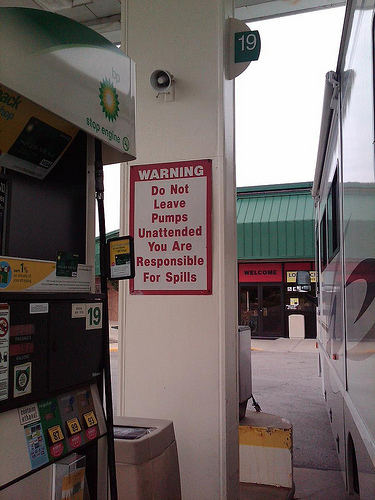
In addition to the obvious irony in this BP gas station’s warning sign, perhaps there is a separate and unintended message in the sign’s last 3 lines – “you are responsible for spills.” The gasoline that we purchase at the pump does not just arrive there magically. That gasoline is the end product of a complex exploration, production, transportation, and refining process. When we consume petroleum products (and other forms of energy), we are tacitly accepting the associated environmental risks. If we aren’t comfortable with those risks, we should look at our own habits and how they contribute.
BP is responsible for the Macondo spill. However, our own lifestyle decisions are the reason for the extraordinary demand for the oil that BP and other companies produce. We can’t blame BP for the intractable sprawl, congestion, and pollution that have resulted from those decisions.
Dual Production System Ups Macondo Recovery to 25,000 bopd
Posted in accidents, well control incidents, tagged accidents, blowouts, Deepwater Horizon, drilling, Gulf of Mexico, macondo, oil spill, safety, well control on June 18, 2010| Leave a Comment »
25,290 barrels of oil were recovered on 17 June through the dual production system – 16,020 bbls through the LMRP cap to the Enterprise and 9,270 bbls (burned) via the choke/kill lines to the Q4000.
Appointments
Posted in accidents, well control incidents, tagged blowouts, Bromwich, Deepwater Horizon, drilling, macondo, MMS, National Commission, offshore oil, oil spill, safety on June 15, 2010| Leave a Comment »
Michael Bromwich, a former Federal prosecutor, will lead the reorganization of the Minerals Management Service into two new bureaus and a minerals revenue office. I hope he meets as many MMS personnel as time allows. He will be pleasantly surprised by their knowledge, integrity, and commitment.
In addition to former Senator Bob Graham and former EPA Administrator Bill Reilly, President Obama named the following individuals to head the National Commission on the BP Deepwater Horizon Oil Spill and Offshore Drilling:
Frances G. Beinecke: President of the Natural Resources Defense Council (NRDC), a non-profit corporation that works to advance environmental policy in the United States and across the world.
Donald “Don” Boesch: President of the University of Maryland Center for Environmental Science, where he is also a professor of Marine Science and vice chancellor for Environmental Sustainability for the University System of Maryland.
Terry D. Garcia: Executive vice president for mission programs for the National Geographic Society.
Cherry A. Murray: Appointed dean of the Harvard School of Engineering and Applied Sciences (SEAS) and the John A. and Elizabeth S. Armstrong Professor of Engineering and Applied Sciences in July 2009, and the past president of the American Physical Society.
Frances Ulmer: Chancellor of the University of Alaska Anchorage (UAA), Alaska’s largest public university.
Transocean Internal Investigation – Interim Report
Posted in accidents, well control incidents, tagged accidents, blowouts, Deepwater Horizon, drilling, Gulf of Mexico, macondo, offshore oil, oil spill, safety, well control on June 15, 2010| Leave a Comment »
Transocean’s interim report is circulating online. Click here: Transocean Investigation