Feeds:
Posts
Comments

Posts Tagged ‘drilling’

BOE does not officially resume posting until 30 August, but we wanted to make sure you were aware of Magne Ognedal’s recent remarks to Upstream

“It is very frustrating,” Ognedal said. “We do not have the information we need to finish the job. We know from the transcripts of the inquiry that the Macondo and Montara blowouts appear to have very similar causes.  However we cannot draw any conclusions until we have access to the report.”

I also suggest that you read the text of Magne’s excellent speech during the Safety Luncheon at ONS in Stavanger.
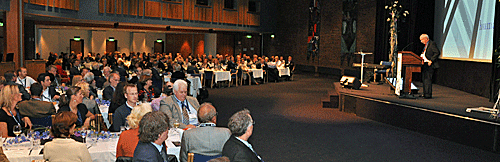
Magne Ognedal Addresses ONS Safety Luncheon

Read Full Post »

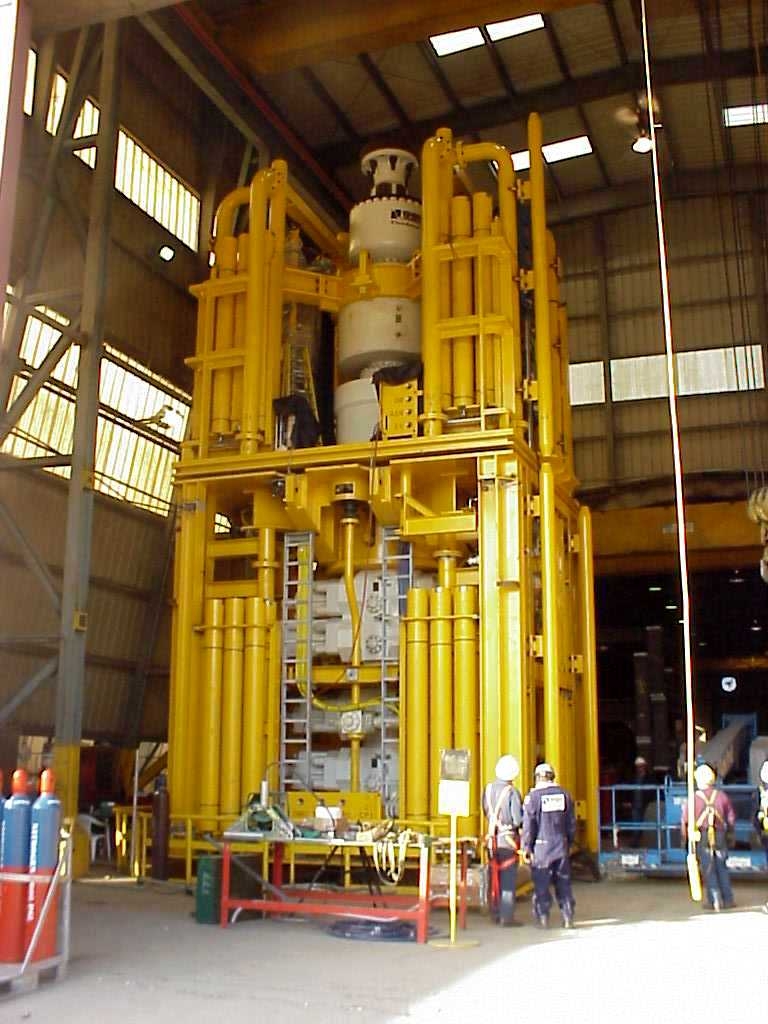
Colin Leach brought this paper to my attention: Subsea Accumulators – Are They a False Reliance? As BOP actuation and shearing power issues take center stage, this paper warrants further review.  Unfortunately, we were only able to link the abstract at this time.  We will post the full paper if permission is granted.

Read Full Post »

The Canadian Senate has decided that the facts do not justify banning Canada’s offshore drilling operations.  The full report is linked.

The Senate also showed support for the International Regulators’ Forum.  Canada will be hosting a major international conference in Vancouver in October.

The committee heard sufficient evidence to make it comfortable with Canada’s (federal and provincial) approach to striking this risk/reward balance andwith its new judgment-based and goal-oriented regulatory approach. Canada is a leading participantin the International Regulators Forum, a group of offshore industry regulators from the most activeoffshore drilling nations, including Norway, the United Kingdom, the United States, Australia, NewZealand, the Netherlands and Brazil. Interestingly, none of these nations have called for or imposedbans on current offshore drilling operations within their jurisdictions following the BP incident.

Read Full Post »

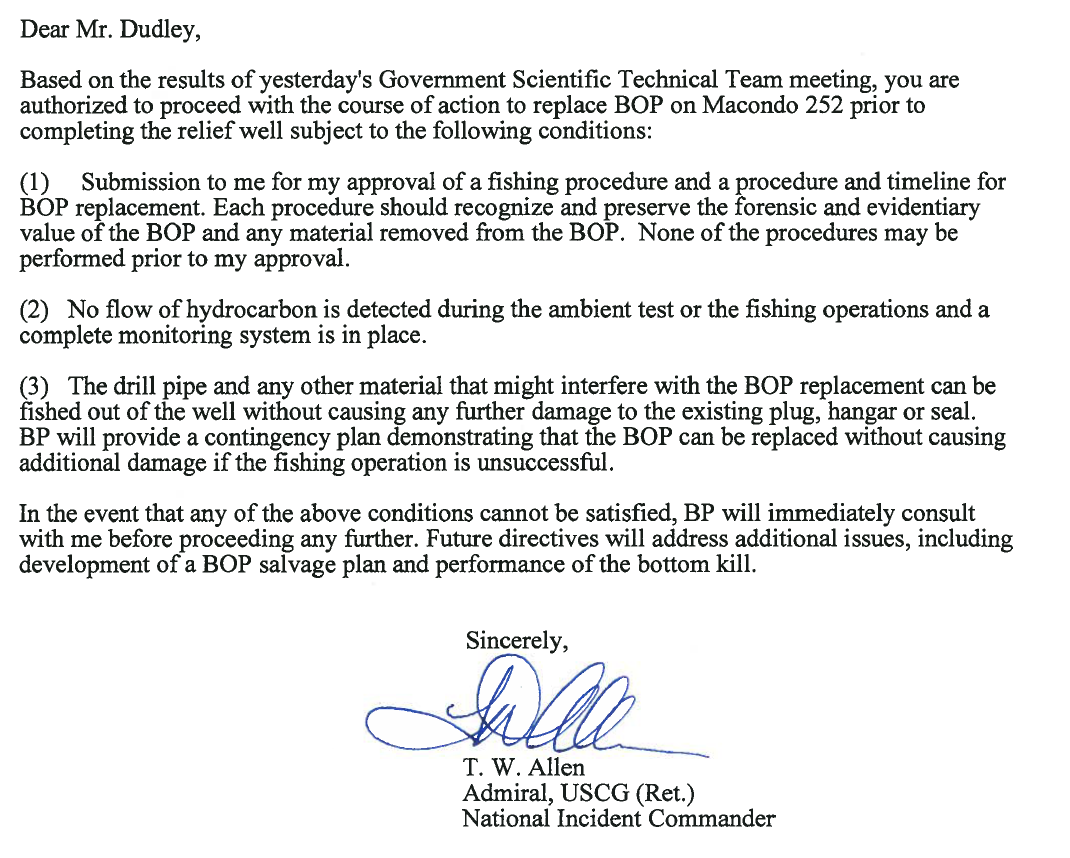
Aug. 19, 2010 letter, click to enlarge

With the new BOP in place, and the capability to enter the well from the top, squeeze cement into the annulus, and set and test plugs, the relief well intercept appears to add nothing but risk.  Is the relief well being finished because of the repeated “read my lips” statements about its necessity or is there a valid reason that we are missing?

Also, with the well killed, should the Incident Commander be directing and approving operations that seem to fall under the plugging and abandonment category?  Those operations are under the purview of the Bureau of Offshore Energy Management, Regulation, and Enforcement (BOEMRE) in the Department of the Interior.  (Actually, according to the applicable MOU, (see section 10), BOEMRE should have had the lead on well control and flow abatement since the well blew out on April 20.)

Read Full Post »

We are currently working with BP engineers and our science team to look at test results and do investigations to lead us to the best way to mitigate any risk of intercepting the annulus and increasing the pressure in the annulus. Admiral Allen

This insistence on drilling into a “killed well” reminds me of the Unified Command’s plan to end to end the “well integrity test” and vent the well after it had been successfully capped on July 15.  Fortunately, the Command showed good judgement and reversed that decision. Perhaps they should do the same with the relief well intercept, which no longer appears to be necessary and may be hazardous.

The obvious next step is to re-enter the well from the top, perforate the production casing and squeeze cement into the annulus, and proceed with the plugging and abandonment operation.  If the Command has reasons why this would not be the best approach, we’d like to hear what they are.

Despite the repeated “my way is the relief well” pronouncements, I trust that the Command will choose the option that accomplishes the objectives with the fewest risks to safety and the environment.

Read Full Post »

Letter from Admiral Allen to BP:

… in response to BP’s request to consider foregoing the relief well, the government scientific technical team has determined that the benefits of the bottom kill procedure outweighs the risks.

  1. Did BP really ask to forgo the relief well or was this just a point of discussion?  If so, it would be nice to hear BP’s side of this.
  2. Is BP confident the annulus is plugged?  If so, what is the basis for their confidence?
  3. If the annulus is plugged, what is the objective for the relief well?  To confirm that cement is in place?  Inject additional cement? Is there sufficient information to properly assess the risks associated with such an injection procedure?
  4. If not unprecedented, it is certainly unusual to drill a relief well into a well that has been killed.  Could measures taken during the abandonment operation (e.g. cut the production casing and set a plug over the production casing  stub) assure the Unified Command that the annulus is sealed?

Read Full Post »

We have heard plenty about Macondo’s real, imagined, and convenient villains, but very little about the heroes.  Let’s pay tribute to them:

  1. First and foremost the eleven men who lost their lives exploring for energy for our economy and security.  Sadly, were it not for the massive spill, their sacrifice would have received little public attention.
  2. The rescue crews who brought the other 115 workers safely to shore.
  3. The responders who worked under difficult conditions to minimize the environmental effects of the spilled oil.
  4. The relief well crews who demonstrated how complex drilling operations should be conducted.
  5. The ROV and well intervention teams.  The performance of the ROVs and subsea tools is perhaps the biggest Macondo success story.  Their pioneering work will be studied in developing the well intervention, capping, and collection plans that will be a part of future drilling programs.
  6. The people of Louisiana, who despite their personal adversity continue to believe that energy, fishing, and other offshore interests can and must co-exist.
  7. The MMS oil spill research program.  In the lean years following the Valdez oil spill research surge, MMS continued to conduct important burning, dispersant, remote sensing, and mechanical cleanup studies, while upgrading and expanding the use of the nation’s major oil spill response test facility – Ohmsett.
  8. The Unified Command scientists who are providing comprehensive scientific data about the effects of the spill, and refuse to be swayed by sensational media reports.
  9. Oil consuming bacteria!
  10. Others?

Read Full Post »

A newspaper says it has obtained an internal audit conducted by BP PLC on the Deepwater Horizon oil rig that details severe safety flaws months before the Gulf of Mexico spill.

link

Comment: Was this a planned leak?  If so, how does this strengthen BP’s legal position?  The DWH had deficiencies (bad for Transoocean), but BP knew about the deficiencies and didn’t ensure that they were corrected (worse for BP?).  As indicated by the poster below (More “Mike Talk”), the poor working relationship between the operator and contractor may have been the real core problem.

Read Full Post »

  1. Now that the Unified Command has had a couple of days to review the static kill data (which were certainly considered in planning the cementing operation that was concluded yesterday), please provide an update on the latest thinking with regard to the well’s flow path.
  2. Please post a cross section schematic (best estimate) of the well after the completion of yesterday’s cementing operation.

Read Full Post »

Upstream has confirmed the crane incident on the Jack Ryan during operations offshore Nigeria.

According to a summary incident report into the accident, seen by Upstream, the port aft crane boom and cab, together with the three men, went overboard during load testing.

Upstream understands that the crane boom snapped during the tests.

The Upstream report is consistent with information provided separately by Malcolm Sharples.  One worker is still missing.

Read Full Post »

« Newer Posts - Older Posts »