Feeds:
Posts
Comments

Posts Tagged ‘drilling’

from The Sun

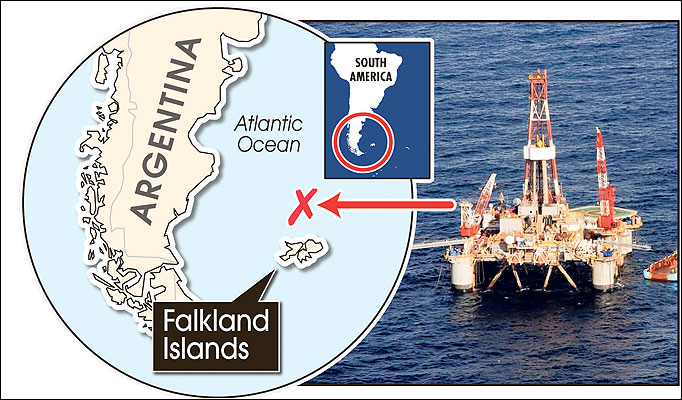
Deepwater drilling may be on hold in US waters, but that is not the case elsewhere.  However, drilling in other parts of the world is not free from political tension and intrigue. Of particular interest is a recent discovery well in 450m of water in the North Falkland Basin. From the Buenos Aires Herald:

As President Cristina Fernández de Kirchner prepares to address the UN General Assembly and renew the Argentine claim on the Malvinas Islands sovereignty, British explorer Rockhopper said its controversial oil discovery offshore the islands could have produced double the amount of oil had a test not been besieged by technical problems.

According to the Sun:

Analysts believe up to 60 BILLION barrels of oil lie in waters off the UK territory.

That estimate would seem to be a considerable stretch (to say the least), but will no doubt complicate the diplomatic challenge facing the UK and Argentina.

Read Full Post »

Admiral Allen’s statement:

I have received extensive briefings over the last 24 hours regarding the final effort to intercept the Macondo well.  Through a combination of sensors embedded in the drilling equipment and sophisticated instrumentation that is capable of sensing distance to the well casing, BP engineers and the federal science team have concluded that the Development Driller III relief well has intersected the Macondo well.  This determination was made based on a loss of drilling fluids that indicated communication had been established beyond the relief well, the pressure exerted against the drill bit as it came in contact with the well casing and, finally, an increase in pressure in the choke line of the Macondo well blow out preventer.  While each of these indicators taken separately would not necessarily be conclusive, the aggregate data available supports the conclusion that the two wells are joined.  It is also important to note that none of the measurements supported a scenario where the annulus of the well is in communication with the reservoir.  Accordingly, we intend to proceed with preparation to cement the annulus and complete the bottom kill of the well.  Further information will be provided as cementing procedures are completed.

Observations:

  1. The relief well engineering team and crew performed exceptionally despite the many distractions and interruptions. Outstanding work.
  2. The new ranging and sensing equipment, combined with real-time measurement-while-drilling technology, made this complex operation seem routine.
  3. The above report seems to confirm that the annulus had been sealed with cement above the producing reservoir.  This was accomplished either when the production casing was cemented prior to the blowout or during the top-kill operation, presumably the former.
  4. There was no report of oil in the mud returns or other evidence of of oil in the annulus surrounding the production casing.  If no oil was encountered in the annulus, this would seem to confirm BP’s conclusion that the well flowed inside the production casing.
  5. Flow was stopped by the capping stack on July 15, and the Macondo well was killed when mud and cement were injected during the top-kill operation.  Since the well was already dead, the cementing of the annulus that will follow is actually part of the plugging and abandonment operation.  While the annulus could have been secured through more conventional plugging procedures, this does not detract from the relief well team’s extraordinary achievement.

Read Full Post »

Despite the vast differences in location and water depth, both the Montara and Macondo blowouts would have been prevented if negative pressure tests had been properly conducted and interpreted after the production casing had been set.

A negative pressure test simulates an underbalanced condition in which the formation pressure exceeds the pressure exerted by the fluid column.  The purpose of the test is to determine if there are leaks in the casing shoe track, casing, or seal assembly. At Macondo, the test was conducted and the evidence of inflow is quite clear.  Unfortunately, that evidence was misinterpreted.  See slides 14-17 in the linked presentation.

At Montara, the testimony suggests that a negative pressure test was not properly conducted.  PTTEP therefore had a false sense of security regarding the integrity of the casing shoe. See page 9 of this transcript.

Both wells subsequently flowed through the shoe track and inside production casing for a combined duration exceeding 5 months.

There are currently no industry standards for conducting and interpreting negative pressure tests.

Read Full Post »

“Can’t happen again” was the mantra of the OCS oil and gas program for 40 years after the Santa Barbara blowout.  “Can’t happen here” was the short-lived message of government and industry after last year’s Montara blowout in the Timor Sea.   Surprisingly, new versions of the “can’t happen” message have been heard since Macondo.  Companies have boasted that “it couldn’t happen to us,” and some government representatives have claimed that their regulatory regimes would have prevented the blowout.  The beat goes on.

Macondo will not be the blowout that ends all blowouts, and Macondo will not be the last major offshore accident.  We need to focus on reducing the risks of another disaster during drilling, production, or transportation, in deep or shallow water, arctic ice, and every other environment where operations are conducted. The new mantra, no matter where you operate or regulate, should be “CAN HAPPEN AGAIN.”  That is the attitude we need if we are to prevent future accidents.  We should preach the “CAN HAPPEN AGAIN” message loudly and clearly, no matter how many years (hopefully decades) elapse before the next major accident.

We’ve heard a lot of details about the shortcomings of the well design, the companies involved, and one of the regulators.  However, consistent with the CAN HAPPEN AGAIN message, we need to also look at the high-level management, leadership, and regulatory issues. How do we sustain outstanding performance and minimize the risks of major accidents?  Here are four suggestions that have received little attention since the blowout:

  1. Challenge industry.  One lesson I have learned from the Norwegians is to make industry take ownership for their problems. Instead of halting deepwater drilling for six months while the government attempts to fix the problems (real and perceived), we should have given offshore operators six months to develop a plan for not only preventing another Macondo, but reducing the risks of any major drilling, production, and pipeline accidents.  If the government wasn’t satisfied with the industry plan, operations could be curtailed until a good plan was developed.
  2. Improve management systems and cooperative industry programs.  US operators and contractors are understandably in a reactive mode with a goal of lifting the moratorium. However, the next disaster will not duplicate this one.  The offshore industry must provide the leadership needed to improve management systems and develop cooperative programs that will monitor performance, evaluate technology and procedures, and asses risks.
  3. Truly reorganize the OCS regulatory program by consolidating safety and pollution prevention functions into a single authority. Wells, platforms, and pipelines are integrated systems.  You can’t divide the components among regulators and expect the regime to function effectively and efficiently. That’s not possible. A few examples (there are may more): separate agencies should not regulate connecting OCS pipelines; separate agencies should not regulate offshore cranes based on the type of facility; and multiple agencies should not regulate the integrity of floating structures.  Because of the complexity of the OCS regime, regulatory and industry personnel spend too much time resolving and coordinating administrative and procedural matters.  This time would be better spent focusing on mission critical safety issues.   A single agency should be responsible and accountable for safety and pollution prevention at offshore facilities, including the review of plans, permit applications, and management systems, and the conduct of inspections and audits needed to assess performance and verify compliance.
  4. Request assistance from international regulatory partners. While numerous US entities have questioned regulators in Norway, the UK, Australia, Canada, and elsewhere, no one has actually asked these organizations for assistance.  In lieu of one or more of the official US inquiries, international regulators should have been called on to review the accident and the regulatory regime. Who has spent more time assessing regulatory options than other regulators?  Who knows more about establishing and achieving safety performance objectives? Who else is knowledgeable and objective, yet insulated from US political influences?

Read Full Post »
Here’s the link. This is a highly specialized and technical task, and no information has been provided on the inspection team. Other than employees of Cameron and their competitors, the pool of people who can perform a detailed inspection of BOP components is pretty small.   It would be interesting to know who is conducting this inspection.

Read Full Post »

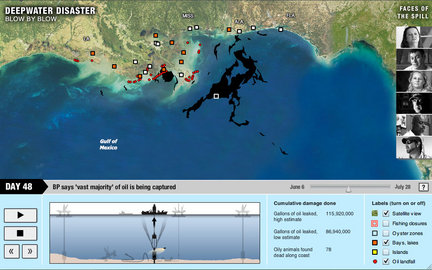
Click here or on the image above to see this excellent animation of the slick movement and well control efforts versus time.  Check it out; this is definitely worth viewing.

Read Full Post »

On 8-9 September, the International Regulators’ Forum (IRF) met in Herndon, Virginia, to address offshore safety issues in the wake of the Macondo and Montara blowouts.  This was the first extraordinary meeting in the IRF’s 17-year history.  In a statement released after the meeting, the IRF resolved to:

  • Provide leadership on safety and safety related regulatory matters for offshore oil and gas activities.  A strategic agenda will be discussed and adopted at the next IRF meeting in October in Vancouver.
  • Develop an audit protocol looking at BOP integrity and operational issues, for use by all IRF members to provide a consistent approach.
  • Continue to strengthen sharing of regulatory practice and experience and provide a sounding board for key initiatives of members.

These and other offshore safety issues will be discussed at the upcoming (18-20 October) IRF conference in Vancouver.  This conference is open to all interested parties.

Read Full Post »

“The goal of our efforts is a culture of safety, in which protecting human life and preventing environmental disasters are the highest priorities, while making leasing and production safer and more sustainable,” said Assistant Secretary Wilma Lewis, who chaired the Safety Oversight Board.

The report of the Department of the Interior’s Safety Oversight Board has been posted on the DOI website.  The report recommends certain improvements in DOI’s offshore oil and gas regulatory program. Because of my participation in this project, I won’t comment on the specifics of the report.  I will say that I was impressed by the professionalism of the Board and the DOI staff who assisted with the project.  All views were openly discussed and carefully considered.

Read Full Post »

Here is the link.

Our main interest was in the flow path and BOP issues:

Flow path:

The investigation team concluded that hydrocarbon ingress was through the shoe track, rather than through a failure in the production casing itself or up the wellbore annulus and through the casing hanger seal assembly.

BOP:

  1. The explosions and fire very likely disabled the emergency disconnect sequence
  2. The condition of critical components in the yellow and blue control pods on the BOP very likely prevented activation of another emergency method of well control, the automatic mode function (AMF), which was designed to seal the well without rig personnel intervention upon loss of hydraulic pressure, electric power and communications from the rig to the BOP control pods. An examination of the BOP control pods following the accident revealed that there was a fault in a critical solenoid valve in the yellow control pod and that the blue control pod AMF batteries had insufficient charge; these faults likely existed at the time of the accident.
  3. Remotely operated vehicle intervention to initiate the autoshear function, another emergency method of operating the BOP, likely resulted in closing the BOP’s blind shear ram (BSR) 33 hours after the explosions, but the BSR failed to seal the well.
BP’s flow path assessment is consistent with our expectations.  Early on, while most of the attention was focused on the annulus, we thought that flow inside the production casing was a distinct possibility.  With regard to the BOPs, BP’s explanation is a more complete than we expected at this time, given that the stack has just been recovered.
More to follow.

    Read Full Post »

    While we wait for the Bly Report (BP), Colin Leach (without the benefit of staff and access) has issued his concise and credible report on Macondo. I recommend that you take a few minutes to read it. Many thanks to Colin for his continued leadership on offshore safety issues.

    Read Full Post »

    « Newer Posts - Older Posts »