Feeds:
Posts
Comments

Posts Tagged ‘DOE’

Look at the US Dept. of Energy homepage and I think you’ll get a better sense of the imbalanced energy policies, in the US and elsewhere, that are contributing to the emerging energy crisis.

There isn’t a single mention of oil or natural gas on the Dept. of Energy homepage. DOE’s priorities are “Combating the Climate Crisis” (embellished with a satellite image of Hurricane Andrew), “Creating Clean Energy Union Jobs” (other energy jobs aren’t important?), and “Promoting Energy Justice.” With regard to the latter, how is driving up energy prices “energy justice?” How is importing more of the oil that we consume “energy justice.” Affordable energy has increased economic opportunities for all and enabled us to better protect our environment. In that regard, this Petr Beckmann slide holds true:

Read Full Post »

In the early 1990’s, Department of the Interior (DOI) and Department of Energy (DOE) leadership dabbled at re-branding the OCS Oil and Gas Program by reversing the order of the words. Clever? Perhaps by Washington public relations standards. One senior manager even changed his license plate from “OCS OIL” to “MMS GAS” (not much competition for those tags 😃). Technical staff were less enthused about this simplistic marketing gimmick that misrepresented the historical and scientific facts about oil and gas production. For many years, natural gas was a byproduct of oil production that was commonly flared. (This practice continues in some regions of the world, although to a lesser extent than in the past.)

Understandably, the Oil and Gas Journal wasn’t very impressed by the change. I saved a copy of their 1/24/1994 editorial (attached) on the subject. Per the OGJ:

We at the Journal love natural gas. But that doesn’t warrant an attempt to repeal the laws of nature and ignore the weight of tradition by renaming everything “gas and oil” this and that.

John L. Kennedy, Editor, Oil and Gas Journal, 1/24/1994)

To their credit, BOEM and BSEE web pages and announcements during recent administrations (both parties) indicate a preference for the more traditional “oil and gas.” (The DOE website largely ignores the existence of either oil or natural gas.) Surprisingly, the American Petroleum Institute (API), an industry trade organization with more than 100 years of history, is now consistently using “natural gas and oil.” This rearrangement of words is not entirely consistent with the interest of API’s members. In the offshore sector, the primary interest of API members is in finding and producing oil. if you think otherwise, look at the EIA GoM gas production data. Most of the Gulf’s declining gas production is now associated with deepwater oil production, and BSEE rightfully requires that this gas be used for fuel or transported for sale. Similarly, gas is a secondary consideration for API members exploring in Alaska given that 35 trillion cu ft of North Slope gas still awaits a pipeline.

Oil companies, and those who represent them, should be proud of their current and historical role in producing oil (and gas) for our economy, security, and way of life; and of the men and women who have toiled to locate and produce petroleum resources for the benefit of society. Are there better energy alternatives? Perhaps, but issues with these alternatives remain to be resolved, and oil and gas will continue to be important. Let’s focus on producing these resources as safely, cleanly, and reliably as possible.

Read Full Post »


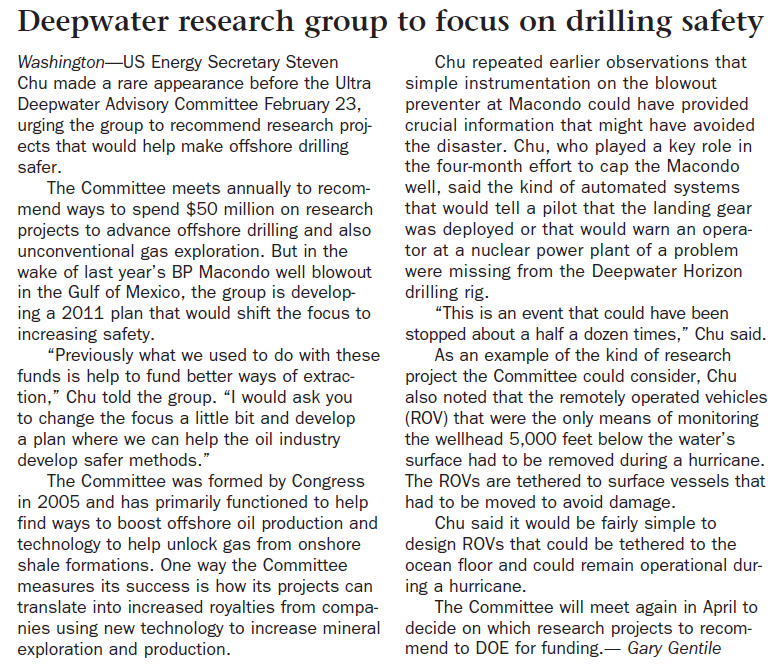
Few Cabinet Secretaries are scientists or engineers, and none has been a Nobel Prize winner. We expect Secretary Chu to be different and yesterday’s meeting with DOE’s Ultra-Deepwater Advisory Committee was not your typical Washington “hit and run” performance. Rather than making a quick speech and running along to his next appointment, Secretary Chu engaged in technical dialogue with our committee for a full hour, offering insights and responding to questions. Among the topics discussed were BOP instrumentation and monitoring, well integrity, ROV/AUV issues, and Macondo findings.

Kudos to Secretary Chu for his commitment to offshore safety.

Gary Gentile published this report on the meeting in Platts Oilgram News. (click on the story to enlarge)

Read Full Post »

I tend to ignore the stream of Unified Command media advisories that provide updates on the whereabouts of cabinet officials and tell us how many times they have been to the Gulf Coast.  However, today’s message about Secretary Chu caught my attention.  I have never met the man, but one senses that he is monitoring the well integrity tests because he is truly interested in the technical details, likes to work with scientists and engineers, is not afraid of a challenge, and feels personally responsible for the success of the intervention work.  Let’s hope the Macondo well holds pressure, so that it can remain shut-in until it is killed.

Read Full Post »

Kudos to Secretary Chu and the Department of Energy for providing online access to Macondo schematics, pressure tests, diagnostic results and other data. This is the type of data that BOE and others have been requesting.  Well done!

Read Full Post »

« Newer Posts