Feeds:
Posts
Comments

Posts Tagged ‘Deepwater Horizon’

Like the National Commission on the BP Deepwater Horizon Oil Spill and Offshore Drilling, the Montara Commission of Inquiry, the Norwegian government, and leading safety and regulatory authorities around the world, the IADC recognizes the risks associated with complex, multi-agency regulatory regimes. A single authority should be responsible and accountable for safety and pollution prevention at offshore facilities, and should draw on the expertise of other agencies and organizations as necessary to achieve performance objectives. 

The safety and environmental  risks associated with fragmented or compartmentalized regulation include gaps, overlap, confusion, inconsistencies, and conflicting standards. Industry and governmental personnel spend too much time coordinating with multiple parties and not enough time managing safety and environmental risks.

Link to IADC comments.  Key quotes:

IADC continues to be concerned by seemingly duplicative regulatory requirements imposed by the Coast Guard and BOEMRE, particularly where the agencies appear to have divergent views regarding the placement of regulatory responsibility.

One cannot holistically address safety when faced with the unyielding and overlapping demands of multiple narrowly-focused regulatory agencies.

Read Full Post »

“It would seem to me, reading between the lines, that the cockpit crew weren’t confident of the information that was being presented to them on the data displays. Maybe — and it’s only a maybe — they took some action that led to the stall warning, and the plane stalling and then being unable to correct it.”

The above quote from a new article on the Air France crash should sound familiar to BOE readers. At both Montara and Macondo, the evidence of hydrocarbon influxes was clear, but personnel misinterpreted or ignored that information. Was this wishful thinking on their part? Was their training flawed? Lack of sleep? Overstressed? Distracted? These issues need to be carefully studied.

Improving well control preparedness is not simply a matter of modifying stack design.  The thought processes and human response tendencies that contribute to well control incidents and other accidents must be fully considered. Monitoring systems must provide timely, accurate, and understandable information, and training programs must teach workers not to rationalize negative signals, but to respond with caution pending further assessment. Trainers must remind students about past disasters and how they could have been prevented.

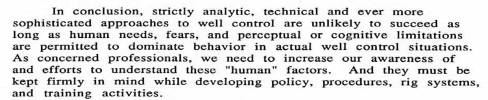
Nearly 20 years after it was written, Paul Sonnemann’s excellent paper on the Psychology of Well Control (excerpt below) is even more relevant today. We need to build upon and apply the lessons.

Read Full Post »

Hundreds of witnesses expected.

The trial won’t proceed quickly, if the parties call all the witnesses on their lists.

Transocean’s roster of 304 included 82 of its own employees, 87 from oil company BP, and 18 from cement contractor Halliburton.

BP listed 71 witnesses from Halliburton, 110 others, plus anyone else who has been or will be deposed.

The United States listed 56 from BP, 32 from Halliburton, and 76 others.

Read Full Post »

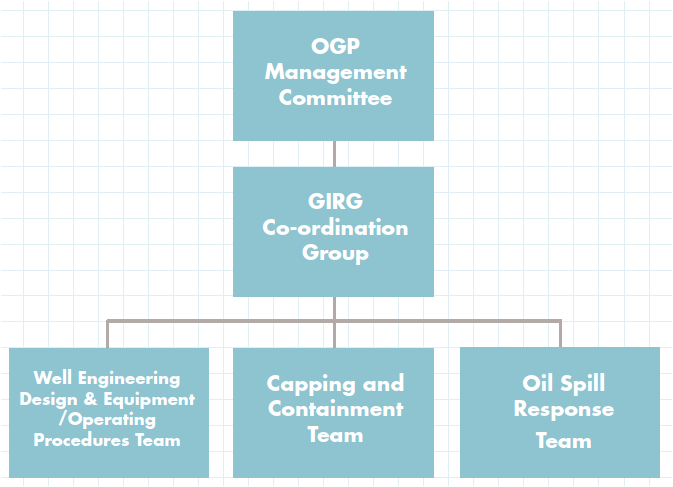
Today, the International Oil and Gas Producers (OGP) released the Global Industry Response Group (GIRG) reports.  GIRG was formed last July with the goal of better managing offshore safety risks. The organizational structure is illustrated below.

Deepwater Wells: Lessons and Recommendations focuses on the critical prevention programs, and is perhaps the most important of the GIRG reports. Since Macondo, the GIRG team and other industry committees have worked diligently on well planning and integrity issues, and are commended for their outstanding efforts. However, the recommendations presented in the GIRG report are surprisingly modest, and do not reflect the technological and management innovation that industry has demonstrated in pioneering offshore development.  The recommendations fail to break new ground, lack specifics, and, in some cases, appear to be a step backward. In short, the oil and gas industry is capable of much more.  Initial comments follow:

  • Incident data (problem): The absence of comprehensive and verified incident data is one of the “systemic” industry weaknesses identified by the National Commission. OGP has tried to address this problem for years, but has not had the industry-wide support needed to develop a credible program. GIRG has wisely recommended a Wells Expert Committee (WEC) to review selected incident data. However, the recommended program suffers from the same weaknesses that constrain existing OGP reporting programs. OGP must rely on “encouraging” its members to participate voluntarily, and non-members are not included. This type of voluntary program was not good enough before Macondo/Montara, and is certainly not good enough now.
  • Incident data (solution): Industry and regulators need an ironclad commitment that all operating companies will submit incident data in accordance with defined protocols. Contractor data must be included. Companies should execute binding agreements with OGP, or some other entity, to provide this information. The data must be managed by a completely independent entity that cannot, in any way, be directed by an industry advocacy group. Regulators and other independent representatives should be included on the management committee. Regulators should prohibit companies that don’t agree to submit these data from from operating within their jurisdictions. A comprehensive incident reporting and data management system is long overdue, and continued delays are not acceptable.
  • Montara: While GIRG is supposedly in response to both Macondo and Montara, the latter seems to have been largely ignored. The deepwater theme does not apply to the Montara platform, which was in only 80m of water. Despite the post-Macondo focus on water depth, shallow water was arguably a more significant contributing factor to the Montara blowout (batched completions using a cantilevered jackup, mudline suspensions, and two-stage platform installation) than deep water was at Macondo. Also, well capping, which was feasible and ultimately successful at Macondo, could not even be attempted at Macondo because of the manner in which these platform wells were suspended. Finally, GIRG  ignores the special gas migration and kick detection issues associated with horizontal completions like Montara, and the relief well rig availability and release issues that were never fully addressed during the Montara inquiry.
  • Emergency worldwide notification system: In conjunction with the incident reporting system, industry needs an emergency notification procedure that goes beyond safety alerts and requires the immediate attention of every operator and wells contractor. During the Montara inquiry, worldwide attention should have been drawn to the inability of the Montara operator to identify a hydrocarbons influx through the shoe track and into the production casing. Could an effective notification system have prevented Macondo? No one can say for sure, but the probability of a blowout at Macondo would have been greatly reduced if key BP and Transocean personnel had participated in discussions about Montara and the importance of proper negative pressure tests.
  • Dependence on regulator: On page 21 of the report, GIRG recommends that a company “carry out a more extensive programme of self-audit” when there is a lack of competent regulatory oversight. An operator should never depend on the regulator to verify its well or management programs, and should never relax its programs regardless of the level of regulation. Detailed regulatory reviews of specific drilling or management programs are never a substitute for operator diligence. Did the operators at Montara and Macondo rely on the regulator to protect them from themselves? Read the official investigation reports and make your own judgement.
  • Best practices: GIRG recommends “refraining from using the term ‘best industry practice’ until this definition is clarified; we prefer ‘good oilfield practice’ for the time being.”  Isn’t the clarification of best practices the role of groups such as this and industry standards committees? This attitude explains some of the technical recommendations in this report which may be “good oilfield practices,” but fail to raise the bar for safety achievement. Would you be satisfied with “good” if  family members were working on rigs or if operations were conducted off your coast? While “best practices” vary depending on the conditions and circumstances, it’s industry’s responsibility to identify those practices, and industry and regulators must set the bar high and keep raising it.
  • GIRG recommends established practices: Some of the GIRG recommendations, such as the “two-barrier” policy have been standard practice for most operators for years.
  • API RP 75: There are numerous endorsements of RP 75 as an important reference for management systems covering the design of wells and other activities.  RP 75 was a reaction to an MMS regulatory initiative 20-years ago to impose safety management requirements on offshore operators. BP, Transocean, and PTTEP had management systems that were generally consistent with the guidance in RP 75. GIRG needs to go beyond RP 75 and focus on improvements that will make safety management systems more effective.
  • API Bulletin 97, Well Construction Interface Document (WCID): Despite the complete absence of public attention, this is perhaps the most important post-Macondo initiative. It’s thus particularly disappointing that this document is now five months late. How does GIRG recommend the use of a document that is not complete and has not yet (to the best of my knowledge) even entered the balloting process? Another recommended and highly important document, updated RP 96 – Deepwater Well Design, has also yet to be finalized.
  • BOP recommendations: Nothing new or innovative is offered by GIRG. The report calls for 2 shear rams, but only one need have sealing capability, which means that the Deepwater Horizon stack met the GIRG specification. While many BOP advances require additional study, some (such as real-time function and pressure monitoring systems) already exist. Other GIRG technology recommendations are rather timid and generally in the form of suggestions for future study (e.g. study cement bond log technology).
  • Training: This section of the report is good, but doesn’t address deficiencies identified in the Montara inquiry and reviews of historical blowout data. Montara and other accidents have demonstrated that senior rig personnel may have limited understanding about well planning and construction practices. These topics are not covered in well control training programs. How does industry plan to address this major deficiency? While well planning is the responsibility of the operator (often a separate group than is represented on the rig), well control decisionmaking requires a fundamental understanding of well construction practices.  Also evident in the Montara testimony was the total absence of understanding on the part of operator, drilling contractor, and cementing personnel about the historical causes of blowouts. The cementers at Montara were unaware that gas migration/influxes during cementing operations were a leading cause of blowouts. Training programs need to be expanded to provide for the discussion of past accidents and how they could have been prevented.


Read Full Post »

…. and gleeful. 

“Is there likely to be litigation over new drilling permits? You bet there is,” said David Petit, a senior attorney with the Natural Resources Defense Council.

“We’ll definitely litigate it,” Kieran Suckling, executive director of the Center for Biological Diversity, said of the federal approval of Shell’s plan. “It’s patently illegal.”

Environmental Suits Threaten Gulf Drilling- Wall Street Journal

Read Full Post »

From the Houston Chronicle:

“I didn’t have a lot of set ideas about how things should work in the energy industry,” Jahnke said. “So I thought ‘Why can’t we try a curved blade?’ like the curved hook on a Swiss Army Knife can opener.”

Since January, T-3 has been testing Jahnke’s design, slicing through just about every size of drill pipe and casing used in the Gulf.

National Oilwell Varco is showing customers its new shear rams — a pair of trident-like blades that puncture a drill pipe before cutting it to shreds. The ShearMax Low Force Casing Shear Rams are aimed at cutting through tool joints – the thickest section of a drill pipe where it screws into another section of pipe.

GE Oil & Gas’ Hydril line of blowout preventers include a hardware and software system that allows an operator to know exactly how far shear rams close within the blowout preventer.

Another new Hydril product captures the natural pressure thousands of feet underwater to help activate a shear ram.

Weatherford International has touted its new “closed-loop” drilling system, which allows for better monitoring for gas as mud comes back from a well during drilling.

Read Full Post »

Chapter 6

Good Woods Hole Oceanographic Institute videos about their participation in the Deepwater Horizon scientific effort. 

Read Full Post »

oil-eating bacteria

scientists led by Terry Hazen, a microbiologist at Lawrence Berkeley National Laboratory, discovered that cold-loving microbes were making quick work of the oil (Greenwire, Aug. 24, 2010). These bugs were, in effect, oil-seeking missiles. They were highly mobile, armed with swimming flagella and protein sensors that could guide them to their oily prey, according to additional work so far unpublished by Hazen’s group.  New York Times

Read Full Post »

AP report:

“The Deepwater Horizon BOP was unreasonably dangerous, and has caused and continues to cause harm, loss, injuries, and damages to BP (and others) stemming from the blowout of Macondo well, the resulting explosion and fire onboard the Deepwater Horizon, the efforts to regain control of the Macondo well, and the oil spill that ensued before control of the Macondo well could be regained,” BP said in the suit.

Read Full Post »

Proposal: Let’s make April 20th International Offshore Safety Day to honor those who have been killed or injured, to recognize the many workers who provide energy for our economies and way of life, and to encourage safety leadership by all offshore operators, contractors, and service companies.

Discussion: April 20th is, of course, the anniversary of the Macondo tragedy in the Gulf of Mexico. Eleven men died on the Deepwater Horizon that day. Many other offshore workers have died or been injured exploring for and producing offshore energy.  167 workers were killed when Piper Alpha exploded in 1988, 84 died when the Ocean Ranger sank in 1982, 123 perished when the Alexander Kielland capsized in 1980, 17 died in a helicopter crash off Newfoundland in 2009, 11 died when the Petrobras 36 sank in the Roncador field in 2001, and many others have been killed working offshore. Some of these accidents, like last summer’s fatality on the Jack Ryan offshore Nigeria, receive no public notice. Others like the fall in the Gulf on Monday or the recent diver fatality in the North Sea receive just a brief mention.

In addition to honoring those killed or injured, Offshore Safety Day would draw attention to the importance of offshore workers, their dedication and commitment, progress that is being made in addressing offshore safety risks, and the outstanding safety management efforts of leading companies around the world.  It’s time for a day to honor offshore workers!

Read Full Post »

« Newer Posts - Older Posts »