Posts Tagged ‘Deepwater Horizon’
Macondo spill cost estimate is now $40 billion
Posted in accidents, well control incidents, tagged accidents, blowouts, bp, Deepwater Horizon, drilling, Gulf of Mexico, macondo, offshore oil, oil spill, safety, well control on November 2, 2010| Leave a Comment »
More on Safety Culture
Posted in accidents, conferences, tagged accidents, Deepwater Horizon, Gonzales, Kie, Mark Fleming, offshore oil, Reason, safety, safety culture, Sawicka, unrocked boat, vancouver on October 29, 2010| 2 Comments »
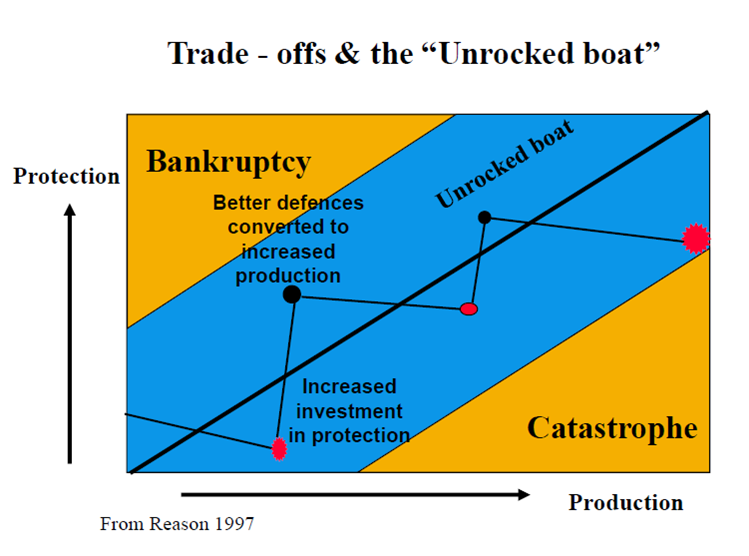
This slide presented by Dr. Mark Fleming during his excellent presentation in Vancouver piqued my interest, so I looked for a bit more information. I found this interesting observation in a paper by Gonzales and Sawicka:
The role of risk perception is particularly interesting. First, performance in both safety and security settings is well characterized by the “unrocked boat” metaphor: Organizations become accustomed to their apparently safe state, thus misperceiving risk and allowing themselves to drift into regions of greater vulnerability, until (near) accidents temporarily induce greater risk awareness. The resulting pattern is oscillatory, with varying amplitude and typically leading to disaster.
The above quote seems to describe the situation on the Deepwater Horizon. Perhaps there was a sense of invulnerability among some employees (including managers) and finishing the job took precedence over safety. As Mark Fleming remarked in his presentation, offshore workers know their employer is in business to produce barrels of oil, not barrels of safety. Concerns about production (or in this case timely suspension of the well) can easily supersede concerns about safety.
The same cultural drivers-time pressure, cost-cutting, indifference to hazards and the blinkered pursuit of commercial advantage-act to propel different people down the same error-provoking pathways to suffer the same kinds of accidents. Each organization gets the repeated accidents it deserves. Unless these drivers are changed and the local traps removed, the same accidents will continue to happen.
Reason goes on to recommend a data collection program that is currently absent, at least on an industry-wide basis:
In the absence of sufficient accidents to steer by, the only way to sustain a level of intelligent and respectful wariness is by creating a safety information system that collects, analyzes, and disseminates the knowledge gained from accidents, near misses, and other sources of ‘free lessons.’
I would suggest that another way to sustain wariness is to present information on past accidents and why they can happen again. How many industry employees know what happened at Santa Barbara, Bay Marchand, Main Pass 41, Ixtoc, the Alexander Kielland, Ocean Ranger, Brent B, South Pass 60 B, and even Piper Alpha?
Finally, Reason reaches this critically important and completely relevant conclusion (keep in mind that this paper is 12-years old):
It need not be necessary to suffer a corporate near-death experience before acknowledging the threat of operational dangers-though that does appear to have been the norm in the past. If we understand what comprises an informed culture, we can socially engineer its development. Achieving a safe culture does not have to be akin to a religious conversion-as it is sometimes represented. There is nothing mystical about it. It can be acquired through the day-to-day application of practical down-to-earth measures. Nor is safety culture a single entity. It is made up of a number of interacting elements, or ways of doing, thinking and managing, that have enhanced resistance to operational dangers as their natural by-product.
Chevron tests point to flawed Macondo cement
Posted in accidents, well control incidents, tagged accidents, blowouts, cement, Chevron, Deepwater Horizon, drilling, Gulf of Mexico, macondo, National Commission, safety, well control on October 28, 2010| Leave a Comment »
Chevron’s report states, among other things, that its lab personnel were unable to generate stable foam cement in the laboratory using the materials provided by Halliburton and available design information regarding the slurry used at the Macondo well. Although laboratory foam stability tests cannot replicate field conditions perfectly, these data strongly suggest that the foam cement used at Macondo was unstable. This may have contributed to the blowout.
Further:
The documents provided to us by Halliburton show, among other things, that its personnel conducted at least four foam stability tests relevant to the Macondo cement slurry. The first two tests were conducted in February 2010 using different well design parameters and a slightly different slurry recipe than was finally used. Both tests indicated that this foam slurry design was unstable.
Drilling Ban to End This Week
Posted in accidents, drilling, Offshore Energy - General, well control incidents, tagged accidents, blowouts, Deepwater Horizon, drilling, Gulf of Mexico, macondo, moratorium, safety, well control on October 12, 2010| Leave a Comment »
The White House said Tuesday the government will lift a moratorium on deep water oil drilling in the Gulf of Mexico “very soon” – likely this week. Washington Post
Too many distractions before Macondo blew?
Posted in accidents, well control incidents, tagged accidents, Australia, blowouts, BOEMRE, Coast Guard, Deepwater Horizon, drilling, Gulf of Mexico, macondo, Montara, safety, well control on October 9, 2010| Leave a Comment »
There were so many simultaneous activities — starting with the displacing of mud to the pumping of fluids overboard — it was difficult to see what was going on. John Gisclair, Sperry Sun (see Times Picayune summary of yesterday’s BOEM-Coast Guard hearing)
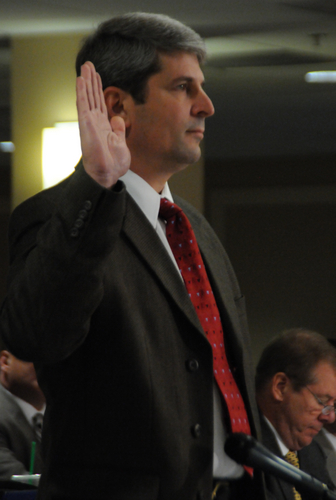
John Gisclair
Too much at once? Hurrying to finish the job? Cost concerns? No one in charge? Distracted by managers visiting the rig? One or more of these human and organizational factors appears to have contributed to the blowout.
Similarly, the rigid commitment to “batching” the development wells (for efficiency reasons) seems to have been a factor contributing to the Montara blowout in the Timor Sea. If after removing the corrosion cap on the production casing, the work on the H1 well had continued in series (i.e. casing tied-back, BOP installed, and well secured) before moving on to another well, this blowout may have been prevented.
At both Macondo and Montara, time pressures (perceived or real) may also have affected the way negative-pressure tests were conducted or assessed. These tests should have detected the influx of hydrocarbons via the shoe track.
National Commission Releases 4 Draft Staff Papers
Posted in accidents, well control incidents, tagged accidents, blowouts, Deepwater Horizon, drilling, Gulf of Mexico, macondo, National Commission, offshore oil, safety, well control on October 6, 2010| Leave a Comment »

Two Items From Yesterday’s CG-BOEM Macondo Hearings
Posted in accidents, well control incidents, tagged accidents, blowouts, Deepwater Horizon, drilling, Gulf of Mexico, macondo, offshore oil, safety, well control on October 6, 2010| Leave a Comment »
Absent live streaming or television, the Times Picayune seems to be providing the best coverage of the Coast Guard – BOEM Macondo hearings in New Orleans. While the legal sparring has attracted the most press interest, two other items in this Times Picayune article caught my attention.
Part of Keplinger and Fleytas’ duties was to monitor indicators of gas detectors and alarms from the bridge. Keplinger was busy showing visiting BP and Transocean officials a video-game-style simulator for 45 minutes to an hour before the explosions, he said, but he insisted that Fleytas was keeping him abreast of readouts of the rig’s systems.
Comment: Just as school teachers shouldn’t have been flying in the space shuttle, “tourists” shouldn’t have been visiting a complex drilling operation when the crew was in the process of setting production casing and suspending a potentially dangerous well. While the visit was well-intended, the last thing the crew needed on that night was to be distracted by a group of corporate executives. The distraction they caused was comparable to driving on a dangerous highway while getting text messages from your boss. Visiting windows should be limited to relatively low-risk operations (e.g. when drilling ahead prior to reaching target intervals), and these windows should immediately close if complications develop.
Keplinger flashed some anger at Capt. Curt Kuchta, captain of the Deepwater Horizon rig, during his testimony. He noted that a fellow rig worker, Chris Pleasant, had to ask Kuchta three times whether to disconnect the rig from the wellhead before he got the go-ahead.
Comment: One of the benefits of drilling from a floating and dynamically positioned rig is the ability to move off location if trouble arises. The failure to disconnect the riser and move away from the well at the first indication of flow contributed significantly to the tragic consequences. The technical and human factors that prevented such a disconnect must be thoroughly examined.
Further comment: The absence of live streaming of these important safety hearings is inexcusable. If a senator or governor were testifying, I expect that the cameras would be there.
Complaints: C-SPAN Says “No” and Transcripts Too Slow!
Posted in accidents, well control incidents, tagged accidents, Australia, blowouts, BOEMRE, Coast Guard, cspan, Deepwater Horizon, drilling, Gulf of Mexico, macondo, Montara, offshore oil, oil spill, well control on October 5, 2010| 2 Comments »
- C-SPAN has opted not to cover this weeks BOEMRE – Coast Guard Macondo hearings. Instead, they are presenting recordings of political rallies, assorted senatorial and gubernatorial candidate debates, and similar fare. In other words, all three channels will be dedicated to the usual political posturing that already receives non-stop national coverage, and the investigation into one of the more significant accidents in US history will be ignored.
- Why does it take 3 weeks to post the transcripts of these hearings? The Australians posted each Montara transcript within hours after the day’s session ended.
Joint BOEMRE-Coast Guard Panel Resumes Questioning
Posted in accidents, well control incidents, tagged accidents, blowouts, David Dykes, Deepwater Horizon, drilling, Gulf of Mexico, Hung Nguyen, investigation, Jason Mathews, Kirk Malstom, macondo, offshore oil, safety, Sylvia Murphy, well control on October 2, 2010| Leave a Comment »
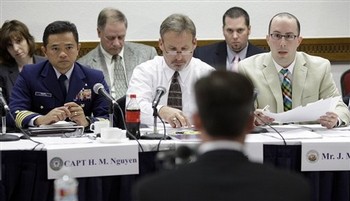
Capt. Hung Nguyen, David Dykes, and Jason Mathews question the witness. Sylvia Murphy and Kirk Malstrom monitor attentively from the 2nd row.
The panel that is most closely investigating the technical and operational aspects of the Macondo blowout reconvenes on Monday morning at 0800 CT in New Orleans.
I would assume that one of the CSpan stations will be covering the hearings, but their broadcast schedule for next week has not yet been posted.
Drilling and Safety Management Rules Announced
Posted in accidents, Offshore Energy - General, Regulation, tagged accidents, blowouts, Deepwater Horizon, drilling, macondo, offshore oil, regulations, safety, safety management, SEMS, well control on September 30, 2010| 2 Comments »
Today, BOEM released fact sheets describing the Drilling Safety and Safety and Environmental Management (SEMS) rules. The complete documents will be available for review as soon as they are published in the Federal Register.
Based on the fact sheet, the Drilling Safety Rule does not appear to include any significant surprises. The rule seems to be generally consistent with the recommendations in Secretary Salazar’s 27 May Safety Measures Report to the President (the “30-Day Report”). This is an Interim Final Rule that will be effective upon publication.
According to the fact sheet, the SEMS Rule will incorporate all elements of API RP 75 into BOEM regulations. This is an improvement, in my opinion, from the proposed rule which incorporated only 4 elements of RP 75. The effective date for this rule is not indicated in the fact sheet.
 Bud's Offshore Energy (BOE)