According to a Financial Times report, the White House is drafting an executive order that will facilitate the stockpiling of critical metals found in the Pacific. The Administration is intent on countering China’s rare earth supply chains and battery mineral dominance.
China plans to build an “Offshore Space Station”2,000 meters below the ocean surface in the South China Sea. The plan is to complete the station, which will accommodate 6 scientists, by 2030.
This is by far the deepest water for which a subsea human habitat has been proposed. By comparison, the planned Proteus (Fabien Cousteau) underwater station will be in just 20 meters of water off the northeast coast of Curaçao. A Sentinel/UK habitat is planned for depths up to 200 meters in the Mediterranean.
The primary focus of the deepwater South China Sea facility will reportedly be the study of deepwater seep ecosystems which are rich in marine life and deposits of methane hydrates. Hydrates are an energy resource that has much potential. However, because of the risk of uncontrolled methane releases and seafloor instability, there is limited support for the production of hydrate methane.
A deepwater science station near hydrates and methane seeps would be a dangerous operating environment given the potential for methane blowouts and cratering caused by destabilized hydrates. Given that nearly all of the research could be conducted safer and cheaper with Autonomous Underwater Vehichles (AUVs) and advanced robotics, the scientific value of a deepwater station seems questionable.
The offshore oil and gas industry considered subsea habitats in the 1970s but has since abandoned the idea. Lockheed designed a one atmosphere seafloor chamber (diagram below) that was installed in the Gulf in 1972 at a water depth of 375 ft.
Dry chamber well and production systems lost favor because of concerns about flooding, high costs, and safety risks associated with transporting workers to the chambers and placing them in close proximity to “live” wells and production equipment.
Perhaps the main drivers for China’s deepwater “space station” are geopolitical. Taiwan, Vietnam, the Philippines, Malaysia, and Brunei reject Beijing’s claims of sovereignty and each claim parts of the South China Sea (see map below).
By establishing a seafloor community in a strategic location, China could strengthen its highly questionable claim to the entire South China Sea. China would also have reason to increase Navy vessel activity in disputed waters to support and defend their subsea community.
This will be a project to watch if it actually goes forward.
“The 19th century is known as the “century of coal,” but, as the technology scholar Vaclav Smil has noted, not until the beginning of the 20th century did coal actually overtake wood as the world’s No. 1 energy source. Moreover, past energy transitions have also been “energy additions”—one source atop another. Oil, discovered in 1859, did not surpass coal as the world’s primary energy source until the 1960s, yet today the world uses almost three times as much coal as it did in the ’60s.“
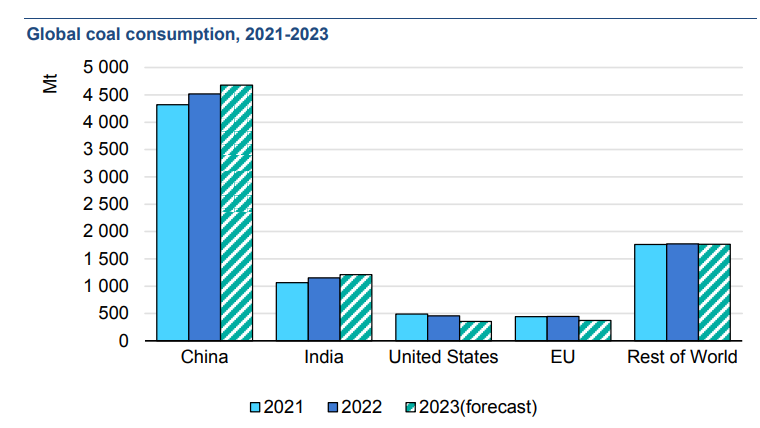
Coal is not going away. Per IEA, coal consumption in 2022 set a new record (8.3 billion tonnes) and will stay at or near that level in 2023 and 2024. See the chart below for 2021, 2022, and 2023 (est.) consumption in million tonnes. India and China are joined by the “Rest of the World” (outside the US and EU) in the billion tonne club.
Message: Coal is cost effective and reliable, and will continue to be a major source of energy.
The state-owned Chinese oil explorer surrendered operating control of those assets to quell U.S. national security concerns, said two people familiar with the agreement who asked not to be named because the terms aren’t public.
China also has boosted annual coal production by 490 million tonnes since last year, enough to meet demand from Germany and Russia combined, the coal mine safety bureau said this month, describing coal as “still our country’s most important source of power”.
The country has continued to develop new coal-fired plants, with construction on the second phase of the Zheneng Liuheng coal-fired power station in eastern China’s Zhejiang province beginning at the start of this month. New coal-fired power construction was at its highest since 2016 last year.
…that the SPR legislation authorized the sale of large volumes of oil for the purpose of easing worldwide prices. Per section 151 of the statute, which was passed following the oil embargoes in the 1970’s, the SPR was intended todiminish the vulnerability of the United States to the effects of a severe energy supply interruption.
…that SPR oil could be sold to all entities including Chinese companies that are also buying oil from Russia, the country being boycotted. How absurd is that? (The confirmation of one such transaction is pasted below.)
ClientEarth, a Shell shareholder, notified the energy major on Monday that it would commence legal proceedings against the company’s 13 executive and non-executive directors for what it said was the board’s failure to adopt a strategy that “truly aligns” with the 2015 Paris climate agreement. The not-for-profit group, which has a strong record of winning climate-related cases, wrote to Shell in advance of petitioning the High Court of England and Wales for permission to bring the claim.
Bad decision by Blackstone; worse timing. Putin and OPEC must be pleased.
Blackstone Inc., once a major player in shale patches, is telling clients its private equity arm will no longer invest in the exploration and production of oil and gas, according to people with knowledge of the talks. The firm’s next energy fund won’t back those upstream investments — a first for the strategy.
As the United States continues to tie its hands with regard to the transportation of natural gas, a fuel that has actually led to a large decrease in CO2 emissions over coal, Russia and China reached an agreement under which Russia will supply 100 million tons of coal to China so that China can continue to open up new coal-fired power plants
A global shift away from nuclear power in response to the atomic plant crisis unfolding in Japan will likely spur a scramble for Australian energy, catapulting the country ahead of Qatar as the world’s biggest supplier of liquefied natural gas in the near future.
Now that Chile, with the help of the international community (including two companies from the Commonwealth of Pennsylvania where the drilling industry began), has rescued the 33 miners, can we drill into the Australian government and rescue the Montara and Varanus Island reports?
While we are at it, can we learn more about these accidents?
Let’s learn from past accidents, so we don’t need dramatic rescues in the future.
The offshore safety record will be suspect until industry and governments have credible, internationally accepted programs and policies for ensuring that accidents are independently investigated and that investigation updates and reports are released in a timely manner.



![[OZLNG]](https://i0.wp.com/si.wsj.net/public/resources/images/AM-AM993_OZLNG_NS_20110316055703.jpg)
 Bud's Offshore Energy (BOE)