Feeds:
Posts
Comments

Posts Tagged ‘BOEM’

Jamie Dimon, CEO JPMorgan Chase

“In my view, America should have been pumping more oil and gas and it should have been supported,” Dimon told CNBC’s Julianna Tatelbaum at the JPM Techstars conference in London.

“We have a longer-term problem now, which is the world is not producing enough oil and gas to reduce coal, make the transition [to green energy], produce security for people,” he said.

“I would put it in the critical category. This should be treated almost as a matter of war at this point, nothing short of that,” he added.

“This is the chance to get our act together and to solidify the Western, free, democratic, capitalist, free people, free movements, freedom of speech, free religion for the next century,” he continued.

“Because if we don’t get this one right, that kind of chaos you can see around the world for the next 50 years.”

Jamie Dimon, CEO, JPMorgan Chase,

Read Full Post »

Which bid was rejected? BOEM announced that 307 of the 308 high bids were accepted. One bid was rejected on fair market value grounds. The unsuccessful bid is not specified on the Sale 257 web page.

When can we expect a statement from Exxon on their intentions for the 94 blocks they acquired? Those 94 blocks (31% of the entire sale) are the elephant in the room, yet we have heard nothing from the company. Given Exxon’s apparent interest in using these leases for CCS purposes, and the tax credits and Federal funding associated with CCS projects (as per the Infrastructure Bill and Inflation Reduction Act), clarification regarding Exxon’s intentions would seem to be appropriate.

Read Full Post »

Pursuant to section 50264(b) of the Inflation Reduction Act of 2022 (Pub. L. No. 117-169), Congress has directed BOEM to award leases to the highest valid bidders in Lease Sale 257, which was held on November 17, 2021. Consistent with this direction, BOEM has accepted 307 of the highest valid bids, totaling $189,888,271.

A total of 33 companies participated in the lease sale, generating $191,688,984 in high bids for 308 tracts covering 1.7 million acres in federal waters in the Gulf of Mexico. One bid was rejected for not providing the public with fair market value.

BOEM

Bottom line:

Read Full Post »

A full day ahead of the deadline! Waiting for an announcement and details.

Read Full Post »

The U.S. Court of Appeals for the D.C. Circuit ruled that BOEM “unreasonably refused to consider possible deficiencies in environmental enforcement” in their Supplemental EIS for Sales 250 and 251. The court found that BOEM did not adequately consider a 2016 Government Accountability Office (GAO) report that was critical of BSEE’s oversight of offshore activities.

More positively, the court chose not to vacate the sales or the EIS:

Moreover, vacatur would be highly disruptive for the lessees. They have paid millions of dollars to obtain their leases and have acted for some four years in reliance on them—including by investing substantial additional sums and by executing contracts with third parties. Moreover, any redo of the lease sales “would be tainted by prior publication of [the] lessees’ proprietary valuation of the leases” following the original sales.

Comments:

  1. How many GAO reports on BSEE or MMS have not been critical of some processes or procedures? None that I can recall.
  2. It’s unreasonable to expect BOEM to consider every GAO or other external criticism of the regulatory program in their EIS’s.
  3. All of the GAO recommendations in the subject report were process related and were closed (implemented) several years ago.
  4. The court exercised good judgement in declining to vacate the sale. Per the decision, the case will be remanded to BOEM for further consideration of the GAO report.


Read Full Post »

Contrary to some media reports and industry comments, the Inflation Reduction Act does NOT require the Department of the Interior (DOI) to award leases to the high bidder on each Sale 257 tract. The legislation requires DOI to accept the highest valid bid for each tract.

As BOE has previously explained, the 94 carbon sequestration bids were clearly not valid, and leases should not be awarded. These bids accounted for 30.5% of the entire sale in terms of the number of tracts receiving bids. (More on the CCS bids.)

There is also the matter of fair market value. Only 9 of the 214 (non-CCS) tracts received more than one bid and none received more than 2 bids. DOI/BOEM may determine that some of the bids did not pass the fair market value test. Are such bids “valid” under the terms of the IRA legislation? Note that 7 of the 93 high bids submitted at the previous sale (Lease Sale 256, November 2020) were rejected on fair market value grounds. All 7 were single bid tracts.

Lastly, there is the unresolved matter of the decision by Judge Contreras to vacate Sale 257. While the legislation seems to clearly supersede that decision, who knows what might happen next on the litigation front.

Read Full Post »

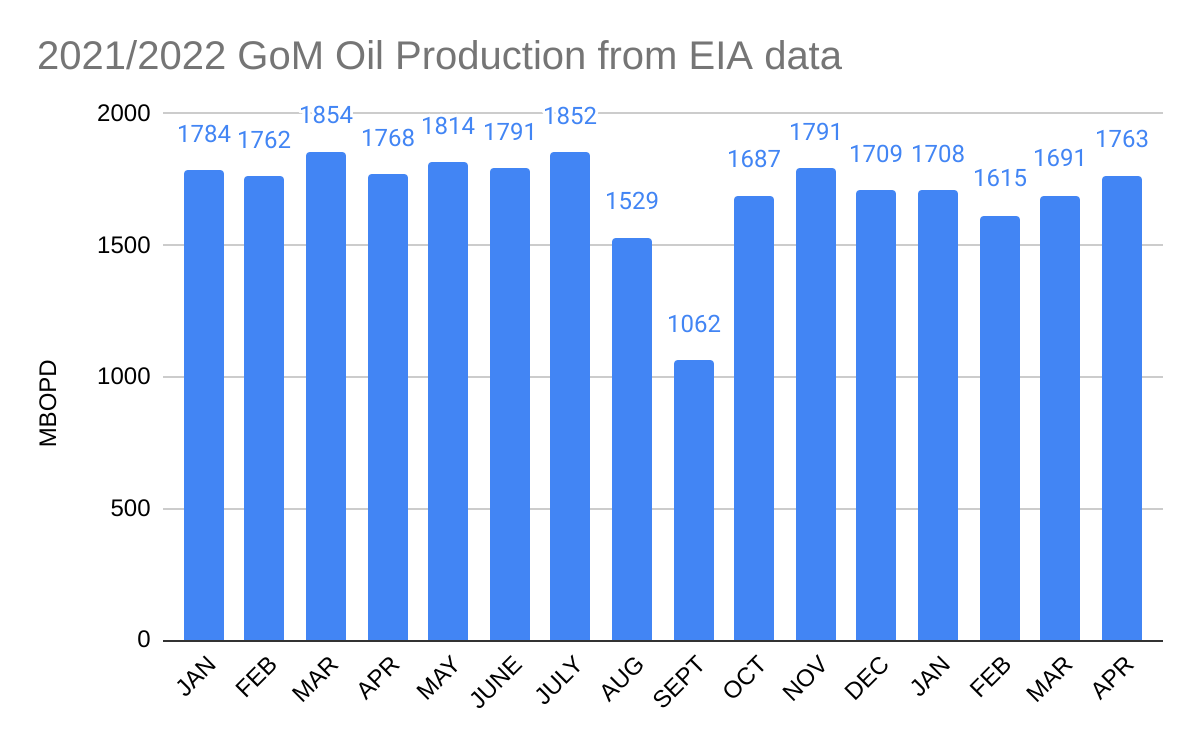
April production increased from March by 72,000 BOPD to 1.763 million BOPD. The increase is associated, at least in part, with Murphy’s King’s Quay field which began producing in early April. 2022 GoM production remains below the levels reached in the first 7 months (pre-Hurricane Ida) of 2021, and is well below BOEM’s forecasted 2022 production rate of 1892 MBOPD. Perhaps BOEM was assuming earlier startup dates for other projects that will begin production later this year or next year. The 2022 YTD dip in production points to the importance of sustained exploration and development.

BOEM’s short-term production forecast is considerably more optimistic than EIA’s. This optimistic forecast, along with unrealistic expectations regarding the “energy transition” are reasons for proposing so few lease sales in the new 5 year leasing program. The logic for this minimalist leasing program seems to be that future production is neither necessary nor desirable. Indeed the program implies that the long-term nature of offshore production is a liability and is justification for limiting OCS oil and gas leasing:

BOEM’s short-term (20-year) production forecast for existing leases shows steady growth from 2022 through 2024 and declining thereafter (see Section 5.2.1). The long-term nature of OCS oil and gas development, such that production on a lease can continue for decades makes consideration of future climate pathways relevant to the Secretary’s determinations with respect to how the OCS leasing program best meets the Nation’s energy needs.

5 Year Leasing Program, p.3

Basing leasing decisions on “future climate pathways” would seem to be a considerable stretch of the Secretary’s authority under the OCS Lands Act and may be inconsistent with the recent SCOTUS decision in West Virginia vs. EPA. A strategic shutdown of the offshore oil and gas program would dramatically increase energy supply and security risks going forward, and should be authorized by Congress.

Read Full Post »

Read Full Post »

Background:

Questions:

  • What are the costs per ton of offshore carbon sequestration including emissions collection, offshore wells and platforms, the associated pipeline infrastructure, ongoing operational and maintenance costs, and decommissioning?
  • What is the timeframe given that the starting point is likely years away?
  • How long would CO2 sequestration continue.
  • Who pays? Polluters? Federal subsidies? Tax credits?
  • Who is liable for:
    • safety and environmental incidents associated with these projects?
    • CO2 that escapes from reservoirs, wells, and pipelines (now and centuries from now)?
    • decommissioning?
    • hurricane preparedness and damage?
  • For Gulf of Mexico sequestration, how much energy would be consumed per ton of CO2 injected? Power source? Emissions?
  • To what extent will these operations interfere with other offshore activities?
  • Relatively speaking, how important is US sequestration given:
  • What are the benefits of offshore sequestration relative to investments in other carbon reduction alternatives?
  • Will BOEM conduct a proper carbon sequestration lease sale with public notice (as required by BOEM regulations) such that all interested parties can bid?
    • What will be the lease terms?
    • Environmental assessment?
    • How will bids be evaluated?
  • What happens to the Exxon bids if the Judge’s Sale 257 decision is reversed?
  • What is the status of the DOI regulations mandated in the legislation with an 11/15/2022 deadline?
    • When will we see an Advanced Notice or Notice of Proposed Rulemaking?
    • Given that DOI has no jurisdiction over the State waters and onshore aspects of these projects, what is the status of parallel regulatory initiatives?
  • Finally and most importantly, how does drilling offshore sequestration wells instead of exploration and development wells increase oil and gas production?
highly simplified conceptual diagram

Read Full Post »

….for continuing to recognize the Conservation Division of the Geological Survey (USGS) as the US offshore safety regulator, even though 40 years have passed since that was the case and there have been 3 successor bureaus. 😀

33 CFR § 140.4 Relationship to other law. (current text excerpted from Coast Guard Subchapter N regulations)

(a) Design and equipment requirements of this subchapter for OCS facilities, including mobile offshore drilling units in contact with the seabed of the OCS for exploration or exploitation of subsea resources, are in addition to the regulations and orders of the U.S. Geological Survey applicable to those facilities.

USGS North Atlantic District, Hyannis, MA, Halloween 1980

Most of us old-timers think the best regulatory framework for the offshore program was in the USGS days (pre-1982). Some of this may be nostalgia, but there are some good reasons for this thinking:

  • USGS was/is an internationally acclaimed scientific organization that was always headed by a renowned geologist. The regulatory program was thus somewhat insulated from political pressures. Vince McKelvey, Bill Menard, and Dallas Peck were the Directors when I worked for USGS. Their credentials are linked. Bill and Dallas visited our Hyannis office (not at Halloween 😀) and were very supportive.
  • The Conservation Division was responsible for onshore operations on Federal lands as well as offshore activity. This facilitated information sharing and offered diverse career opportunities. My first bosses in New Orleans had worked previously in the Farmington and Roswell, NM offices.
  • We had excellent synergy with the other USGS divisions. The Marine Science Center in Woods Hole was an incredible resource for our Hyannis office. The Woods Hole office, particularly Mike Bothner and Brad Butman, had a critical role in the Georges Bank Monitoring Program, the best ever (in my biased opinion) environmental study of exploratory drilling operations in a frontier area.
  • The USGS Conservation Division had a very small and supportive headquarter’s staff, which minimized the potential for conflict with field offices.
  • Prior to the formation of the Minerals Management Service (MMS) in 1982, the Bureau of Land Management was responsible for leasing, but all regulatory functions were under USGS. This included resource evaluation/conservation, plan review and approval, permitting, inspections and enforcement, and investigations. The division of MMS responsibilities, most notably the assignment of plan approval to the leasing bureau (BOEM) rather than the regulatory bureau (BSEE), complicates the work of both bureaus and is a prescription for inefficiency, confusion, overlap, and conflict.

Read Full Post »

« Newer Posts - Older Posts »