- C-SPAN has opted not to cover this weeks BOEMRE – Coast Guard Macondo hearings. Instead, they are presenting recordings of political rallies, assorted senatorial and gubernatorial candidate debates, and similar fare. In other words, all three channels will be dedicated to the usual political posturing that already receives non-stop national coverage, and the investigation into one of the more significant accidents in US history will be ignored.
- Why does it take 3 weeks to post the transcripts of these hearings? The Australians posted each Montara transcript within hours after the day’s session ended.
Posts Tagged ‘accidents’
Complaints: C-SPAN Says “No” and Transcripts Too Slow!
Posted in accidents, well control incidents, tagged accidents, Australia, blowouts, BOEMRE, Coast Guard, cspan, Deepwater Horizon, drilling, Gulf of Mexico, macondo, Montara, offshore oil, oil spill, well control on October 5, 2010| 2 Comments »
Joint BOEMRE-Coast Guard Panel Resumes Questioning
Posted in accidents, well control incidents, tagged accidents, blowouts, David Dykes, Deepwater Horizon, drilling, Gulf of Mexico, Hung Nguyen, investigation, Jason Mathews, Kirk Malstom, macondo, offshore oil, safety, Sylvia Murphy, well control on October 2, 2010| Leave a Comment »
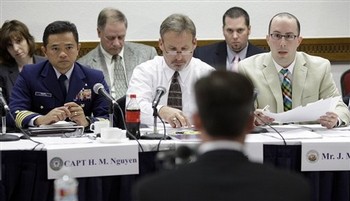
Capt. Hung Nguyen, David Dykes, and Jason Mathews question the witness. Sylvia Murphy and Kirk Malstrom monitor attentively from the 2nd row.
The panel that is most closely investigating the technical and operational aspects of the Macondo blowout reconvenes on Monday morning at 0800 CT in New Orleans.
I would assume that one of the CSpan stations will be covering the hearings, but their broadcast schedule for next week has not yet been posted.
Drilling and Safety Management Rules Announced
Posted in accidents, Offshore Energy - General, Regulation, tagged accidents, blowouts, Deepwater Horizon, drilling, macondo, offshore oil, regulations, safety, safety management, SEMS, well control on September 30, 2010| 2 Comments »
Today, BOEM released fact sheets describing the Drilling Safety and Safety and Environmental Management (SEMS) rules. The complete documents will be available for review as soon as they are published in the Federal Register.
Based on the fact sheet, the Drilling Safety Rule does not appear to include any significant surprises. The rule seems to be generally consistent with the recommendations in Secretary Salazar’s 27 May Safety Measures Report to the President (the “30-Day Report”). This is an Interim Final Rule that will be effective upon publication.
According to the fact sheet, the SEMS Rule will incorporate all elements of API RP 75 into BOEM regulations. This is an improvement, in my opinion, from the proposed rule which incorporated only 4 elements of RP 75. The effective date for this rule is not indicated in the fact sheet.
Several interesting items!
Posted in Uncategorized, tagged accidents, Australia, blowouts, Canada, macondo, Newfoundland, NOPSA, offshore oil, safety, safety culture, well control on September 30, 2010| Leave a Comment »
- The Canada-Newfoundland and Labrador Offshore Petroleum Board unveiled their new website. Very impressive!
- Jane Cutler, CEO of NOPSA (Australia), made an outstanding (must-view) presentation on Safety Priorities for 2010. My favorite quote:
Safety culture is how the organization behaves when no one is watching.
Also, NOPSA’s September Newsletter has some interesting updates including information on the jackup failure offshore China.
- Joel Achenbach, a very good reporter, wrote an excellent Washington Post article on that addresses some of Macondo’s human and organizational factors. I do disagree with the deepwater emphasis, particularly his BOP comments. As we have noted on several occasions, subsea BOPs have a far better performance record than surface BOPs. Also, having the stack right at the surface is a hindrance, not a benefit, if the rig is on fire.
And how does a reporter question the humility of engineers? 🙂
Engineers do amazing things, but they aren’t always as smart as they think, nor their systems as robust as they seem on paper.
Cuba Drilling Article in the NY Times
Posted in cuba, tagged accidents, cuba, Gulf of Mexico, hurricanes, macondo, mooring, offshore oil, oil spill, safety on September 30, 2010| Leave a Comment »
 In our last Cuba update, we noted that their next deepwater well always seems to be a year away. So it came as no surprise when we saw this in a New York Times article:
Yet next year, a Spanish company will begin drilling new wells 50 miles from the Florida Keys — in Cuba’s sovereign waters.
Comment: We have been hearing this for five years. Will the well really be spudded next year?
The nascent oil industry in Cuba is far less prepared to handle a major spill than even the American industry was at the time of the BP spill. Cuba has neither the submarine robots needed to fix deepwater rig equipment nor the platforms available to begin drilling relief wells on short notice.
Comments: (1) Not a good time for the US to be lecturing Cuba about oil spills. (2)In the event of a spill, all well intervention, relief well, and spill response equipment would no doubt be made available to Cuba without hesitation and with the full support of the US government. (3)A Cuban blowout is unlikely because every operator and contractor in the world will be focusing on well integrity and BOP performance issues that were factors in the Macondo blowout. (4)Informed international contacts have advised us that Cuban offshore officials are knowledgeable and committed to internationally accepted safety and pollution prevention standards.
My biggest concern with regard to Cuban offshore operations, assuming a moored rig is used, is that the rig would be set adrift during a hurricane and that anchors, mooring lines, or hulls could damage coral reefs and other sensitive seafloor features. In the US, the MMS and industry did a lot of good work on mooring risk assessments and improved anchoring systems and mooring lines. Given the significant probability that Cuban rigs will be exposed to hurricane conditions, it is imperative that US and Cuban specialists meet to discuss these issues. Once a rig is adrift, there is not much that can be done to stop it.
Also, in an award winning project, a multi-agency US government team demonstrated enhanced satellite monitoring capabilities that provide timely information on the location of evacuated rigs. These capabilities can be combined with gps systems to ensure continuous rig-tracking.
US-Cuban cooperation on offshore safety and pollution prevention issues is in the best interest of both countries, and should be encouraged without hesitation.
Industry Response Needs To Go Beyond Deepwater Drilling
Posted in accidents, tagged accidents, bp, macondo on September 29, 2010| Leave a Comment »
BP has announced a new safety unit and other organizational changes. For more on the changes, see the Upstream report.
From a BOE perspective, the most interesting comment in the BP release was this Bob Dudley quote:
Our response to the incident needs to go beyond deepwater drilling. There are lessons for us relating to the way we operate, the way we organize our company and the way we manage risk.
I hope the rest of the offshore industry has the same view and is prepared to work together to assess and mitigate operational risks. To date, industry has reacted impressively to issues raised since the Macondo well blew out on 20 April. However, what is being done to identify operational and safety risks that could trigger the next disaster? When will complete, consistent, and verified international incident data be collected and published?. How do you manage risks without such data? Why weren’t the lessons from Montara quickly disseminated around the world? If they were, Macondo may have been prevented.
Aban Pearl – Update and Surprising Finding
Posted in accidents, tagged aban pearl, accidents, PDVSA, semisumbersible, Trinidad and Tobago, venezuela on September 29, 2010| 1 Comment »
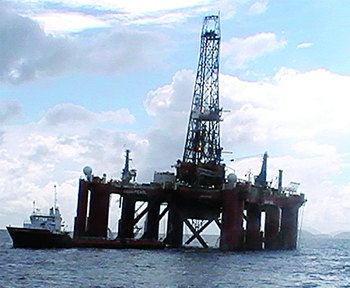
Aban Pearl listing off Trinidad in August 2009
For those who haven’t been following this saga, the Aban Pearl, a semi-submersible drilling rig, sank off of Venezuela on 13 May 2010. The seas were calm and the skies were clear, so the cause of the accident is a mystery. We have learned from a reliable and knowledgeable source that PDVSA, the national oil company of Venezuela, has conducted an official investigation to determine the cause(s) of this accident. We urge them to release their report so that all may benefit from their findings.
While searching the web for other information on the Aban Pearl, I was surprised to find that the rig was reported to be listing offshore Trinidad & Tobago in August 2009, and that assistance was requested from the T&T Coast Guard. This incident occurred nine months before the rig sank offshore Venezuela.
According to Public Relations Officer at the T&T Coast Guard Lt Kirk Jean Baptiste, the T&T Coast Guard received a distress call from the rig around 2.45 pm. “The Coast Guard received a call that one of the flotation devices on the rig was taking in water which caused the rig to lean on one side,” he said. Sources said it belonged to an Indian company, but was registered in Singapore. They said it was not working, but just passing through T&T waters. Rigs are normally moved with the help of other boats.
Colin comments on Montara-Macondo Float Collar Issues
Posted in accidents, well control incidents, tagged accidents, Australia, blowouts, BOE, Colin Leach, Deepwater Horizon, macondo, Montara, offshore oil, safety, well control on September 28, 2010| Leave a Comment »
 We have commented frequently about the similarities between the Montara and Macondo blowouts, particularly the root cause casing shoe issues. In this post, Colin Leach draws attention to the float shoe and collar issues that permitted oil and gas to enter both wells. Click here to view the full post.
The Bly report (page 70) noted some significant “inconsistencies” in the operation of the float shoe/float collar (see full post). This is so similar in nature to the “inconsistencies” in the 9 5/8″ cement job on the Montara well to be scary. The bottom line is that both disasters could have been prevented if these “inconsistencies” had been recognized and additional barriers placed above the float collar. In fact even if there are no “inconsistencies”, the placing of an additional barrier or so seems like an exceptionally prudent step, which would not take that much time or effort.
Deep water is not the problem – Update
Posted in accidents, well control incidents, tagged accidents, blowouts, bly, BOE, bp, Deepwater, Deepwater Horizon, drilling, Gulf of Mexico, macondo, Montara, offshore oil, safety, well control on September 28, 2010| 1 Comment »
As previously posted (July 27, 2010), deep water had little to do with the well integrity problems and other contributing factors leading to the Macondo blowout. The Bly (BP) report further confirms this position.
Of the eight key findings in the Bly report (listed below), only number 4 could be considered to be more of a deepwater issue. The BOP failures may also have been influenced by deepwater factors. However, as previously noted, surface BOPs have a much higher failure rate than subsea stacks.
While the Montara blowout was in relatively shallow water, slight variations of findings 1 through 4 were the primary causes of that accident.
BP findings:
- The annulus cement barrier did not isolate the hydrocarbons.
- The shoe track barriers did not isolate the hydrocarbons.
- The negative-pressure test was accepted although well integrity had not been established.
- Influx was not recognized until hydrocarbons were in the riser.
- Well control response actions failed to regain control of the well.
- Diversion to the mud gas separator resulted in gas venting onto the rig.
- The fire and gas system did not prevent hydrocarbon ignition.
- The BOP emergency mode did not seal the well.
Department of the Interior Officials Testify at Commission Hearings
Posted in accidents, tagged accidents, blowouts, Deepwater Horizon, drilling, Gulf of Mexico, macondo, National Commission, offshore oil, oil spill, safety on September 27, 2010| Leave a Comment »

Secretary Salazar, Deputy Secretary Hayes, and BOEMRE Director Bromwich testified at today’s National Commission hearings. Director Bromwich made several important announcements and comments of interest to BOE readers:
- He has completed his public meetings and will submit his report to the Secretary by the end of the week, approximately two months ahead of schedule. Does this point to an early end to the drilling moratorium?
- Two significant interim final rules will also be issued by the end of the week. These rules will address well integrity, BOP performance, and other issues raised in the 30-day report submitted to the President at the end of May.
- New drilling will not be authorized until operators and contractors can demonstrate compliance with the new rules.
- BOEMRE resources will be reallocated to assist with the workload associated with the resumption of drilling.
Chairman Reilly expressed concerns about the leasing and regulatory functions reporting to the same Assistant Secretary under the new organizational structure. He also drew attention to the regulatory regimes in Norway, the UK, and elsewhere, and the importance of studying those programs.
Secretary Salazar’s goal is for the US offshore oil and gas program to serve as the “gold standard” for safe and clean operations around the world.
 Bud's Offshore Energy (BOE)