May 28, 2010 by offshoreenergy
Why did BP stop mud injection for approximately 20 hours, starting at 2300 CT on the first day of the operation, not resuming until yesterday evening? Prior to the start of the top kill operation, there was no indication that there would be a long pause after an initial pumping period, and according to BP there have been no equipment problems. While stopping to monitor pressure data is understandable, the length of the pause is puzzling.
Why was no one advised that the long-awaited and enormously significant operation had been temporarily suspended? Apparently, Admiral Allen was not aware of the suspension when he spoke with the LA Times yesterday morning, so it is not surprising that no one else knew. The media and other interested observers were watching the seafloor cameras all day looking for signs that the operation was having some effect. Why didn’t someone simply advise that the operation had been temporarily suspended while data were being evaluated?
Posted in accidents, well control incidents | Tagged accidents, blowouts, Deepwater Horizon, drilling, Gulf of Mexico, macondo, offshore oil, oil spill, safety, well control | Leave a Comment »
May 27, 2010 by offshoreenergy
- Flow Rate Technical Group: The group has estimated the well flow rate at 12000-19000 bopd. This appears to be a rigorous estimate.
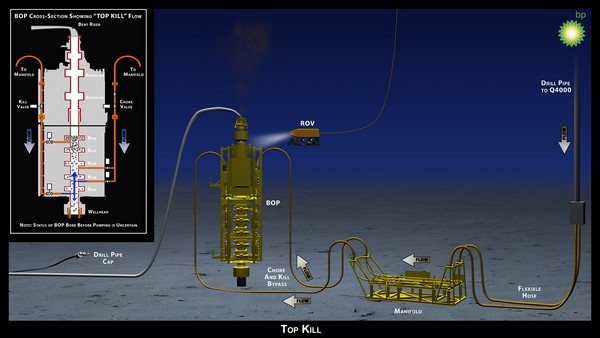
- TKO – BP stopped injection last night at approximately 2300 CT to monitor data (first we’ve heard about that; that step was not discussed last night). Phase 2 injection begins this evening. BP will use bridging material and perhaps some junk shot. Results are encouraging to date, and the hydrocarbon flow has been suppressed during mud injection. However, hydrocarbon flow from the well continues. Equipment is performing well.
- Seven in situ burns were conducted today.
Posted in accidents, well control incidents | Tagged accidents, blowouts, Deepwater Horizon, drilling, Gulf of Mexico, macondo, offshore oil, oil spill, safety, well control | 2 Comments »
May 27, 2010 by offshoreenergy
Engineers have succeeded in stopping the flow of oil and gas into the Gulf of Mexico from a gushing BP well, the federal government’s top oil spill commander, U.S. Coast Guard Adm. Thad Allen, said Thursday morning.
Posted in accidents, well control incidents | Tagged accidents, admiral allen, blowouts, Deepwater Horizon, drilling, Gulf of Mexico, macondo, offshore oil, oil spill, safety, top kill, well control | 1 Comment »
May 27, 2010 by offshoreenergy
- TKO update: BP is wise not to declare victory prematurely, but the Top Kill Operation (TKO) seems to be proceeding as planned.
- Better than a lava lamp?: I’ve heard from some people who can’t stop watching the live BOP and leakage videos. Is this addiction treatable? 🙂
- To those suggesting a military takeover of the response: The US Coast Guard is already in charge and is doing well. The last time I checked the Coast Guard was still part of the military.
- Why hasn’t the flow path been determined?: There appear to have been so many well planning and construction mistakes that one can make a good argument for both backside (annular flow outside the production casing) and inside flow (up the shoe track and inside the casing).
Posted in accidents, well control incidents | Tagged accidents, blowouts, Deepwater Horizon, drilling, Gulf of Mexico, macondo, offshore oil, oil spill, safety, well control | Leave a Comment »
May 26, 2010 by offshoreenergy
I watched the live stream of the Unified Command Press Conference. My impressions:
- Admiral Landry (USCG) and Doug Suttles (BP) have impressed me throughout this ordeal. They have kept their heads under very difficult circumstances. I salute them for their leadership.
- While it’s too early to make a call on Top Kill, the early signs are encouraging. There have been no apparent system or operational glitches. Also from some of the camera shots, the mud seems to be “outrunning” the oil and gas – a positive sign.
- We should know a lot more in the morning.
Posted in accidents, well control incidents | Tagged accidents, Admiral Landry, blowouts, Deepwater Horizon, Doug Suttles, drilling, Gulf of Mexico, macondo, offshore, offshore oil, oil spill, safety, well control | Leave a Comment »
May 26, 2010 by offshoreenergy

Check out the BP memo.
Also, per yesterday’s Top Kill technical briefing the flow path from the reservoir has still not been determined. While the consensus among informed observers seemed to be that the flow was outside the production casing, information in the BP memo suggests a possible shoe failure. The float collar issues (see BP memo) are eerily Montara-esque.
Posted in accidents, well control incidents | Tagged accidents, blowouts, Deepwater Horizon, drilling, Gulf of Mexico, macondo, Montara, offshore oil, oil spill, safety, well control | 1 Comment »
May 25, 2010 by offshoreenergy
 Not to put any more pressure on the Top Kill Team, who must already feel the weight of columns of 17 ppg mud on their shoulders, but this has to be the most significant well control operation in history. No BOE reader needs to be reminded of the environmental, economic, social, resource policy,and political importance of this operation. In Washington, where drilling experts are now plentiful, all eyes are on an operation deep beneath the Gulf of Mexico.
This will be a dynamic kill – the flow of drilling mud entering the well has to overcome the flow of oil and gas exiting – flow vs. flow, density vs. density, pressure vs. pressure. Can the mud stay ahead long enough to kill the well? Will the injection equipment perform as designed? Does the well have sufficient integrity to withstand the pressure? We’ll know soon. It’s time.
Posted in accidents, well control incidents | Tagged accidents, blowouts, Gulf of Mexico, macondo, offshore oil, oil spill, safety, top kill, well control | 1 Comment »
May 23, 2010 by offshoreenergy

Max Ruelokke
BOE friends Max Ruelokke, Chairman of the Canada – Newfoundland and Labrador Offshore Petroleum Board and Stuart Pinks, CEO of the Canada – Nova Scotia Offshore Petroleum Board, will appear before the House of Commons Standing Committee on Natural Resources on Tuesday, May 25th. The meeting is at 9:00 am ET and will be broadcast live on the web. Click on Meeting No. 17.
Among the topics certain to be discussed is Chevron’s Lona 0-55 well, which is currently being drilled in 2600m of water in the Orphan Basin offshore Newfoundland. Max and Stuart are very bright and capable engineers and regulators; I’m sure you will appreciate their insights.
Posted in Uncategorized | Tagged Canada, Chevron, Lona 0-55, Pinks, Ruelokke | Leave a Comment »
« Newer Posts - Older Posts »