March 14, 2011 by offshoreenergy

I’ll hold my opinions about nuclear power until the crisis in Japan eases. Instead, I thought I’d check on the status of offshore nuclear plant proposals.
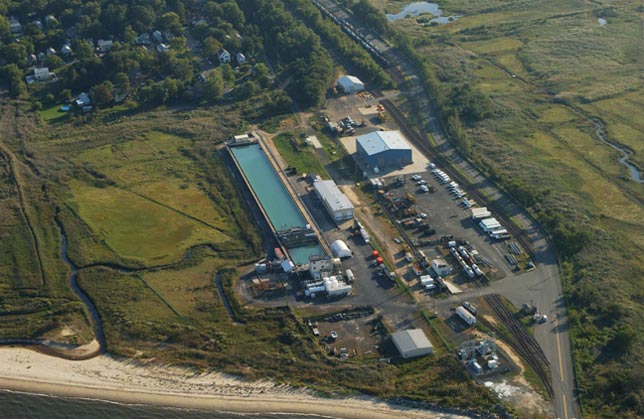
Nuclear powered submarines date back to 1954 when the USS Nautilus was launched, and offshore nuclear plant concepts are almost as old. No such facilities have been built, but French companies are studying a subsea nuclear plant concept (see picture), and Russia has launched a floating nuclear plant prototype.
Less than a month ago, the Ecologist provided an update on the French and Russian projects. These plans will no doubt receive much more public attention as a result of the tragedy in Japan, but the French concept is quite interesting.
Pros:
Cores would be protected by three barriers: fuel cladding, reactor vessel and hull. The designers argue that immersion in sea water would ensure an infinite natural means of passive cooling and permit inherent safety and security. In addition, each plant would also be protected against potential intruders. The French argue that a submerged power plant would be less vulnerable to earthquakes, tsunamis, or floods, and would be far less vulnerable to terrorist attack.
Cons:
Sceptics are concerned that warmer water released from the reactors could be dangerous for local ecosystem. And, should there be a nuclear accident ‘the sea will be destroyed,’ according to the President of Anti-nuclear organisation Crilan, based in Cherbourg. ‘The fierce warming-up of the water will cause a massive thermal shock that will destroy sea life.’
Posted in Offshore Energy - General | Tagged floating nuclear plant, France, Russia, subsea nuclear plant | Leave a Comment »
March 13, 2011 by offshoreenergy
 A wise old Indian said:
Only the government would believe that you could cut a foot off the top of a blanket, sew it to the bottom, and have a longer blanket.
The fact that Daylight Savings Time is one of our more noteworthy energy policy achievements speaks volumes about our current economic predicament.
Posted in Uncategorized | Tagged daylight savings time, energy policy | Leave a Comment »
March 13, 2011 by offshoreenergy

Former President Bill Clinton said Friday that delays in offshore oil and gas drilling permits are “ridiculous” at a time when the economy is still rebuilding, according to attendees at the IHS CERAWeek conference. Politico.com
Posted in drilling, energy, Offshore Energy - General | Tagged Bill Clinton, drilling, Gulf of Mexico, IHS CERA, offshore oil | 1 Comment »
March 12, 2011 by offshoreenergy
The tragedy in Japan has added yet more uncertainty to nervous energy markets:
Japan will likely need more imported oil and natural gas due to closures of nuclear reactors caused by Friday’s earthquake and tsunami, but volumes can’t be calculated accurately as it is unclear how much industrial output has been affected by the disaster and how long power nuclear and thermal power plants will remain closed.
Wall Street Journal
It’s much too early to gauge how the nuclear power industry, which some have touted as a model for safety achievement, will be affected.
Standards news and discussion:
Offshore Safety Institute?
The CEOs of major oil and gascompanies will meet March 18 to decide how to proceed with the formation of a US offshore drilling safety institute, William Reilly, the co-chair of the National Oil Spill Commission, said March 8. Platts Oilgram News
Marco Aurelio Garcia, foreign policy adviser to President Dilma Rousseff, told reporters in Havana exploratory work off Cuba’s northern coast had not shown good results and that Brazil wanted to concentrate on its own oil fields.
Since BP’s disastrous Deepwater Horizon accident in the Gulf of Mexico last April, the risks of offshore oil drilling have been a hot topic. One place it isn’t questioned much is Brazil, whose oil production industry is one of the fastest-growing in the world because of vast new deepwater oil reservoirs discovered in the past five years.
Mexican Deepwater Update (Platts Oilgram News)
Pemex has just begun to explore in Mexico’s Gulf of Mexico waters deeper than 1,000 feet, but 28 billion undiscovered barrels of oilequivalent are thought to exist in that area, some of which borders US territorial waters. Pemex officials said the company is forging a development plan for its first deepwater field, Lakach, located northeast of the state of Veracruz in about 3,200 feet of water. First production is expected in 2015.
Environmentalists are furious at a proposal by the petroleum company Shell to start exploration drilling off one of Western Australia’s most treasured reefs. Ningaloo Reef off the north-west coast, has been nominated for World Heritage listing.
Posted in accidents, cuba, drilling, energy, Uncategorized | Tagged Australia, Brazil, deepwater drilling, drilling, energy, ISO TC 67, Japan, macondo, Mexico, Montara, Ningaloo Reef, nuclear, offshore energy, offshore safety institute, Petrobras, standards | Leave a Comment »
March 6, 2011 by offshoreenergy

BOE staffer departs for special assignment
This week, our staff will be fully immersed in special projects, and will not be able to post on the blog. All BOE subscriptions will be extended by a week at no cost to our subscribers. 🙂
While we are gone, we encourage you to read the “Best of BOE” (best being a relative term :))
Posted in Uncategorized | Leave a Comment »
March 5, 2011 by offshoreenergy
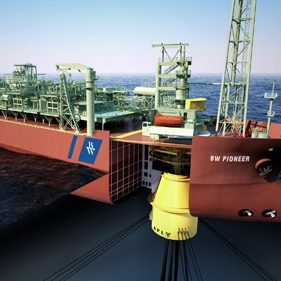
BW Pioneer
The US Coast Guard has issued the first ever Certificate of Compliance for a Floating Production Storage and Offloading (FPSO) facility in the Gulf of Mexico.
The BW Pioneer, under lease to Petrobras, will operate in the Cascade and Chinook fields.
Posted in Offshore Energy - General, oil | Tagged BW Pioneer, Cascade Chinook, FPSO, Gulf of Mexico, Petrobras | Leave a Comment »
March 5, 2011 by offshoreenergy
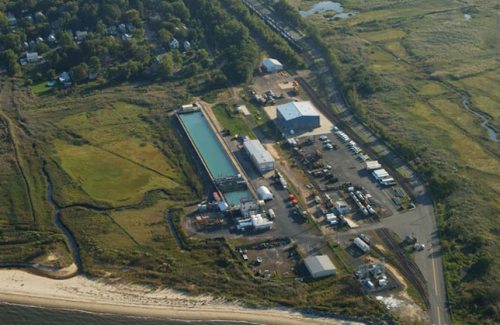
Ohmsett
The seemingly endless crowing about the absence of improvements in spill response capabilities is a story by itself. This topic warrants a full discussion when time permits, but for now I’ll offer a few comments and observations:
- The Macondo offshore spill response was unprecedented and impressive, and the lessons learned will be applied to improve spill response preparedness around the world.
- Those who claim that there has been no progress in spill preparedness either have no real interest in spill response or have not been paying attention.
- Even in the lean years following the Valdez oil spill research surge, the much-maligned MMS continued to conduct important burning, dispersant, remote sensing, and mechanical cleanup studies, while upgrading and expanding the use of the nation’s major oil spill response test facility – Ohmsett (pictured above). This research was effectively applied during the Macondo spill and smaller, less publicized incidents. Click here for a nice summary of the program and here for the very extensive list of projects and links to the reports. Domestic and international partnerships, most notably with Norway and Canada, helped sustain this important research.
- Despite periodic attempts to reprogram Ohmsett funding, MMS was able to continue to support this outstanding research facility. Learn more about Ohmsett.
- During the blowout, the networks featured the snake oil salesmen and hucksters who peddle super-sorbents and oil-consuming substances during every major spill. That time should have been given to response experts and serious oil spill researchers.
- Former industry executives with no real spill response experience trumpeted, without any documentation, claims of extraordinary recovery rates elsewhere (usually in places where no one gets to watch). Their favorite concept, supertanker response systems, received a lot of air time until the “Whale” tanker-skimmer flopped as predicted.
- You would think that Kevin Costner’s very good separator (tested at Ohmsett in 1999!) was the only advance in response technology. Perhaps more movie and TV stars should get involved with spill response. Charlie (Oil) Sheen would no doubt attract interest to the cause. 🙂

NWS Earle Executive Officer Claudill, Kevin Costner, and Ohmsett Manager Bill Schmidt (1999 photo at Ohmsett)
Posted in accidents | Tagged accidents, blowouts, Gulf of Mexico, macondo, MMS, offshore oil, ohmsett, oil spill, Valdez | Leave a Comment »
March 4, 2011 by offshoreenergy
This is not the best translation (from Spanish by Google), but I think you get the gist:
A report is in the hands of the Federation of Petroleum Workers of Venezuela (FUTPV) shows the “precarious” state that is the drill ship PetroSaudi Discover, which operates in the Gulf of Paria in the Gran Mariscal gas project Sucre. This platform, as declared by the executive secretary and coordinator of health and safety of FUTPV, Eudis Girot, bear the same fate as his partner Aban Pearl, black on 13 May 2009 in the same coasts, if not halted operations and taken to Trinidad and Tobago for repair.
“We already knew it was a scrap, just like Aban Pearl,” said a source.
More on the Aban Pearl.
Posted in accidents | Tagged aban pearl, Petrosaudi Discover, venezuela | 1 Comment »
March 3, 2011 by offshoreenergy
From Platts Oilgram News article by Gary Gentile:
The team examining the BOP in Louisiana conducted tests in January and February of this year that showed that with the proper amount of hydraulic fluid pressure, the rams on the BOP would close, according to Dan Tillema, an investigator with the US Chemical Safety Board.
Portions of drill pipe were found in the BOP and the pipe was cut, Tillema said—a sign that the rams did close at some point during the incident.
But Tillema cautions against making any assumptions based on the test results sofar. Some reports have suggested that rubber gaskets around the rams were worn awayby the massive flow of oil and gas gushing from the Macondo well, overcoming the BOP’s capacity. That is just one of several possibilities, Tillema said. “We haven’t made any conclusions yet,” he said.
Posted in accidents, well control incidents | Tagged accidents, blowouts, BOP, chemical safety board, Deepwater Horizon, drilling, Gulf of Mexico, macondo, offshore oil, safety, well control | 2 Comments »
March 3, 2011 by offshoreenergy
In recent years various bodies have concluded that certain MMS offices and programs have violated ethical rules or guidelines. In the wake of the Deepwater Horizon disaster, some questioned whether ethical lapses played any role in causing the blowout. The Chief Counsel‘s team found no evidence of any such lapses.
Posted in Uncategorized | Tagged accidents, blowouts, Deepwater Horizon, drilling, Gulf of Mexico, macondo, MMS, National Commission | 2 Comments »
« Newer Posts - Older Posts »