- The Petrobras Cascade-Chinook project, which includes the first Floating Production Storage and Offloading (FPSO) facility in the Gulf of Mexico, received final approval.
- The US will be a major purchaser of Brazilian (Petrobras) deepwater oil production. Will some of the tankers pass through US offshore areas that are closed to exploration and production?
Posted in Offshore Energy - General, oil | Tagged Brazil, Cascade Chinook, FPSO, offshore oil, Petrobras | Leave a Comment »
Kudos to:
- The US Coast Guard for promptly analyzing the Gulf of Mexico sheen that was reported over the weekend and determining that it was not associated with offshore oil and gas production.
- The many news organizations and journalists who ignored the irresponsible speculation, and waited for the Coast Guard to complete its investigation.
Posted in Uncategorized | Tagged Coast Guard, Gulf of Mexico, oil sheen | Leave a Comment »
What was reported as a miles-long oil slick in the Gulf of Mexico is likely a plume of silt emanating from a dredging operation on the Mississippi River, a U.S. Coast Guard spokesman said Sunday.
So much for the hysterical post-Macondo rush to judgement by a few reporters.
Posted in Uncategorized | Tagged Coast Guard, Gulf of Mexico, oil sheen | Leave a Comment »
The Examiner is reporting the following:
The oil sheen is suspected of coming from the Matterhorn field which includes a deepwater drilling rig, Matterhorn Seastar that is owned by W&T Technology. The oil is suspected from coming from a leak in the well which is a producing well.
Suspected by whom? Does the reporter have legitimate information or is this rank speculation? The Coast Guard is sorting this out, so we should know something soon. A statement from W&T would be helpful.
Posted in Uncategorized | Tagged Coast Guard, Gulf of Mexico, sheen, W&T | Leave a Comment »
The Coast Guard said in a news release that it received a report of a three-mile-long rainbow sheen off the Louisiana coast just before 9:30 a.m. local time on Saturday. Two subsequent sightings were relayed to the Coast Guard, the last of which reported a sheen that extended from about 6 miles south of Grand Isle, La. to 100 miles offshore.
Though the Coast Guard was able to confirm that there is a substance on the water’s surface, it has not yet been able to determine if it is oil. Wall Street Journal
Posted in Uncategorized | Tagged Coast Guard, Gulf of Mexico, oil spill | Leave a Comment »
Per the Platts Oilgram report that we posted on 17 March, here is the complete court filing..
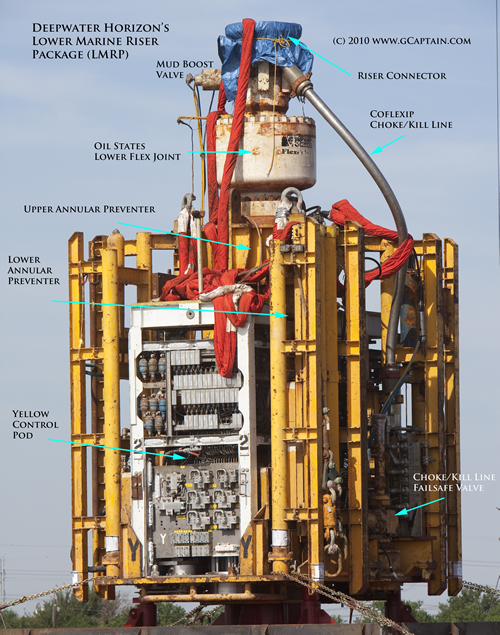
These are the additional tests recommended by BP’s consultant Ralph Linenberger:
- Removal and forensic analysis of each annular element
- Hydraulic signature testing of the annular preventer operator and ram preventers operators
- Disassembly and inspection of the annular preventer and ram preventer bonnets
- Laser scanning of (i) the entire BOP wellbore; (ii) the upper annular packer and upper annular cap; (iii) the inside of the riser kink; and (iv) the wellbore-facing surfaces of the casing shear ram bonnets
- Hydraulic circuitry pressure test
- ST lock circuit confirmation
- Solenoid pie connector pin measurement and corresponding female receptacle analysis.
Is anyone else surprised that some (all?) of these tests hadn’t already been conducted? That would seem to be the biggest revelation from the BP court filing.
Posted in accidents, well control incidents | Tagged accidents, blowouts, BOP, Deepwater Horizon, drilling, forensics, Gulf of Mexico, macondo, offshore drilling, safety, well control | Leave a Comment »

The supermoon is a normal part of the moon’s orbit around Earth. Because of small fluctuations in that oval-shaped orbit, the moon will be about 8 percent closer to Earth than it usually would be at that point in orbit. That means it will look huge, about 14 percent bigger and 30 percent brighter than full moons occurring on the opposite side the orbit, according to NASA. Arizona News
Posted in Uncategorized | Leave a Comment »

Specialists are launching a fourth undersea search effort next week for the plane’s so-called black boxes, or flight recorders.
‘We are convinced if we find the black boxes we’ll be able to reconstruct what really happened on this tragic flight Air France 447,’ Enders said. Airbus officials say the search is a company priority.
Air France and Airbus will finance the estimated $12.5 million cost of the new search, in which three advanced underwater robots will scour the mountainous ocean floor between Brazil and western Africa, in depths of up to 4,000 meters (13,120 feet).
Already $27.5 million has been spent on three previous search attempts that failed to find Flight 447’s voice and data recorders. Daily Mail
Aviation safety proponents have argued that it’s time to start replacing black boxes with satellite systems that stream critical data real time. Similarly, as we have previously suggested, it’s time for real time monitoring of wellhead and BOP pressures and functions. This relatively inexpensive improvement would support testing and maintenance programs, improve our understanding of BOP performance, assist with well control decisions, and facilitate investigations.
Posted in accidents | Tagged accidents, Air France 447, black box, blowouts, BOPE, drilling, safety | 1 Comment »
“After extensive review and development, the oil and natural gas industry has approved the creation of the Center for Offshore Safety, which will promote the highest level of safety for offshore operations, through an effective program that addresses management practices, communication and teamwork, and which relies on independent, third-party auditing and verification,” said Jack Gerard, API president and CEO. “The board directed API to further develop the operational framework and timeline for the center—working with other industry stakeholders—to enhance industry safety and environmental performance.”API Announcement
Comments:
- Encouraging decision.
- Organizational details will be critical.
- It’s good that the center will be affiliated with the standards function and located in Houston (not Washington).
- Member support must be consistent and sustained.
- Operating companies that are not API members should be involved.
- Non-US companies should be welcome.
- Contractors and service companies should be involved.
- The focus should not be solely on deepwater operations. Most major accidents have occurred on the shelf, and most of the contributing factors to Macondo were not deepwater related.
- A comprehensive, verified international incident data base is critical.
Posted in accidents | Tagged API, Offshore Safety Center | 2 Comments »


As was the case with Macondo, great minds have already figured out what went wrong at Fukushima and who is to blame.
Here’s what they tell us. Sound familiar?
- The company cut corners to save money!
- There wasn’t enough government oversight!
- Management failed to properly assess the risks!
- The regulator is corrupt!
- Warnings were ignored!
- The operation is not safe in that environment!
- The company and industry have a poor safety culture!
- Our country’s regulations are much more stringent!
- It couldn’t happen here!
- The threat is spreading; people in Panic-stan are in danger!
I’m no nuclear power advocate, but it would be nice if everyone focused on fixing the problem, protecting those who are truly endangered, and restroring some sense of normalcy in Japan. There will be plenty of time to investigate and find fault.
By the way, do you remember the fear mongering about Macondo oil on East Coast beaches?
- May 2, 2010: The AP reported that oil will be on Florida East Coast beaches in “almost no time.”
- May 22, 2010: Local news in Norfolk, VA reports that the slick has entered the Loop Current superhighway and Virginia Beach is in imminent danger.
- July 30, 2010: NOAA issues a release southern Florida and East Coast beaches are not threatened.
Posted in accidents | Tagged Fukushima, macondo | Leave a Comment »

