Feeds:
Posts
Comments

40 years ago today, drilling began on the first two exploratory wells on Georges Bank, a large seafloor feature that separates the Gulf of Maine from the Atlantic Ocean. The Cape Cod Times headline (below) attests to the drama that was unfolding 155 miles southeast of Nantucket. After years of debate, oil embargoes, gas lines, and the threat of future supply disruptions had tipped the political balance in favor of offshore leasing, and OCS Sale No. 42 (North Atlantic) was held one week before Christmas in 1979. Looking back, I find it remarkable that only 19 months elapsed between the lease sale and the initiation of drilling. During that time, bids were evaluated, exploration and spill response plans were drafted by the operating companies and reviewed by the Federal regulators and six coastal states, fisheries issues were addressed, and a comprehensive monitoring program was developed and initiated. Perhaps most impressive was the manner in which government (Federal and State), industry, and academic professionals with very different personal opinions about offshore drilling collaborated to assess and monitor impacts and mitigate risks.
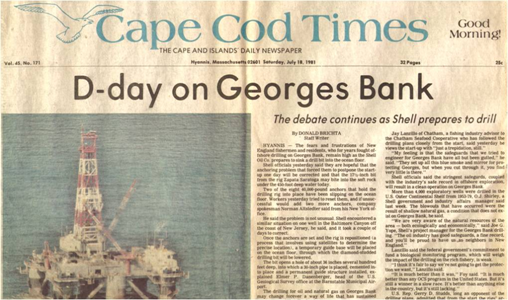
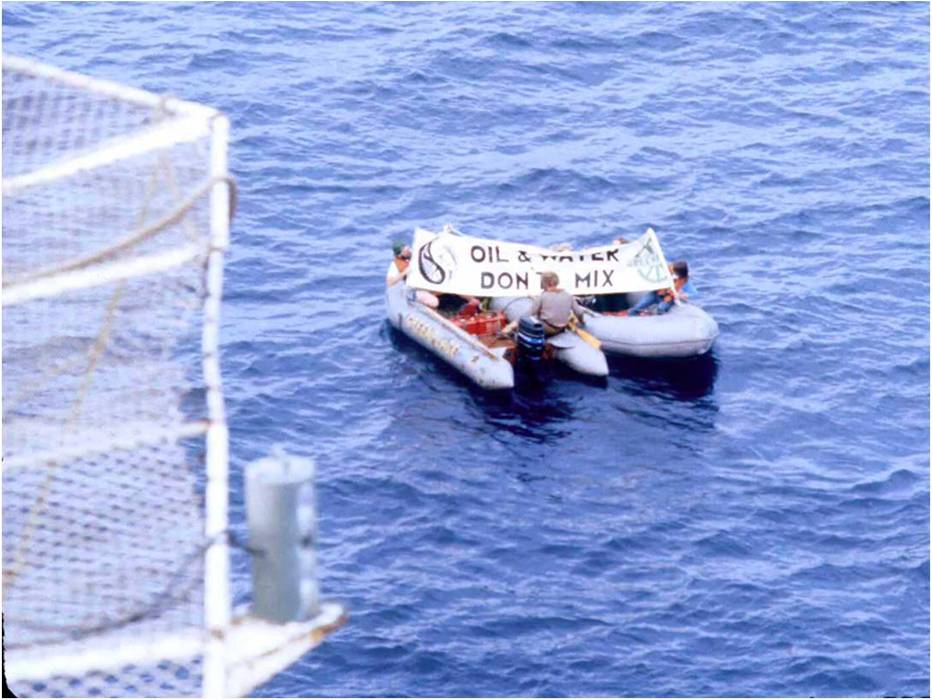
The protesters pictured above were dispatched to the Zapata Saratoga drilling rig from the Greenpeace vessel Rainbow Warrior. Given the remote location, the protest was unexpected. However, the drilling operation was not disrupted and no action was taken against the protesters. Four years later, the Rainbow Warrior was bombed by French commandos while in port in Auckland, NZ prior to planned protests against French nuclear testing in the South Pacific. Sadly, one crew member was killed during this incident.

Below is a list of the exploratory wells that were drilled on Georges Bank. In addition, two off-structure geologic test wells were drilled in 1976 and 1977. None of the wells discovered commercially significant oil and gas resources. However, gas shows led to erroneous press reports such as the article below. In 2000, the Minerals Management Service (MMS) published a summary of the geologic findings.


Operator
Lease No.
Block/Well
Rig

___________

Water
Depth
(ft.)


_________


Lat/Long
Miles SE
Nantucket

____________


Onsite


__________


Spud

________


Offsite


_________


Well
Depth
(ft. )

________

Exxon
0170
133/1
Alaskan Star
22540°49’05”
67°56’03”
112
7/22/817/24/81 11/24/81 13,808

Shell
0218
410/1
410/1R
Saratoga
45240°34’24”
67°12’32”
155
7/10/81
8/8/81
7/24/81
8/10/81
8/8/81
3/31/82
875
15,043

Mobil
0200
312/1
Midland
26040°39’27”
67°45’55”
125
11/21/8112/8/816/27/8219,652

Exxon
0153
975/1
Alaskan Star
20941°00’24”
67°37’19”
125
11/24/8111/25/813/10/8214,313

Tenneco
0182
187/1
Alaskan Star
30040°46’15”
67°23’19”
140
3/10/823/12/828/22/8217,744

Shell
0210
357/1
Saratoga
26540°36’51”
67°44’41″1
128
4/2/824/14/829/27/8219,090

Conoco
0179
145/1
Aleutian Key
30040°49’59”
67°17’06”
145
5/9/825/13/828/25/8214,115

Mobil
0196
273/1
Midland
30240°41’04”
67°30’12”
140
6/28/826/30/829/13/8215,190
Excerpted from “Georges Bank Exploratory Drilling, 1981-1982” by EP Danenberger

Regulatory policy lessons from the Georges Bank experience:

  • Regulators with overlapping responsibilities function best as a joint authority, particularly at the field level.  While MOUs/MOAs tend to be primarily for the purpose of protecting regulatory turf, joint authorities focus on the specific mission and how the performance objectives they can best be achieved. Capt. Barry Eldridge had the foresight to co-locate a USCG Marine Safety Detachment, headed by Bob Pond, adjacent to the USGS office at Barnstable Municipal Airport.  This facilitated cooperative reviews, coordinated inspections, and joint exercises.  This collaboration led to the first ever unannounced offshore response drills.    Similar USCG/DOI organizational arrangements have proven effective in the Pacific and in the Gulf of Mexico, particularly for monitoring hurricane preparations and responses.
  • Strive to conduct regulatory functions at a single field office.  USGS had the foresight to assign exploration plan review, environmental assessment, and coordination with State government responsibilities to our district office.  As a result, our environmental specialists, geologists, engineers, and inspectors worked together, along with our State and Federal partners, from the initial planning to the decommissioning stages.  Positive working relations were developed and everyone was informed and involved.  A subsequent reorganization changed the structure of our office and led to greater control from Washington, which (unsurprisingly) was not helpful.  
  • Transparency may be a bit of a buzzword, but it’s critical to regulatory success.  Other than proprietary geologic information and well reports, we fully informed our regulatory partners about the status of activities, all incidents and near-misses, and any operational issues. Conveying news that is not-so-good, like the mooring failures that were experienced by 2 Georges Bank rigs, is part of the mission.
  • Those regulating the operations should be informed about and a part of the environmental monitoring programs. Our office worked closely with the Woods Hole and other scientist conducting the comprehensive Georges Bank Monitoring Program.  In support of Mike Bothner, USGS Woods Hole scientist, we tracked every drilling fluid additive, and verified the materials that were available on each rig.  Mike conducted a material balance on the barite and looked for chromium and other metals in sediments near the well sites. His outstanding work is summarized in this paper.  
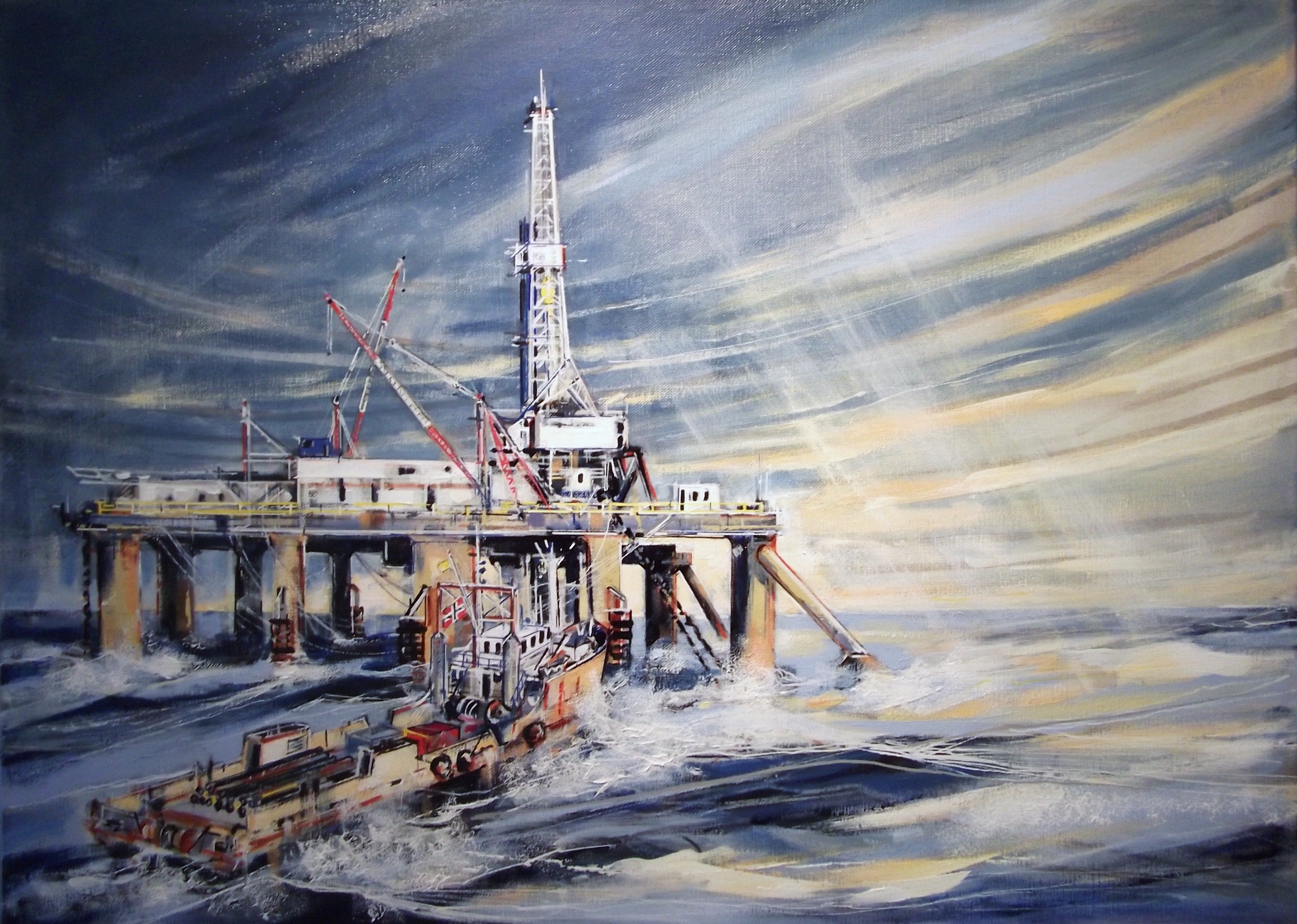
After a brief pause (only 10 years 😀), the BOE blog is set to return on 7/22/2021. In the meantime, I am sharing this outstanding painting by Jean-Louis Daeschler, a pioneering offshore engineer and a very accomplished artist. Click on the image to enlarge.

Painting by JL Daeschler. Sharing with his permission.

I didn’t know what to expect when I kicked off this independent blog 18 months ago. I wanted to share some fun stuff, most notably the “Not My Job Award” favorites and the long list of “rigs-to-reefs” spinoffs. The blog was also a good way to follow and comment on emerging offshore energy issues and events.

Things didn’t go quite as planned, and two major accidents shaped our commentary and discussion. During the early days of the blog, attention was focused on the Montara hearings.  Each day’s transcripts were posted within hours by the very efficient Montara Inquiry staff, so we were able to read the transcripts in the early morning hours (US eastern time). Our small band of Montara watchers commented daily on the events and received mention during the hearings.

Next came Macondo.  The tragic fire and explosion killed 11, and the pollution spectacular that followed was streamed live for a worldwide audience. While officials in the US and around the world were busy solving problems that had yet to be identified, true offshore safety leaders were closely monitoring the investigations to learn what happened and why. Unfortunately, important gaps in our understaning of the accident still remain.

In light of increased personal and professional commitments, I have decided to discontinue BOE.  The blog will be removed from the web on August 12th.  I want to thank those who have visited the blog. Surprisingly, our obscure site had lots of visitors in the US and around the world.

In particular, I would like to thank Odd Finnestad and Cheryl Anderson.  Odd is an expert on regulatory policy who helped shape Norway’s highly respected offshore safety program and has advised governments around the world about regulatory and safety issues. Odd has been an important contributor to BOE from the outset. Cheryl is the world’s leading authority on oil spill occurrence rates and causes, and has contributed numerous entries to the blog.

I also want to thank JL Daeschler, a pioneering subsea engineer, for his insights and commentary. In addition to being an outstanding engineer, JL is a very talented artists whose works are now on display at prestigious galleries in Edinburgh, Scotland.  In you visit that wonderful city, make sure you view some of JL’s artwork.  There are others who have made major contributions to BOE, but have chosen to remain anonymous.  You know who you are; thank you for the support!

For good coverage of offshore safety issues, I encourage you to monitor Platts, Upstream, Fuel Fix, and Nola.com.  I hope these or other professional sites develop tracking systems for offshore accidents and hold operators and regulators accountable for publishing updates and reports in a timely manner.  I will continue to push for improvements in the collection and reporting of incident data.

I also recommend that you monitor the regulators’ websites. The site of the Petroleum Safety Authority of Norway (psa.no) provides timely information, reports, risk assessments, and updates on activities in the Norwegian sector, and is an excellent example of what a safety regulator’s website should look like.

In closing, I want to say that I am very optimistic about the future of offshore oil and gas operations in the US and around the world. I continue to be amazed by the dedication, competence, and commitment of offshore energy professionals. Although we don’t agree on everything, we are all committed to safety and pollution prevention. We can’t change the past, but we can shape the future. The world needs offshore energy, and it’s our job to respond to the challenge.

Feel free to contact me at edanenberger@gmail.com if there are any matters you wish to discuss.

Offshore to the future!

Bud

Phil Rae piece in Fuel Fix

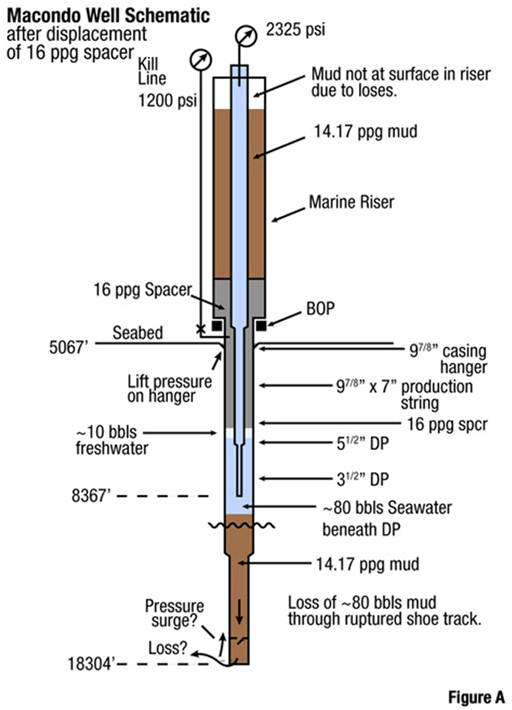
  1. The well clearly had losses through the shoe during the initial displacement of the heavy spacer with seawater, immediately prior to the negative test.
  2. Allowing for, and accepting, losses of ~80 bbls during spacer displacement, explains ALL pressure and flow anomalies without the need to create or invoke undocumented and unsubstantiated valve closures or manipulations that contradict witness testimony of events. It also eliminates the need to adopt unrealistically-low pump efficiencies for the rig pumps, hypothetical washed-out tubing and ridiculously high viscosities for the drilling mud, in an effort to fit questionable computer models.
  3. Despite extensive examination by investigators and the publication of several reports, the fact that the well experienced losses, making it even more severely underbalanced than was planned, has been given little credence or has received little or no attention, despite several clear indications that this was the case. While this statement regarding losses may be self-evident, its significance on the outcome at Macondo merits closer examination since it explains many previous, apparently-contradictory aspects of the disaster.
  4. Under-displacement of heavyweight spacer, as a result of losses during displacement, caused U-tubing and partial evacuation of the kill line, the lower end of which was later refilled with heavyweight spacer, driven by pressure and flow from the formation. The vacuum, initially, and subsequent invasion of heavy fluid rendered the kill line useless for monitoring the well since the line was effectively blind to pressure changes in the well.
  5. While initial flow into the well was through the shoe, pressure above the casing hanger seal during the negative test was reduced to levels that could have allowed the casing to lift, compromising the seal and possibly also allowing flow from the external annulus.
  6. The well encountered further losses during the second displacement (to displace the riser), after completion of the negative test. These losses, which were perhaps as much as 200 bbls, effectively replaced heavy mud with sea water in the casing below the drill pipe. This further underbalanced the well to the point that it was being kept under control only by pumping friction pressure. As the pump rate was reduced prior to shut down for the sheen test, effectively reducing system backpressure, the now severely underbalanced well began to flow.


oil-eating bacteria

Woods Hole Oceanographic Institute scientists have published important new findings on the rapid bacterial degradation of the Macondo spill.

They found that bacterial microbes inside the slick degraded the oil at a rate five times faster than microbes outside the slick—accounting in large part for the disappearance of the slick some three weeks after Deepwater Horizon’s Macondo well was shut off.


Cheryl Anderson forwarded this interesting Anchorage Daily News update on hydrate production research and linked information about the specific Department of Energy research projects.

The methane – carbon dioxide exchange project is particularly interesting and is summarized nicely by the Daily News:

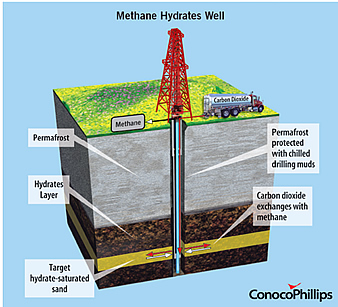
Conoco Phillips will try injecting carbon dioxide into the hydrate. Laboratory tests show that injecting carbon dioxide displaces methane, which comes out of the hydrate as a gas. The idea is that the carbon dioxide molecules take the place of the methane molecules in the hydrate, keeping it stable.

This could be neat, if it works. Carbon dioxide would be permanently sequestered, or stored, underground, while the methane is extracted and the hydrate is left intact.

One question the Conoco Phillips production test will attempt to answer is whether this reaction in the hydrate can occur fast enough for methane production to reach practical volumes.

The comment below is an understatement, but the enormous energy potential justifies the research.
This isn’t a slam dunk, though. The technical challenges are considerable.

Dauphin Island tarballs, May 2011

Cheryl’s update after reviewing the latest reports:

  • There is a USCG unified command specific to BP spill residue after storms.
  • The tarballs are not considered toxic, just an unattractive nuisance.
  • Tarball cleanup on Dauphin Island was halted on May 1 to protect nesting birds.
  • BP estimates a total Macondo spill volume of about 4 million bbl as opposed to the government estimate of 4.9 million bbl.
  • BP estimates that 850,000 barrels were captured, burned or skimmed off the water.
  • 1,260 people remain employed in spill cleanup as of [July 14, 2011], down from a peak of 48,200 a year ago

Articles of interest:

Alabama.com

WALA New Orleans

Bloomberg Business Week 

Much ado about nothing courtesy of the Associated Press:

Copies of the forms submitted by more than 100 inspectors, engineers and permit reviewers in five Gulf coast offices were obtained by the AP under the Freedom of Information Act. Personal information, such as the names of the employees, their friends and their family members, was blacked out to protect privacy. But the companies with ties to government workers were disclosed, and they represent a who’s who of the offshore oil and gas industry, from majors like Chevron, Shell and BP to smaller companies such as W&T Offshore Inc., Ankor Energy LLC and Hilcorp Energy Co.

So yesterday we linked an article about proposed legislation that would, among other things, require that offshore inspectors have “at least three years experience in the oil and natural gas field.” Today, we read contradictory (and silly) comments like the one below in the AP piece that criticize such experience. How would you like to be an oil and gas inspector or prospective offshore regulator?

“It’s nearly impossible to determine where the oil industry ends and the government’s regulatory agency begins,” said Scott Amey of the Project on Government Oversight, after reviewing AP’s data. “These new instances indicate that BOEMRE staff are connected to individuals and oil companies, which raises concerns about lax oversight and the integrity of the agency. Without enhanced enforcement authority and independent oversight of these potential conflicts, I’m uncertain that BOEMRE can assure the public that it is truly watchdogging the offshore oil industry.”

Give these people a break. I have seen absolutely no evidence that improper government-industry relationships or compromised inspections had anything to do with the Macondo blowout or any other recent incident. Inspection and engineering personnel are under continuous scrutiny well beyond what most employees would accept, and recuse themselves from assignments if there could be even a perception of a conflict of interest.

The US offshore program, and every other safety regulator, needs people who understand the operations and technology that they regulate. These regulators need to communicate regularly with industry personnel on operational and regulatory issues. Too little interaction with their professional peers is a greater danger than too much. You don’t advance safety technology and procedures, and resolve concerns, without communication.

DOI offshore personnel have had and will continue to have more than enough oversight; time to move on to another cause.

We now have yet another legislative proposal, this time from the House, that fails to address the fundamental offshore safety and regulatory policy issues.

Very interesting findings for those interested in the fate of spilled oil:

The deep sea entrainment of water-soluble hydrocarbons has far-reaching implications for deep water oil spills. Our results demonstrate that most of the C1-C3 hydrocarbons and a significant fraction of water-soluble aromatic compounds were retained in the deep water column, whereas relatively insoluble petroleum components were predominantly transported to the sea surface or deposited on the seafloor, although the relative proportions are not known.

The resulting apportionments of hydrocarbon transfers to the water column and atmosphere are therefore very different for a deep water oil spill versus a sea-surface oil spill. During seasurface oil spills, highly water-soluble components such as BTEX, C3-benzenes, and naphthalene quickly volatilize and are rapidly lost to the atmosphere within hours to days, thereby limiting the extent of aqueous dissolution into the water column. In the case of the Deepwater Horizon oil spill, however, gas and oil experienced a significant residence time in the water column with no opportunity for the release of volatile species to the atmosphere. Hence, water-soluble petroleum compounds dissolved into the water column to a much greater extent than is typically observed for surface spills.