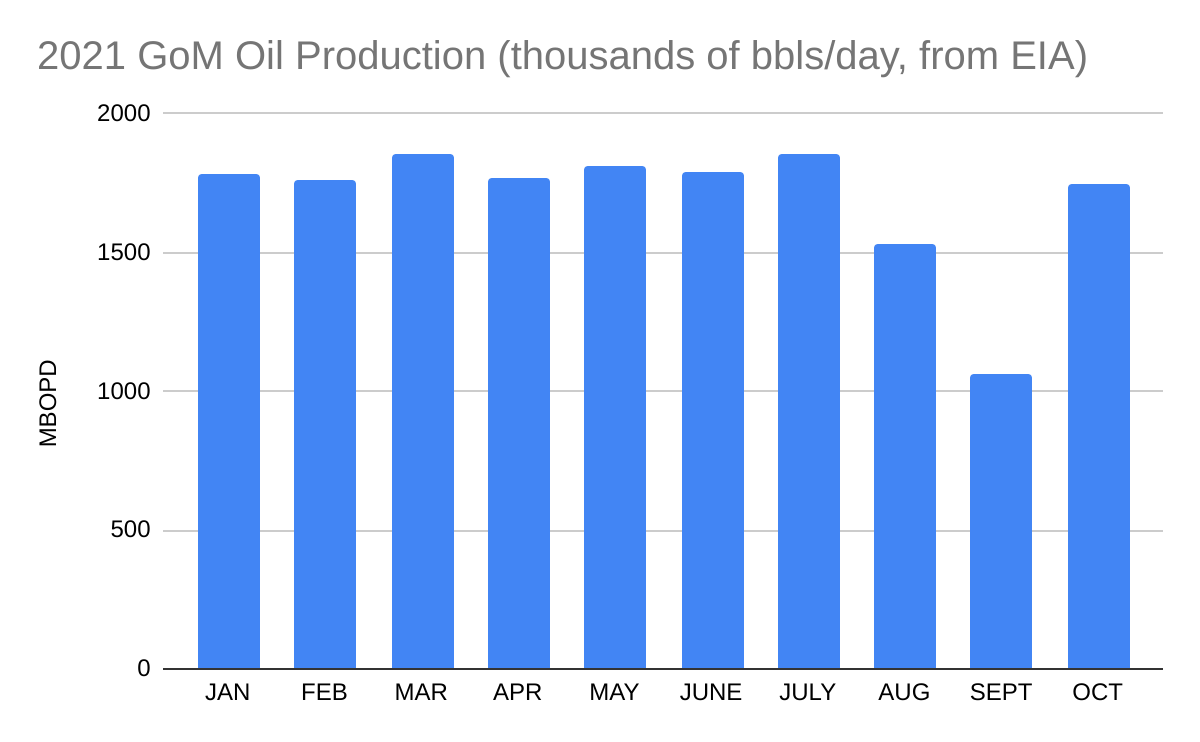
October production rebounded to 1.744 million BOPD from the 2021 low of 1.064 million BOPD in September (Hurricane Ida). November and December production should exceed 1.8 million BOPD.
October production rebounded to 1.744 million BOPD from the 2021 low of 1.064 million BOPD in September (Hurricane Ida). November and December production should exceed 1.8 million BOPD.
Posted in Gulf of Mexico, hurricanes, Offshore Energy - General, oil | Tagged Gulf of Mexico, Hurricane Ida, October, production | Leave a Comment »
As we enter 2022, BOE salutes the outstanding Minerals Management Service (MMS) professionals who retired from the successor bureaus in 2021:
With very few exceptions, the career staff in the US offshore program are highly competent and dedicated to their safety, environmental, and resource management missions. I have also found this to be true for the professionals occupying similar positions elsewhere in the offshore world. Cultures, legislation, policies, and practices differ, but the objectives and commitment are similar.
Posted in Offshore Energy - General, Uncategorized | Tagged offshore safety regulators | Leave a Comment »
I’m sharing this photo of the masterpiece Rig at Sunset. Next year, BOE will explore the painting’s symbolism and cultural significance.
May the glow of Rig at Sunset guide, comfort, and inspire you in 2022! 😃

Posted in offshore, Offshore Energy - General, Uncategorized | Tagged Happy New Year 2022, masterpiece, Rig at Sunset | 2 Comments »
Quite a bit per the GAO, and their report only deals with DOE management of demonstration projects. The Infrastructure Bill authorizes $2.5 billion for commercial projects (and much more for other CCS purposes).
DOE provided nearly $684 million to eight coal projects, resulting in one operational facility. Three projects were withdrawn—two prior to receiving funding—and one was built and entered operations, but halted operations in 2020 due to changing economic conditions. DOE terminated funding agreements with the other four projects prior to construction.
DOE provided approximately $438 million to three projects designed to capture and store carbon from industrial facilities, two of which were constructed and entered operations. The third project was withdrawn when the facility onto which the project was to be incorporated was canceled.
GAO
So DOE’s actual success ratio was 0.182 (2 for 11) – not very compelling.
With regard to proposals for offshore carbon sequestration, who will be liable for future cost overruns, operating losses, infrastructure failures including pipeline and well leaks, and decommissioning costs? Who ensures that there will never be any leakage from CO2 disposal reservoirs? Does all of this fall on the Federal government?
Corporations that want to engage in carbon sequestration for commercial or other purposes should fund the projects with their own revenues or fees charged to the companies whose emissions they are collecting. The Outer Continental Shelf is publicly owned and those wishing to dispose of substances should pay a usage fee, be responsible for all costs, and be liable for pollution and damages.
Posted in CCS, climate, decommissioning, energy policy, Gulf of Mexico | Tagged CCS, DOE, GAO, infrastructure bill | Leave a Comment »
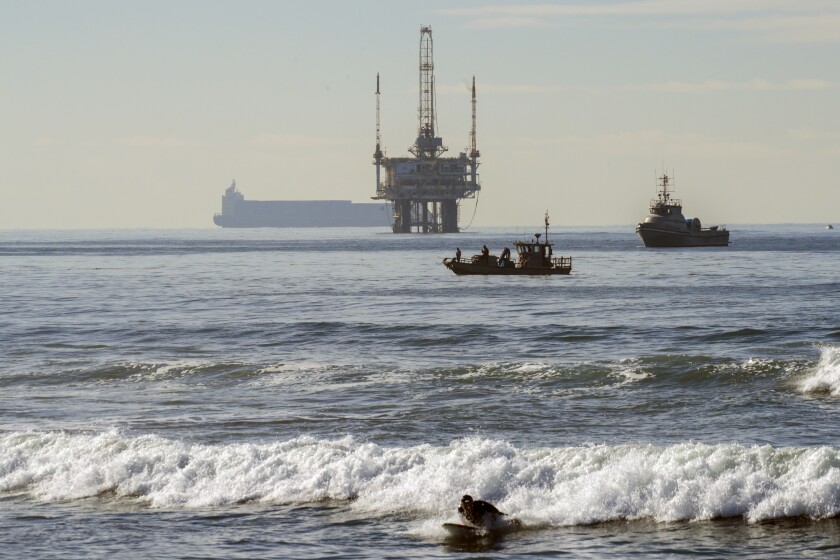

Per the LA Times, a DCOR pipeline has been identified as the source of a sheen in California State waters near Bolsa Chica State Beach. The pipeline transports oil from Platform Eva. All platform and pipeline operations in the vicinity have ceased.
Posted in California, Offshore Energy - General, pipelines | Tagged California, pipeline spill, Platform Eva | 2 Comments »
Taylor Energy’s Mississippi Canyon Block 20 “A” platform was destroyed by a massive mudslide during Hurricane Ivan in 2004 (see illustrations below). Per Naval Research Laboratory sensors, “Ivan the Terrible” generated freak waves as high as 91 feet, and NRL computer models suggest that wave heights may have exceeded 130 feet. The changes in pressure resulting from the motion of the huge waves triggered the flow of the unstable Mississippi delta sediments. The platform was swept 500 feet downslope and the wells were severed and buried under a deep layer of sediment. That was essentially the end for Taylor Energy, as the company would spend the next 17 years locating and plugging wells, decommissioning piping, collecting seepage, and mitigating pollution. Since 2008, when Taylor sold its remaining oil and gas assets, the company has been solely engaged in the MC-20 response.
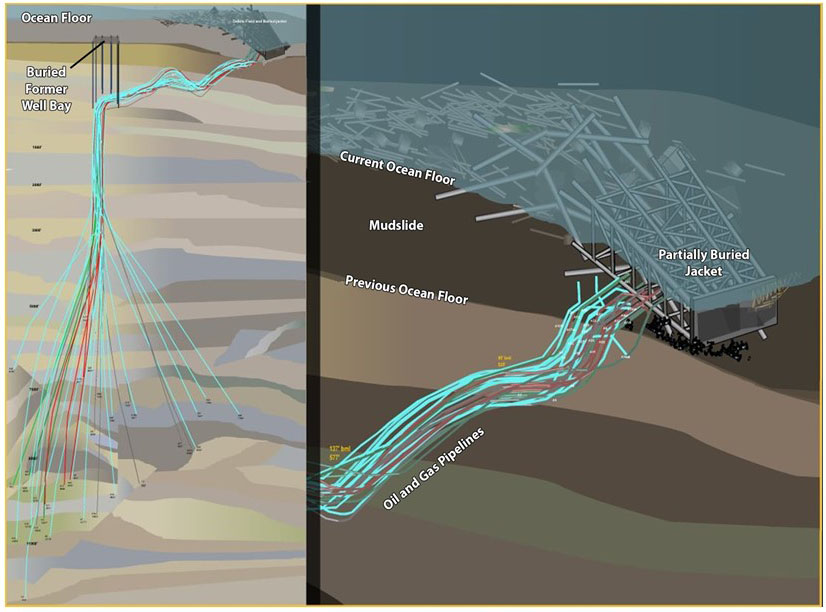
Last week, Taylor and the Justice Department signed a consent degree that transfers the company’s remaining assets and control of the decommissioning trust fund to the Federal government. Questions remain as to whether the platform and wells could have been better designed to withstand the mudslide (note that the platform was installed and operated by BP prior to being sold to Taylor), and whether more should have been done to mitigate the seepage. Taylor does a good job of making its case at their response website.
Few offshore operators would argue that what happened to Taylor couldn’t happen to them. That would be brash and foolish. Hopefully, the companies that remain have absorbed the lessons of MC-20 and are applying them to their operations and management programs.
Posted in accidents, decommissioning, Gulf of Mexico, Offshore Energy - General | Tagged consent decree, Hurricane Ivan, Mississippi Canyon, mudslide, Taylor Energy | Leave a Comment »
Posted in Uncategorized | Leave a Comment »
An old offshore platform in the U.S. Gulf of Mexico is set to be converted into a working fish farm, creating a blueprint for future aquaculture re-use projects and providing repurposing options for old oil and gas assets.
offshore-energy.biz

Congratulations to the Gulf Offshore Research Institute (GORI) and Innovasea on their plans to transform an offshore Texas gas platform into a working fish farm.
For the complete list of alternative uses for offshore oil and gas platforms, see our Rigs-to-Reefs+++ page.
Posted in decommissioning, energy policy, Gulf of Mexico, Offshore Energy - General, rigs-to-reefs | Tagged aquaculture, GORI, Innovasea, rigs-to-reefs, rigs-to-roe | Leave a Comment »

Posted in Offshore Energy - General, Uncategorized | Tagged Northern Lights, Norway, offshore platform | Leave a Comment »
At the behest of Congress, coastal areas and beaches are now designated as Unusually Sensitive Areas (USAs). Given that any offshore liquids pipeline has the potential to affect coastal waters or beaches, the rule would seem to require that all such pipelines be included in Integrity Management Programs, which are mandatory for pipelines that could affect USAs. (The IMP requirements would almost certainly apply to all DOT regulated offshore pipelines. Their applicability to DOI/producer pipelines is less certain. Of course, very little is clear and consistent in US offshore pipeline regulation.)
As one would expect, the recent Huntington Beach pipeline spill is among the incidents cited in the justification for this regulation. More surprisingly, the Santa Barbara well blowout was also cited. This incident occurred 53 years ago, was the result of a reckless drilling program, and had nothing to do with production operations or pipelines.
As noted in a recent BOE post, the regulatory regime for offshore pipelines is badly in need of overhaul. DOT and DOI, with inconsistent jurisdictional boundaries, regulations, and approaches, have primary responsibility and multiple regulatory entities have roles.
Lastly, PHMSA seems to have inadvertently posted a highlighted copy of the new regulation. Nothing at all scandalous (looks like someone was highlighting potential talking points), but possibly amusing to other regulation nerds. 😃
Posted in energy policy, pipelines, Regulation | Tagged IMP, PHMSA, pipelines, Regulation | Leave a Comment »


