Feeds:
Posts
Comments

Archive for the ‘Offshore Energy – General’ Category

Below and linked is the most recent C-NLOPB incident posting:

  • Timely
  • Front page
  • Advises about any casualties or pollution (none in this case)
  • Briefly describes incident without speculating on causes
  • Informs about next steps
  • Well done

INCIDENT DISCLOSURE 2022

NEAR MISS ON THE HIBERNIA PLATFORM

March 25, 2022

Hibernia Management and Development Company (HMDC) has reported that on March 20, 2022 a crane on the Hibernia Platform was lifting a mini container when it made contact with a scaffold hoarding. There were three people working inside the hoarding at the time of contact. No one was injured and there was no damage to the scaffold hoarding.

West pedestal crane operations were halted and HMDC has initiated an investigation to determine the potential classification of the incident.

C-NLOPB Safety Officers were already scheduled to travel to the Hibernia Platform in the coming days and will follow up with HMDC to review this incident and the near miss that occurred on March 15.

The C-NLOPB is also monitoring HMDC’s investigations of these incidents.
Read Full Post »

123 workers lost their lives in the North Sea.

Tiå går og di seie tiå lege adle sår
Men ein mista bror e sår som aldri gror
Kanskje vil dårr gå vinter og vår
Sei oss klart kor dokker står
Håpte på at han sko komma
At han sko komma hjem igjen

Time is gone, they said; time would heal all wounds
But to lose a brother is a wound that will never heal
It could take as long as the never-ending winter and spring [i.e., never]
I hope that he should come
That he should come home again

Excerpt from the Alexander L. Kielland (1980) Song

Read Full Post »

Read Full Post »

“I am deeply honored to join the Interior Department and continue my public service career on behalf of the American people. I’ve dedicated my life to keeping the public safe, and I look forward to continuing that service alongside the Bureau of Safety and Environmental Enforcement’s incredible career employees,” said Director Sligh.

DOI Press Release

Excellent opening comment. Best wishes to Director Sligh in this very important position. BSEE is critical to our economic future and energy security.

Read Full Post »

Shell Vit0
Chevron Anchor
BP’s Argos
Murphy’s King’s Quay

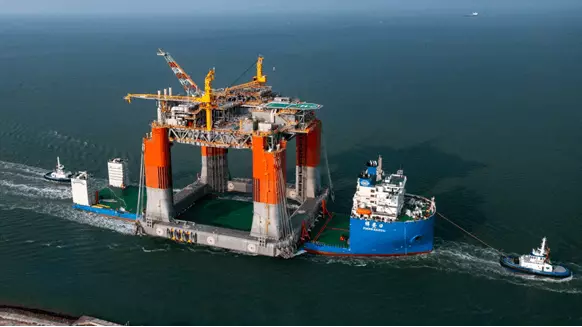
After a several year lag in deepwater Gulf of Mexico development, a new generation of projects is moving toward first production. Shell’s Vito and Whale, BP’s Argos, Chevron’s Anchor, and Murphy’s King’s Quay are similar in many ways including the following:

  • Floating production units
  • Lighter, smaller semisubmersible designs
  • Excellent structural integrity and storm performance characteristics
  • Lower project costs, shorter cycle times
  • 4000 to 8600′ water depth
  • Subsea wells, small surface footprint
  • High production rates anticipated: 100,000 – 150,000 BOE/D
  • Standardized equipment
  • Energy efficient gas turbines
  • Advanced remote monitoring, fewer onboard staff
  • Simpler = safer (assuming equivalent well and production safety system integrity)
  • Limited number of wells + high production rates/well + efficient power generation and processing equipment + restricted flaring + pipeline transportation = low GHG intensity production

Read Full Post »

Read Full Post »

  • While the text of the announcement implies otherwise, the new name prioritizes the “transition” over concerns about energy supply, security, and reliability. In that regard, the timing seems questionable.
  • Why not the North Sea Energy Authority (NSEA) or UK Offshore Energy Authority (UKOEA)?
  • Will OPEC+ be impressed? Perhaps China will add a few coal-fired power plants in honor of the name change.
  • Dan Yergin understands that energy transitions are complicated. Quoting Yergin’s outstanding article in the Atlantic:

The term energy transition somehow sounds like it is a well-lubricated slide from one reality to another. In fact, it will be far more complex: Throughout history, energy transitions have been difficult, and this one is even more challenging than any previous shift.

The 19th century is known as the “century of coal,” but, as the technology scholar Vaclav Smil has noted, not until the beginning of the 20th century did coal actually overtake wood as the world’s No. 1 energy source. Moreover, past energy transitions have also been “energy additions”—one source atop another. Oil, discovered in 1859, did not surpass coal as the world’s primary energy source until the 1960s, yet today the world uses almost three times as much coal as it did in the ’60s.

Read Full Post »

“Norway cannot escape the unpleasant fact: this is a form of war profit”, daily paper Dagbladet wrote in an editorial. “While Ukraine is being destroyed, and most other countries are mainly feeling the negative effects of the war, such as higher energy prices, higher food prices and general inflation, we are making a gain”, it said.

thelocal.no

While such introspection is commendable, energy supply issues in Europe would be far worse were it not for Norway’s actions including:

Read Full Post »

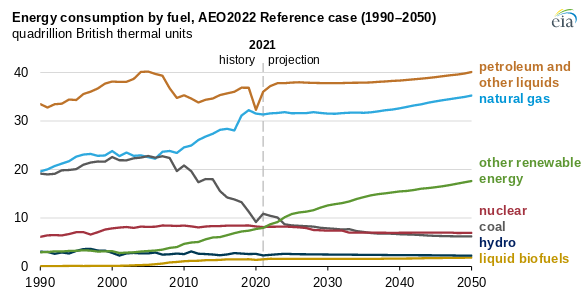
EIA

While demand will remain strong, supply is a concern:

“Capex cuts by international oil companies and national oil companies in 2020 was about 35%,” he said. “We’re now showing another 23% reduction in capex levels” from pre-pandemic levels this year. In 2019, E&P companies spent $525 billion, an amount which plummeted to $341 billion in 2021, he added. “We have to get back to $525 billion over several years until 2030 to restore market balance,” McMonigle said. “I’m afraid what we’re seeing with the energy crisis is on our doorstep.”

Joseph McMonigle, World Oil Congress

Read Full Post »

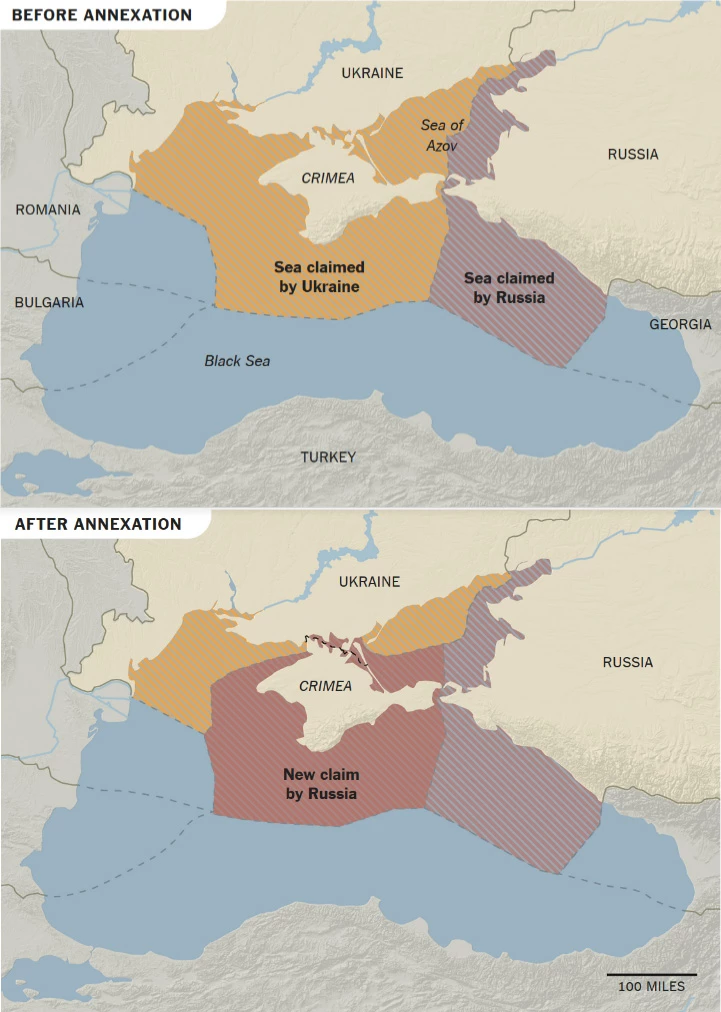
Per our previous post on this topic, the Ukranian shelf may contain more than 70 Tcf of natural gas, most of which was seized by Russia along with Crimea. This illegal seizure of resources in 2014 should be considered as part of any long-term settlement and before easing sanctions on Russia.

For those who want to learn more, this 2018 article by Ukranian journalist Kostiantyn Yanchenko has proven to be particularly insightful. A few key points:

when in 2014, two-thirds of the former Ukrainian water area passed to Russia with the occupation of Crimea, only a few experts assumed that the struggle for control over energy resources might have been among the main reasons for annexation. Against the background of Moscow’s famous explanation “Why Crimea? Be[cause]Kosovo!”, this version looked unconvincing, but there are many reasons to give it a second glance.

The naysayers often argue that Russia doesn’t have the technology to extract gas on the deep-water shelf. This is true, at least now. However, as researchers note, Russia’s short-term objective was not to benefit from the Black Sea gas but to block its production by the Western companies and hence secure its own positions in the European market. 

Furthermore, Russia largely relies on an energy leverage in international relations. Thus, “The Energy Strategy of Russian Federation Until 2020” starts with the statement: “Russia has significant reserves of energy resources and a powerful fuel and energy complex, which is the basis for economic development, an instrument for domestic and foreign policy.”

Read Full Post »

« Newer Posts - Older Posts »