Feeds:
Posts
Comments

Archive for the ‘Guyana’ Category

Linking a good article from our friends in Guyana.

Nestled on the northern tip of South America, the small nation of Guyana, now the fastest growing economy in the world, will become the continent’s second biggest oil producer by 2027.

OilNow Guyana

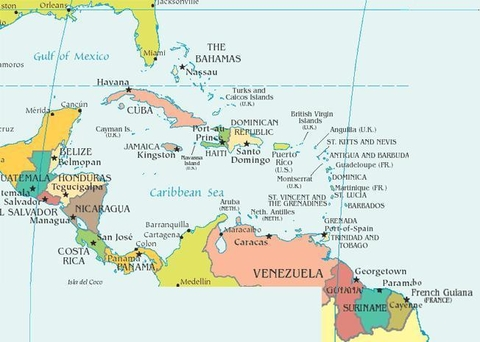
Neighboring countries in the Caribbean region including Jamaica, Barbados, and Grenada are taking notice. And then there is Venezuela ….

Read Full Post »

The first class of Petroleum Engineering graduates from the University of Guyana (UG photo posted by OilNow)

For more information about the UG Petroleum Engineering program.

Read Full Post »

The Metal Shark 115 Defiant patrol boat

Per our post about the threat from Venezuela, Guyana has acquired its ninth patrol boat.

The Metal Shark vessels are built in Franklin, Louisiana.

Chris Allard, chief executive officer of Metal Shark, said in August “We believe this formidable, American-made patrol craft will be a game-changer for regional security.

OilNow

Read Full Post »

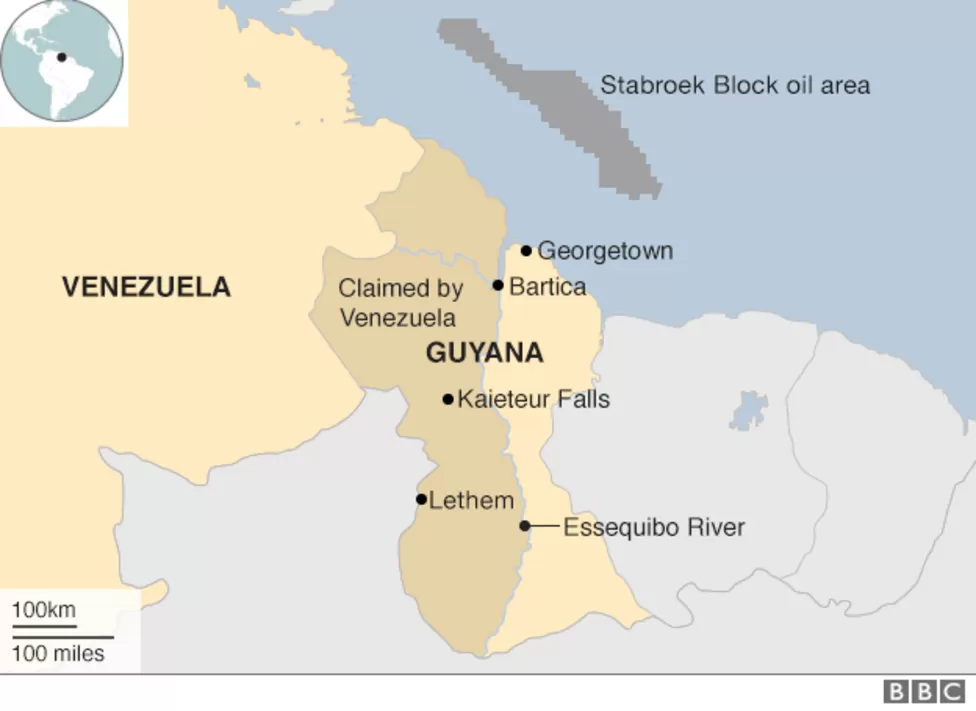
Having severely damaged their own oil industry, the government of Venezuela is intent on taking control of Guyana’s offshore resources. Venezuela seeks to annex 2/3 of Guyana and the adjacent offshore territory. The existing boundary was settled in accordance with international law in 1899.

Venezuela’s next step is to hold a referendum on assuming control of the contested territory. How thoughtful 🙄

“Question 5 proposes the creation of Venezuelan state of Guyana Essequibo and an accelerated plan for giving Venezuelan citizenship and identity cards to the Guyanese population.”

I suspect that very few Guyanese are interested in Venezuelan citizenship.

US statement:

Ambassador Brian A. Nichols, Assistant Secretary for Western Hemisphere Affairs at the U.S. Department of State, emphasized that “efforts to infringe upon Guyana’s sovereignty are unacceptable.”

Venezuela’s referendum is scheduled for December 3.

Read Full Post »

“Stampede,” Gulf of Mexico: Hess 25% owner and operator, Chevron 25% owner
  • Most importantly, both companies have excellent safety and compliance records as evidenced by their Honor Roll achievements.
  • Hess is an attractive company with impressive assets. Were there other suitors?
  • Chevron is currently a partner on the Stampede, Esox, and Tubular Bells deepwater projects that are operated by Hess. There is thus an established deepwater development relationship.
  • The acquisition of Hess means that Exxon and Chevron will now be partners in Guyana. That should be interesting.
  • Chevron’s CEO Mike Wirth is quoted as saying “We’ve got too many CEOs per BOE, so consolidation is natural.” That comment seems a bit self-serving, but makes sense from the perspective of an acquiring CEO. Employees of the companies being acquired may have a somewhat different view.
  • In the Gulf of Mexico, will the combined company be greater than the sum of the parts in terms of lease acquisition, exploration, and development?
  • Will combining the companies limit the diversity of geological assessments and exploration strategies?
  • Consolidation affects participation in workshops and on committees engaged in assessing technology and developing standards. More limited participation in these activities, which are critical to offshore safety, was a justified concern of my former boss, the late Carolita Kallaur.
  • Add Hess to the list of important offshore operators that, for all intents and purposes, no longer exist. This list includes (among others): Amoco, Arco, Texaco, Getty, Gulf, Unocal, Sun, Anadarko, BHP, Mobil, Phillips (or Conoco), Noble Energy, Pennzoil, Kerr-McGee, and Newfield.

Read Full Post »

OilNow photo: Dianna Persaud (left) and Kavita Singh

Per OilNow, Noble Corp. is awarding 4 scholarships to 4 students to attend Massachusetts Maritime Academy to earn degrees in Maritime Transportation or Maritime Engineering. The first 2 students are pictured above at Mass Maritime.

The selection process was highly competitive, as it should be, with more than 100 applicants.

The students will intern for Noble in the summers, and have positions with the company after graduation. This is a great opportunity for the students and a smart move by Noble.

(As an aside, my wife, whom I met during the exploratory drilling on Georges Bank in the 1980s, is a native Cape Codder, and her mother once taught at Mass Maritime. I’m sure the students from Guyana will do well there, and will adapt to the brisk Buzzards Bay winters 😀)

Massachusetts Maritime Academy

Read Full Post »

Good for Guyana and good for offshore energy!

In Guyana’s inaugural offshore licensing round, Sispro Inc. stands out as the only Guyanese company among the bidders. Located in South Cummingsburg, Georgetown, this indigenous start-up is a stand-out. So, who are the locals behind it?

Founded by four women – Dr. Melissa Varswyk, Abbigale Loncke-Watson, Dr. Ayodele Dalgety Dean, and Dee George, Sispro has leadership with diverse backgrounds in finance, health, education, energy, and human rights.

OilNow, Guyana

Interesting:

Out of the 14 bids made in Guyana’s inaugural offshore licensing round, Sispro was the only individual bidder, with others bidding as groups. 

And it looks like they have assembled a capable, mostly Guyanese, team.

Read Full Post »

OilNow, an informative and boldly named media outlet that covers the oil and gas sector in Guyana, reports that “the Guyana government expects crude oil exports this year to generate US$11.3326 billion in 2023, a 14% increase from the 2022 figure.

Of course, the 3 Stabroek Block partners who are responsible for this production – Exxon (45%), Hess (30%), and CNOOC (25%) – are also doing quite well. If you are wondering about this curious mix of companies – a US supermajor, a large US independent, and a state-owned Chinese mega-company – this OilNow post explains what happened.

Initially, Exxon and Shell were 50/50 partners in the Stabroek Block. Shell thought the chances for success were slim and opted out a year before the world class Liza discovery (ouch!). After Shell departed, Exxon sent “at least 35 letters” to prospective partners and only Hess and CNOOC responded favorably (actually, it was Nexen, not CNOOC that responded). The Liza discovery followed and the rest is history.

Will exploration offshore Jamaica and Barbados also prove successful? Stay tuned.

OilNow

Read Full Post »

Pangea
Quartz

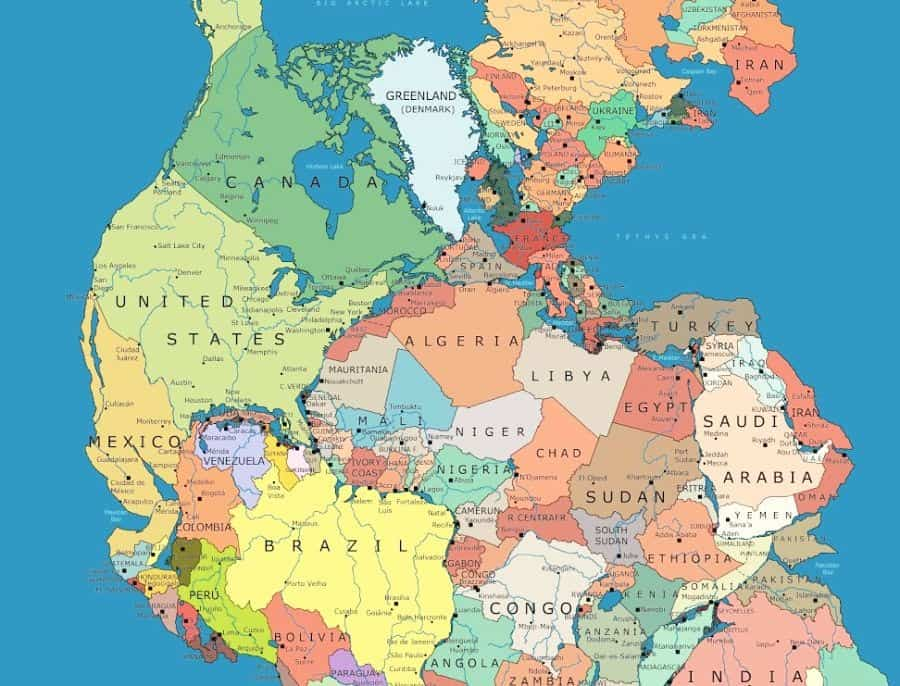
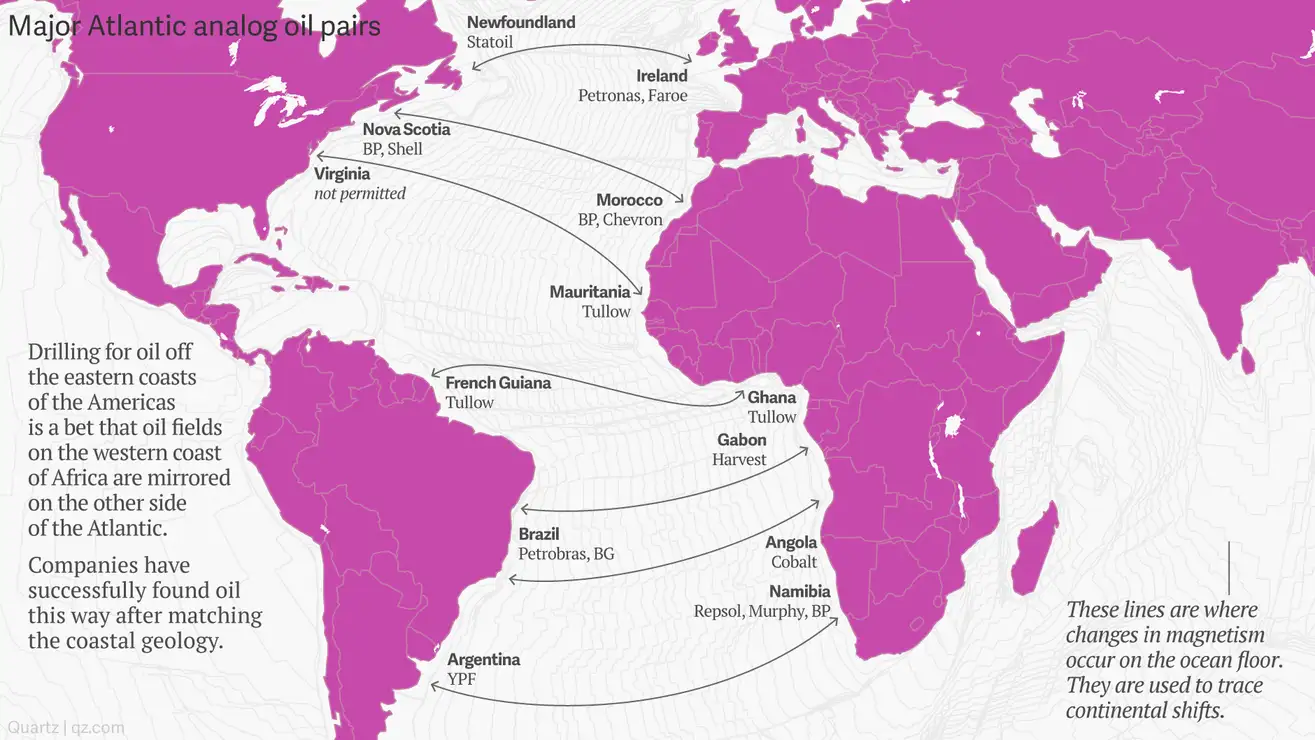
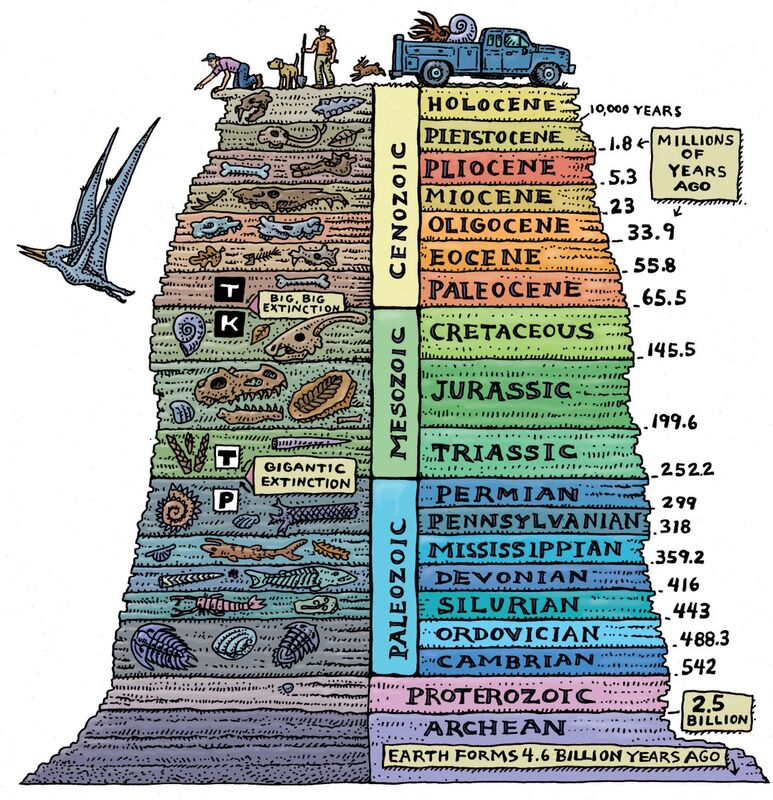
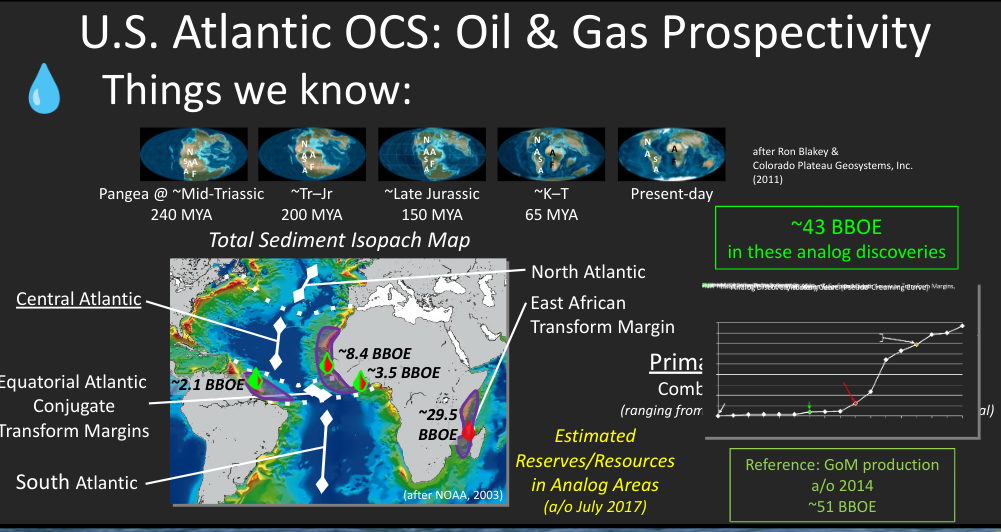
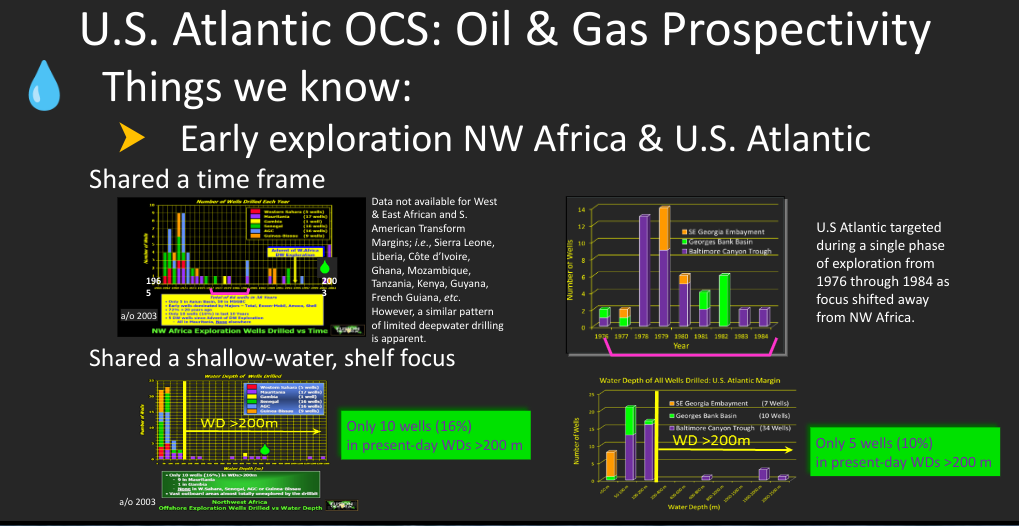
Until the late Triassic period, Virginia, the Carolinas, and Georgia were cojoined with Mauritania and Senegal as part of the Pangea super-continent. These Pangea neighbors share a common ancient geology.

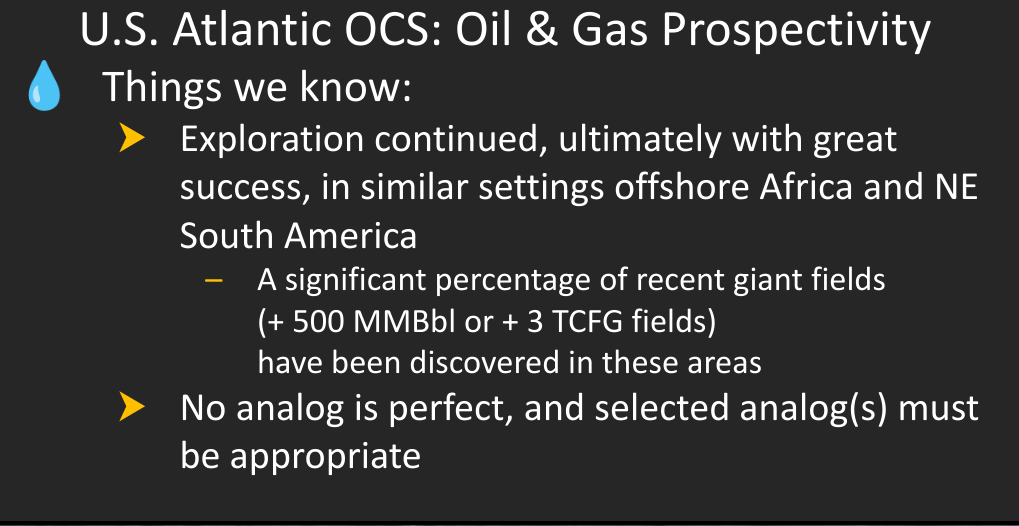
Paul Post believed the untested West African analogs in the US Atlantic were highly prospective, and could contain >20 billion BOE. Paul was not alone in his thinking about Atlantic resource potential. Sadly, Paul is no longer with us 😥, so I’m sharing a few of his slides as a reminder of his important work. I have also attached his 2016 report and am linking the 2021 update.

Given the current Atlantic moratoriums and the steep legal, social, and political barriers that would have to be cleared, evaluating the US Atlantic is not imminent. However, nearly all Atlantic nations and their Caribbean and North Sea cousins have exploration programs and some have been wildly successful. Oil and gas consumption will be stable or growing for the foreseeable future, and it’s important to better understand the petroleum potential of our Atlantic continental margin.

Read Full Post »

There are a number of recent articles related to the Guyana Supreme Court ruling on Exxon’s financial assurance obligations. An Oil Now piece (quoted below) is the most informative. It seems that the Supreme Court decision is based on a provision of Exxon’s EPA permit and that EPA is siding with Exxon in this dispute.

The Guyana government and the Environmental Protection Agency (EPA) are set to appeal a recent Guyana Supreme Court ruling that determined that the EPA and ExxonMobil affiliate, Esso Exploration and Production Guyana Limited (EEPGL), breached the terms of the Liza 1 environmental permit. The permit was revised and granted to EEPGL last year for operations in the Stabroek Block, offshore Guyana.

Justice Sandil Kissoon granted several declarations, including that the EPA failed to enforce compliance by EEPGL of its Financial Assurance obligations to provide an unlimited Parent Company Guarantee Agreement and/or Affiliate Company Guarantee Agreement to indemnify and keep indemnified the EPA and the Government of Guyana against all environmental obligations of the Permit Holder (EEPGL) and Co-Venturers (Hess and CNOOC) within the Stabroek Block.

While acknowledging the court’s ruling, the Government of Guyana, as a major stakeholder, maintained in a statement that the Environmental Permit imposes no obligation on the Permit Holder to provide an unlimited Parent Company Guarantee Agreement and/or Affiliate Company Guarantee Agreement. The government believes that Justice Kissoon erred in his findings and that the ruling could have significant economic and other impacts on the public interest and national development.

OIlNow

Unlimited liability is a rather daunting and open-ended obligation that would trouble permittees in any industry.

In the US, the liability for oil spill cleanup costs is unlimited for offshore facilities, but there is a liability cap for the resulting damages. That cap is currently $167.8 million after a recent inflation adjustment. BP, of course, paid far more than that for damages associated with the Macondo blowout. BP’s costs, which amounted to an astounding $61.6 billion, were both voluntary and compulsory as a result of agreements and settlements. Keep in mind that the damage liability limit was only $75 million at the time. One can imagine what would have happened if a company with less financial strength or more inclination to fight had been responsible for the spill.

Read Full Post »
« Newer Posts - Older Posts »