Feeds:
Posts
Comments

Archive for the ‘energy policy’ Category

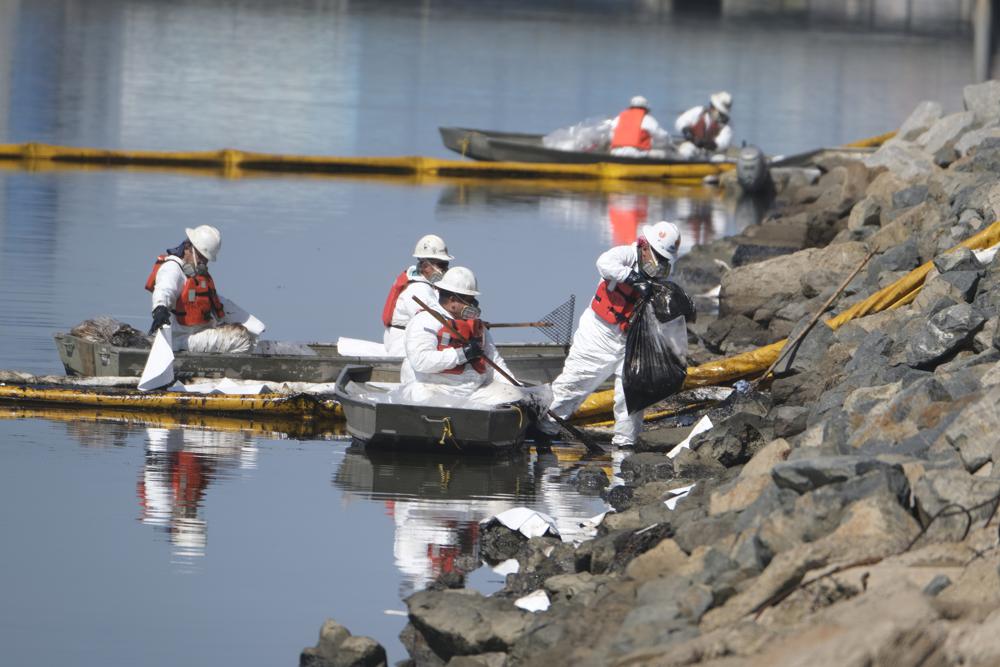
Cleanup contractors unload collected oil in plastic bags trying to stop further oil crude incursion into the Wetlands Talbert Marsh in Huntington Beach, Calif., Sunday, Oct. 3, 2021. One of the largest oil spills in recent Southern California history fouled popular beaches and killed wildlife while crews scrambled Sunday to contain the crude before it spread further into protected wetlands. (AP Photo/Ringo H.W. Chiu)
AP Photo/Ringo H.W. Chiu
  • Large, sudden pipeline spills are usually caused by external impacts (e.g. anchor dragging). If that was not the case, the spill was presumably caused by significant, undetected corrosion.
  • The internal (smart pig) and external inspection history of the pipeline will be an important part of the investigation.
  • Another important consideration is the extent to which pressure and volumetric monitoring systems were in place and functioning. Early reports imply that the leak was not discovered until the slick was observed on the water surface.
  • An excellent 2008 case study details the challenges that were experienced in internally inspecting this pipeline. This presentation provides good background information on the pipeline and the initial internal inspection efforts.
  • Why isn’t BSEE, the Federal bureau that inspects the Beta Unit facilities and approves the spill response plan, part of the Unified Command? BSEE is also a leader in spill response research.
  • Per the Unified Command, 1218 gallons of oil-water mix were recovered as of Sunday. This is pretty minimal – only 29 barrels (including water) and <1% of the estimated spill volume, but is not atypical for mechanical spill response operations. It may also be that the 3000 bbl spill estimate was overly conservative (i.e. high).
  • Also per the Unified Command: “One oiled Ruddy duck has been collected and is receiving veterinary care. Other reports of oiled wildlife are being investigated.” If this was the extent of wildlife impacts as of Sunday, some of the reporting on this spill has been hyperbolic.
  • A comprehensive review of the balkanized regulatory regime for offshore pipelines is long overdue, as is an update to Federal pipeline regulations.
  • This spill, Hurricane Ida, and offshore COVID issues have further demonstrated the importance of BSEE. Why has the Administration still not appointed a BSEE Director? Keep in mind that this appointment does not require Senate confirmation.

Read Full Post »

The House Oversight Committee has requested that executives from Exxon, Shell, Chevron, BP, and testify on October 28th.

“We are deeply concerned that the fossil fuel industry has reaped massive profits for decades while contributing to climate change that is devastating American communities, costing taxpayers billions of dollars and ravaging the natural world,” Oversight Chairwoman Carolyn Maloney, D-N.Y., and Rep. Ro Khanna, D-Calif., wrote in a letter to oil executives.

House Oversight Committee

Expect moral outrage, sloganeering, and finger pointing (the Washington salute). A link for viewing the hearing will be posted at the committee website.

Read Full Post »

I was saddened to learn that the National Academy of Sciences is selling the Jonsson Center in Woods Hole, MA. This amazing meeting and conference facility is at a great waterfront location at the epicenter of marine research on the Atlantic Coast. You can buy the estate for a mere $27.5 million and continue its use as a conference center serving the marine science and policy communities.

“I think the concern is this is a historically important location for science, from its long history with the institutions,” said Dr. Saito. “To see one of our science institutions pack up and leave is sad for the community. Also, the loss of that conference facility, which I think is a really valuable resource for not just the area but for US science, is a sad thing to see happen as well.”

Makoto Saito, WHOI

Read Full Post »

Election Results 2021: Norway Set for New Prime Minister - Life in Norway

While Conservative Party leader Erna Solberg will no longer be Prime Minister, her likely replacement, Labor leader Jonas Gahr Støre, seems to be a moderate on energy issues:

“I believe that calling time on our oil and gas industry is the wrong industrial policy and the wrong climate policy,” Stoere told reporters.

KFGO

Monday’s result means Labour neither needs the Marxist Red Party nor the anti-oil Green Party to rule, thus lessening the pressure for big shifts.

“Labour will not make any dramatic changes to the oil industry,” said Teodor Sveen-Nilsen, an energy analyst at Sparebank 1 Markets.

EuroNews

Read Full Post »

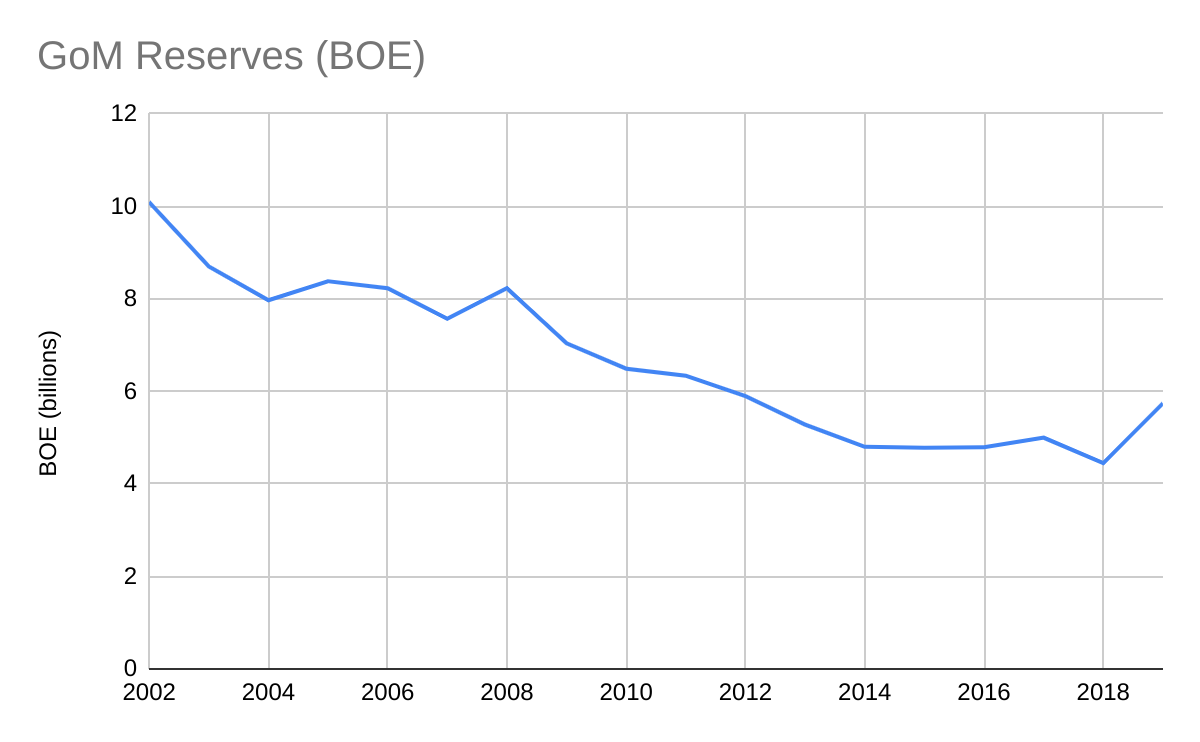
BOEM just released their update of Gulf of Mexico OCS oil and gas reserves as of 12/31/2019. Oil reserves increased by 35.2% as a result of 6 new fields being added.

The reserve additions are necessary and welcome given the high depletion rates from 2002 to 2018 when reserves (plotted above) declined steeply while production rates held steady or increased. The concerns about the sustainability of current GoM production rates, as expressed in our 7/26/2021 post, remain given the historically low levels of exploratory drilling. For the reasons presented in that post, our view is that the importance of GoM production will increase, not decrease, over the next decade.

Read Full Post »

The Department of the Interior (Interior) confirmed today that the Department of Justice (DOJ) has appealed the preliminary injunction entered by the district court in Louisiana v. Biden, which enjoined Interior from implementing the pause in new federal oil and gas leasing 

DOI statement 8/16/21

The day after the fall of Kabul and 5 days after the White House urged OPEC to increase production, DOI reiterated the Administration’s support for a pause in oil and gas leasing on Federal lands (including the OCS). Given the increased risk of long-term oil supply uncertainty, rigid support for a blanket leasing pause would not seem to be a prudent policy position at this time.

DOI argues that greenhouse gas (GHG) emissions must be curtailed, but reductions in domestic production would increase the demand for imports with higher GHG intensity. Reductions in deepwater Gulf of Mexico production, which has low GHG intensity and other environmental advantages (few dispersed facilities distant from shore), would be particularly detrimental. Of course, any public policies that discourage natural gas production would also have distinct air emissions costs.

If supply restrictions increase the price of oil, net reductions in oil consumption and GHGs could be achieved. However, as evidenced by the recent appeal for increased OPEC production, higher oil prices are not consistent with Administration policy.

Read Full Post »
« Newer Posts