But certainly, the supply and — and OPEC and putting additional pressure on OPEC is something that — that, certainly, our national security team will continue to do.
I will also note that, as it relates to gas prices, we remain concerned about trends we have seen where, even as supply has increased at times over the last several months, we’ve still seen heightened prices.
The FTC — we’ve asked the FTC to look into that. They’ve said they were doing that.
This decision is more about exercising political power than advancing our energy future, which is dependent on collaboration among all sectors of the energy industry.
Oil and gas producers are “banned,” but major energy consumers are welcome to support the conference.
The 3 oil companies mentioned in the article are major investors in offshore wind and other renewable energy projects. These companies have spent hundreds of millions of dollars to purchase US offshore wind leases and will spend much more on the projects that follow. They are also major investors in low carbon intensity offshore oil and gas production.
Does the US government, which (at taxpayers expense) is sending a very large delegation to COP26, support this type of discriminatory behavior toward major contributors to our economy?
While the delegates are attending the conference, the folks at home are seething about gasoline prices and inflation.
With regard to air emissions, the advantages of deepwater Gulf of Mexico production are rather obvious:
High production rates per well
Few surface facilities (57 deepwater platforms, 3% of GoM total, produce 90+% of oil)
Modern gas turbines for power generation
Tightly enforced restrictions on flaring and venting
Better control of fugitive emissions
Distant from shore (not a factor for GHG effects)
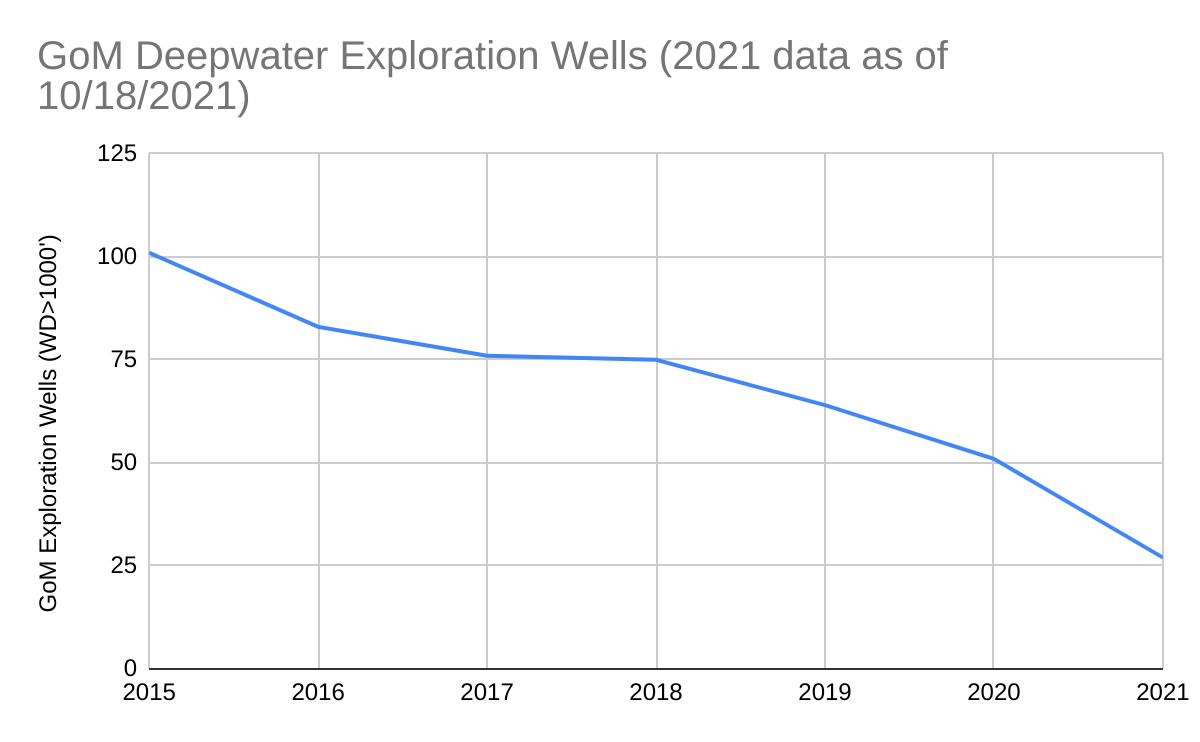
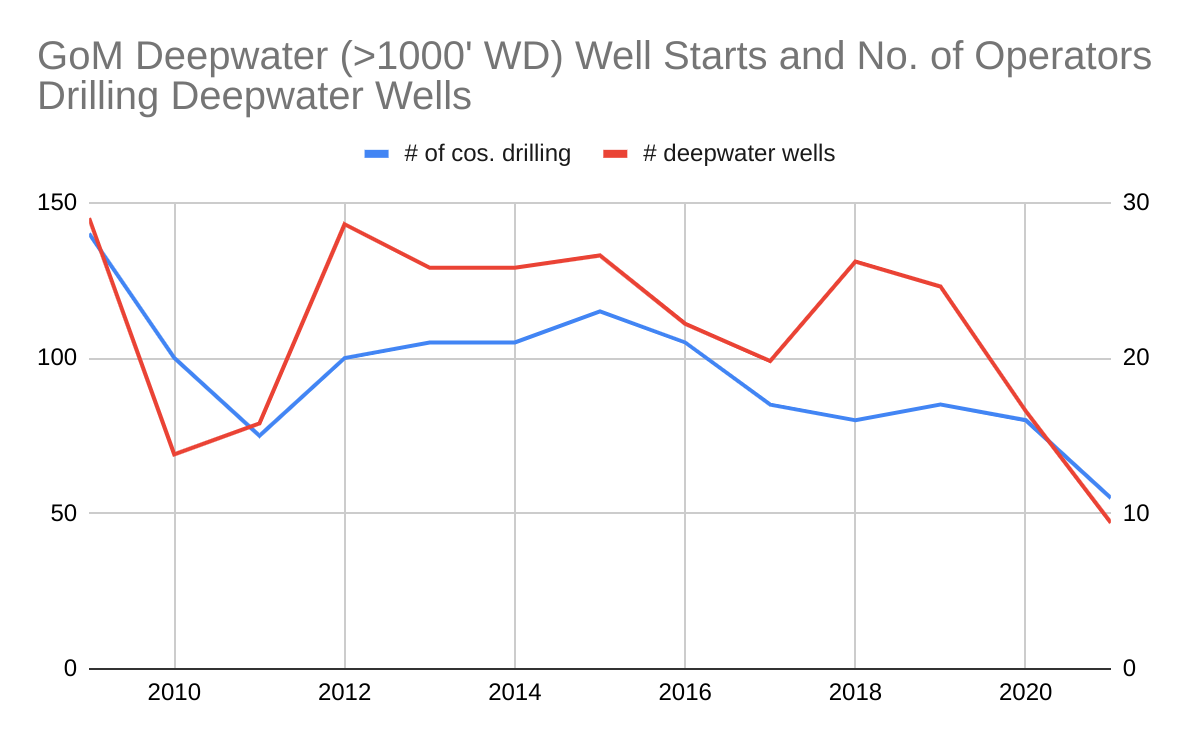
Wood Mackenzie, NOIA, and others contend that restrictions on GoM leasing are contrary to carbon reduction goals.
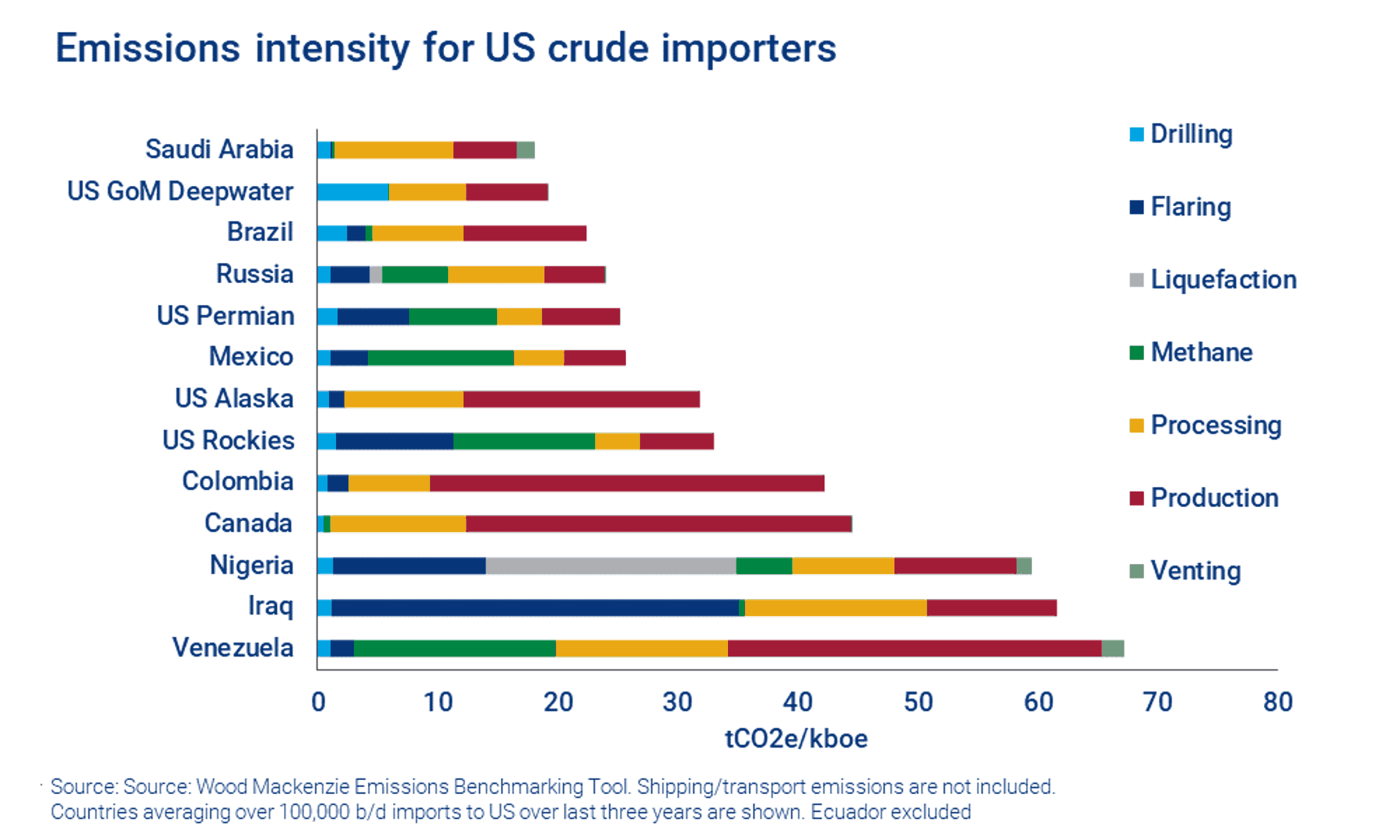
An important and unintended consequence of enacting more restrictive policies such as a lease ban or increase in royalty rate in the Gulf of Mexico is that it could give rise to carbon leakage to countries that export crude to US.
In light of the policy implications of GHG emissions, a Carbon Intensity Workshop is highly recommended. The estimates generated by Wood Mackenzie, Rystad, and others need to be explored in depth. Is data quality an issue? How are the data verified? Is there regulator or third party oversight? What are the assumptions behind the estimates? Also, for the purposes of US policy decisions, product transportation emissions should certainly be included. A barrel produced in the Middle East is not the same as a barrel produced in the GoM.
Looking at the chart above, I have immediate questions about the drilling emissions (blue). What wells are included? What about workovers and other well operations? I’m surprised that the deepwater GoM drilling emissions are so high relative to the other regions. While dynamically positioned MODUs have high fuel consumption rates, deepwater wells are few in number relative to shale drilling. Also, why are Brazil’s drilling emissions, which I assume are primarily associated with deepwater operations, so much lower that those for the GoM.
BOEM/BSEE and/or the Gulf Research Program (NASEM) would seem to be good sponsors for such a workshop.
Leading up to #COP26 convening in Glasgow next month, the OPEC SG advised legislators and policymakers to consider the fact that billions of people lack reliable and affordable modern energy, a basic need for all.
For those interested in regional and international oil market data, OPEC’s monthly reports are quite good. You can download the October report here.
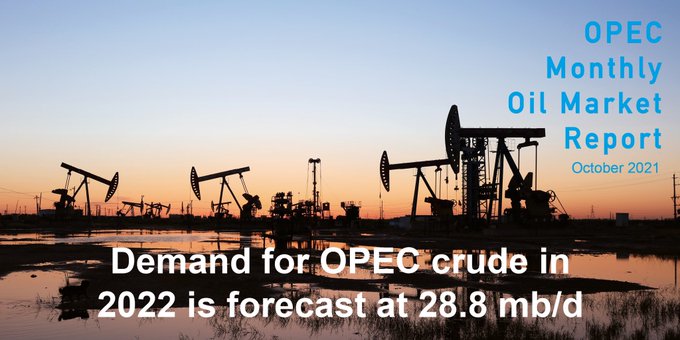
Demand for OPEC crude in 2022 was revised up by 0.1 mb/d from the previous month’s assessment to stand at 28.8 mb/d, around 1.0 mb/d higher than in 2021.
Overall Conclusion Currently, there are no regulations that require removal of subsea pipelines if they are not an obstruction to navigation. Based on the high costs for removing the pipelines, the personnel risk involved in the removal operations, the negative effect on overall emissions to air and the very limited reduction in discharges to sea, the overall conclusion is that it is better to leave the pipelines in place. If possible, re-use of the pipelines is the optimal solution.
Environmental Impacts The impacts on the environment and the marine environment from pipelines and cables left in place were found to be very minor. Conversely recovery operations will have a negative impact on the environment. The number of vessels required for removal operations and long operating hours will result in considerably more releases and emissions than leaving the pipelines in place. In addition the energy savings benefit from recycling the pipeline materials will be exceeded by the energy required to remove the pipelines and separate the materials.
The “Habitat” impacts row seems questionable. Pipeline removal certainly has a greater impact on habitat than abandonment in place, particularly for buried pipelines.
85% of pipeline incidents reported to PHMSA from 2002-2009 occurred irrespective of the age of the pipeline, with just 15% related in some way to the age of the pipeline.
The properties of the steels which comprise natural gas pipelines do not change with time; that is, pipe does not “wear out.”
The fitness of a pipeline for service does not necessarily expire at some point in time.
The integrity of those pipelines for which the fitness for service may degrade with the passage of time can be assessed periodically. Timely repairs – and other mitigation efforts – based on those assessments will ensure the pipeline’s continued fitness for service.
A well-maintained and periodically assessed pipeline can safely transport natural gas indefinitely.
Look at the US Dept. of Energy homepage and I think you’ll get a better sense of the imbalanced energy policies, in the US and elsewhere, that are contributing to the emerging energy crisis.
There isn’t a single mention of oil or natural gas on the Dept. of Energy homepage. DOE’s priorities are “Combating the Climate Crisis” (embellished with a satellite image of Hurricane Andrew), “Creating Clean Energy Union Jobs” (other energy jobs aren’t important?), and “Promoting Energy Justice.” With regard to the latter, how is driving up energy prices “energy justice?” How is importing more of the oil that we consume “energy justice.” Affordable energy has increased economic opportunities for all and enabled us to better protect our environment. In that regard, this Petr Beckmann slide holds true:
As the global economy recovers and global leaders prepare to gather for a landmark conference on climate change, the sudden energy crunch hitting the world is threatening already stressed supply chains, stirring geopolitical tensions and raising questions about whether the world is ready for the green energy revolution when it’s having trouble powering itself right now.
In the United States, which as an energy producer has been spared the worst consequences of the crisis even as gasoline prices have hit their highest mark since 2014, Energy Secretary Jennifer Granholm suggested Wednesday that the Biden administration might sell off part of the country’s Strategic Oil Reserve or ban exports of crude oil.
Energy analysts warned that such moves could be self-defeating, and on Thursday the department backpedaled.
Energy analysts argue that Europe moved too quickly away from fossil-fueled power, before ensuring that sufficient renewable sources could take up the slack in an emergency. Caught halfway in a transition that should take decades, they say, Europe is now scrambling to find coal and gas to burn in its remaining traditional plants.
In Guangdong, China’s most populous province, authorities have banned the use of elevators in office buildings for the third floor and below, encouraged residents to use natural light as much as possible, and asked for air conditioners to be adjusted to higher temperatures. Beijing and Shanghai canceled annual light shows during the Golden Week holiday that spanned the first week of October.




 Bud's Offshore Energy (BOE)