Feeds:
Posts
Comments

Archive for the ‘energy policy’ Category

OCS Lease Sale 259 was mandated by Congress, and was held on March 29, 2023, two days before the deadline established in the Inflation Reduction Act. Ah, but compliance with environmental law, which is of course subject to interpretation, was still required.

So the formula for eNGOs in such cases is to sue on NEPA grounds in a friendly Federal court. In the case of Sale 259, the plaintiffs asserted that BOEM’s climate change and Rice’s whale analyses were inadequate.

With regard to climate change, the reality is that incremental Gulf of America production will have virtually no effect on petroleum consumption and global GHG emissions. Increased GoA production will actually have a slight positive effect on worldwide GHG emissions given the relatively lower carbon intensity for deepwater Gulf production.

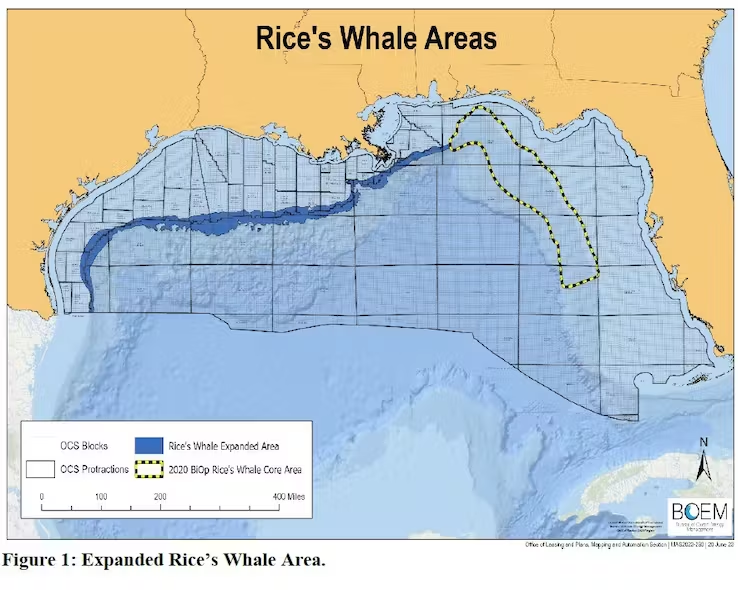
With regard to the Rice’s whale, Darren Ireland’s analysis is compelling:

Based on the limited data available on the use and occurrence of Rice’s whale in the central and northwestern GOMx (one acoustic study (Soldevilla et al. 2022b), one confirmed sighting (NMFS 2018a) and a few unconfirmed sightings (Rosel et al. 2021)), there is insufficient scientific evidence to determine that essential features for Rice’s whale conservation are indeed present in the central and northwestern GOMx. In fact, data on the life-history requirements of Rice’s whale even in the core habitat are still lacking and need further investigation.

Unsurprisingly, Judge Amit P. Mehta of the US District Court for the District of Columbia, has ruled that BOEM’s environmental assessments on climate change and the Rice’s whale were deficient, and has ordered the parties and intervenors to jointly submit a proposed briefing schedule by April 3, 2025. “The court will also order additional briefing on remedy” (e.g. onerous operating restrictions).

In case you haven’t suffered enough, the judge’s full opinion is attached.
Read Full Post »

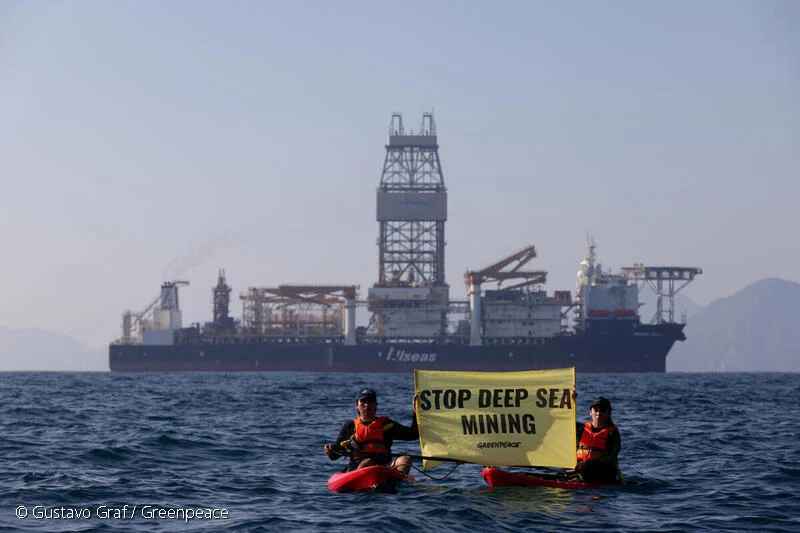
pictured:TMC pilot trials

Lars Herbst brought this bold and rather surprising deepsea mining development to my attention. Let the screaming begin!

NEW YORK, March 27, 2025 (GLOBE NEWSWIRE) (emphasis added) — TMC the metals company Inc. (Nasdaq: TMC) (“TMC” or the “Company”), an explorer of the world’s largest undeveloped resource of critical metals for building infrastructure, power generation, transmission, and batteries, today announced that its subsidiary The Metals Company USA LLC (“TMC USA”) has formally initiated a process with NOAA under the U.S. Department of Commerce to apply for exploration licenses and commercial recovery permits under existing U.S. legislation, the Deep Seabed Hard Mineral Resources Act of 1980 (DSHMRA).

Following extensive legal diligence on DSHMRA, NOAA’s implementing regulations and other applicable environmental protection legislation, the Company strongly believes that the U.S. seabed mining code offers the greatest probability of securing a permit for commercial recovery of deep-sea mineral resources in a timely manner.

Gerard Barron, Chairman & CEO of The Metals Company, commented: “Over the last decade, we’ve invested over half a billion dollars to understand and responsibly develop the nodule resource in our contract areas. We built the world’s largest environmental dataset on the CCZ, carefully designed and tested an offshore collection system that minimizes the environmental impacts and followed every step required by the International Seabed Authority. But, despite collaborating in good faith with the ISA for over a decade, it has not yet adopted the Regulations on the Exploitation of Mineral Resources in the Area in breach of its express treaty obligations under UNCLOS and the 1994 Agreement.

“We believe we have sufficient knowledge to get started and prove we can manage environmental risks. What we need is a regulator with a robust regulatory regime, and who is willing to give our application a fair hearing. That’s why we’ve formally initiated the process of applying for licenses and permits under the existing U.S. seabed mining code. After extensive legal review and constructive engagement with NOAA and other officials across the U.S. government, we believe the United States offers a stable, transparent, and enforceable regulatory path. TMC USA expects to submit applications to NOAA in the second quarter of 2025. We’re encouraged by the growing recognition in Washington that nodules represent a strategic opportunity for America—and we’re moving forward with urgency.”

Previous deepsea mining posts

Greenpeace photo

Read Full Post »

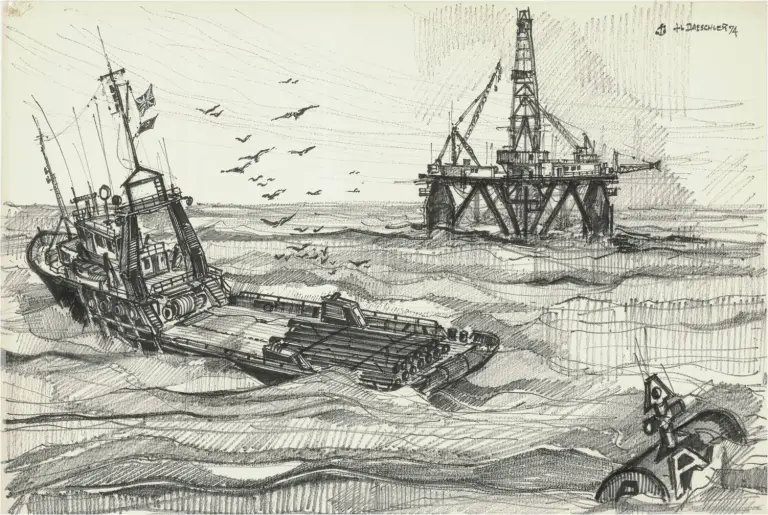
Waiting on Weather” by JL Daeschler

JL Daeschler, pioneering subsea engineer, outstanding artist, and BOE contributor, lives in Scotland. He shared these concerns about the state of the UK offshore industry:

Since projects have been shelved, contractors have left the country – so no drill rigs, no exploration, no pipelines, and no crane barges. The list of disciplines put out of work is far longer.
The big international operators have left looking for better opportunities overseas with milder environments and cheaper manpower support. Air travel, modern communication systems, and immediate electronic access to information and support facilitate operations anywhere in the world.
So what is left in the UK sector of the North Sea are the few installations running towards the end of production. Their years are numbered.
The North Sea could have had a sustainable greener and safer project profile if the momentum had been kept. It’s like an oil & gas pandemic, except you do not work from home if you operate rigs and vessels. No research, no strategy, and no money !!!

Read Full Post »

Scotsman letter

Industry sources tell us, authoritatively, that the North Sea could produce around half of all the oil and gas the UK will need up until at least 2050 – if new projects are developed. Meanwhile, as instead we shut down our existing wealth, China continues burning dirty coal and making us more dependent on their products.

As it stands, Offshore Energies UK (OEUK) says the UK is on track to produce just four billion of the 13-15bn barrels of oil and gas the country will need over the next 25 years.

It is time for those making decisions in London and Edinburgh to put away all the green zealotry nonsense and get the UK powerhouse moving again. Given 25 years they could make a good start on installing small, clean, nuclear plants dotted across the UK to help in great part to pick up the load.

We need planning, not zealotry. It is now even more clear the green emperor is not wearing clothes. When will Energy Secretary David Miliband be convinced?

Alexander Mckay

Edinburgh

And from an offshore worker @Deano9981:

As someone who actually works in the North Sea on oil rigs I have heard almost all my life how the oil and gas will be gone in 10 years. 35 years in this industry and the first time I am likely to be unemployed is because of the government. Not the end of oil fields.

Read Full Post »

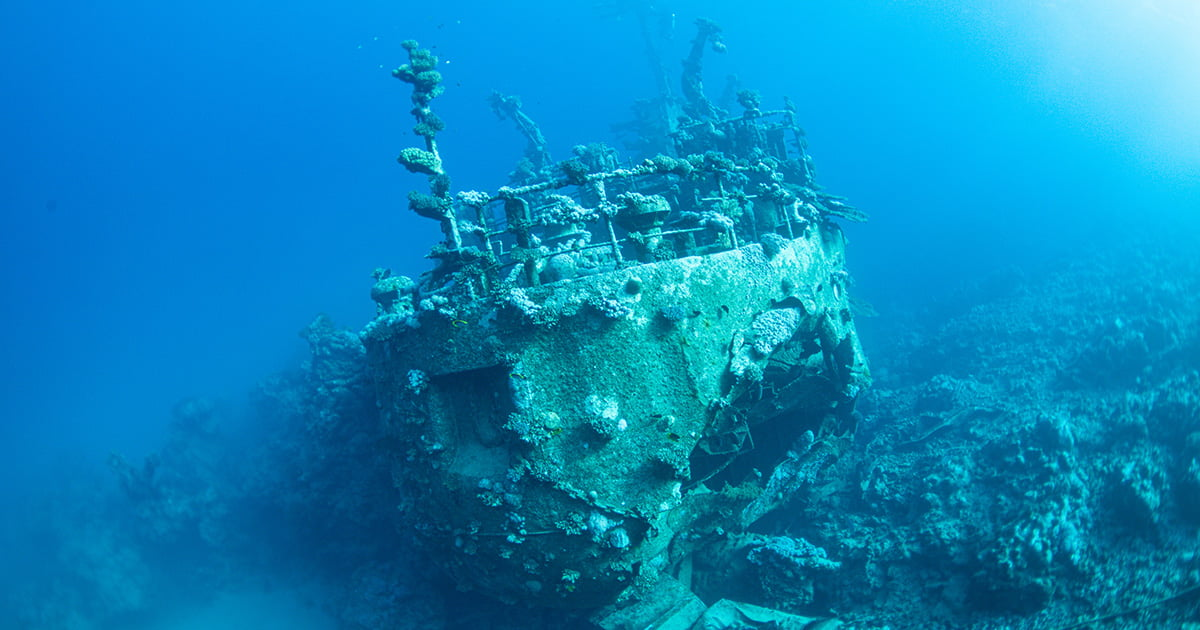
BOEM’s 2024 Marine Archaeology Rule

Exercising authority granted in the Congressional Review Act (Chapter 8 of Title 5 of the United States Code), Congress passed Joint Resolution 11 nullifying the Bureau of Ocean Energy Management rule titled “Protection of Marine Archaeological Resources” (Sept. 3, 2024).

Nullification of a final rule is not common. Since its Enactment in 1996, the CRA has been used to overturn only 20 rules. This is the first time an OCS energy rule has been nullified.

Enactment of a CRA resolution of disapproval is unlikely in most circumstances, because a President would be expected to veto a joint resolution disapproving a rule issued by the President’s own Administration.

There are also time limitations for nullifying a rule. The joint resolution must be introduced during a 60-days- of-continuous-session period beginning when the rule has been published in the Federal Register and been received by Congress. However, if within 60 session days after a rule is submitted, Congress adjourns its session, the periods to introduce and act on a disapproval resolution reoccur in their entirety in the next session of Congress.

It’s also noteworthy that a CRA resolution cannot be filibustered if the Senate acts on the resolution during a 60-days-of-Senate-session period beginning when the rule has been received by Congress.

Most of the 20 nullifications involved rules finalized at the end of a previous administration that were nullified at the beginning of a new administration with a majority in both chambers of Congress. That is the case for the Marine Archaeology Rule, which was published at the end of the Biden administration and nullified at the beginning of the Trump administration. .

The nullified OCS rule required operators to submit an archaeological report identifying potential archaeological resources with any exploration or development plan. The rule modified regulations that only required such a report only when a BOEM regional director had reason to believe that an archaeological resource may be present in the lease area. 

Archaeological survey requirements have been somewhat contentious since they were introduced in the 1970s. There were concerns about decisions to require the protection of speculative, low probability sites that could significantly alter operating plans.

A reasonable balance and an apparent consensus was achieved by limiting the report requirements to areas where studies and other information indicated the potential for such resources. BOEM’s new rule tightened the requirement considerably, which led to opposition and ultimately nullification.

Resolution Timeline

2/4/2025SenateResolution Introduced by Sen. Kennedy
2/25/2025SenatePassed by Yea-Nay Vote 54 – 44
3/6/2025HousePassed by Yea-Nay vote: 221 – 202, 1 Present
3/13/2025Presidentsigned

Read Full Post »

Juergen Maier, chairman of GB Energy, “a planned British government-owned renewable energy investment body,” is promising to revive Aberdeen with “green energy” jobs, and to create “something special for the years ahead.”

Maier: “Floating offshore wind, green hydrogen, and carbon capture should be as synonymous with Aberdeen’s future as oil and gas have been with its past.” This is an interesting comment given that the success of the industries he is promoting is far from assured; nor is the continuation of government edicts and subsidies on which they are dependent.

How many times have we been told that the government driven energy transition would create thousands of jobs? How many workers in economically important industries have been told to transition to politically favored professions? How many Keystone Pipeline workers found the promised “green energy jobs?” Why were coal miners condescendingly told to “learn to code?”

Perhaps Mr. Maier should broaden his message by showing support for development of the Rosebank and Jackdaw fields, and for sustaining production of oil and gas, on which the UK will be dependent for many years. As Louise Gilmour wisely opined in her column in the Scotsman:

We need more of it because even the most ardent supporters of renewable energy, the most vocal proponents of net zero, quietly admit oil and, especially, gas will be needed for a couple of decades at least. That obvious truth, that inarguable necessity, is not, apparently, enough for ministers to encourage UK production, however, or temper their rhetoric around renewables.

Allowing our rigs and refineries to power down and relying on other countries to keep the lights on still seems a little, well, counter-intuitive. We will import oil and gas but not produce it while happily exporting contracts, skills and jobs overseas? The practical impact of Labour’s refusal to grant new exploration licences in the North Sea might remain unclear but the message it sent was absolutely crystal.

Read Full Post »

China plans to build an “Offshore Space Station” 2,000 meters below the ocean surface in the South China Sea. The plan is to complete the station, which will accommodate 6 scientists, by 2030.

This is by far the deepest water for which a subsea human habitat has been proposed. By comparison, the planned Proteus (Fabien Cousteau) underwater station will be in just 20 meters of water off the northeast coast of Curaçao. A Sentinel/UK habitat is planned for depths up to 200 meters in the Mediterranean.

The primary focus of the deepwater South China Sea facility will reportedly be the study of deepwater seep ecosystems which are rich in marine life and deposits of methane hydrates. Hydrates are an energy resource that has much potential. However, because of the risk of uncontrolled methane releases and seafloor instability, there is limited support for the production of hydrate methane.

A deepwater science station near hydrates and methane seeps would be a dangerous operating environment given the potential for methane blowouts and cratering caused by destabilized hydrates. Given that nearly all of the research could be conducted safer and cheaper with Autonomous Underwater Vehichles (AUVs) and advanced robotics, the scientific value of a deepwater station seems questionable.

The offshore oil and gas industry considered subsea habitats in the 1970s but has since abandoned the idea. Lockheed designed a one atmosphere seafloor chamber (diagram below) that was installed in the Gulf in 1972 at a water depth of 375 ft.

Dry chamber well and production systems lost favor because of concerns about flooding, high costs, and safety risks associated with transporting workers to the chambers and placing them in close proximity to “live” wells and production equipment.

Perhaps the main drivers for China’s deepwater “space station” are geopolitical. Taiwan, Vietnam, the Philippines, Malaysia, and Brunei reject Beijing’s claims of sovereignty and each claim parts of the South China Sea (see map below).

By establishing a seafloor community in a strategic location, China could strengthen its highly questionable claim to the entire South China Sea. China would also have reason to increase Navy vessel activity in disputed waters to support and defend their subsea community.

This will be a project to watch if it actually goes forward.

Read Full Post »

Senator Schiff and 22 California representatives sent the attached letter to Gov. Newsome urging him to:

  • Require the Fire Marshal to reconsider the state waiver for the pipeline, conduct environmental review, and hold a public hearing;
  • Require a coastal development permit for restart of the pipeline;
  • Require State Parks to conduct environmental review and hold a public hearing prior to deciding whether to approve a new easement for the pipeline through Gaviota State Park.

The good news for Sable: Despite the bluster in the letter’s opening paragraphs, none of the requests to Gov. Newsome are knockout punches. The first two relate to matters that have already been addressed and Sable is in a favorable position. The third, the Gaviota State Park easement renewal, is currently under review and should not be a decisive blow.

The bad news for Sable: Punches will continue to be thrown even after production resumes (should that ever actually happen.)

Much more on Sable

Read Full Post »

Orsted photo: wind wakes trailing turbines at Vattenfall’s Horns Rev wind farm offshore Denmark

The oil industry has a long history of dealing with the correlative rights issues associated with oil drainage from competitive reservoirs. Similar issues are arising in the offshore wind industry.

Orsted believes ‘catastrophic wake losses’ threaten the existence of their Irish Sea wind farms, claiming that wakes from EnBW, BP, and RWE projects could shorten the life of Orsted’s assets. Note that wind wakes can stretch as far as 100 km.

Orsted claims that four nearby wind farms in the Irish Sea could result in a drop in Orsted’s annual energy production of up to 5.34%, and is seeking mitigation or compensation.

This is all rather familiar to the oil industry and its regulators, particularly the call for compensation!

Read Full Post »

The California Coastal Commission is simply out of control and has veered far from its purpose of protecting the coast,” said Rep. Kiley. “From blocking SpaceX rocket launches to obstructing fire prevention projects, the Commission has repeatedly threatened the safety of Californians and weakened our national defense, while needlessly undercutting innovation and economic progress. The need to rein in the Commission has become urgent as we face the challenge of rebuilding Los Angeles following the fires.

The bill (attached), introduced by Kevin Kiley (CA), would amend the Coastal Zone Management Act (CZMA) to expedite important coastal activities, including national security initiatives, critical infrastructure development, and disaster mitigation and recovery efforts. Key provision:

‘‘(2) LIMITATION ON OBJECTION.—An objection or other challenge by a coastal state to an activity subject to a conclusive presumption of concurrence under paragraph (1) may not delay or otherwise prevent the activity from proceeding.”

While perhaps unlikely to be enacted, the bill addresses regulatory authority that many perceive to be unchecked and abusive. Congressional attention is clearly warranted.

Read Full Post »

« Newer Posts - Older Posts »