Feeds:
Posts
Comments

Archive for the ‘well control incidents’ Category

Absent live streaming or television, the Times Picayune seems to be providing the best coverage of the Coast Guard – BOEM Macondo hearings in New Orleans.  While the legal sparring has attracted the most press interest, two other items in this Times Picayune article caught my attention.

Part of Keplinger and Fleytas’ duties was to monitor indicators of gas detectors and alarms from the bridge. Keplinger was busy showing visiting BP and Transocean officials a video-game-style simulator for 45 minutes to an hour before the explosions, he said, but he insisted that Fleytas was keeping him abreast of readouts of the rig’s systems.

Comment: Just as school teachers shouldn’t have been flying in the space shuttle, “tourists” shouldn’t have been visiting a complex drilling operation when the crew was in the process of setting production casing and suspending a potentially dangerous well. While the visit was well-intended, the last thing the crew needed on that night was to be distracted by a group of corporate executives.  The distraction they caused was comparable to driving on a dangerous highway while getting text messages from your boss. Visiting windows should be limited to relatively low-risk operations (e.g. when drilling ahead prior to reaching target intervals), and these windows should immediately close if complications develop.

Keplinger flashed some anger at Capt. Curt Kuchta, captain of the Deepwater Horizon rig, during his testimony. He noted that a fellow rig worker, Chris Pleasant, had to ask Kuchta three times whether to disconnect the rig from the wellhead before he got the go-ahead.

Comment: One of the benefits of drilling from a floating and dynamically positioned rig is the ability to move off location if trouble arises.  The failure to disconnect the riser and move away from the well at the first indication of flow contributed significantly to the tragic consequences.  The technical and human factors that prevented such a disconnect must be thoroughly examined.

Further comment: The absence of live streaming of these important safety hearings is inexcusable.  If a senator or governor were testifying, I expect that the cameras would be there.
Read Full Post »

  • C-SPAN has opted not to cover this weeks BOEMRE – Coast Guard Macondo hearings.  Instead, they are presenting recordings of political rallies, assorted senatorial and gubernatorial candidate debates, and similar fare.  In other words, all three channels will be dedicated to the usual political posturing that already receives non-stop national coverage, and the investigation into one of the more significant accidents in US history will be ignored.
  • Why does it take 3 weeks to post the transcripts of these hearings? The Australians posted each Montara transcript within hours after the day’s session ended.

Read Full Post »

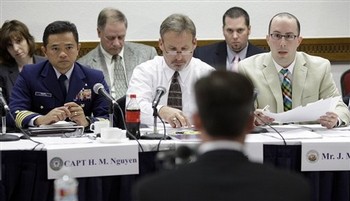
Capt. Hung Nguyen, David Dykes, and Jason Mathews question the witness. Sylvia Murphy and Kirk Malstrom monitor attentively from the 2nd row.

The panel that is most closely investigating the technical and operational aspects of the Macondo blowout reconvenes on Monday morning at 0800 CT in New Orleans.

I would assume that one of the CSpan stations will be covering the hearings, but their broadcast schedule for next week has not yet been posted.

Read Full Post »

We have commented frequently about the similarities between the Montara and Macondo blowouts, particularly the root cause casing shoe issues. In this post, Colin Leach draws attention to the float shoe and collar issues that permitted oil and gas to enter both wells. Click here to view the full post.

The Bly report (page 70) noted some significant “inconsistencies” in the operation of the float shoe/float collar (see full post). This is so similar in nature to the “inconsistencies” in the 9 5/8″ cement job on the Montara well to be scary. The bottom line is that both disasters could have been prevented if these “inconsistencies” had been recognized and additional barriers placed above the float collar. In fact even if there are no “inconsistencies”, the placing of an additional barrier or so seems like an exceptionally prudent step, which would not take that much time or effort.

Read Full Post »

As previously posted (July 27, 2010), deep water had little to do with the well integrity problems and other contributing factors leading to the Macondo blowout. The Bly (BP) report further confirms this position.

Of the eight key findings in the Bly report (listed below), only number 4 could be considered to be more of a deepwater issue.  The BOP failures may also have been influenced by deepwater factors.  However, as previously noted, surface BOPs have a much higher failure rate than subsea stacks.

While the Montara blowout was in relatively shallow water, slight variations of findings 1 through 4 were the primary causes of that accident.

BP findings:

  1. The annulus cement barrier did not isolate the hydrocarbons.
  2. The shoe track barriers did not isolate the hydrocarbons.
  3. The negative-pressure test was accepted although well integrity had not been established.
  4. Influx was not recognized until hydrocarbons were in the riser.
  5. Well control response actions failed to regain control of the well.
  6. Diversion to the mud gas separator resulted in gas venting onto the rig.
  7. The fire and gas system did not prevent hydrocarbon ignition.
  8. The BOP emergency mode did not seal the well.

Read Full Post »

Monday’s hearings will be broadcast on CSpan 2 beginning at 0900 ET. Admiral Allen will be the first witness and will address decision-making within the Unified Command.  Given the number of high profile witnesses and the limited time allotted to each witness,  in-depth questioning would seem to be unlikely.  Will this be a day of short speeches?

Read Full Post »

Montara Blowout, Timor Sea

I awoke to two very important developments from Australia as reported by Anthea Pitt with Upstream:

  1. According to Energy Minister Martin Ferguson, the Montara Inquiry Report will be publicly released by the end of the year. As BOE readers know, there are important similarities between the Montara and Macondo blowouts, most notably the production casing cementing issues that created a flow path via the shoe track on both wells and the evidence that both disasters would have been prevented if negative flow tests had been properly conducted and interpreted.  Would Macondo have been prevented if BP and Transocean had followed the Montara hearings and made sure that all drilling personnel were aware of the causes of this 74-day blowout in the Timor Sea?
  2. Minister Ferguson also announced that the role of the National Offshore Petroleum Safety Authority (NOPSA) will be expanded:

By expanding Nopsa’s role, one central agency will look out for the safety of our offshore workers and the environment from exploration to decommissioning. That means it will be responsible for approvals and regulation of safety and environment, as well as integrity of facilities and day-to-day operations.

Bravo to Australia and Minister Ferguson! As I indicated in  a submission to the Montara Commission and testimony before the US Senate Committee on Energy and Natural Resources, a single agency must be responsible and accountable for the regulation of offshore oil and gas operations if safety and pollution prevention objectives are to be achieved.

Read Full Post »

Now that Admrial Allen has officially confirmed that the dead Macondo well is in fact dead, what is the legacy of the relief well?

  1. The relief well was Macondo’s opposite – a technological marvel that was flawlessly planned and precisely drilled without incident.
  2. The relief well verified new sensing and ranging tools for locating a well.
  3. The relief well contributed to the “burial” of Macondo by further cementing and pressure testing the annulus
  4. Perhaps most importantly, the relief well provided further confirmation that Macondo flowed inside the production casing and not in the annulus surrounding that casing.  Was this an unstated BP objective in supporting the decision to complete the intercept operation? Remember that after the top kill cementing operation killed the well, BP requested that the Unified Command “consider foregoing the relief well.”  This was an appropriate request since the annulus could have been secured through conventional plugging and abandonment practices. Whether or not BP changed positions on the intercept, the completion of that operation seems to have helped the BP legal defense.  Misinterpreting negative pressure tests, missing signs of flow, and mis-routing that flow would seem to be more defensible than improperly designing the well, ignoring centralizer recommendations, and foregoing the cement bond log.

Read Full Post »

who 'dat?

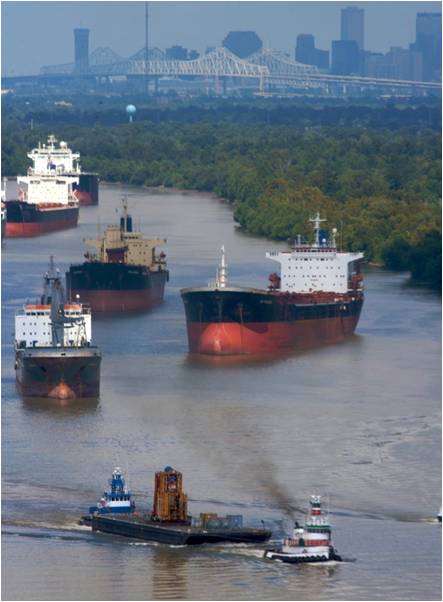
The BOP stack from the Macondo well is pictured in the foreground while being transported up the Mississippi River.  New Orleans is in the background.

Read Full Post »

Admiral Allen’s statement:

I have received extensive briefings over the last 24 hours regarding the final effort to intercept the Macondo well.  Through a combination of sensors embedded in the drilling equipment and sophisticated instrumentation that is capable of sensing distance to the well casing, BP engineers and the federal science team have concluded that the Development Driller III relief well has intersected the Macondo well.  This determination was made based on a loss of drilling fluids that indicated communication had been established beyond the relief well, the pressure exerted against the drill bit as it came in contact with the well casing and, finally, an increase in pressure in the choke line of the Macondo well blow out preventer.  While each of these indicators taken separately would not necessarily be conclusive, the aggregate data available supports the conclusion that the two wells are joined.  It is also important to note that none of the measurements supported a scenario where the annulus of the well is in communication with the reservoir.  Accordingly, we intend to proceed with preparation to cement the annulus and complete the bottom kill of the well.  Further information will be provided as cementing procedures are completed.

Observations:

  1. The relief well engineering team and crew performed exceptionally despite the many distractions and interruptions. Outstanding work.
  2. The new ranging and sensing equipment, combined with real-time measurement-while-drilling technology, made this complex operation seem routine.
  3. The above report seems to confirm that the annulus had been sealed with cement above the producing reservoir.  This was accomplished either when the production casing was cemented prior to the blowout or during the top-kill operation, presumably the former.
  4. There was no report of oil in the mud returns or other evidence of of oil in the annulus surrounding the production casing.  If no oil was encountered in the annulus, this would seem to confirm BP’s conclusion that the well flowed inside the production casing.
  5. Flow was stopped by the capping stack on July 15, and the Macondo well was killed when mud and cement were injected during the top-kill operation.  Since the well was already dead, the cementing of the annulus that will follow is actually part of the plugging and abandonment operation.  While the annulus could have been secured through more conventional plugging procedures, this does not detract from the relief well team’s extraordinary achievement.

Read Full Post »

« Newer Posts - Older Posts »